Inspiration

AI has made it dramatically easier to build software, but distribution is still difficult. A solo founder can ship a product in a weekend and still struggle to find customers because marketing requires strategy, content, consistency, channel knowledge, and continuous learning.

We wanted to build the marketing department that a small technical team cannot afford yet: a set of specialized AI agents that share memory, coordinate work, and operate with human approval at important points.

While building the marketing product, we noticed the same engine could help investors discover overlooked founders. The result is VC Brain, a sourcing workflow that finds builders through public signals and evaluates their distribution gravity instead of relying only on pedigree, funding, or warm introductions.

### What it does

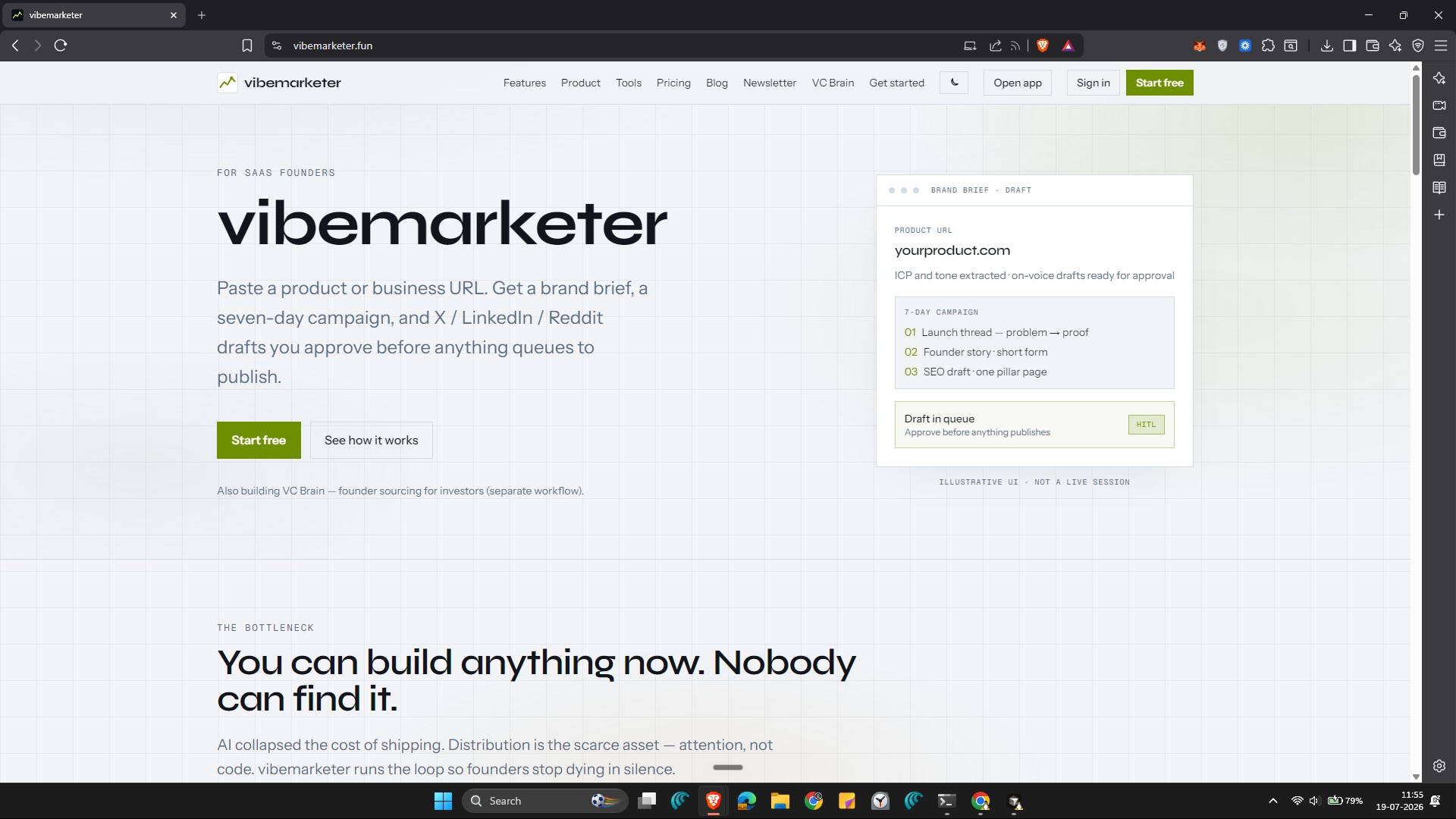
vibemarketer turns a product URL into a structured marketing workspace.

The system can:

  • Extract product positioning, audience, tone, and marketing pillars.
  • Store persistent brand and product memory.
  • Generate a seven-day campaign plan.
  • Produce channel-specific drafts for platforms such as Reddit, X, and LinkedIn.
  • Coordinate specialized agents for strategy, content, distribution, SEO/AEO, growth, and analytics.
  • Hold high-risk actions in a human approval queue.
  • Preserve agent traces and evidence for inspection.
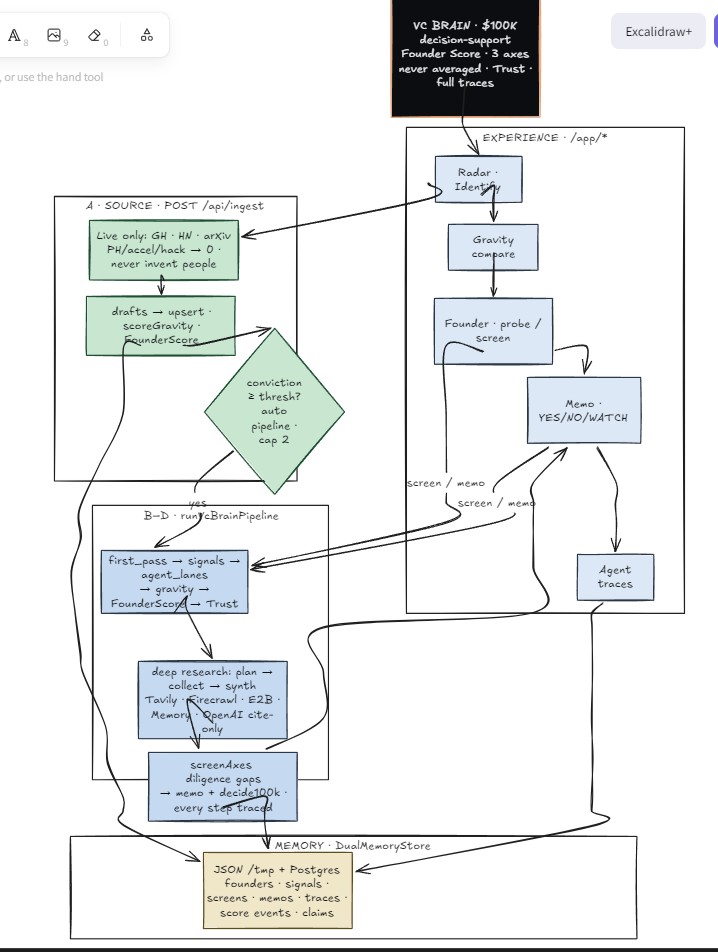
  • Run the VC Brain workflow to discover founders from GitHub, Hacker News, arXiv, and other public sources.
  • Score founders using separate dimensions such as founder signal, market fit, and idea quality.
  • Generate an evidence-backed investment decision memo.

The product is designed around the loop:

SENSE → THINK → CREATE → GATE → ACT → LEARN

### How we built it

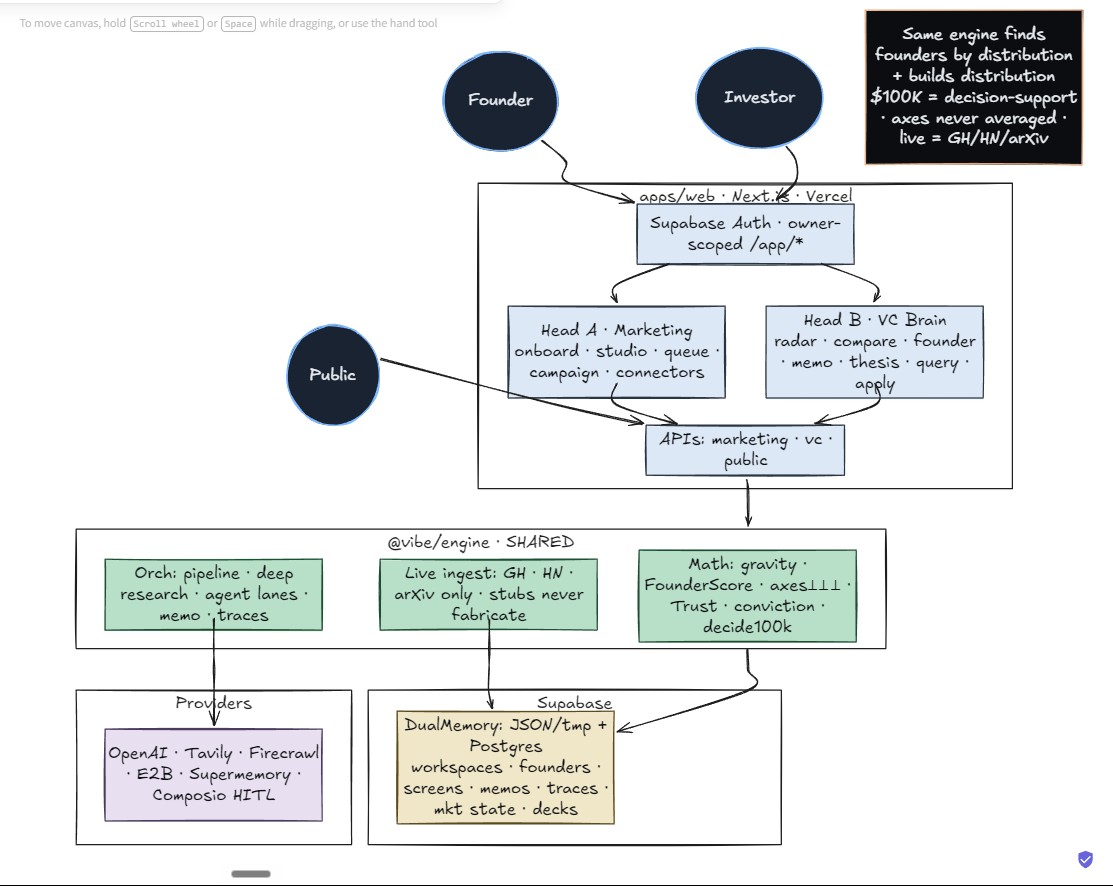
We built a TypeScript monorepo using Next.js, Supabase, and a shared @vibe/engine package.

The architecture has four main layers:

  1. Connectors and ingestion collect public signals and product information.
  2. Memory stores source-tagged, timestamped information about brands, founders, products, and signals.
  3. Reasoning and scoring combines AI extraction with deterministic scoring logic.
  4. Agent heads turn the shared engine into either a marketing workflow or VC Brain sourcing workflow.

The web application provides the user interface and server-side API routes. Supabase provides authentication and Postgres-backed workspace data. Firecrawl is used for web research and extraction, Tavily supports public-web research, and E2B can run isolated code-forensics tasks.

For the hackathon version, Gemini should be integrated through [Vertex AI / Gemini API — select the actual implementation] for [brand extraction / campaign planning / research synthesis — specify the actual use]. The application records model, timestamp, request type, latency, and result metadata so judges can verify that Gemini is operating in the product.

Scores are calculated deterministically in code rather than being invented by a language model. Every important claim can be connected to source evidence, and risky publishing actions remain approval-gated.

### Challenges we ran into

The hardest challenge was making the system useful without pretending that AI-generated text is the same as autonomous business execution.

We had to separate language generation from numerical decisions, preserve source evidence, and ensure that scraped content could not directly change tool permissions or publish content. We also had to design for incomplete data. A founder with no famous employer, funding history, or large audience should not automatically receive a zero score.

Another challenge was balancing autonomy with platform safety. Social publishing and engagement can damage a brand when executed without context, so the product uses a configurable autonomy dial and human approval gates.

Finally, we had to keep two seemingly different products coherent. Marketing Fleet and VC Brain share the same ingestion, memory, evidence, and traceability spine; only their final “heads” are different.

### Accomplishments that we are proud of

  • Built a working deployed product rather than a standalone chatbot demo.
  • Created a reusable agent engine with two product workflows.
  • Implemented persistent workspace and brand-memory concepts.
  • Built deterministic, explainable founder scoring.
  • Added evidence-linked traces and decision memos.
  • Designed human approval into the publishing workflow.
  • Created a clear path from a free distribution audit to a paid marketing product.
  • Dogfooded the product’s marketing website with the same brand-memory and content concepts it sells.

### What we learned

The most important lesson was that an AI product needs an operating system, not just a prompt.

Memory, scheduling, connectors, guardrails, approvals, evidence, and feedback loops determine whether an agent can safely perform useful work. We also learned that “autonomous” should not mean “unreviewable.” The best workflow is autonomous for repetitive discovery and preparation, while remaining transparent and approval-gated for consequential actions.

We also learned that public activity is a meaningful but imperfect signal. Distribution gravity can help surface overlooked founders, but the system must show confidence, cite evidence, and abstain when the signal is insufficient.

### What’s next

Our next step is to convert early users from waitlist and product demos into paying customers. We plan to launch the marketing workflow with one high-value loop first: finding relevant Reddit and Hacker News conversations, drafting useful responses in the customer’s voice, and routing them through approval.

After that, we will add more connectors, scheduled campaigns, attribution, customer feedback loops, and subscription expansion. For VC Brain, we will backtest distribution-gravity scoring against historical founder outcomes and improve calibration without hiding uncertainty.

Built With

Share this project:

Updates