-
-
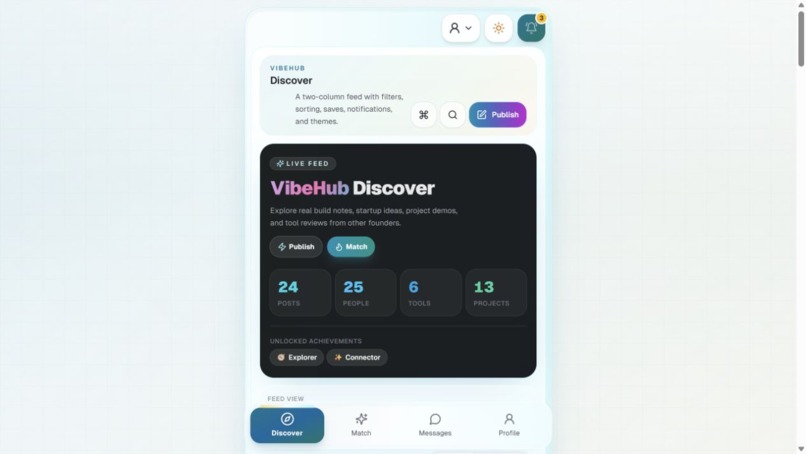
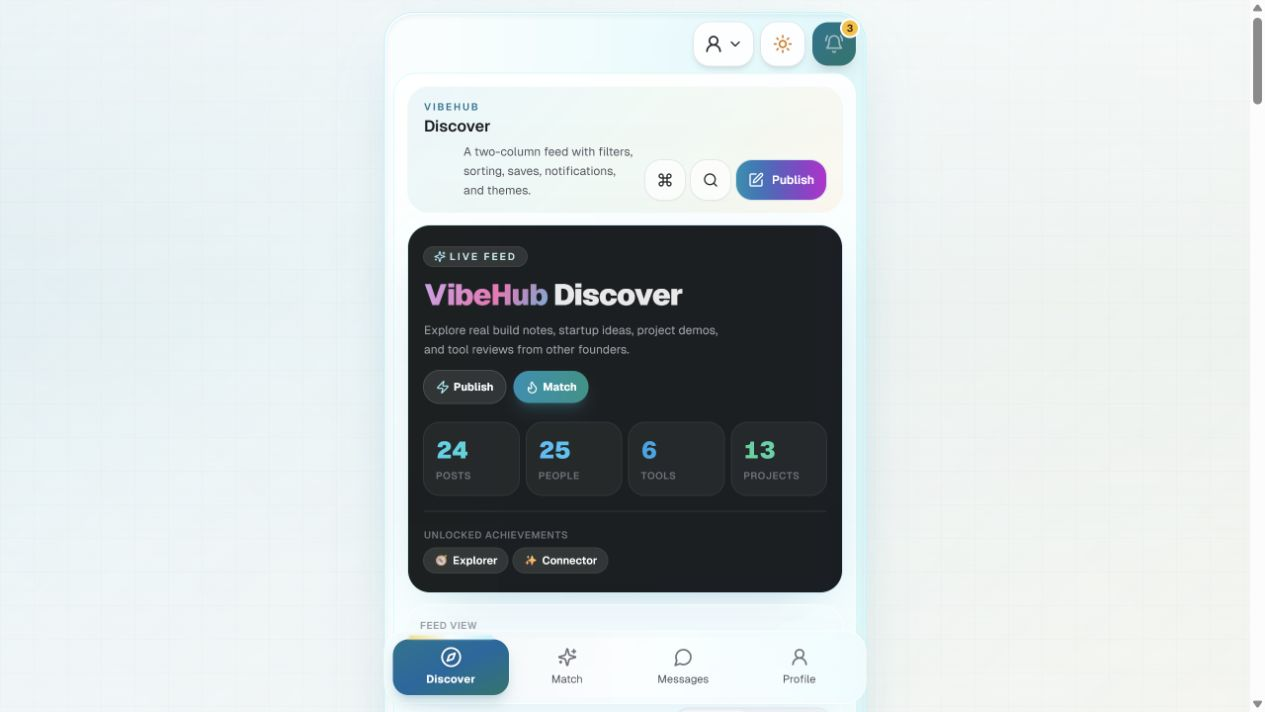
Discover founder posts, projects, and working evidence.
-
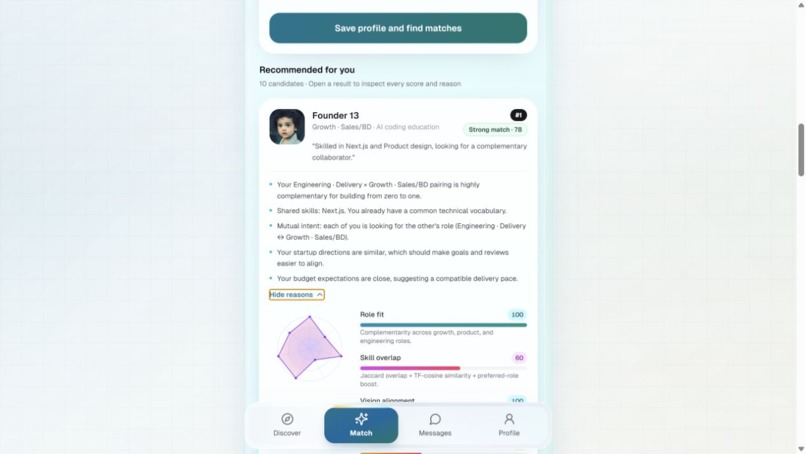
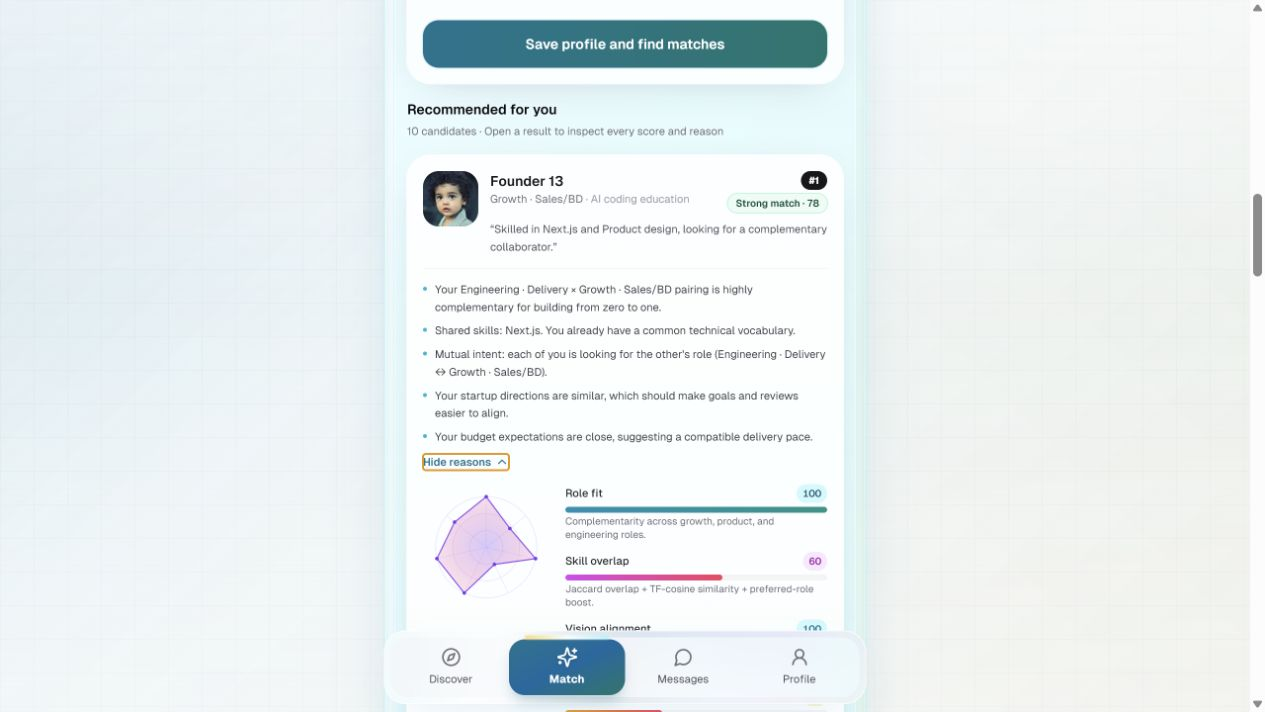
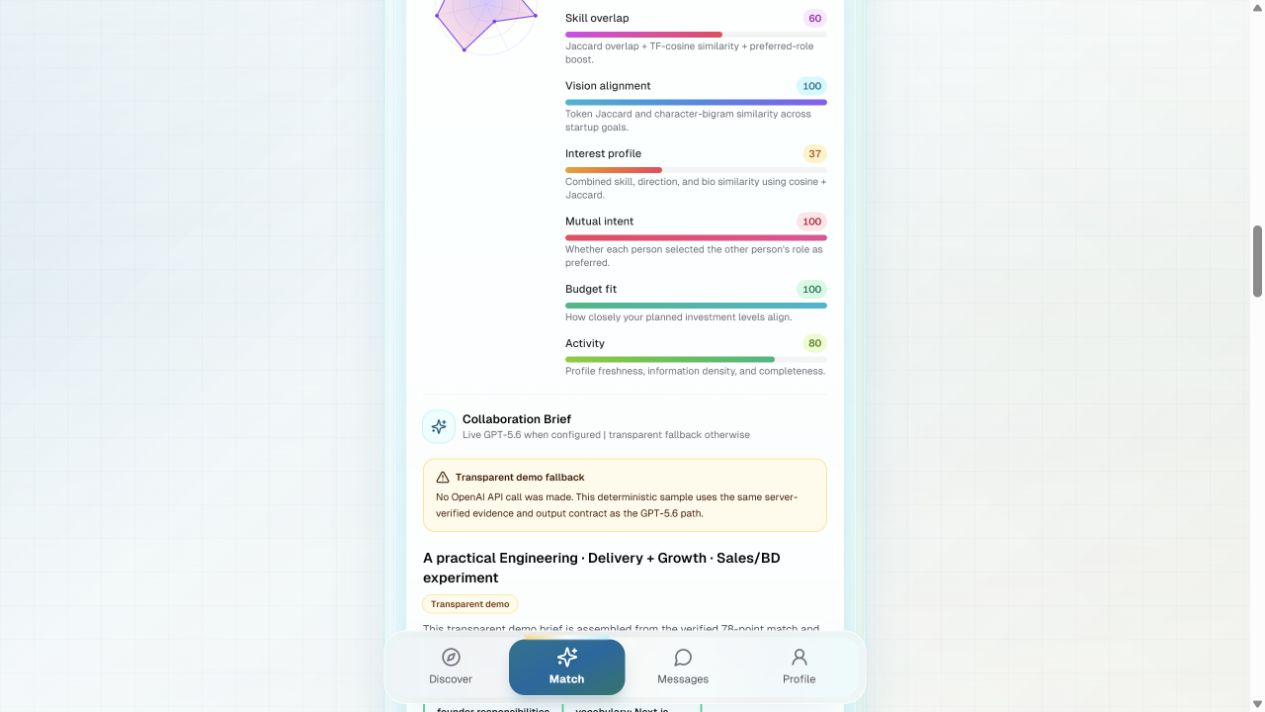
Explainable founder match with deterministic evidence.
-
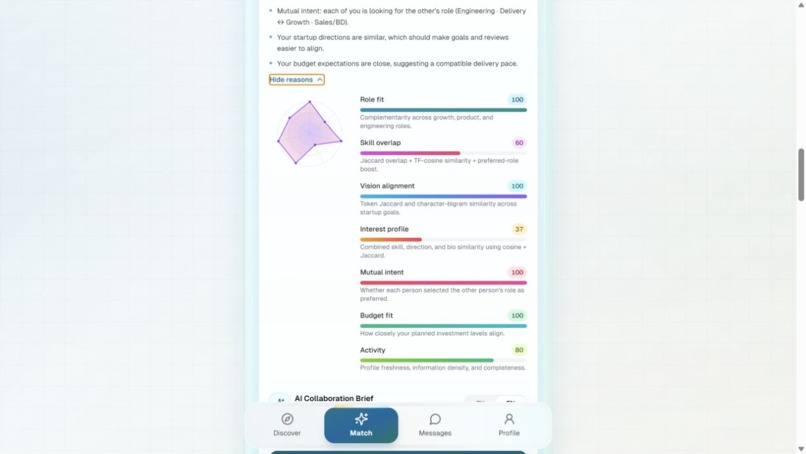
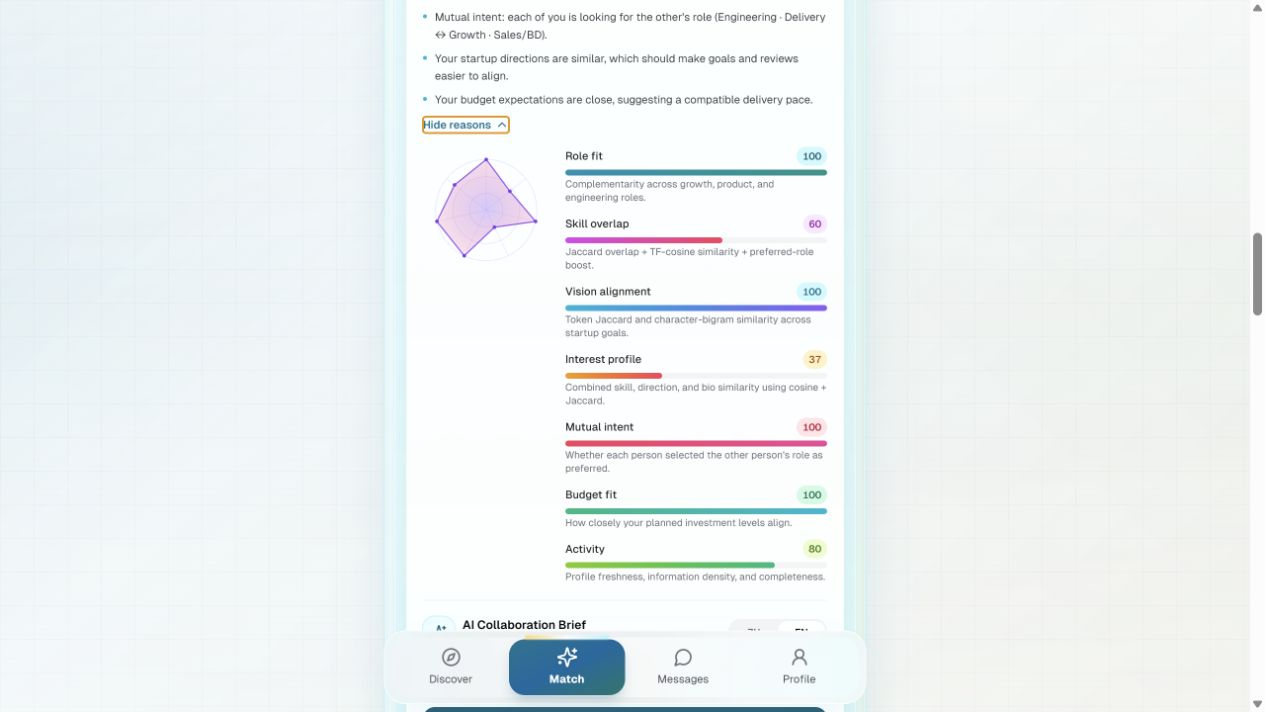
Seven auditable compatibility dimensions.
-
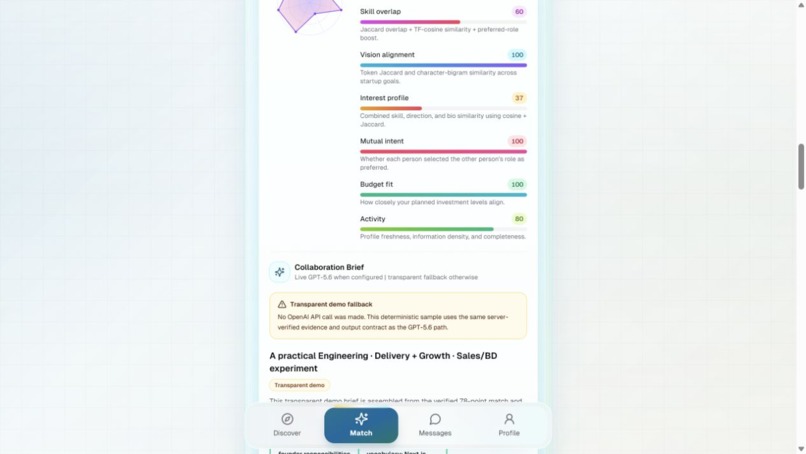
Evidence, risks, opener, and a seven-day collaboration sprint.
-
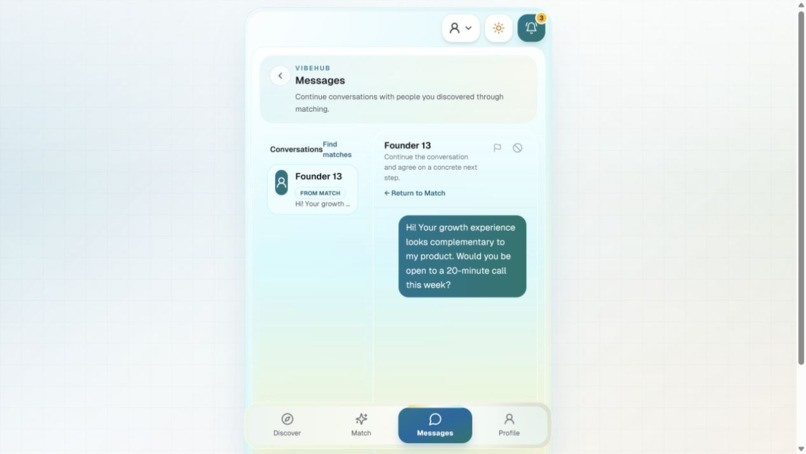
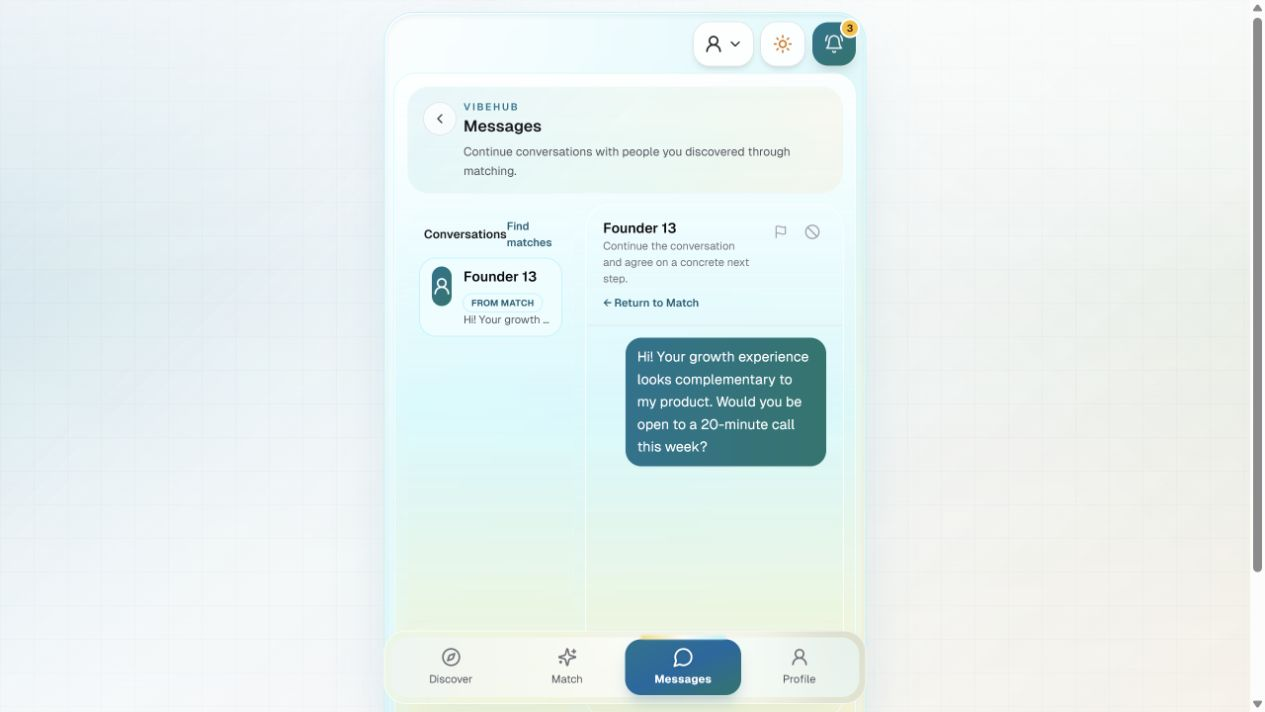
Direct Match-to-Messages collaboration handoff.
Inspiration
AI coding tools are changing who can build software. A growing number of founders, designers, operators, students, and independent creators without traditional engineering backgrounds can now use natural language, low-code thinking, and AI collaboration to produce working prototypes.
Once the barrier to writing code falls, the next bottleneck is no longer simply, "Can I build it?" The harder questions become: What should I build? Who is it for? How do I validate it? How do I reach users? Who should I build it with? And how can a prototype become a sustainable project?
For small startup teams, finding a potential cofounder is not the same as finding someone with a similar profile. Early-stage teams need complementary roles, compatible ways of working, and a low-risk way to test collaboration before making a major commitment. Existing social feeds and networking tools can introduce people, but they rarely turn a promising profile into an evidence-backed next step.
I built VibeHub to close these gaps. As AI brings a much broader group of people into software creation, they need better ways to discover opportunities, demonstrate what they can do, and find the right people to work with. VibeHub helps a solo founder move from discovery, to an explainable match, to a real conversation, and finally to a small collaboration experiment. The larger purpose is to bring software entrepreneurship within reach of far more people.
VibeHub is being built as a social platform for vibe-coding beginners, AI product creators, and early-stage founders. Its broader vision is a "project-based social network for the AI coding era": a network organized around what people are building, what they are learning, which tools they use, and which collaborators they need. Over time, ideas, collaboration opportunities, and services within that network can be discovered, discussed, matched, and exchanged.
What it does
VibeHub has four focused modules: Discover, Match, Messages, and Profile.
Discover surfaces founder posts, projects, tools, and working notes. Match uses a deterministic model to score role complementarity, skill overlap, vision alignment, interest signals, mutual role intent, budget fit, and recent activity. Users can expand each candidate to inspect every scoring dimension.
The Build Week feature adds an AI Collaboration Brief powered by GPT-5.6. It uses verified matching signals and bounded profile evidence to produce exactly three evidence signals, two risks paired with testable experiments, a personalized first message, and a seven-day sprint with success and stop conditions. The user can then open a message thread directly from the match result.
The repository contains the complete GPT-5.6 integration path. Because I am temporarily unable to provision an API key from my current region, the hosted demo uses a clearly labeled deterministic fallback. It follows the same evidence contract and interface, returns mode: transparent_demo, and explicitly states that no model call was made. Supplying a valid server-side key automatically switches the same endpoint to live GPT-5.6.

VibeHub keeps ranking deterministic and explainable, then uses GPT-5.6 after candidate selection to turn evidence into an actionable collaboration test.
Design and user experience
The experience is organized around four durable destinations instead of a growing collection of disconnected AI tools. Discover creates context, Match makes the decision process visible, Messages turns a recommendation into action, and Profile gives the user control over identity and safety.
The 30-second matching sequence is intentional: it creates a focused transition from profile editing to candidate review. The result card then progressively reveals evidence, a radar chart, and all seven score dimensions. GPT-5.6 appears only after a user chooses to inspect a candidate, so AI supports a decision instead of interrupting the browsing flow.
How I built it
The application uses Next.js 14, React, TypeScript, Tailwind CSS, and Prisma. Local development uses SQLite, while production uses PostgreSQL. The original deterministic matching engine remains responsible for ranking candidates so that scores are reproducible and inspectable.
The new server-side /api/match/brief endpoint recomputes the selected candidate's score, verifies authentication, checks whether either participant has blocked the other, retrieves a bounded amount of recent profile evidence, and calls the OpenAI Responses API. GPT-5.6 runs with medium reasoning and a strict JSON Schema. The response is validated again before it reaches the client.
The model prompt treats every profile string as untrusted data, prohibits sensitive-trait inference and invented achievements, and requires falsifiable recommendations. Requests use store: false and a hashed safety_identifier.
This architecture creates a clear trust boundary: deterministic code decides rank; authenticated server code decides what evidence may be shared; GPT-5.6 transforms that evidence into a collaboration plan; and the client renders only schema-validated fields.

The production endpoint exposes two explicit paths: live GPT-5.6 when a valid server key is configured, or a transparent deterministic fallback that never claims a model call.
How I used GPT-5.6
GPT-5.6 is not used as a generic chatbot or as a replacement for the ranking algorithm. It performs the reasoning-heavy bridge between an explainable score and an actionable collaboration decision.
The model receives deterministic evidence and limited participant context, then converts it into a structured brief that answers four practical questions: Why might this match work? What could fail? How should the conversation begin? What should the pair test together in seven days?
Strict structured outputs make the result reliable enough to render as a product workflow rather than as uncontrolled free-form text.
How I used Codex
I built VibeHub as a solo participant and used Codex as my primary engineering collaborator. Codex audited the existing repository, established a pre-Build Week baseline, implemented the OpenAI SDK integration and structured-output route, connected the new interface to the matching flow, ran production builds and lint checks, and browser-tested the complete Match-to-Messages path.
The Git history makes the Build Week work auditable: commit b635752 is the pre-event baseline; commit 9cf95e1 adds the GPT-5.6 Collaboration Brief; commit 06b4221 delivers the complete English product experience; and commit 0098994 adds the transparent no-key demo path used by judges.
Challenges I ran into
The main design challenge was deciding which decisions should remain deterministic and which should use a language model. Using GPT-5.6 to rank people would have made scores harder to reproduce and explain. Keeping ranking deterministic while using GPT-5.6 to interpret evidence produced a clearer architecture and a more trustworthy experience.
Another challenge was preventing profile content from becoming instructions to the model. The implementation treats profile strings as untrusted data, limits the available context, uses a strict output schema, and validates every response on the server.
Accomplishments that I am proud of
Before I began using AI to build my own products, I worked as a geological engineer at a copper mine in Afghanistan. My work ranged from exploration and procurement to engineering delivery and cultural heritage protection. I never imagined that I could create an app of my own. My master's research had convinced me that programming was simply not my strength.
Today, frontier language models and Codex have helped me cross a barrier that once felt impossible and participate in a hackathon that previously seemed open only to software professionals. Being able to build, enter, and submit a working product is itself an accomplishment I am deeply proud of.
I am also proud that:
- The AI capability is part of a complete user journey rather than an isolated prompt demonstration.
- Each identified risk is paired with a testable experiment instead of generic encouragement.
- The Collaboration Brief follows a strict structured-output contract that can be rendered reliably in the product interface.
What I learned
Building my own app has shown me that I can begin moving into a new field and learn an entirely new body of knowledge.
I also learned that the most valuable role for GPT-5.6 is not deciding who a founder should trust. It is helping people turn incomplete evidence into a small, reversible experiment. Combining deterministic ranking, structured model output, and a direct messaging handoff made the result more useful than any one layer alone.
Potential impact
Cofounder mismatch is expensive because people often discover incompatibility only after committing significant time, equity, or money. VibeHub changes the unit of commitment from "become cofounders" to "run one bounded experiment together." This approach can help solo founders, student builders, and independent developers test working relationships earlier and with clearer expectations.
We can already see an emerging trend: more lightweight product experiments will be driven by small teams, individual creators, and AI-assisted builders. They do not need another heavy startup-services platform. They need lightweight infrastructure where they can quickly publish an idea, show their process, reuse tools, find collaborators, and build a record of trust.
VibeHub aims to provide that infrastructure for people leaving established career paths and entering AI-enabled entrepreneurship, making it easier for a much broader group of builders to participate in the next wave of software creation.
What's next for VibeHub
Next, I plan to add collaboration-outcome feedback, evaluate brief quality against real founder conversations, give users more control over which evidence may be shared with the model, and package the product for distribution on iOS and Android.
Built With
- api
- codex
- css
- gpt-5.6
- next.js
- openai
- postgresql
- prisma
- react
- responses
- tailwind
- typescript


Log in or sign up for Devpost to join the conversation.