-
-
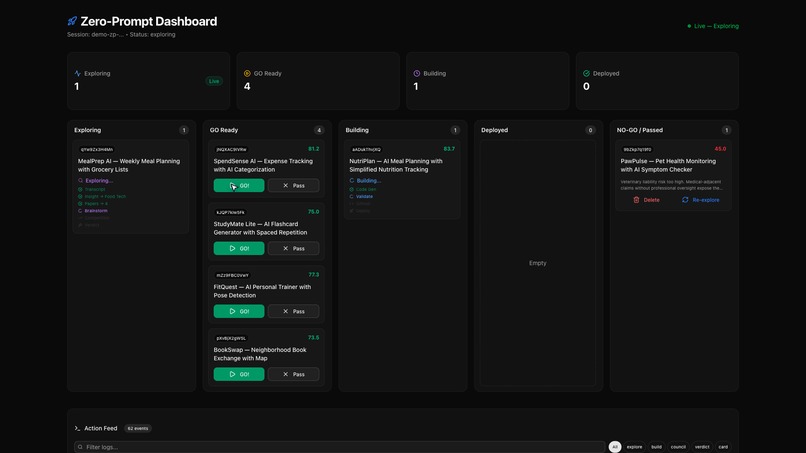
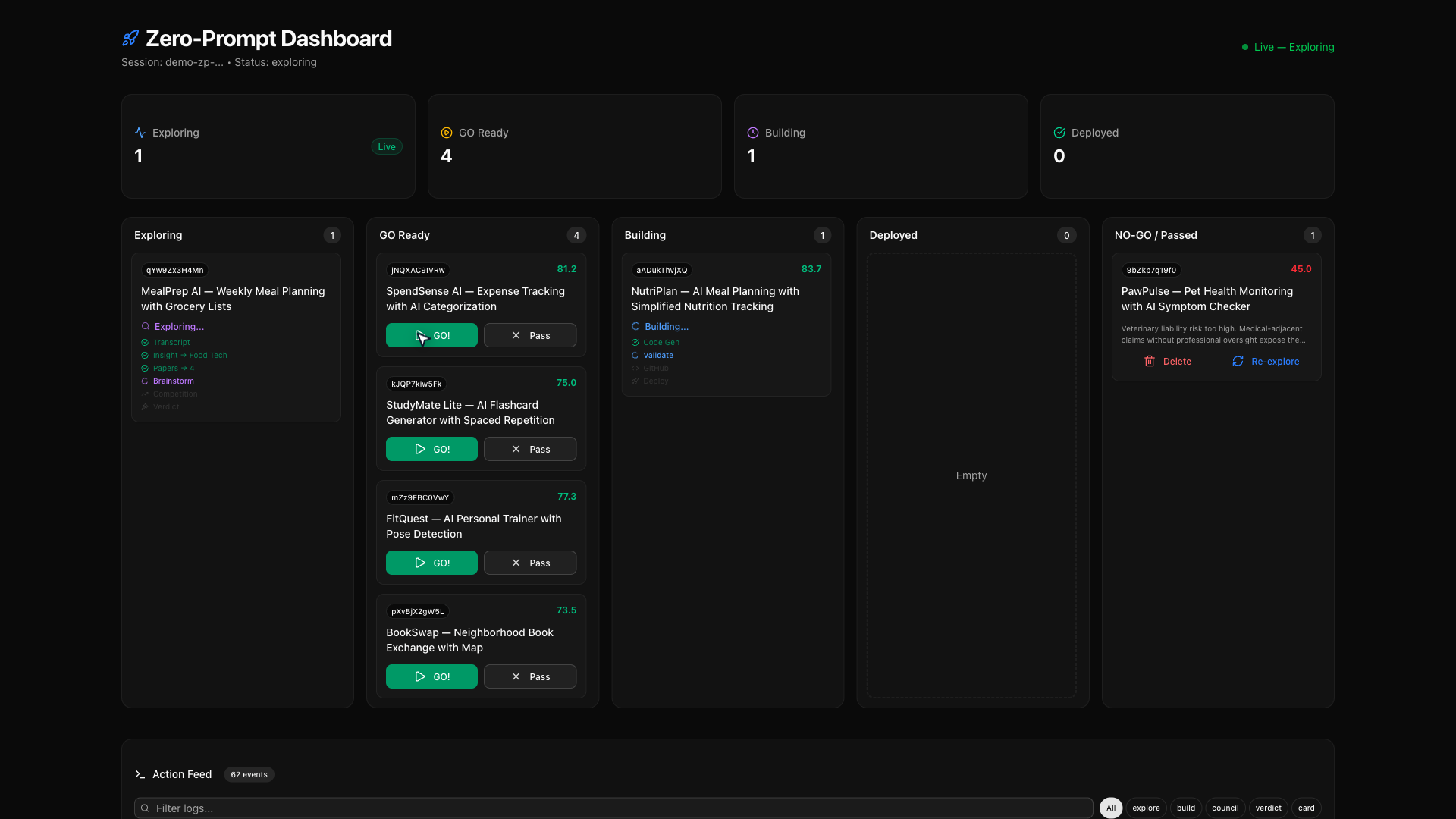
Zero-Prompt Kanban: live GO/NO-GO ranking, build progress, and deployed apps — all streaming in real time
-
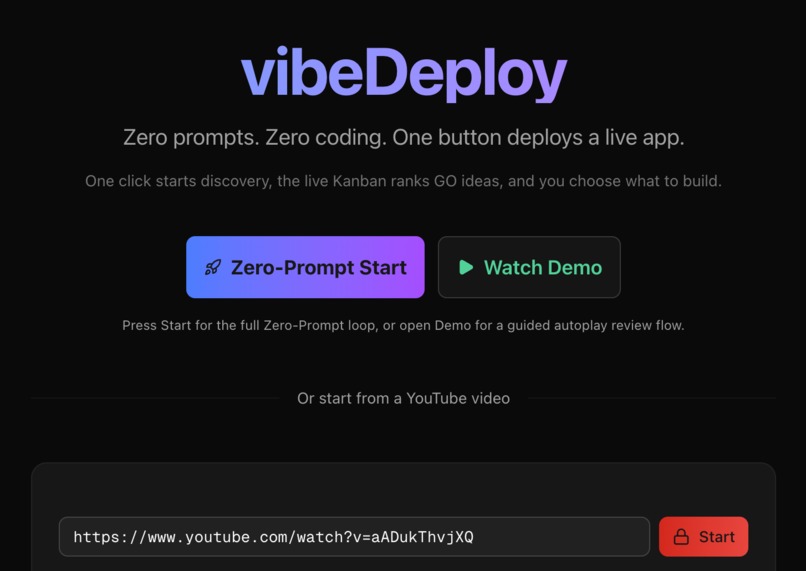
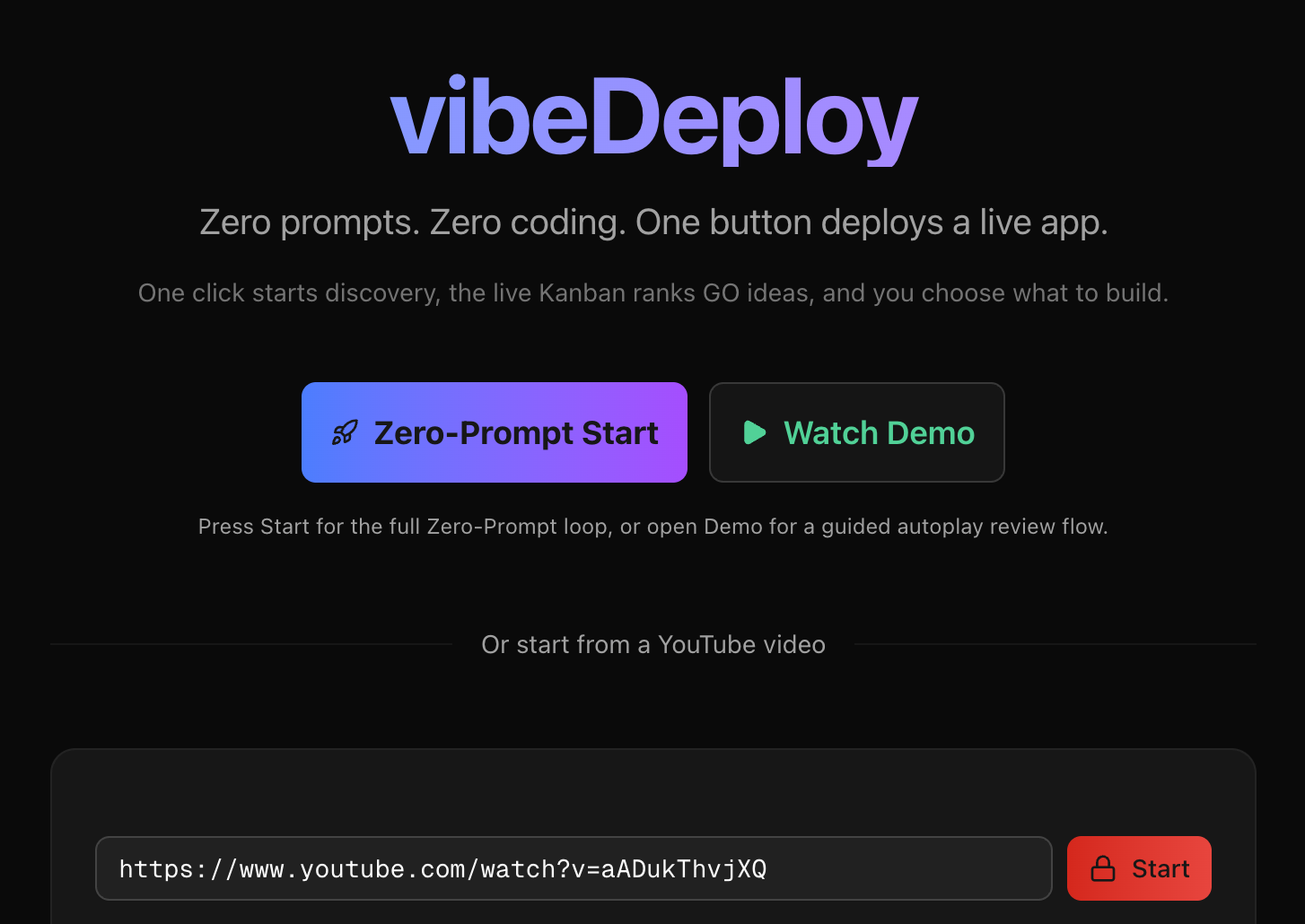
One-click Zero-Prompt Start launches autonomous idea discovery — no prompts, no setup, just click and watch
Inspiration
Most AI code generators stop at code. They produce files that fail type checks, skip deployment, and leave users to figure out hosting alone. We asked: what if an AI system handled the entire journey — from discovering the idea to deploying a live app — with zero prompts?
What it does
vibeDeploy is a Zero-Prompt autonomous pipeline on DigitalOcean.
- One click starts AI-powered discovery from YouTube
- Transcript extraction pulls source material from candidate videos
- Gemini AI extracts app ideas and enriches them with academic research (OpenAlex, arXiv)
- Competitive analysis checks market saturation
- Deterministic scoring ranks each idea as GO or NO-GO on a live Kanban board
- The user picks any GO card to build
- Contract-first code generation produces type-safe frontend + backend
- Build validation iterates until quality passes (target ≥ 85% match rate)
- Automated deployment ships the app to DigitalOcean App Platform with a live URL and public GitHub repo The entire flow — from discovery to deployment — runs autonomously. The user only makes one decision: which GO card to build.
How we built it
vibeDeploy is a dual-runtime application:
- Backend: Python 3.12, Gradient ADK, FastAPI, LangGraph state graphs
- Frontend: Next.js 16.1, Tailwind CSS, Framer Motion, SSE for real-time updates
- Infrastructure: DigitalOcean App Platform, Managed PostgreSQL, Spaces The architecture is contract-first: an OpenAPI spec is generated before any code, then TypeScript types and Pydantic models are derived from it. Code is generated per-file with targeted retry on failure, validated through syntax, import, and build checks, then deployed with health verification.
DigitalOcean Gradient™ AI usage (13 capabilities)
- Gradient ADK — agent entrypoint and orchestration
- Knowledge Bases — contextual retrieval
- Evaluations — output quality scoring
- Guardrails — content safety
- Tracing — pipeline observability
- Multi-Agent Routing — council and pipeline coordination
- A2A Handoff — agent-to-agent delegation
- Serverless Inference — LLM calls via DO Inference API
- App Platform — dual-component deployment (api + web)
- Spaces — artifact storage
- Image Generation — visual assets
- Agent Versioning — deployment history
- MCP Integration — tool connectivity Managed PostgreSQL stores sessions, cards, lineage, and workflow state.
Challenges we ran into
- Session persistence: the orchestrator stored sessions in memory, losing all state on server restart. We implemented DB-first hydration with lazy loading from PostgreSQL.
- LLM-generated lockfiles: AI-produced
package-lock.jsonfiles causednpm cimismatches on DigitalOcean's Node.js buildpack. Fixed by stripping fake lockfiles when real npm validation is unavailable. - Stream termination: LangGraph's
astream_eventsdidn't reliably signal completion after the deployer node finished. We solved this with mid-stream card status updates — detecting deployment events during streaming rather than waiting for the loop to end. - Build quality: single-shot code generation had ~40% deploy success. The contract-first, per-file approach with iterative validation raised this to ~90%+.
Accomplishments we're proud of
- A fully working Zero-Prompt pipeline: click → discover → rank → build → deploy
- Live deployed apps generated autonomously with working URLs and public GitHub repos
- Real-time Kanban UI that streams every step as it happens
- 13 DigitalOcean Gradient™ capabilities integrated into one coherent workflow
What we learned
- Validation matters more than generation quality — bad code that gets caught is better than good code that silently fails
- Contract-first architecture (OpenAPI → types → code) eliminates most frontend/backend mismatches
- Live visibility into AI workflows (streaming Kanban, action feed) builds trust and enables debugging
- Deployment is not the last step — it's an integral part of the feedback loop
What's next
- Improve GO-card-to-build handoff with richer MVP proposals
- Expand reusable templates and scoring criteria
- Tighter feedback loops from deployed apps back into future builds
- Community-facing template marketplace for generated app patterns
Built With
- anthropic-claude
- arxiv-api
- digitalocean
- digitalocean-app-platform
- digitalocean-gradient-adk
- docker-sdk
- fastapi
- framer-motion
- google-gemini
- langgraph
- next.js
- openai-gpt
- openalex-api
- postgresql
- python
- tailwind-css


Log in or sign up for Devpost to join the conversation.