Inspiration
The frustration of the endless debug-test-fix cycle inspired VibeCI. Developers spend countless hours writing code, running tests, analyzing failures, applying fixes, and repeating often for a single feature. We asked: What if an AI could handle this entire loop autonomously? We envisioned a world where developers describe what they want, and an intelligent agent delivers verified, working code proving it works before a human ever sees it.
What it does
VibeCI is an autonomous code engineer powered by Google Gemini that takes a task description and independently:
- 🔍 Analyzes the codebase and requirements
- 📋 Plans a minimal implementation approach
- 🛠️ Generates code patches (unified diffs)
- 🧪 Runs tests in isolated containers
- 🔬 Diagnoses any failures using test logs
- 🔄 Iterates with fixes until all tests pass
- ✅ Produces verification artifacts (logs, diffs, screenshots)
All of this happens without human intervention until the task is complete.
How we built it
We built VibeCI with a modern full-stack architecture:
• AI Engine: Google Gemini 3 Pro with structured JSON outputs for planning, patch generation, failure analysis, and fix generation
• Backend: Node.js + TypeScript + Express orchestrating the autonomous loop
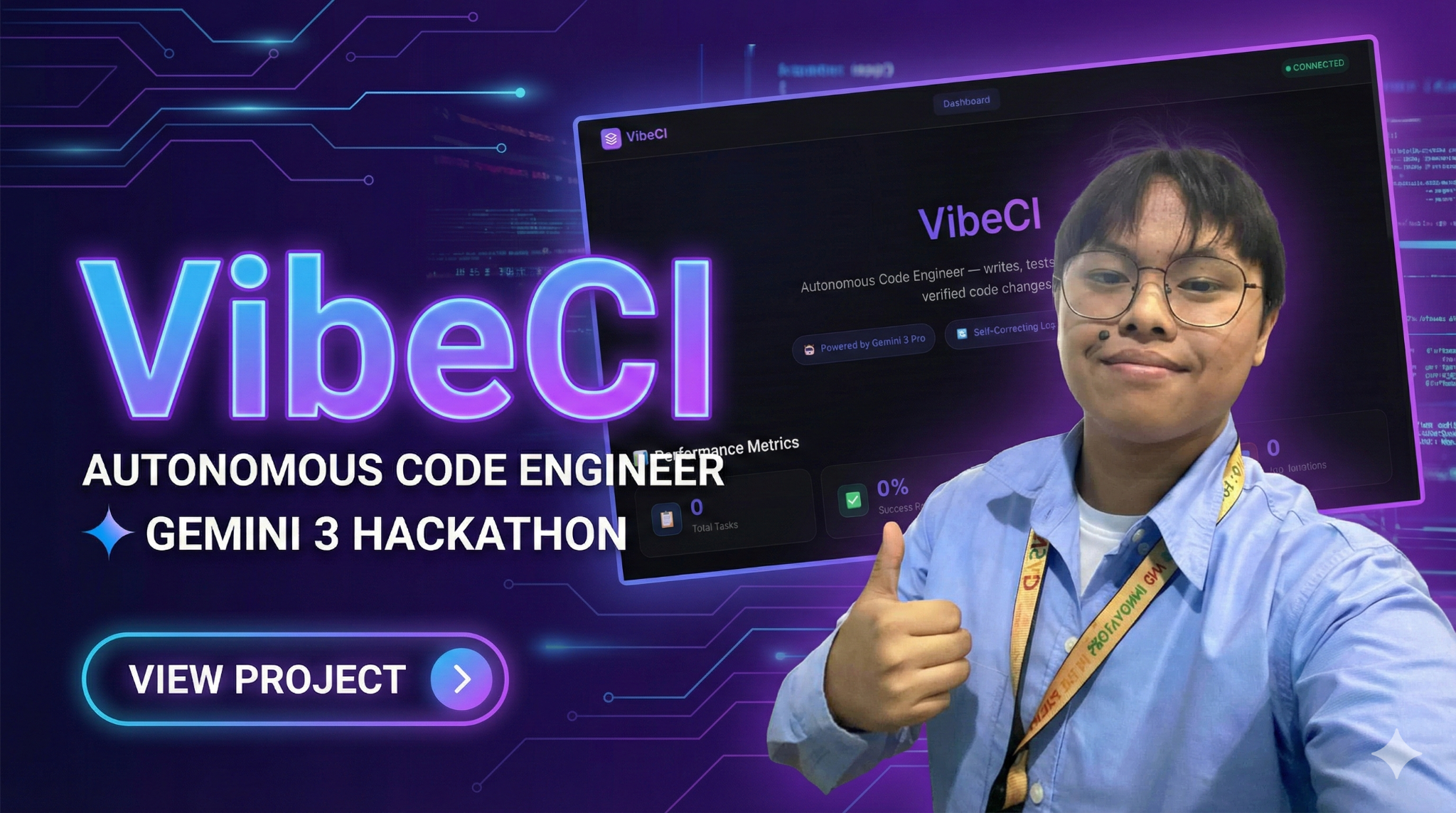
• Frontend: React + Vite with a real-time trace viewer and glassmorphism UI
• Database: SQLite for task and artifact persistence
• Testing: Jest for unit tests, Playwright for E2E verification
• Real-time Comms: WebSocket for live streaming agent thoughts and actions
The core innovation is our self-correcting orchestration loop the agent plans, generates code, runs tests, and if they fail, analyzes the logs and generates fixes automatically.
Challenges we ran into
• Reliable diff parsing: Getting Gemini to generate valid unified diffs that apply cleanly to real codebases required extensive prompt engineering and structured output schemas • Orchestration complexity: Managing the state machine of plan → patch → test → diagnose → fix with proper error handling and rollback was intricate • Real-time UI sync: Streaming agent thoughts and events via WebSocket while keeping the UI responsive required careful architecture • Production deployment: Configuring Heroku with proper git binary paths and environment variables for a monorepo presented unexpected hurdles
Accomplishments that we're proud of
• ✨ 90% time savings — Tasks that took 30 minutes manually now complete in ~3 minutes
• 🎯 75% first-try success rate — Most tasks complete in ≤3 iterations
• 🔍 Thought Signatures — Structured reasoning checkpoints for full auditability
• 🎨 Premium UI — Glassmorphism design with real-time trace viewer showing the agent "thinking"
• 🚀 End-to-end autonomous flow — From task description to verified, working code with zero human intervention
What we learned
• Structured outputs are crucial: JSON schemas make LLM outputs reliable and parseable
• Self-correction beats single-shot: The iterative fix loop dramatically improves success rates
• Transparency builds trust: Showing the agent's reasoning in real-time helps users understand and trust the system
• Prompt engineering is an art: Small changes to system prompts have outsized impacts on output quality
• Agentic AI needs guardrails: Rate limiting, sandboxing, and verification artifacts are essential for safe autonomous operation
What's next for VibeCI
• GitHub PR Integration: Auto-create pull requests with verification artifacts attached
• Multi-language Support: Extend beyond JavaScript/TypeScript to Python, Go, and more
• Team Collaboration: Shared dashboards and task queues for development teams
• Custom Prompt Templates: Let teams define their own coding standards and patterns
• Enterprise Features: SSO, audit logs, and on-prem deployment options
• Jira/Slack Integrations: Trigger tasks from issue trackers and get notifications in team chat
Built With
- archiver
- cors
- css
- docker
- dotenv
- express.js
- gemini
- git
- github
- heroku
- html
- javascript
- jest
- playwright
- react
- sqlite
- typescript
- uuid
- vite
- websockets

Log in or sign up for Devpost to join the conversation.