-
-
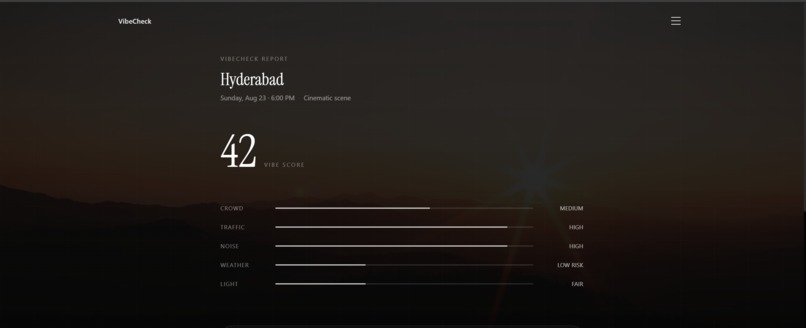
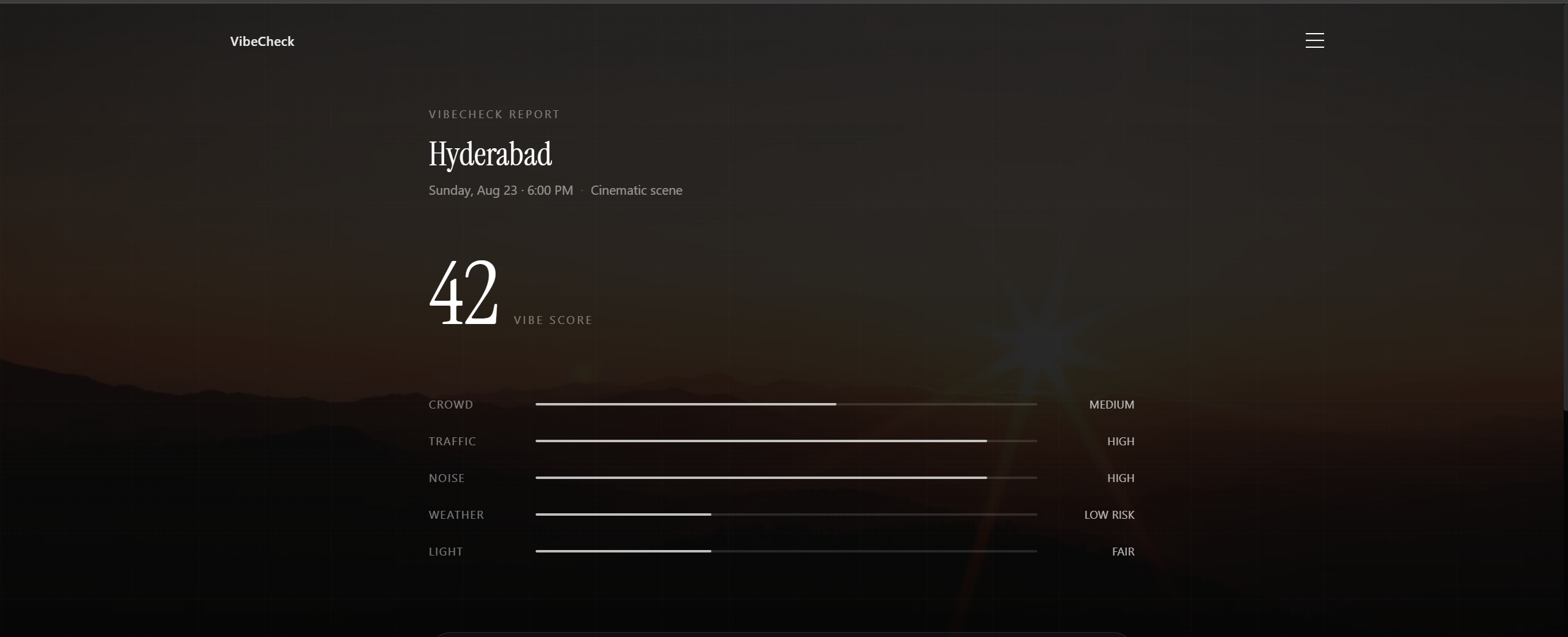
VibeCheck combines crowd, traffic, noise, weather, and lighting signals into one clear score for the planned shoot.
-
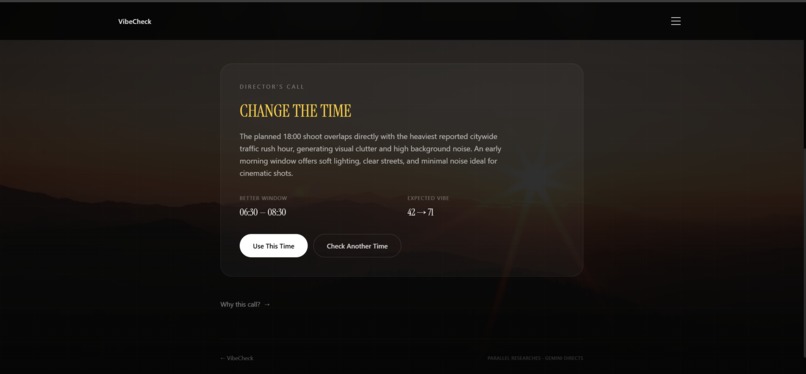
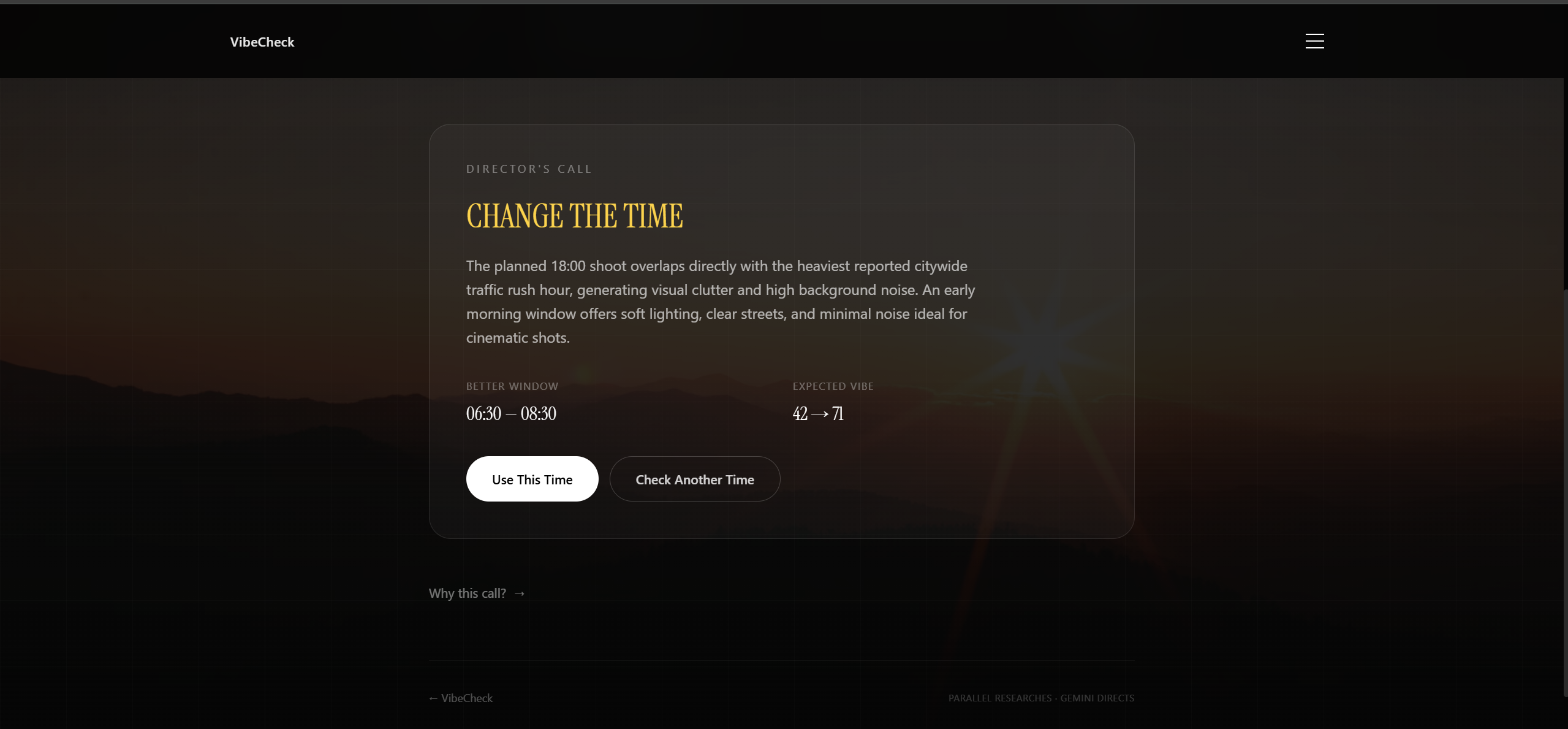
The Director's Call turns complex signals into an actionable recommendation, including a better time and expected Vibe Score.
-
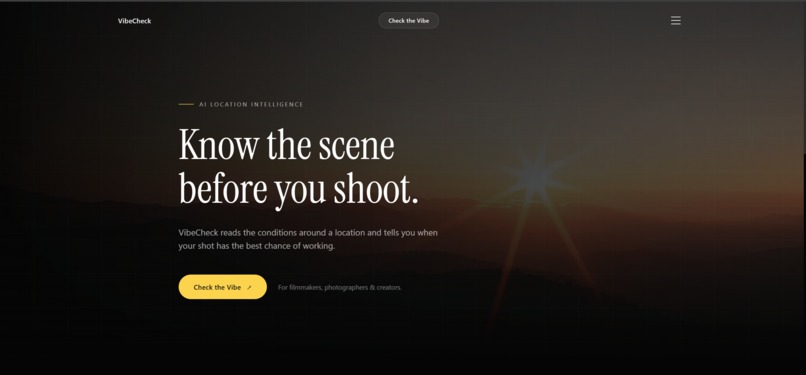
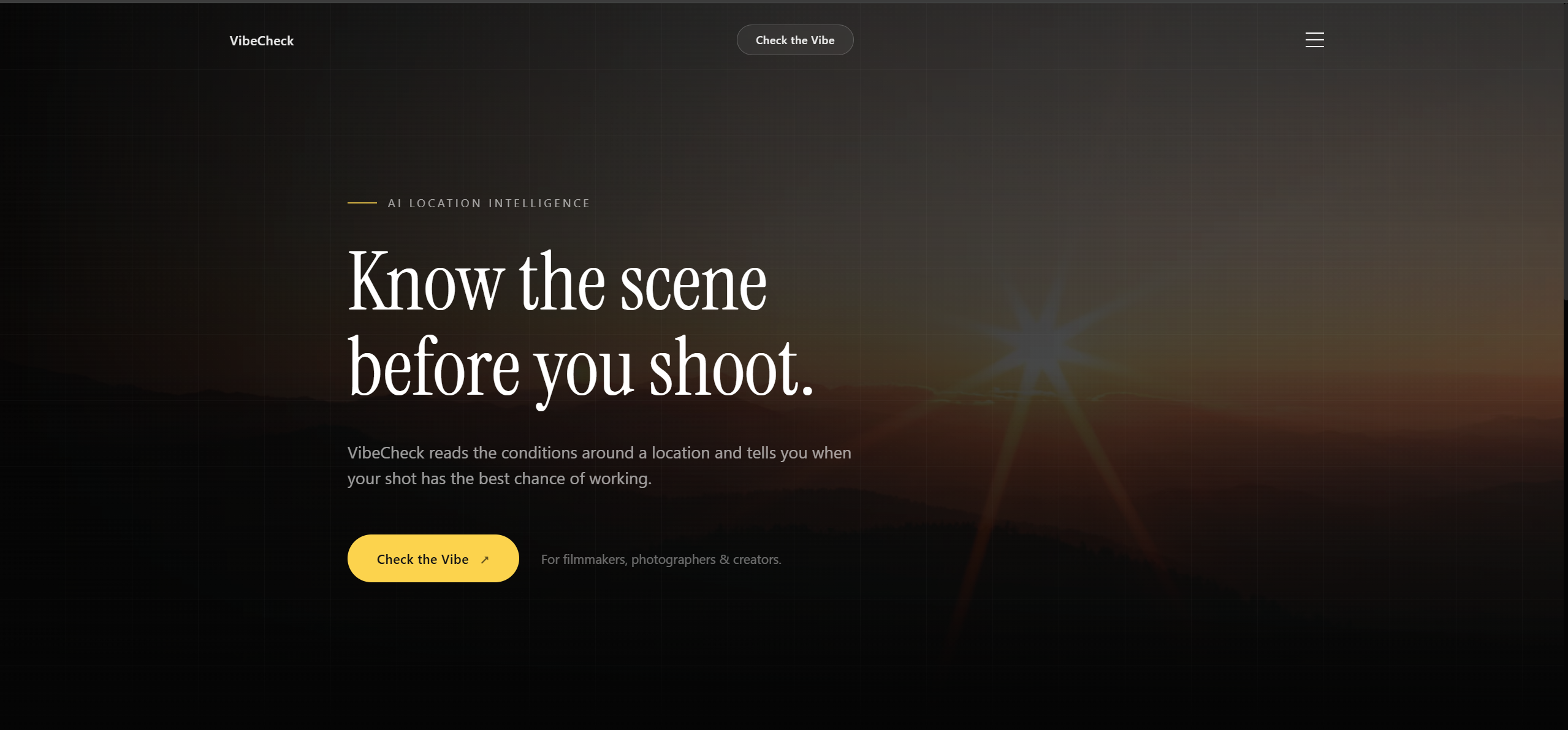
VibeCheck turns a location into a shooting decision, helping creators understand the scene before they bring their crew.
-
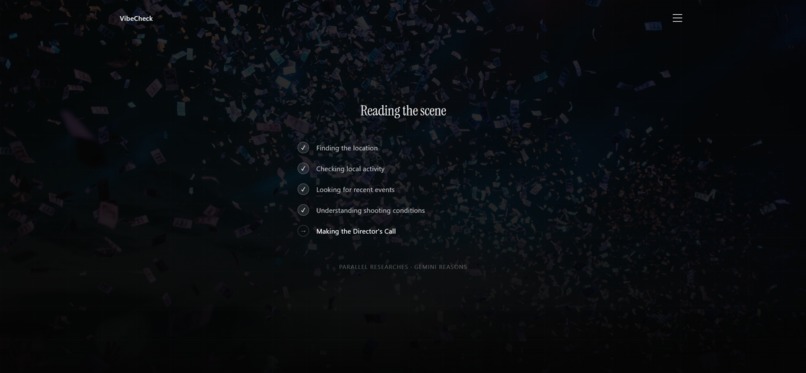
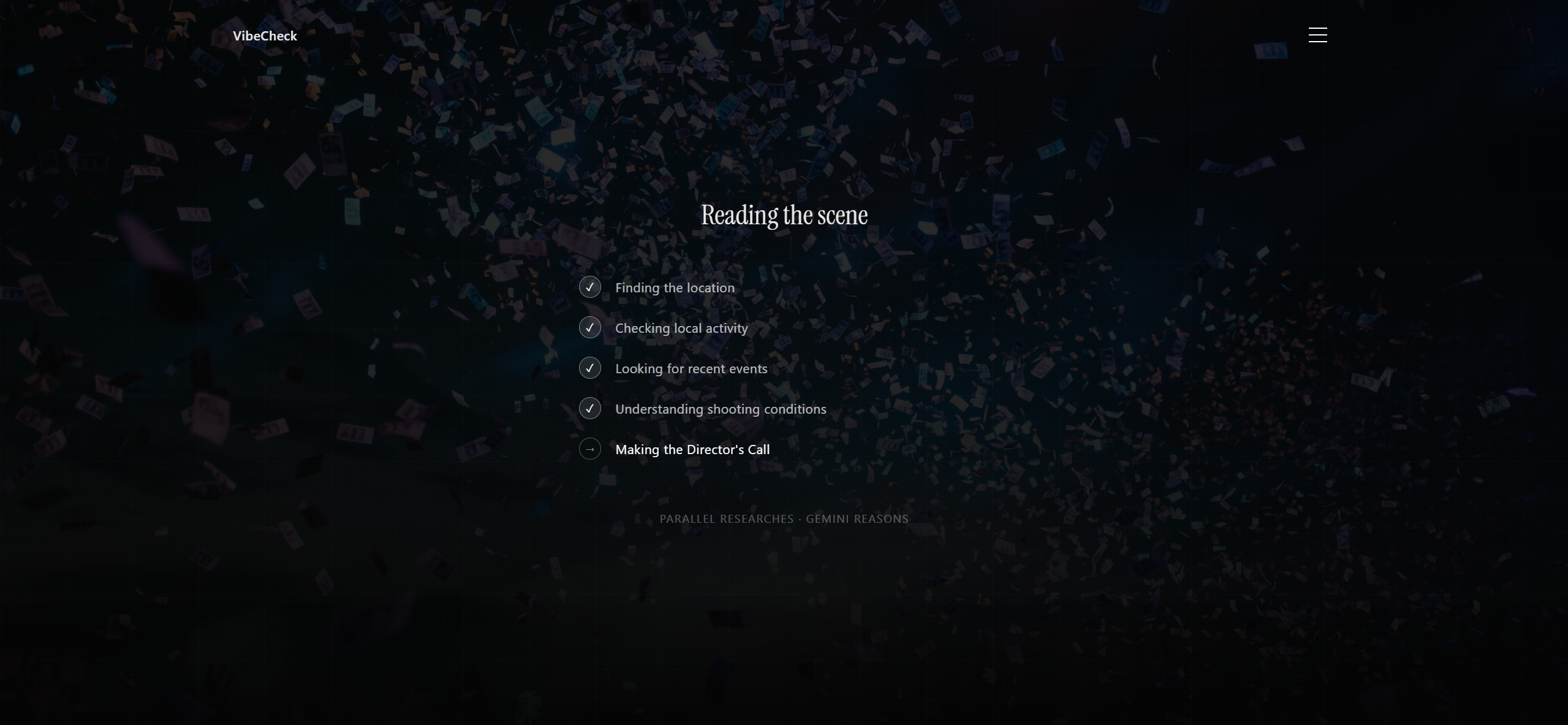
The agent researches the location, local activity, recent events, and shooting conditions before making its Director's Call.
Inspiration
I write, and I’ve always been passionate about photography. One of my closest friends has been interested in making short films for a long time, so when he finally decided to shoot one, a few of us got together to help.
We had the script, camera, actors, and a location we had carefully chosen. We had even planned the scene around the lighting we expected to get there.
Then we arrived.
The location was packed. There was constant traffic, people walking through our frame, and enough background noise to ruin almost every dialogue take. We tried waiting, changing angles, and moving around, but the situation didn’t really improve.
The light was disappearing. Everyone was getting tired. We were losing the few hours we had.
Eventually, we packed everything up.
On the way back, my friend said:
“I wish we had known this before coming here.”
That sentence became the idea behind VibeCheck.
I realized that checking a location isn't enough. A place can look perfect on a map and still be completely wrong for a shoot at a particular time.
I wanted to answer one simple question:
“Should I actually bring my crew here right now?”
What it does
VibeCheck is an AI-powered location intelligence agent for creators.
A filmmaker enters:
A location Date and time Type of scene they want to shoot
VibeCheck gathers relevant signals around that location and time, including expected public activity, traffic, location popularity, weather, and other environmental conditions.
The gathered information is then analyzed by Gemini in the context of the planned scene.
Instead of giving the creator another complicated dashboard, VibeCheck gives them a simple Director's Call:
🟢 GO
The location and timing look suitable.
🟡 CHANGE THE TIME
The location works, but another time could provide better conditions.
🔴 AVOID
The conditions are likely to make the shoot difficult.
For example, if someone plans a quiet dialogue scene at a crowded location during evening traffic, VibeCheck can recommend moving the shoot to an earlier, quieter window.
The goal is simple:
Turn scattered information into one useful decision before the crew leaves home.
How we built it
We deliberately kept the core product small and focused.
The workflow is:
Location + Time + Scene → Gather Signals → AI Reasoning → Director's Call
The user enters their shooting plan through a cinematic, step-by-step interface.
The system then gathers relevant location information using the Parallel Search API. These signals provide context such as recent mentions, activity, events, reviews, and other useful information around the location.
That research is passed through a structured agent workflow to Gemini.
The AI considers the signals together with the type of scene being filmed.
For example:
High expected public activity Moderate traffic Good weather Quiet dialogue scene
The important conclusion isn't simply that each individual condition exists. The system needs to understand that the combination makes the planned shoot less suitable.
The result is converted into a structured response containing:
Vibe Score Crowd level Traffic level Noise level Weather risk Lighting conditions Recommended time Recommended shooting window Director's reasoning Confidence
we also designed the interface so that users don't have to understand the underlying APIs or AI system.
They simply ask:
“Can I shoot here at this time?”
And VibeCheck does the work behind the scenes.
Challenges we ran into
The biggest challenge was dealing with uncertainty.
A location isn't static. Crowd levels, traffic, weather, and local activity can change throughout the day.
we didn't want VibeCheck to pretend that it could predict reality perfectly.
Instead, we designed it to communicate risk and reasoning clearly.
Another challenge was deciding what not to build.
There are countless things I could add: parking, permits, nearby facilities, equipment planning, budgets, sunrise calculations, crew management, and more.
It was tempting to keep expanding.
But I kept returning to the original problem.
we are not trying to manage an entire film production.
we are trying to help someone make one better decision before they start their shoot.
we also had to make the AI reasoning useful rather than just generating a nice paragraph. The output needed to end with an actionable recommendation, not another page of information.
Accomplishments that we're proud of
We are proud that we turned a frustrating real-world experience into a product that could genuinely help other creators.
we are especially proud of the simplicity of the experience.
A user doesn't need to understand APIs, search systems, weather data, or AI models.
They simply provide their location, time, and scene.
VibeCheck handles the analysis and returns a practical recommendation.
we are also proud of the Director's Call concept.
Instead of overwhelming users with information, we designed the product around the decision that actually matters.
Most importantly, I built VibeCheck with the mindset that AI should not exist just because it is impressive.
The AI has a job to do.
It connects information that normally lives in different places and turns it into something a creator can act on.
What we learned
Our biggest lesson was that a powerful AI product doesn't necessarily need a complicated interface.
At first, I thought adding more features would make VibeCheck more impressive.
We eventually realized the opposite.
The strongest part of the product is the reasoning loop:
What are the conditions?
What am I trying to shoot?
Do those two things work together?
If not, what should I change?
We also learned that good AI UX is about hiding complexity.
The user shouldn't have to understand how multiple signals were combined.
They should simply understand:
“This isn't a good time. Try 6 AM instead.”
That is the value we wanted to create.
What's next for VibeCheck
VibeCheck started as a solution to one frustrating shoot, but I see many ways to make it more useful for creators.
Some of the features we want to explore next are:
Live Vibe Checks using current location activity Scene-aware recommendations for dialogue, action, portraits, street scenes, and cinematic shots Multiple time suggestions instead of just one recommendation Alternative nearby locations when the original location isn't suitable Historical patterns to understand how locations behave at different times Crew and equipment considerations for more serious productions Mobile-first experience so creators can check a location while already on the move
My long-term vision is simple:
VibeCheck should become the first thing a creator checks before saying, “Let's shoot here.”
Because a great production doesn't always begin when the camera starts recording.
Sometimes, it begins with knowing where—and when—to press record.
VibeCheck — Know the scene before you shoot.
Built With
- ai
- cloud
- express.js
- gemini
- github
- node.js
- parallel
- react
- restapi
- tailwindcss
- typescript
- vercel
- vite


Log in or sign up for Devpost to join the conversation.