-
-
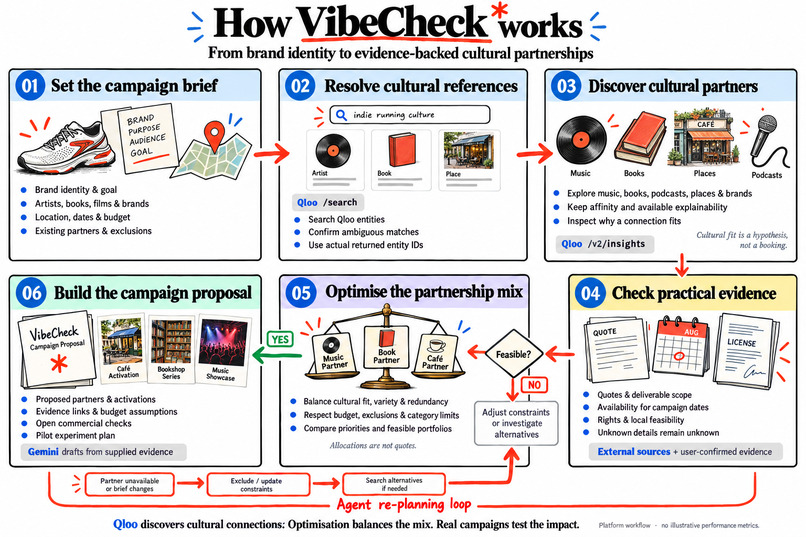
How VibeCheck works
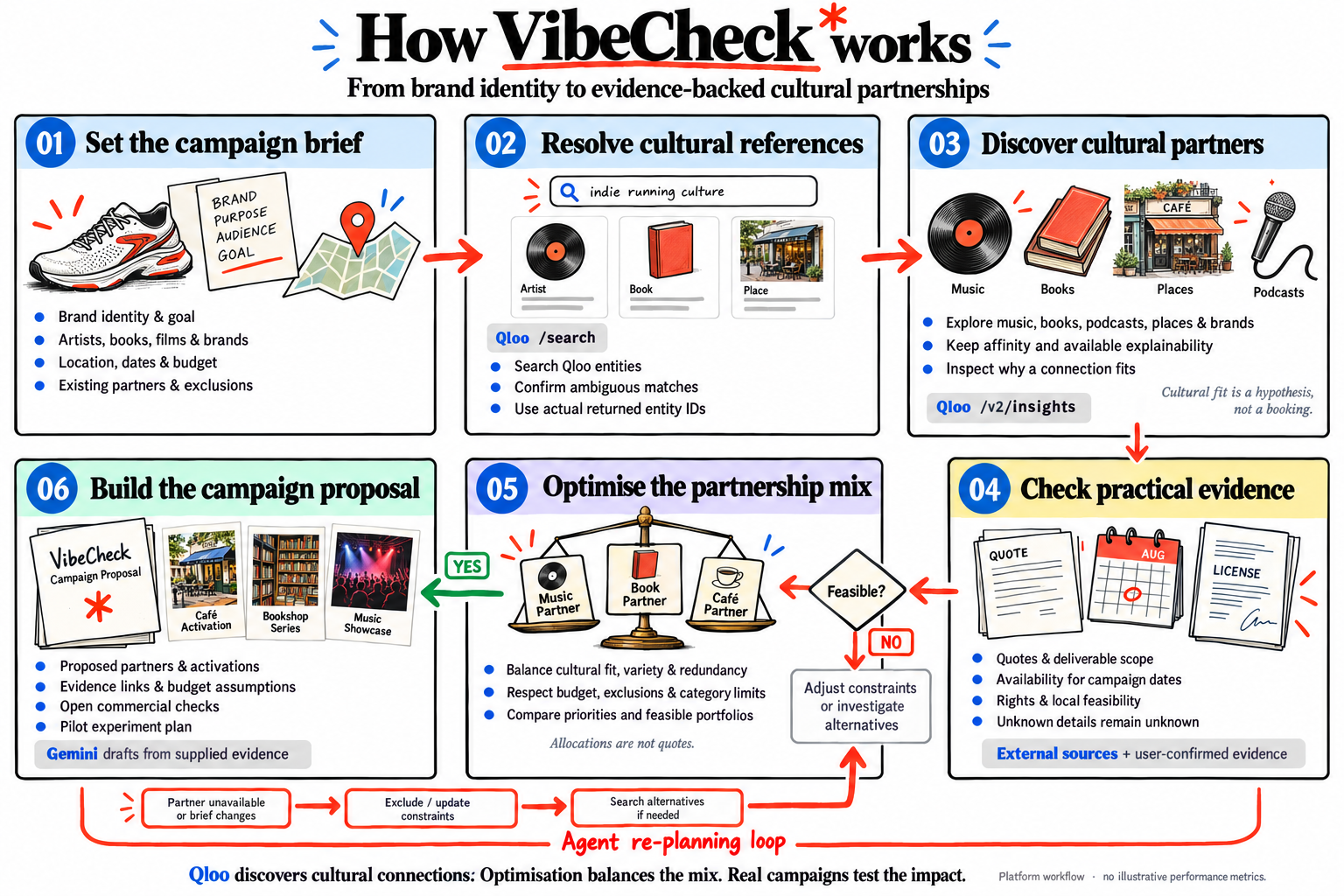
VibeCheck: Unexpected Partners. Meaningful Connections.
Inspiration
A running brand’s next collaboration might belong in a listening café, an independent bookshop or a neighbourhood music venue. Finding that connection takes more than searching for another sports influencer.
Brand teams often start with familiar categories and recognisable names. That makes research manageable, but it can leave promising cultural connections unexplored. Meanwhile, an AI assistant can produce an imaginative partnership pitch without providing evidence that the suggested connection makes sense.
We wanted to bring discovery and decision-making together: help a brand explore beyond its usual circle, then explain why a partnership deserves consideration.
That became VibeCheck—a cultural partnership scout that uses Qloo to ground discovery and data science to turn a candidate list into a considered campaign portfolio.
What it does
VibeCheck starts with a campaign brief: brand identity, cultural references, objective, location, dates, planning budget and existing partners.
The workflow resolves references to Qloo entities and explores potential collaborators across music, books, podcasts, places and brands. Returned affinity and explainability provide evidence for examining the cultural connection. They support a partnership hypothesis, not a guarantee of commercial success.
The portfolio engine selects a complementary mix under explicit constraints. Users can adjust the relative importance of fit, category variety, redundancy and cost, then inspect how the proposed shortlist changes.
VibeCheck separates cultural discovery from commercial verification. Quotes, availability, rights and local feasibility require separate evidence. When prices are unknown, exploratory planning uses explicitly labelled spending allocations rather than invented sponsorship fees. A stricter mode excludes candidates without the required commercial evidence.
If a partner becomes unavailable, the workflow excludes that candidate, recomputes the portfolio and investigates additional alternatives when needed. The output can include proposed activations, supporting evidence, budget assumptions, unresolved checks and a pilot experiment plan.
How we built it
We developed the core workflow as a Python prototype using pandas, NumPy, requests, Pydantic, SciPy and Plotly, with Qloo for cultural discovery and Gemini for structured campaign concepts.
The Qloo integration uses entity search to resolve references and Insights requests to retrieve cross-domain candidates. It retains actual entity IDs, raw affinity, available explainability and retrieval timestamps. Ambiguous references need confirmation; missing evidence stays missing.
The data science engine uses a binary mixed-integer optimisation model. Its objective combines within-category affinity rank utility, category coverage, a tag-overlap redundancy penalty and planning cost. Constraints enforce portfolio size, category requirements, exclusions and a budget including contingency.
These utilities and weights are transparent planning choices. They are not learned estimates of campaign performance, and tag overlap is not presented as measured audience overlap.
Provider calls are bounded, cached and logged. Pydantic schemas validate structured outputs, while evidence-reference checks reject citations to IDs that were never supplied. Gemini proposes activations and explains the selected mix; deterministic code handles eligibility, cost accounting and optimisation.
We also designed the product around a white collaboration canvas: photographic partner cards, red annotations, an editable campaign brief and a portfolio builder. The visual experience makes the relationship between a brand, its references and candidate partners easy to explore.
Challenges we ran into
The central challenge was keeping three questions separate: Does this partner fit culturally? Can the collaboration happen? Is it worth testing? One affinity score cannot answer all three.
Cross-domain comparison also needed care. We avoided treating raw scores from different categories as interchangeable probabilities and made the ranking transformation explicit.
Commercial uncertainty created another challenge. A shortlist looks more complete when every candidate has a price, but unsupported numbers would make the decision less trustworthy. We introduced separate exploratory and confirmed modes, source requirements and freshness checks.
Portfolio selection required more than choosing the highest-ranked names. Several strong candidates may be too similar or exceed the budget together. The optimiser has to consider the combination and report infeasibility when the constraints cannot be satisfied.
Finally, evaluating Qloo’s contribution fairly required a matched comparison. Giving one AI arm more context or more refinement opportunities would make the result difficult to interpret.
Accomplishments that we're proud of
We built an inspectable decision workflow that connects cultural discovery, evidence review, constrained optimisation and partner replacement.
The prototype includes 19 passing offline software checks, covering identity ambiguity, missing affinity, budget feasibility, exclusions, stale evidence, currency handling and citation validation. For a small test case, we checked the optimiser’s objective against exhaustive enumeration.
We are proud of the distinction between a promising cultural lead and a commercially confirmed partner. Unknown details remain visible rather than being filled in to make the proposal look finished.
The workflow also exports candidate records, evidence checklists, portfolios and a campaign report, so the reasoning can be reviewed beyond the interface.
What we learned
Cultural intelligence becomes useful when it changes a concrete decision: which candidates are discovered, which combination is chosen, or which alternative replaces a partner that drops out.
We learned that transparent constraints matter as much as persuasive explanations. “No feasible portfolio under these conditions” can be a more useful result than a confident recommendation that ignores the budget.
We also learned to separate software validation from product effectiveness. Passing an optimisation test does not prove a campaign will perform better. That requires independent review and, eventually, real experiments.
What's next for VibeCheck
Our next step is completing and validating the hosted collaboration-canvas experience against the prototype’s evidence and optimisation contracts.
We want to deepen the data science with candidate-by-reference cultural fingerprints, leave-one-reference-out sensitivity tests and portfolio trade-off views. These would help users understand which connections are stable, which depend on one reference and what each additional partner contributes.
We also plan stronger commercial research integrations and a broader evaluation across campaign briefs. A matched Gemini-only comparison and blinded human reviews can test discovery quality without using Qloo alignment itself as proof that Qloo wins.
Over time, permissioned campaign results could support learning from actual outcomes. Until then, VibeCheck’s role is clear: uncover an unexpected connection, show the evidence and help a team decide what deserves a real-world test.


Log in or sign up for Devpost to join the conversation.