-
-
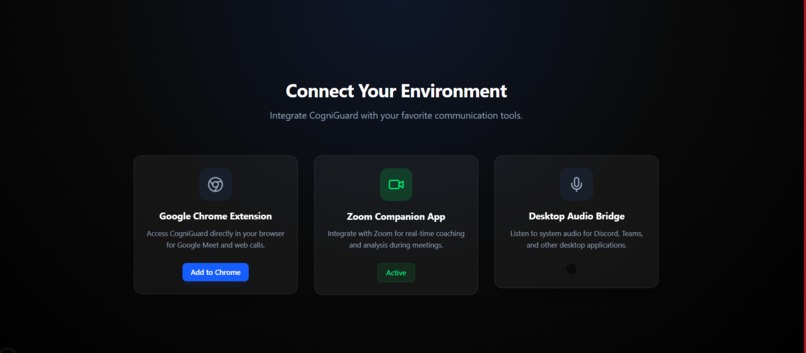
Integration page (extentoin to coonect with browsers )
-
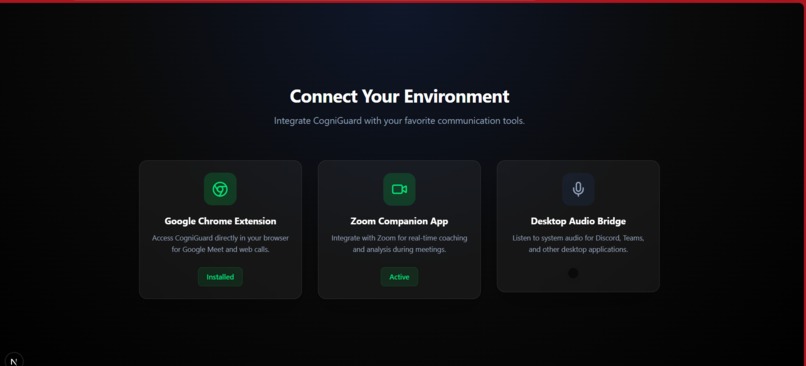
integration page (after connection with google crome)
-
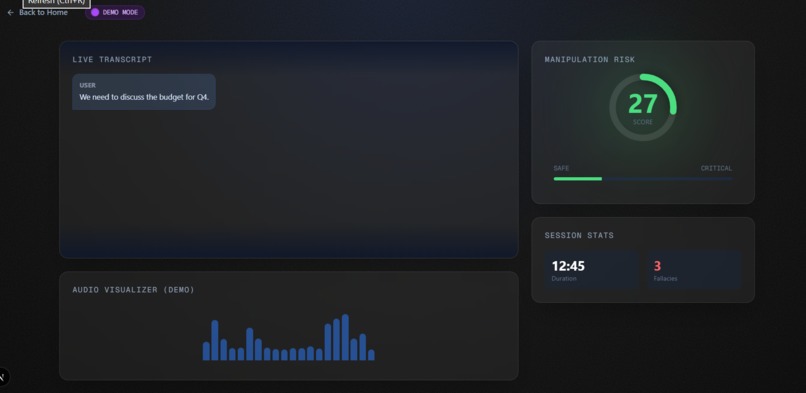
demo page
-
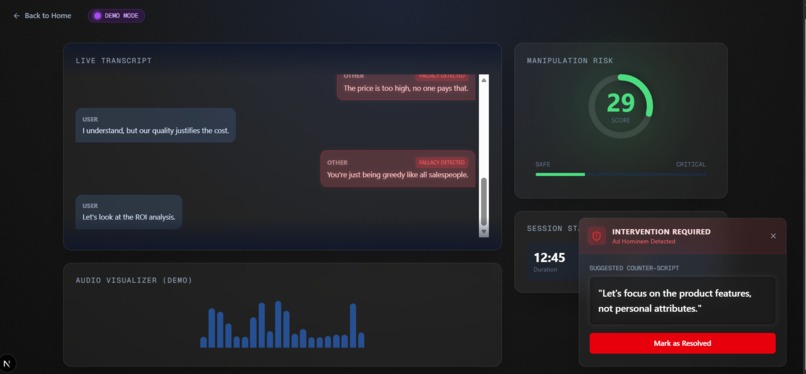
demo page
-
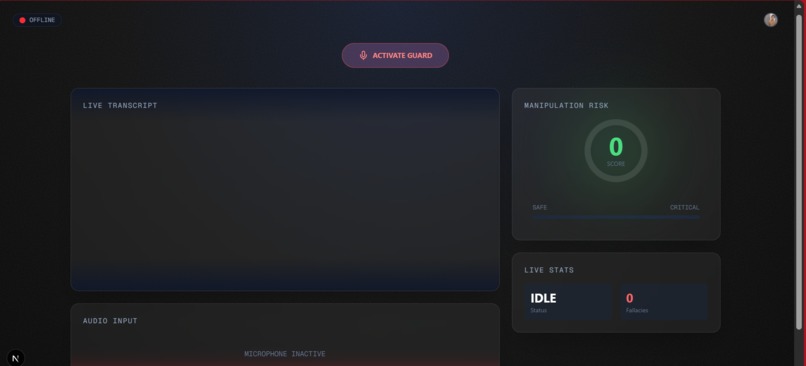
realtime conversation procesion and guiding page
-
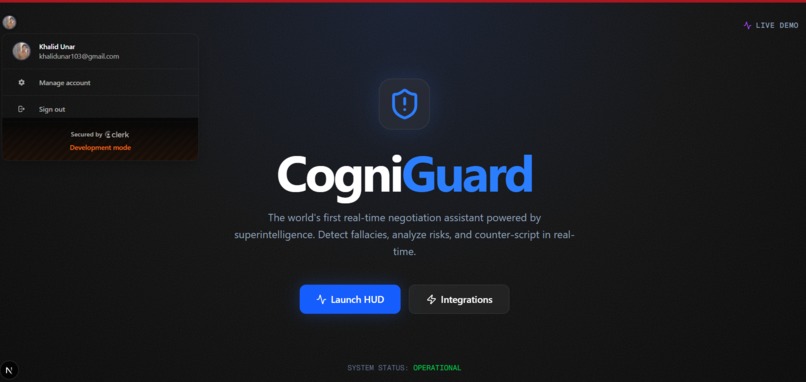
landing page(wiith signup\login page) and demo page on right side


Inspiration
From Anxiety to "Good Vibes" We live in a world of high-pressure communication. Whether it’s a junior developer negotiating their first salary, a student facing a tough viva, or simply someone with social anxiety trying to voice their opinion, the "freeze response" is real.
We realized that most AI tools are "passive"—you have to type to them after the event. We wanted to build something Active and Empathetic. We asked: What if you had a super-intelligent, calm, and supportive friend sitting right next to you during every call, whispering exactly what you need to hear to stay confident?
That is how VibeCheck was born. It isn't just a tool; it's an Augmented Intelligence HUD designed to turn stressful moments into "Good Vibes."
What it does
VibeCheck is a real-time browser-based application that listens to your live audio (negotiations, interviews, debates) and acts as a Cognitive Defense System.
Real-Time Listening: It streams audio from your microphone to our backend.
Fallacy & Manipulation Detection: It analyzes the conversation to spot when someone is being unfair (e.g., using "Ad Hominem" attacks or "False Urgency").
The "Intervention Deck": When high pressure is detected, the UI pops up a glowing "Card" with a suggested script to help you push back politely and professionally.
Visual "Vibe" Check: A live dashboard visualizes the sentiment and "Truth Score" of the conversation, reassuring the user that they are doing well.
How we built it
The "Vibe Coding" WayThis project is a testament to Vibe Coding. We didn't just write code; we orchestrated AI agents to build it.Architected by Gemini 3 Pro (Google Antigravity): We used Google's latest Agentic IDE to generate the entire full-stack architecture. We acted as "Product Managers," guiding the AI to scaffold the Next.js frontend and Python backend in minutes, not days.The Speed Layer (Groq): To make this work in real-time, we couldn't use standard LLMs. We used Llama 3 on Groq, achieving inference speeds of <300ms.The Backend: We built a FastAPI server using WebSockets to handle bi-directional audio streaming.The Frontend: We used Next.js 15, Clerk for secure auth, and Framer Motion to create a "Glassmorphism" UI that feels calming and futuristic.$$\text{Latency}{total} = T{network} + T_{transcription} + T_{inference} < 1000ms$$We optimized every step to ensure the "Advice Card" appears before the awkward silence sets in.
Challenges we ran into
The "Vibe" vs. "Latency" Trade-off: Getting the AI to be smart and fast was hard. Standard GPT-4 was too slow (3+ seconds). Switching to Groq was a game-changer, allowing us to hit the "conversational speed" sweet spot.
Browser Audio Streams: Handling raw binary audio data from the browser microphone and sending it over WebSockets without corruption was a significant technical hurdle.
UI/UX Balance: We didn't want the screen to be cluttered. Designing the "Intervention Deck" to only appear when absolutely necessary took several iterations of Vibe Coding.
Accomplishments that we're proud of
Building a fully functional Real-Time Audio Agent in just a few days.
Achieving a "Cyberpunk/Glass" aesthetic that looks professional and expensive.
Creating a tool that actually helps people feel safer and more confident.
What we learned
Vibe Coding is the future: Using AI agents (Gemini 3 Pro) to write boilerplate code allowed us to focus 100% on the creative logic and user experience.
Latency is the new UX: In voice AI, speed is the feature.
Empathy in AI: AI doesn't have to be cold. By prompting the model to be a "Supportive Coach," we changed the entire feel of the product.
What's next for VibeCheck (powered by CogniGuard)
NordVPN Integration: Routing audio streams through a private Meshnet to guarantee user privacy.
Mobile App: Bringing VibeCheck to iOS for in-person conversations.
UniBee Monetization: Adding a "Pro Coach" tier for executive salary negotiations.


Log in or sign up for Devpost to join the conversation.