-
-
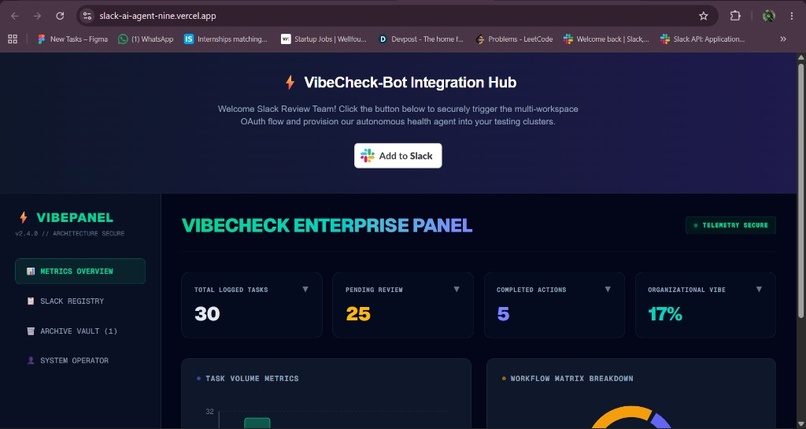
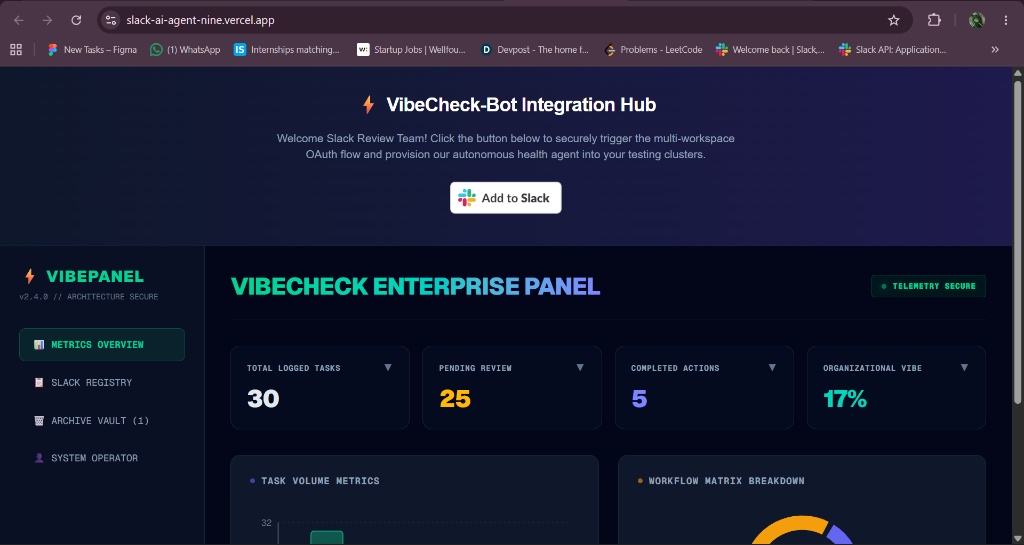
Multi-Workspace Landing Gateway - Secure OAuth flow portal featuring the interactive Add to Slack handshake.
-
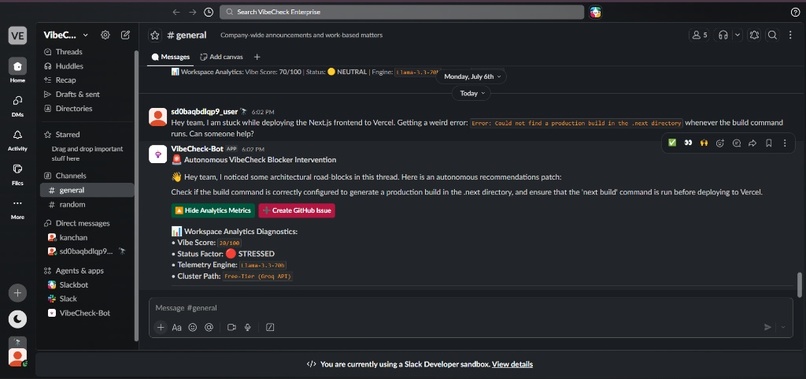
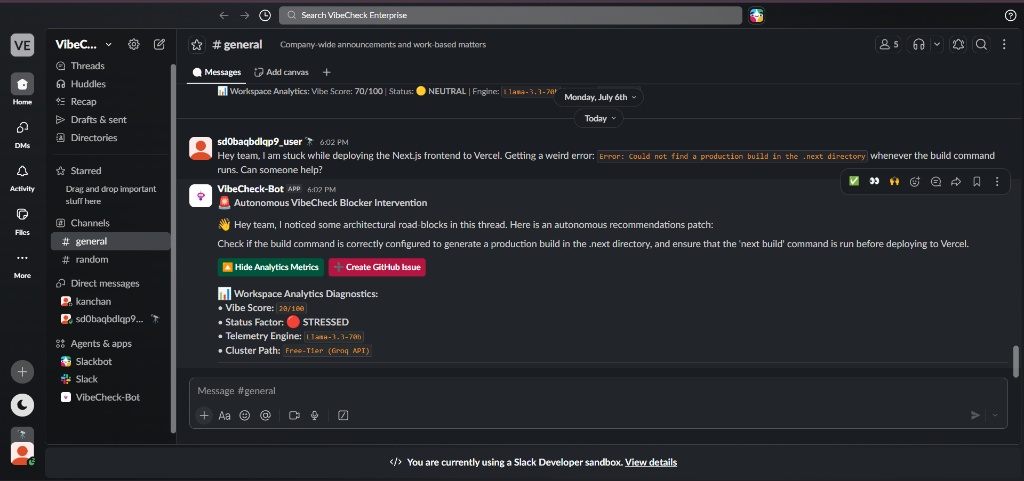
AI Blocker Intervention - Live context-aware recommendation card triggered inside Slack using Groq API.
-
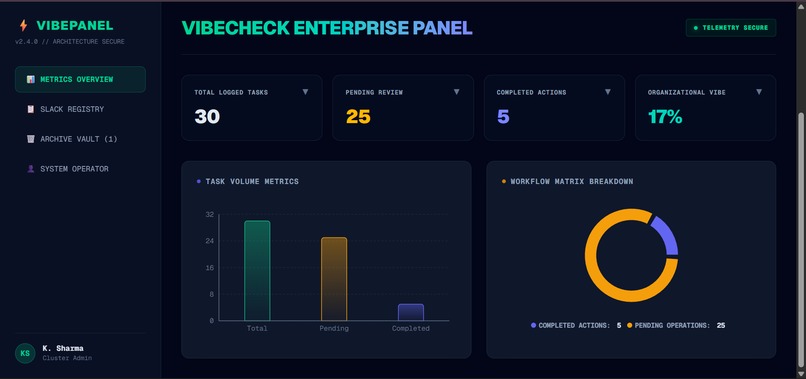
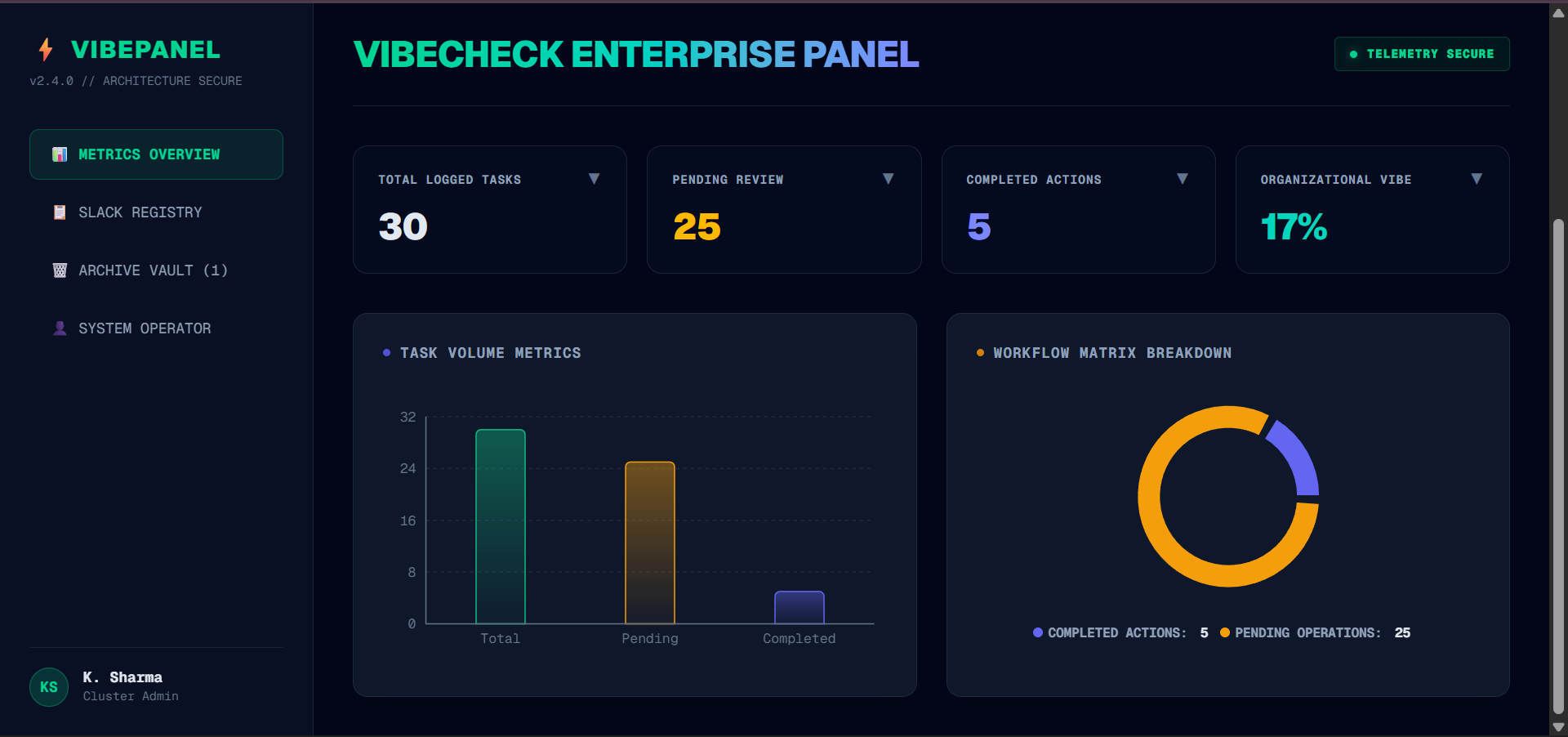
VibePanel Dashboard - Next.js tracking panel showing task charts and overall team sentiment metrics.
-
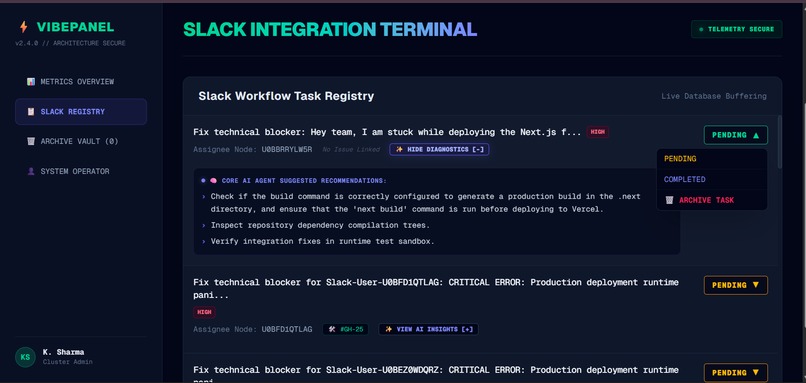
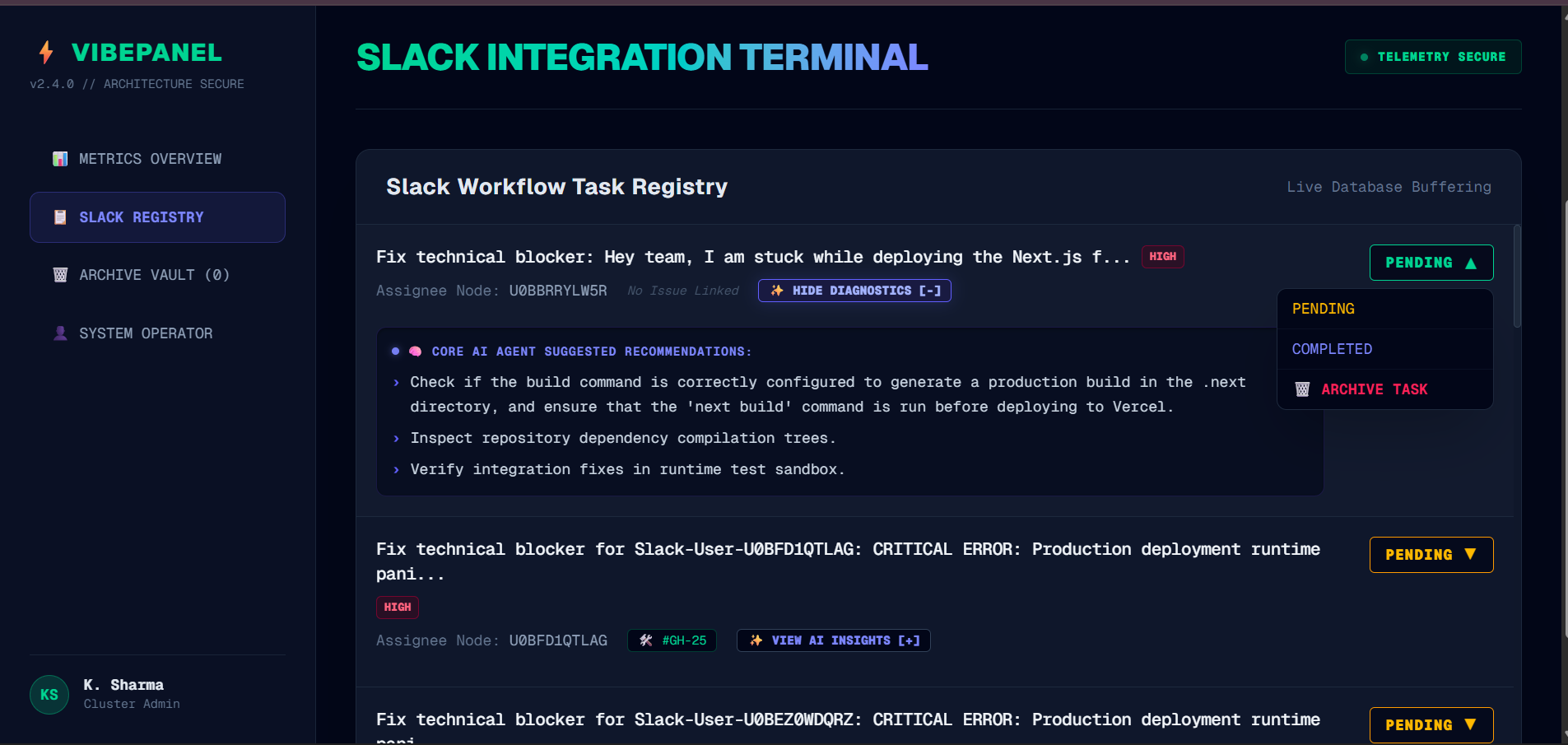
Slack Workflow Registry - Centralized panel where workspace logs are tracked by current state.
Inspiration
As remote engineering teams scale, managing technical blocks and developer burnout gets incredibly messy. Usually, when a dev hits a critical runtime error or starts feeling overwhelmed, they either drop a frantic message in Slack or suffer in silence. Important errors get buried under chat noise, and managers completely lose track of real team progress. I wanted to build a seamless infrastructure tool that doesn't feel like another annoying corporate tracker, but a silent health agent that watches out for technical tension and helps teams stay unblocked automatically.
What it does
VibeCheck-Bot is an autonomous management and orchestration agent for engineering teams. It operates in two main modes:
Direct Assistance: Team members can casually DM the bot anytime to debug or query status configuration points.
Context-Aware Monitoring: When invited to a public channel, the bot doesn't interfere with general casual conversations. However, the moment it detects technical tension—like a developer pasting an application panic stack or expressing extreme technical stress—it immediately drops a dynamic AI-driven solution card right inside the channel chat.
Real-Time Bi-Directional Dashboard Integration: The moment a channel issue is detected, the bot automatically creates a pending tracking task on the manager's Next.js dashboard with live metric charts. Inside the Slack card, developers get an instant interactive button to file a GitHub Issue with a single click, along with a direct URL link to that issue.
When a team member resolves the issue and sends a Pull Request, or when the manager merges the PR, the system automatically marks the task as Resolved on the dashboard and sends a live update message back to the Slack channel.
Managers can also manually switch tasks from Pending to Complete or Archive them directly from their dashboard panel, which instantly triggers an automated status broadcast back to the Slack channel.
How we built it
The entire core pipeline is powered by an asynchronous Node.js and Express stack deployed dynamically on Vercel. Real-time bi-directional interactions are handled using the Slack Web API, Event Subscriptions webhooks, and Block Kit interactive payloads. For the intelligence layer, I used LLaMA models via the Groq API to intercept raw channel logs, check for high-stress patterns, and formulate hyper-contextual responses.
The frontend management dashboard is engineered using Next.js, parsing data streams into live visual tracking charts. To tie everything together, I designed an absolute multi-workspace distribution handshake through an OAuth "Add to Slack" landing gateway that securely synchronizes tokens on database level.
Challenges we ran into
This project threw some heavy architectural challenges at me! Managing a smooth multi-workspace authorization loop while debugging local webhooks was a massive headache initially.
The biggest engineering challenge was perfecting the automated bi-directional synchronization loop between Slack interactions, GitHub PR state merges, and the Next.js backend database. Ensuring that standard Express middleware threads didn't block during heavy concurrent event spikes required a complete optimization of my asynchronous API response handling.
Accomplishments that we're proud of
I am incredibly proud of designing a system where a simple text event in Slack can effortlessly spawn a fully tracked dashboard instance and an external GitHub issue within seconds. Bridging three separate ecosystems—Slack UI blocks, an AI sentiment engine, and Next.js live chart visualization—into a cohesive, fully deployed product as a solo engineer feels like a huge milestone for me.
What we learned
Building this project forced me to dive incredibly deep into production-grade event-driven systems, OAuth token lifecycles, and security scopes. I also learned how to scale backend environments to securely handle concurrent webhooks without losing track of workspace contexts in the database.
What's next for VibeCheck-Bot
Right now, the entire multi-system tracking workflow is fully operational and thoroughly tested, but the GitHub issue generation logic is pointing to a centralized repository for demonstration purposes.
The absolute next milestone is making the repository mapping fully dynamic. I am working on expanding the OAuth identity flow so that when any team member clicks the "Create Issue" button inside Slack, the issue is generated dynamically within their own personal target GitHub repository instead of the centralized main repository, while still cleanly mapping pull requests back to the manager's main dashboard pipeline. ⚠️ Production & Testing Note for Judges: The application core backend is fully operational and deployed live on production infrastructure. However, the intelligence layer currently utilizes the free-tier Groq API (LLaMA model). Due to standard free-tier rate limits, making rapid, consecutive high-volume requests during testing might temporarily trigger a rate block from the API provider. For the best evaluation experience, I kindly recommend sending test messages in the Slack channel with a slight pause (3-5 seconds) between inputs to allow our asynchronous webhooks to process smoothly without hitting the external API threshold.
Built With
- groq-api-(llama)
- mcp-server-integration
- next.js
- node.js
- render
- slack-block-kit
- slack-web-api
- vercel


Log in or sign up for Devpost to join the conversation.