About the project
The spark
Most hackathon projects sprint from idea to spec, then stall at the missing WHY. Stakeholders want market sizing, ROI, risks, and a crisp executive narrative—fast. Vibe PM Agent fills that gap as Kiro’s why-layer, turning raw ideas into evidence-backed business cases and board-ready one-pagers inside the same workflow where specs and code already live.
What it does
- Runs as a Kiro-native MCP server.
- Analyzes opportunities (market, competition, risks, assumptions) with citations.
- Generates business cases with multi-scenario ROI and sensitivity notes.
- Produces executive outputs (one-pager / PR-FAQ) that are ready for review.
- Saves artifacts to predictable folders (
reports/,.kiro/steering/,examples/spec-augmentation/) for easy auditing.
How we built it
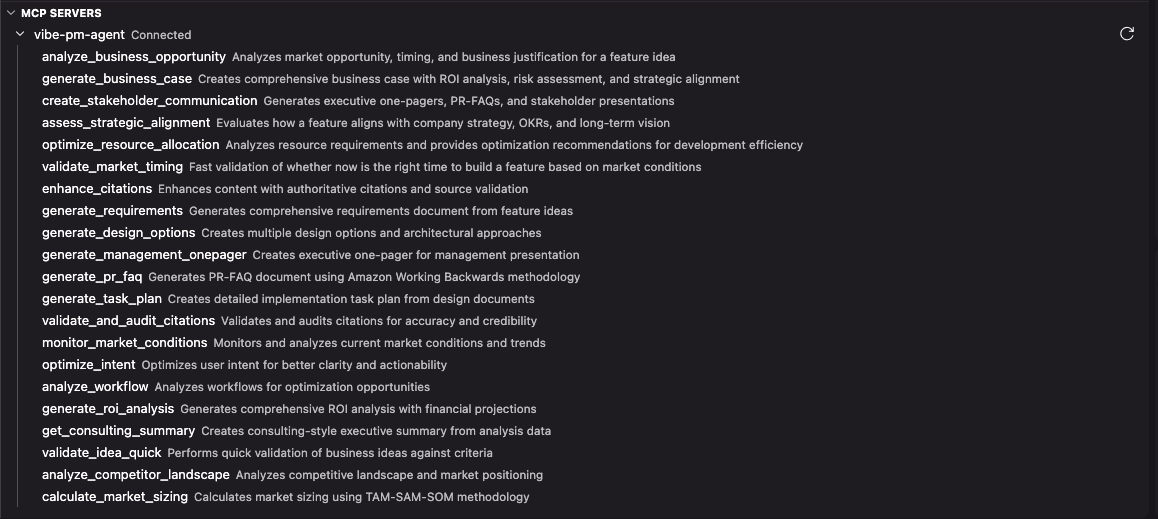
- Architecture: Node/TypeScript MCP server exposing focused tools (
analyze_business_opportunity,generate_business_case,create_stakeholder_communication, etc.). Stdio transport for easy Kiro integration. - Kiro integration:
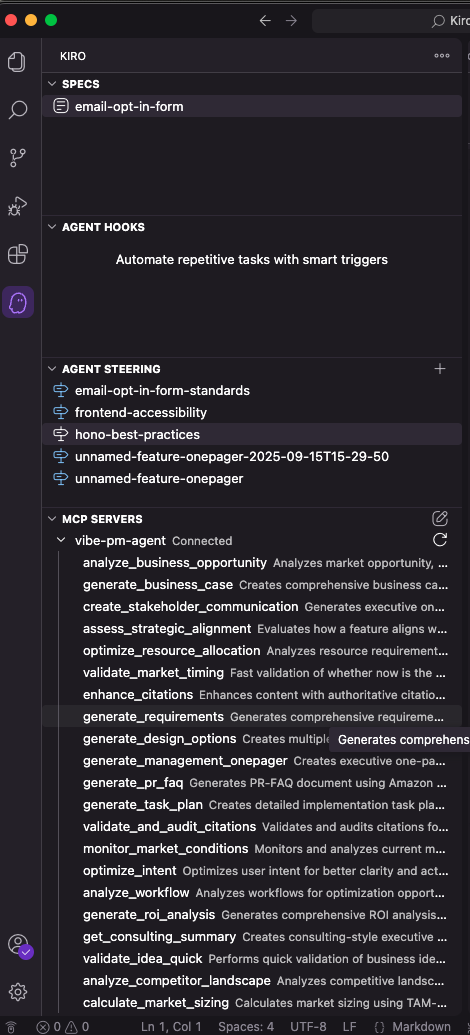
- Emits steering files to keep conversations in “PM mode.”
- Produces spec-augmentation snippets Kiro can ingest in spec-to-code flows.
- Structures outputs to be hook-friendly (e.g., trigger on PR labels).
- Emits steering files to keep conversations in “PM mode.”
- Evidence & outputs: Each major claim includes citations, a lightweight credibility tag, and a confidence score. Outputs are JSON/Markdown for reproducibility and diffs.
- DX:
npm ci && npm run build && npm testfor sanity; demo scripts reproduce the full flow in under three minutes.
What we learned
- Steering > prompts: Reusable steering reduced drift and made outputs reviewable by non-authors.
- Rationale is first-class: Pairing specs with explicit assumptions/risks/trade-offs improves both engineering clarity and the business case.
- Citations change behavior: Requiring sources cut vague statements and increased stakeholder trust.
- Reproducibility wins demos: Structured artifacts committed to the repo turn subjective “looks good” into objective diffs.
Challenges we faced
- Grounding & hallucination control: Designed a simple credibility rubric and limited citation age to reduce noise.
- Latency vs. depth: Split market scans into smaller tools and streamed partials to keep UX responsive.
- Spec alignment: Iterated to ensure augmentation helped engineering (scope/acceptance criteria) rather than adding fluff.
- Deterministic runs: Standardized outputs, added basic tests, and fixed key parameters so judges can re-run and see comparable results.
Why it matters
Great teams don’t just ship features—they make better bets. By embedding market/ROI reasoning alongside specs—directly in Kiro—Vibe PM Agent shortens the path from “promising idea” to “greenlight,” leaving auditable artifacts leadership can trust.

Log in or sign up for Devpost to join the conversation.