
Inspiration
Reddit is one of the only platforms where you can watch collective opinion form in real time — comment sections are basically a live poll on everything. We wanted to build a game that makes that visible and fun to interact with, instead of just scrolling past it. Vibe Meter turns "what does everyone else think?" into the actual game mechanic: you guess where the crowd will land on a question, and the gap between your instinct and the hive's consensus is the whole hook.
What it does
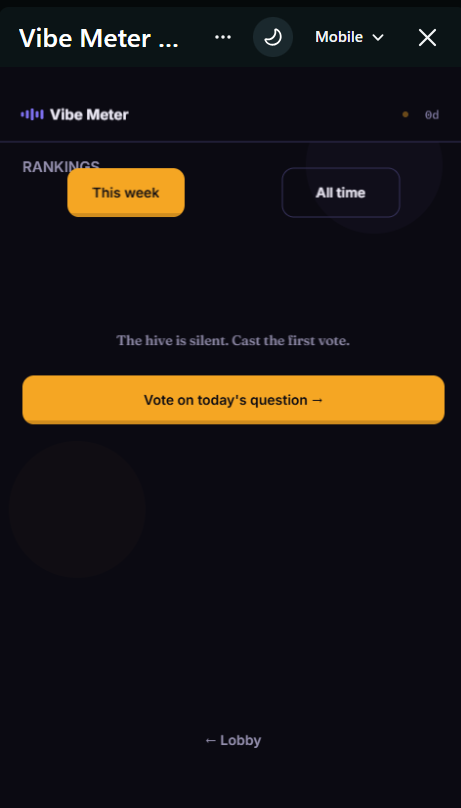
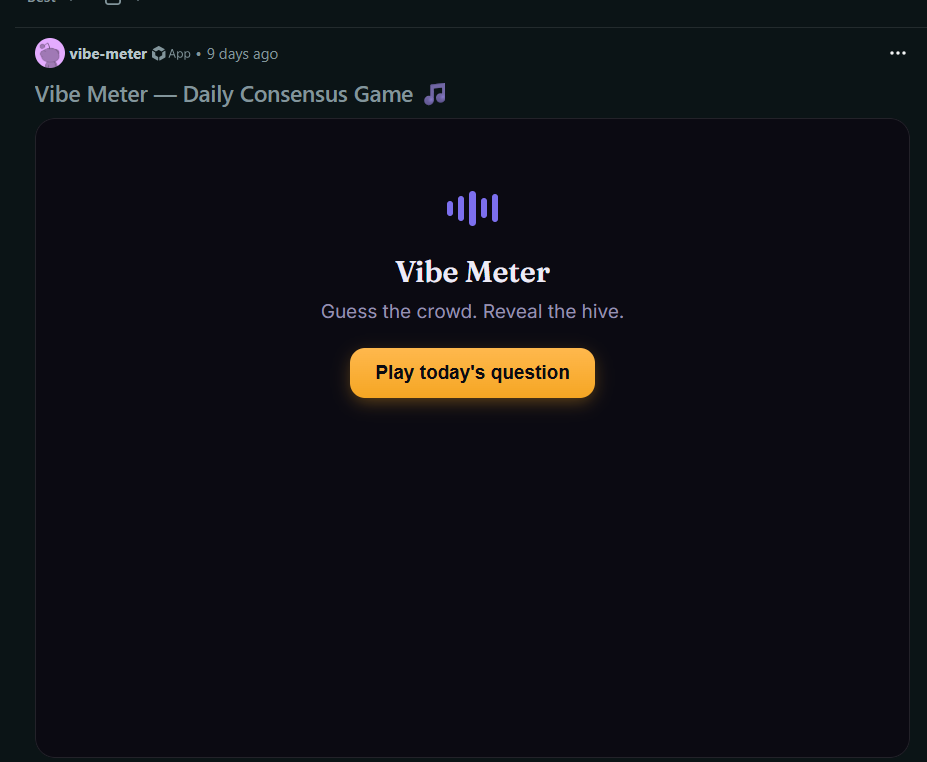
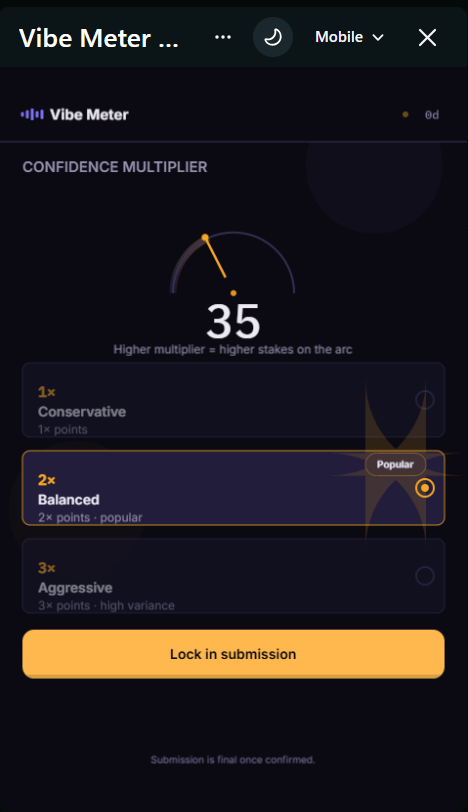
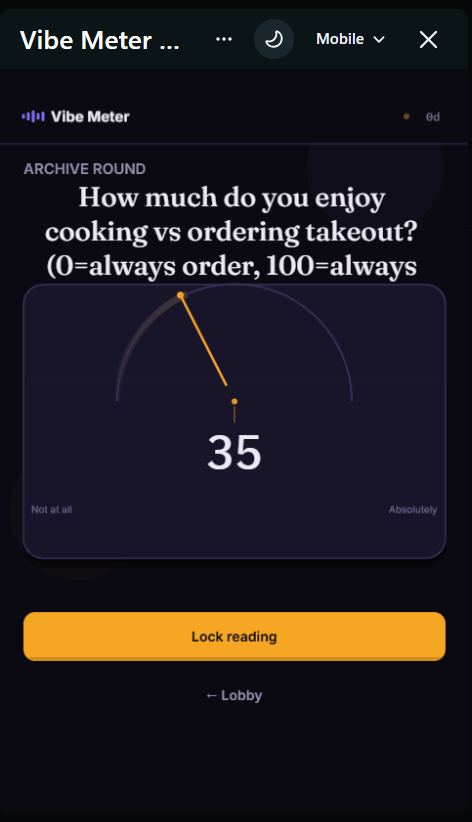
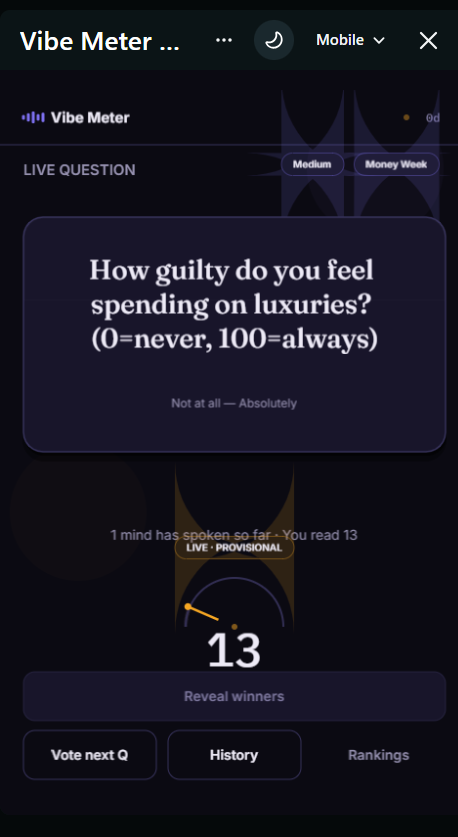
Vibe Meter is a daily consensus game built as a Reddit custom post. Each round, players drag a needle on a gauge to place their guess on a question (e.g. "How much should you tip at restaurants?"), lock it in, and see how closely they matched the community.
- Live signal: as soon as you vote, you see a provisional live match percentage against everyone who's voted so far — the crowd number isn't static, it's alive.
- Final reveal: when a question closes, a full reveal plays showing the locked crowd average, your match verdict ("In the Hive" / "Close Call" / "Against the Hive"), and your score.
- Community-driven question queue: new questions rotate on a set cycle, and community members can propose the next question in the comments — if a proposed question gets enough votes, it jumps the queue and becomes the next live question. The game's content pipeline is literally powered by Reddit's own voting mechanism.
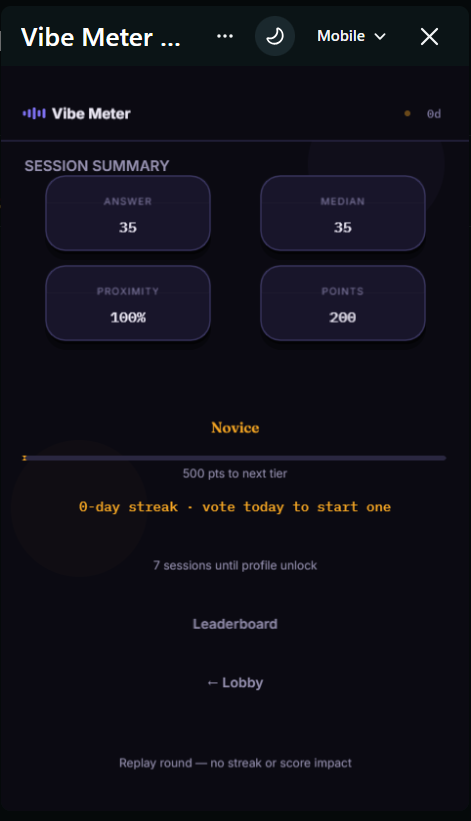
- Streaks, confidence bets, and a personality profile: players can raise the stakes on a guess with a confidence multiplier, build a daily streak, and over time build a personality profile showing how their instincts compare to the hive (e.g. more optimistic/pessimistic than average on certain topics) — designed to be a shareable, evolving reason to keep coming back.
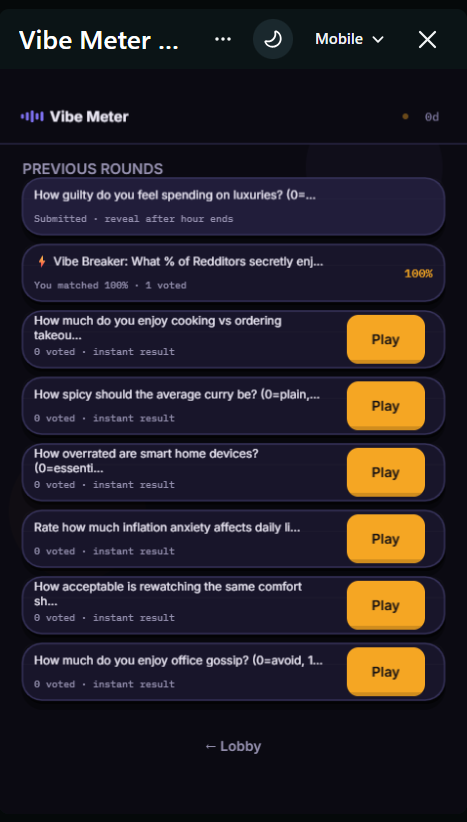
- Replay: past questions stay playable any time, with the full reveal shown instantly since that data is already locked — so no one is ever locked out of the experience by timing.
How we built it
Built on Reddit's Devvit platform as a custom post type, with Redis for persistence (votes, scores, streaks, question queue state) and Phaser powering the interactive gauge/reveal canvas. [Confirm/adjust: exact Phaser scene structure, any other libraries, frontend framework if used alongside Devvit blocks.]
Challenges we ran into
Getting the Devvit webview lifecycle right was the trickiest part — specifically the handoff between the static post preview and the live interactive webview, and making sure the postMessage handshake between the Devvit block and the webview was reliable. We also iterated a lot on the reveal experience itself: an instant reveal felt flat, but a single long delayed reveal risked losing players entirely, so we landed on a two-stage model — live provisional feedback immediately, with the full ceremonial reveal on a shorter, predictable cycle.
Accomplishments that we're proud of
Making the question queue genuinely community-driven — letting subreddit comment votes decide what the app asks next — rather than just hosting a generic guessing game on Reddit. That felt like the right way to actually use what makes Reddit different from any other platform.
What we learned
[Your call — e.g. lessons about Devvit's execution model, Redis data modeling for real-time aggregation, or UI/animation design for suspense-driven reveals.]
What's next
Expanding the comment-vote question pipeline with better moderation/spam guards, more difficulty tiers, and deeper personality-profile insights as more rounds of data accumulate per user.

Log in or sign up for Devpost to join the conversation.