-
-
Circle Take — a self-correcting production loop for AI-generated episodes. Bad takes don't make the cut. Built on Qwen Cloud.
-
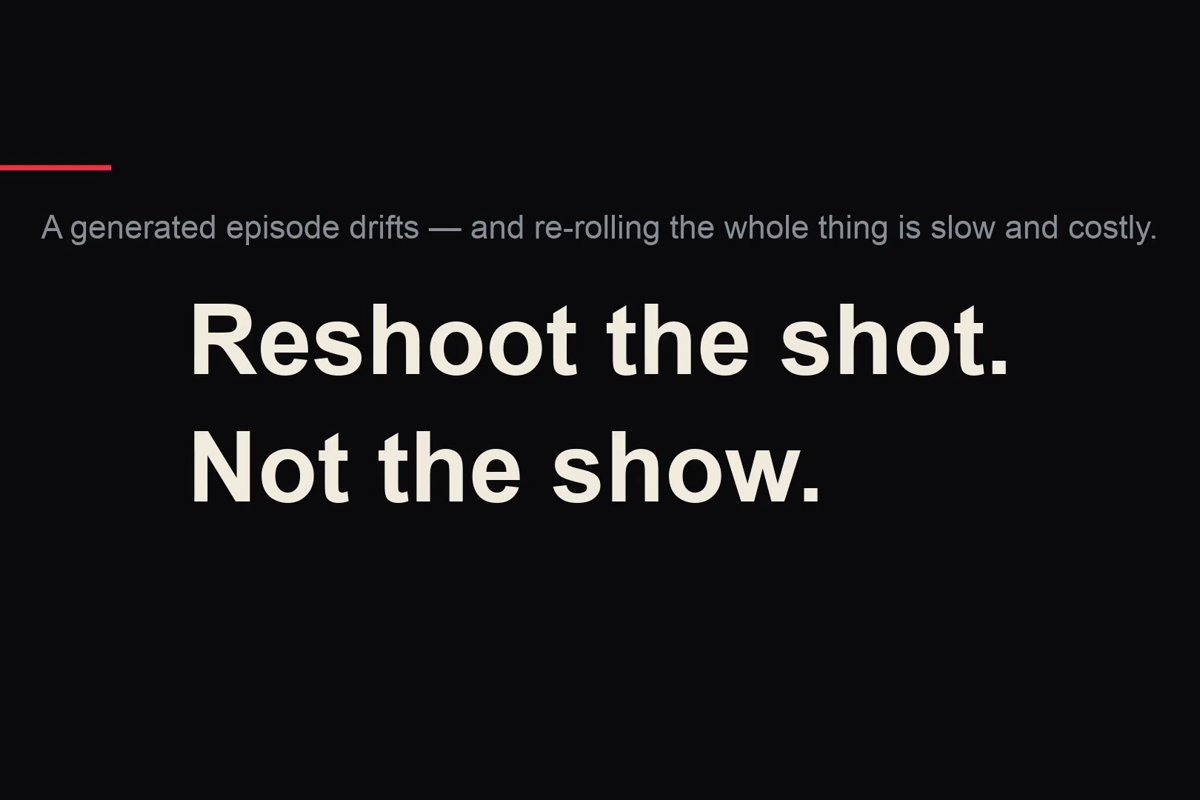
The core idea: when a generated episode drifts, reshoot only the broken shot — not the whole show.
-
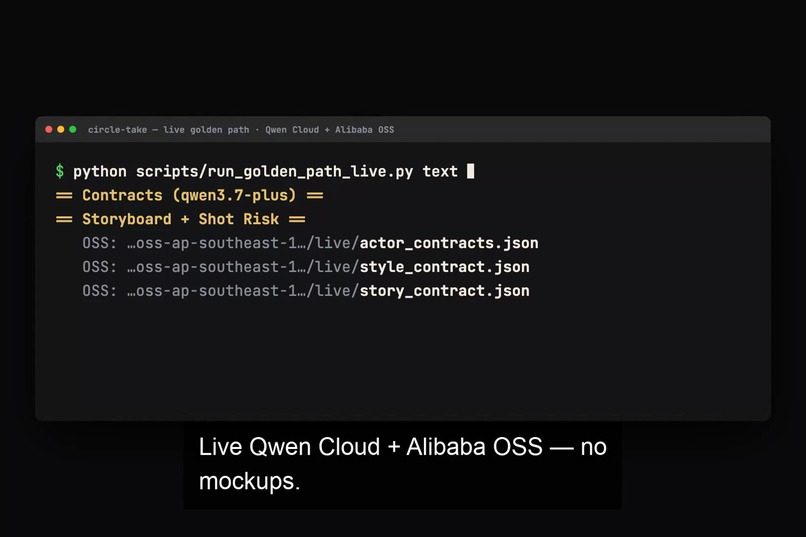
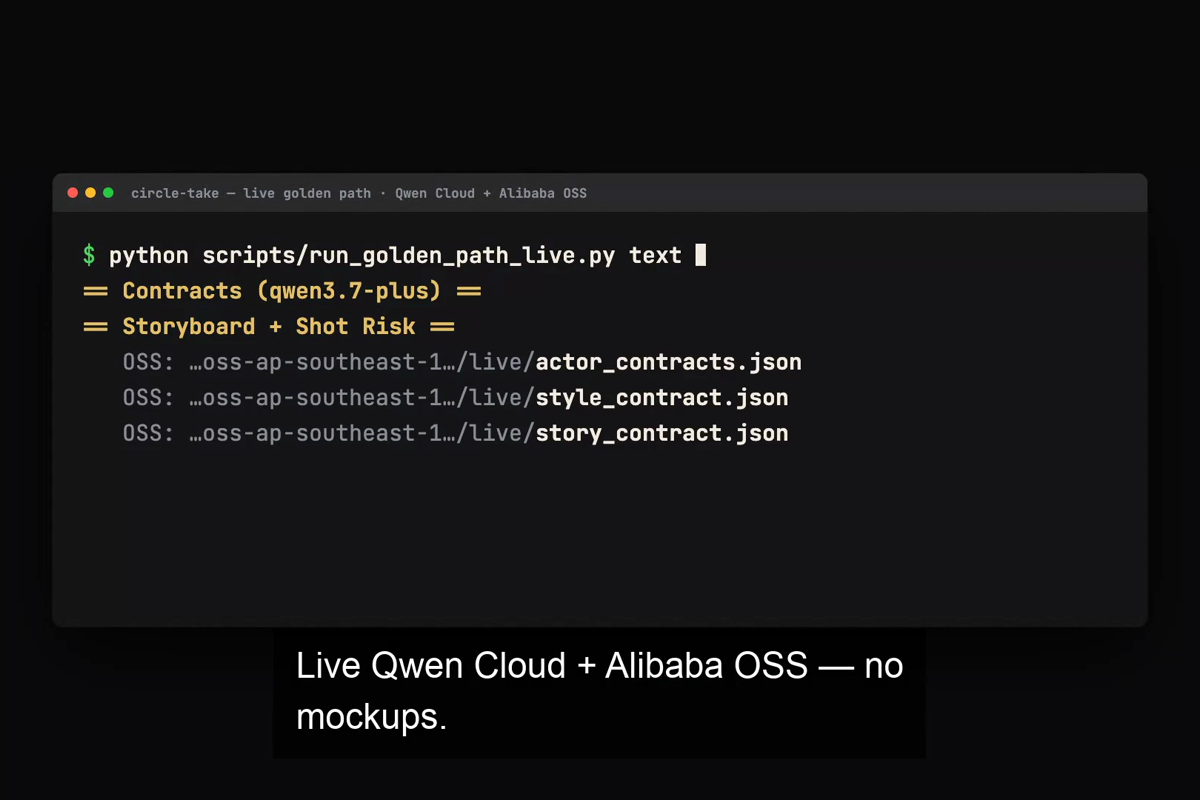
Not staged: the live run makes real qwen3.7-plus calls and uploads artifacts to Alibaba Cloud OSS — no mockups.
-
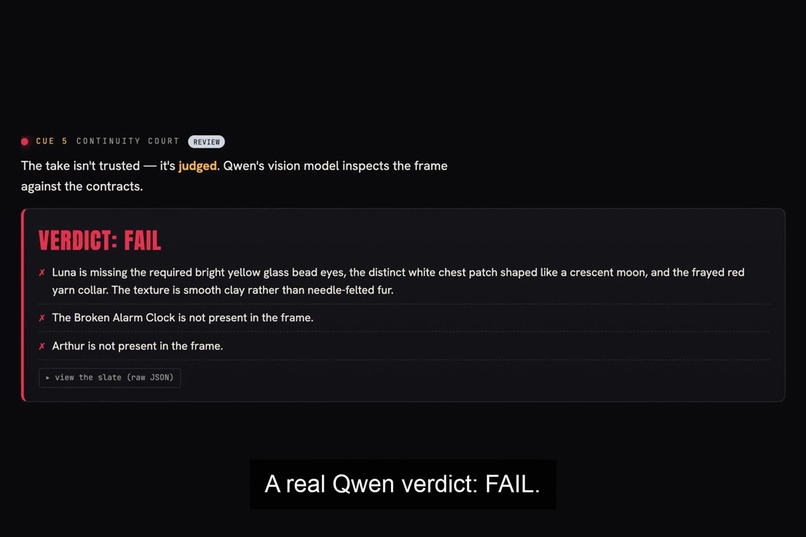
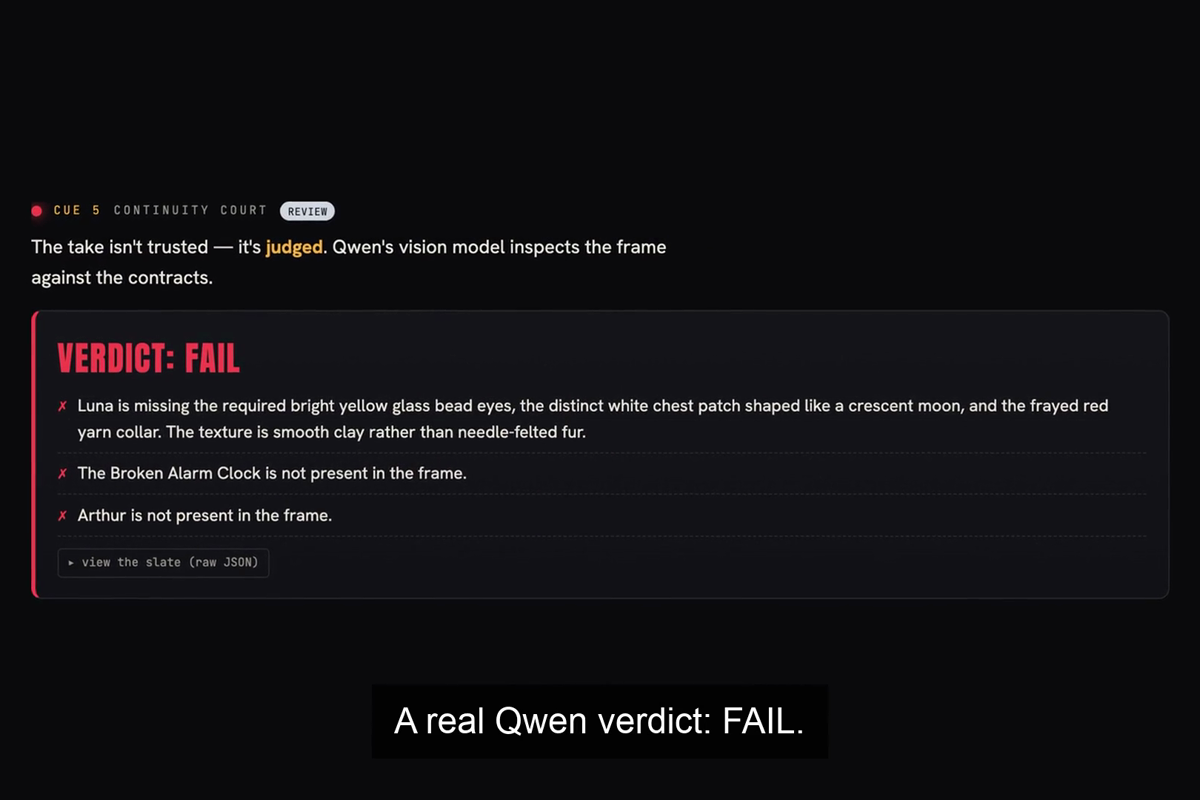
Continuity Court: a real Qwen-vision call returns VERDICT: FAIL with the exact marker violations. Only Shot 2 goes back.
-
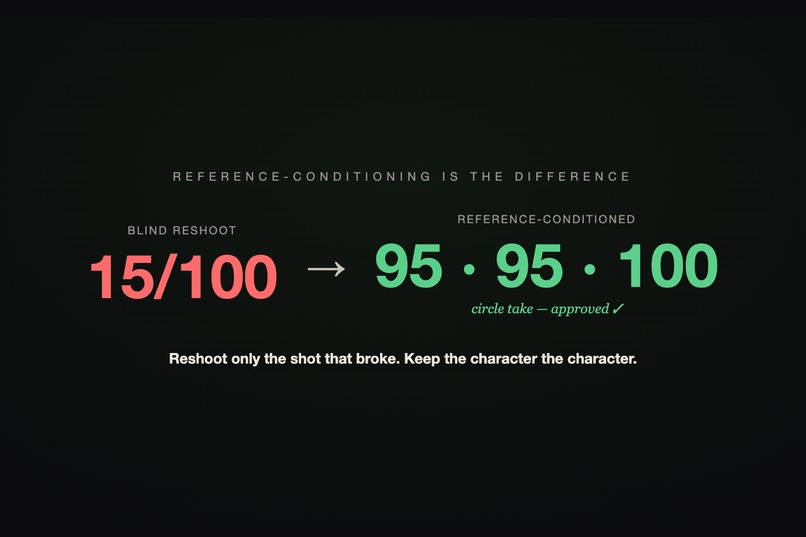
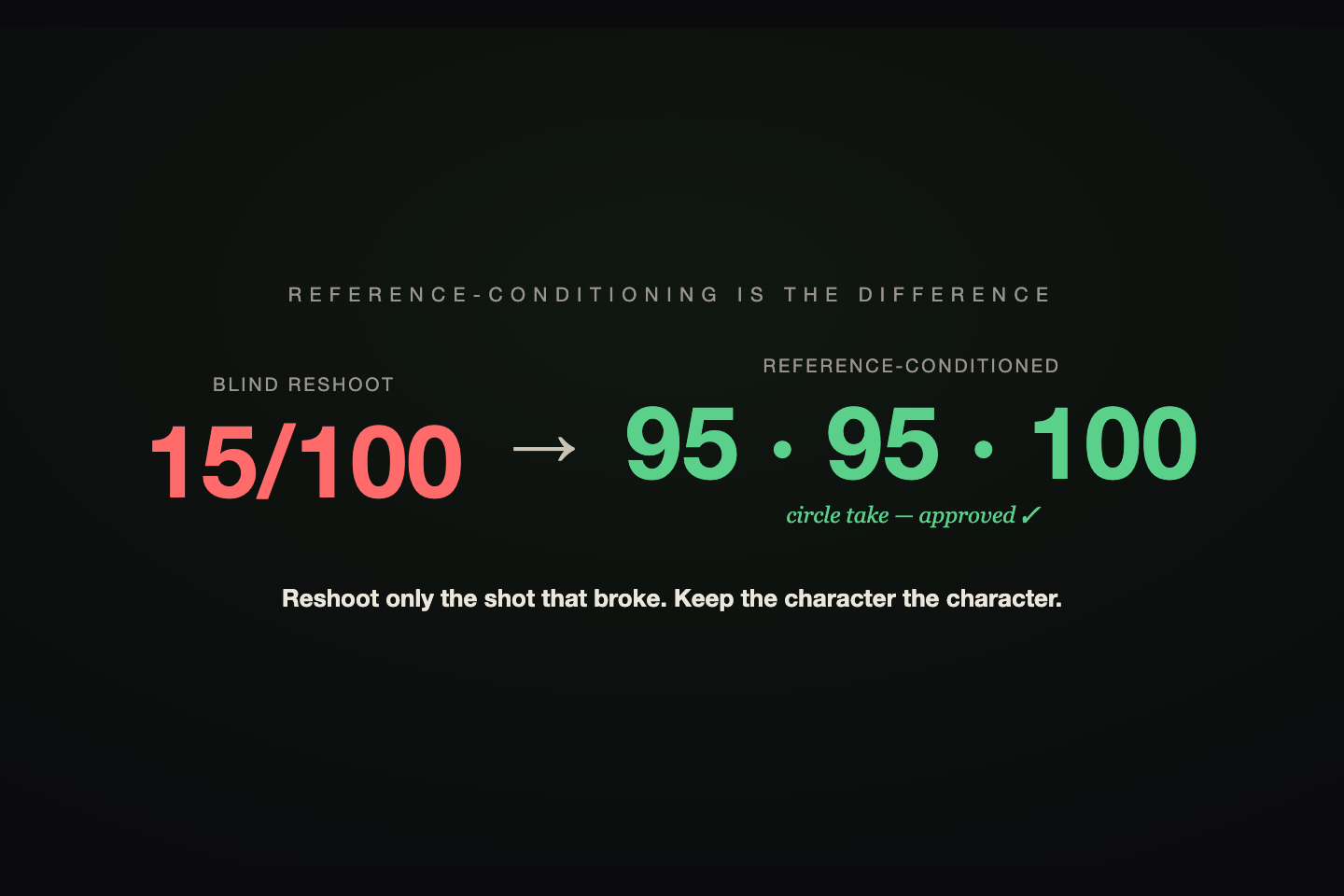
BLIND 15/100 → REFERENCE-CONDITIONED 95·95·100 · approved ✓
Inspiration
Most AI video tools can generate a clip. Creators need repeatable episodes — where characters, props, style, and unresolved threads survive across shots and across episodes. Circle Take is named after the film-set "circle take": only approved takes make the production record. Bad takes don't make the cut.
What it does
Circle Take is a self-correcting production loop for AI-generated episodes. From a short drama brief it builds Actor / Style / Story Contracts, a storyboard with a Shot Risk Ledger, generates shots with Wan, then judges every take with Qwen vision against the contracts. When continuity breaks, it reshoots only the failed shot — and the Anchor Gate refuses to greenlight a take it can't verify, even its own reshoot. Only approved anchors become Red-Thread Memory for the next episode.
The one-line idea: reshoot the shot, not the show.
How we built it
An agentic pipeline on Qwen Cloud:
- Scripty turns the brief into Actor / Style / Story Contracts (Qwen structured output).
- A Storyboard Slate + Shot Risk Ledger score identity risk before a frame exists.
- A Route Selector picks T2V / R2V / I2V / VideoEdit per shot.
- Wan 2.7 generates the shots.
- Continuity Court — real Qwen-vision returns a structured
VERDICTJSON. - Reshoot Spell writes a delta-only repair for the failed shot.
- Anchor Gate approves or quarantines the corrected take.
- Red-Thread Memory stores story facts + approved visual anchors.
Backend: FastAPI · Python 3.12 · Pydantic v2 · SQLite · Docker. Artifacts upload to Alibaba Cloud OSS. The demo's narration is itself generated by Qwen3-TTS.
What makes it different
It's not another generator — it's a memory + correction layer around generation. In the demo's live run, Luna loses her identity markers and Qwen returns VERDICT: FAIL. A blind text-only reshoot scores identity 15/100 → QUARANTINE — the gate refuses to ship what it can't verify. The reference-conditioned reshoot, locked onto an identity keyframe, then scores 95 · 95 · 100 → approved, and only that approved take becomes Red-Thread Memory. The gate ships only what it can verify, so memory stays clean.
Challenges we ran into
- Character identity drifts across shots, especially when a prop occludes the actor.
- Prompt repetition isn't enough → Actor Contracts, Reference Packs, and Anchor-Gated Memory.
- Targeted repair can fail → the path falls back VideoEdit → R2V → shot rewrite.
- Explaining the whole loop in under 3 minutes → one honest golden path.
Accomplishments that we're proud of
- A memorable CUT ritual in the first 30 seconds.
- Continuity turned into a judgeable artifact: verdict JSON, delta repair, before/after, appr
- An honest, strict Anchor Gate — it quarantines what it can't verify (blind 15/100) and greenlights only what it can (95 · 95 · 100).
- A reproducible demo pipeline + objective QC (loudness / duration / black-frame).
What we learned
Generated-video workflows need production supervision, not just better prompts. A useful showrunner must remember what should persist, detect when it breaks, and decide what's approved for the next episode.
What's next
- More Style Contracts beyond the Clay Stop-Motion MVP.
- Reference Pack authoring + approval tools.
- Shot-level repair routing + cost controls.
- Red-Thread Memory across many generated episodes.


Log in or sign up for Devpost to join the conversation.