-
-
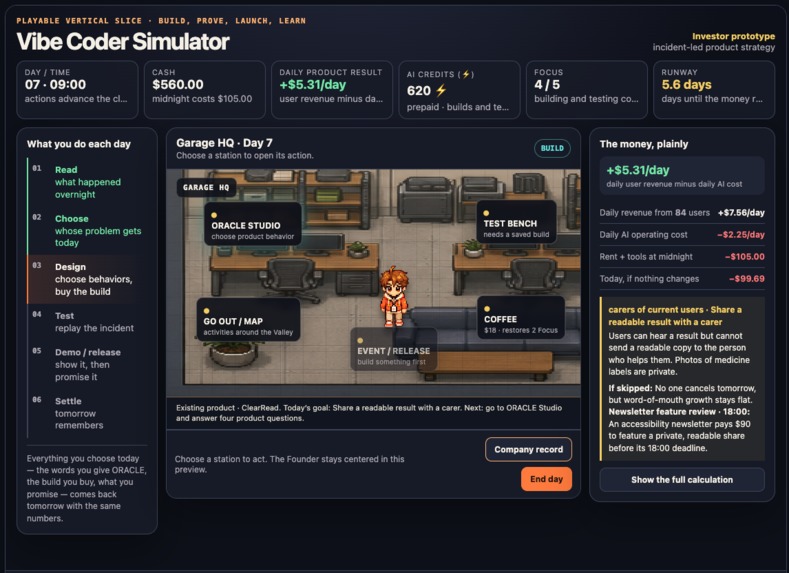
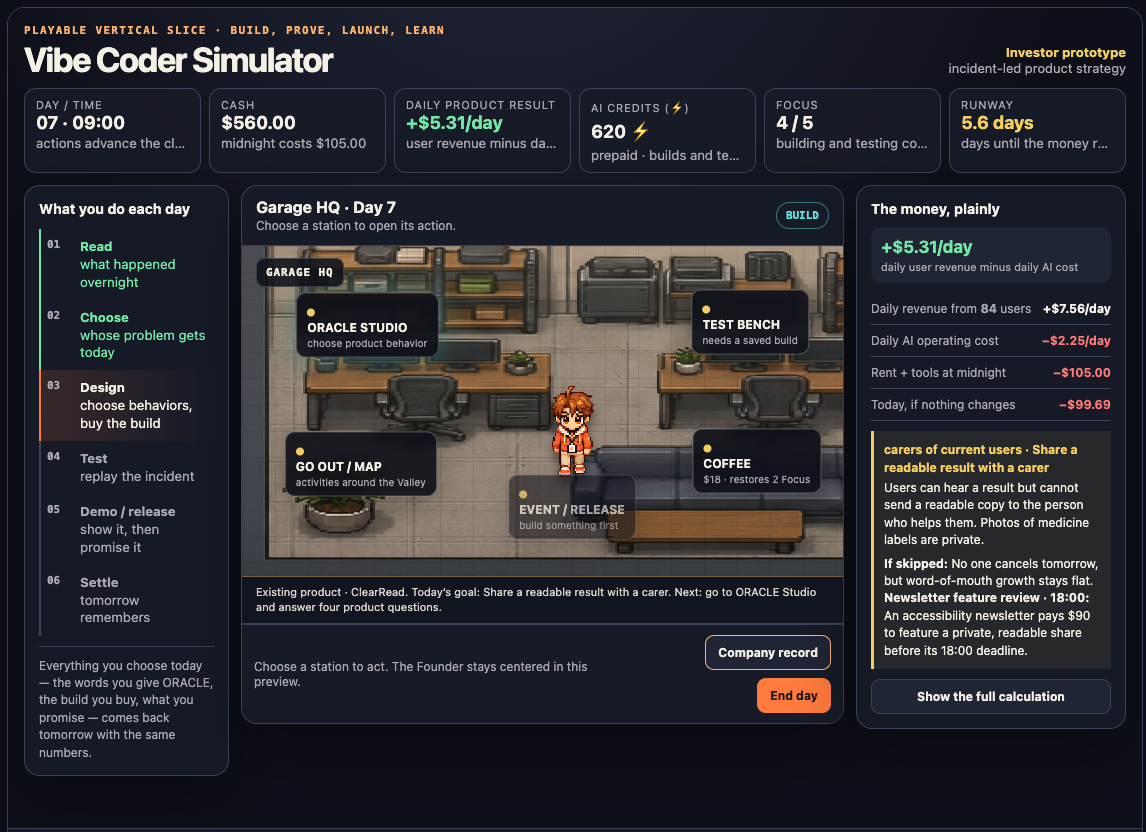
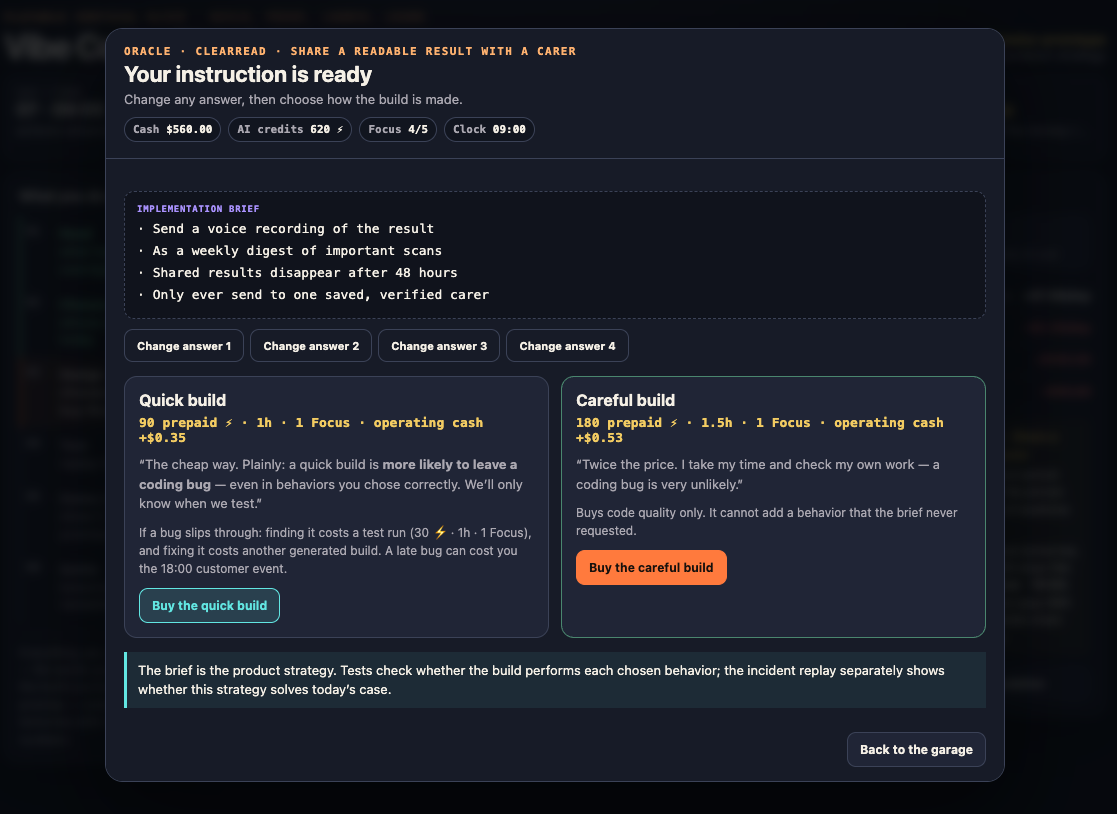
Vibe Code Simulator’s playable Day 7 loop combines time, cash, AI credits, product choices, and persistent consequences.
-
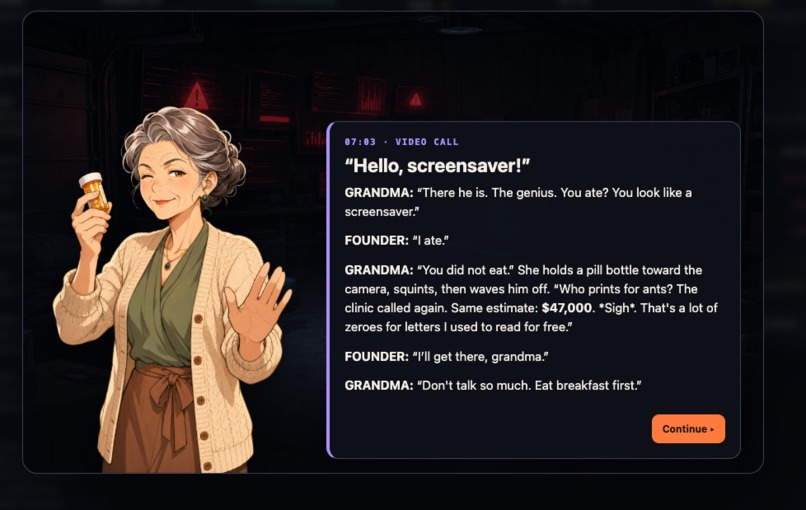
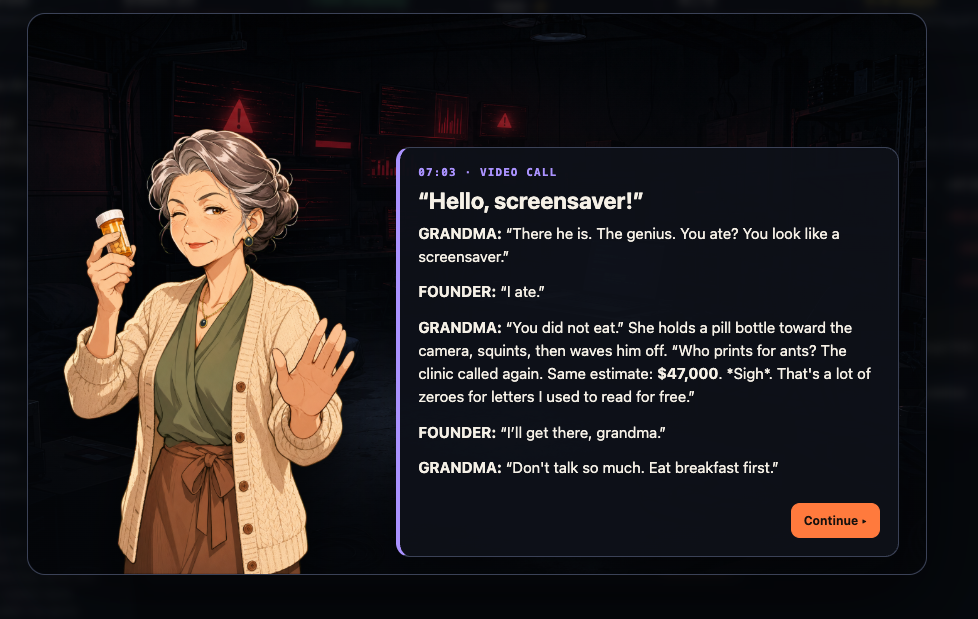
Grandma’s $47,000 sight-restoring operation gives the simulation a human goal—and creates the continuity question that must be solved.
-
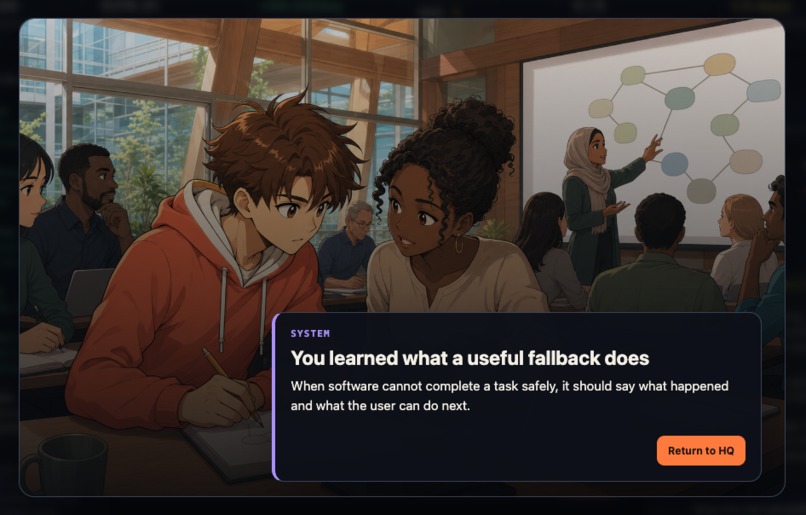
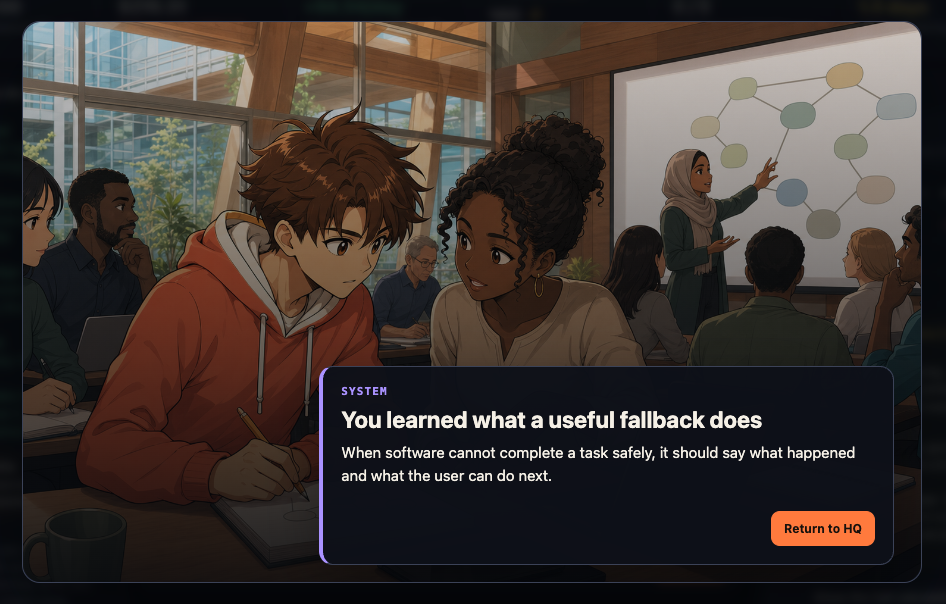
Learning about responsible engineering practices in the world of AI is a major focus in the game.
-
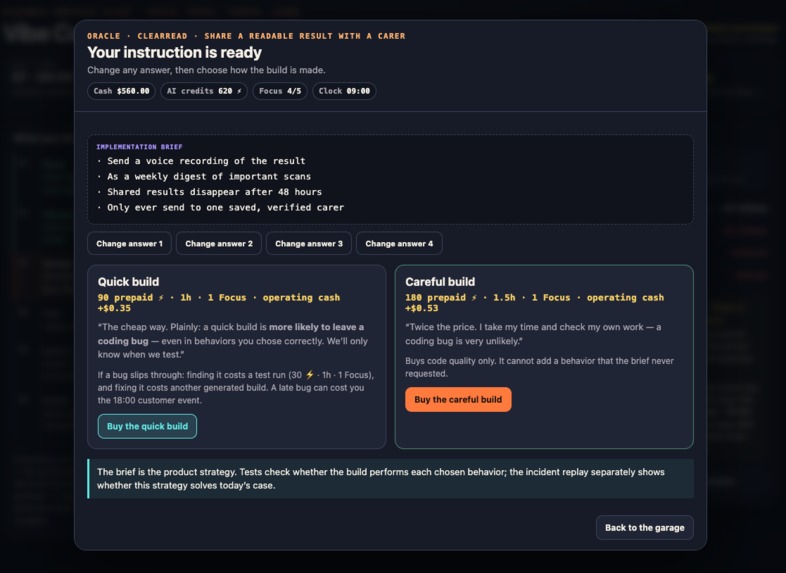
Creating software is a part of the experience of Vibe Code Simulator.
-
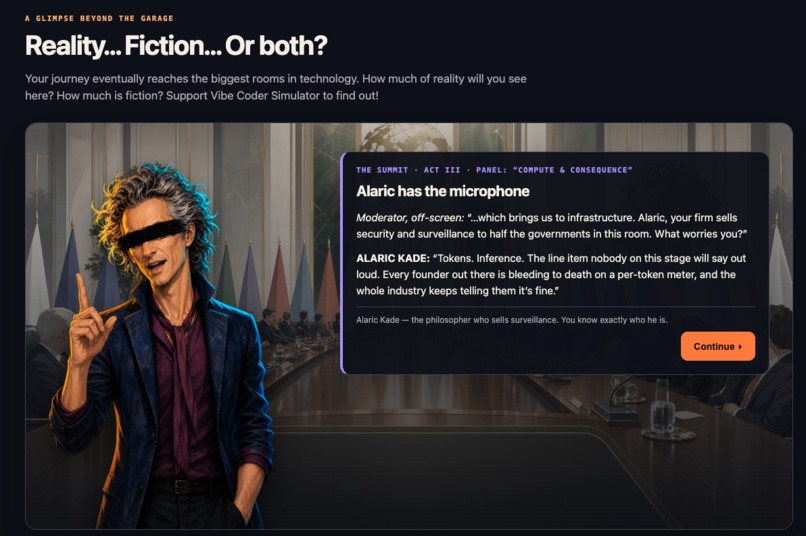
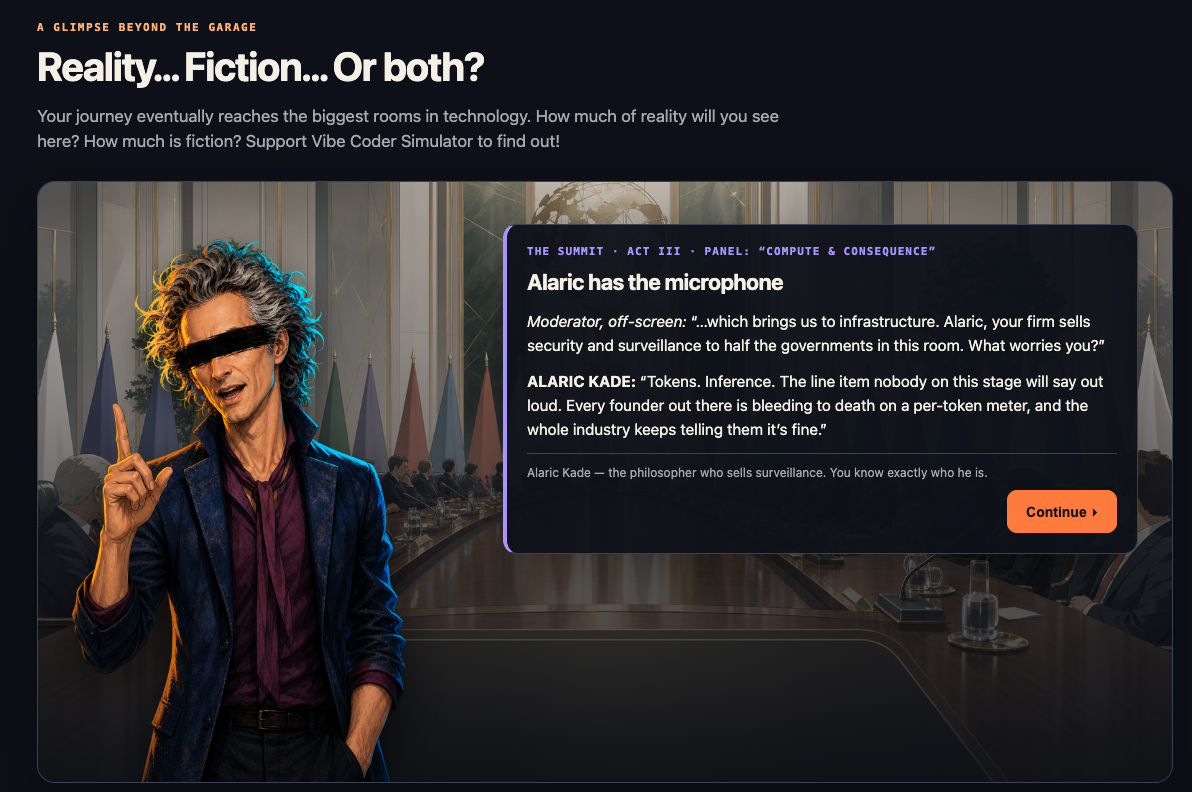
Familiar faces in technology appear as part of this game... Or is it reality?
-
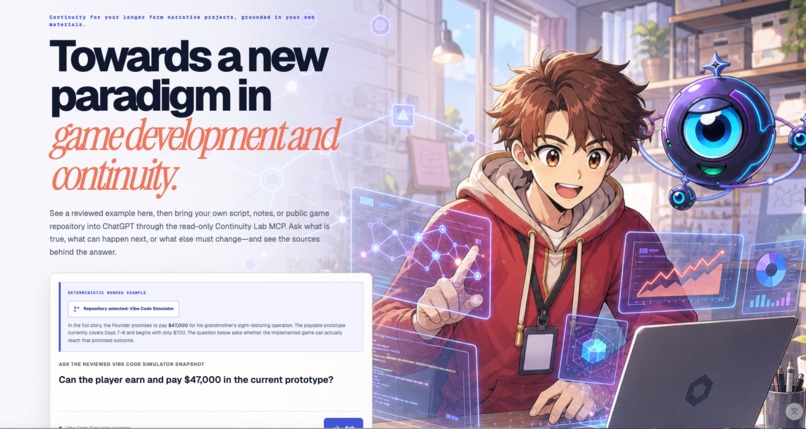
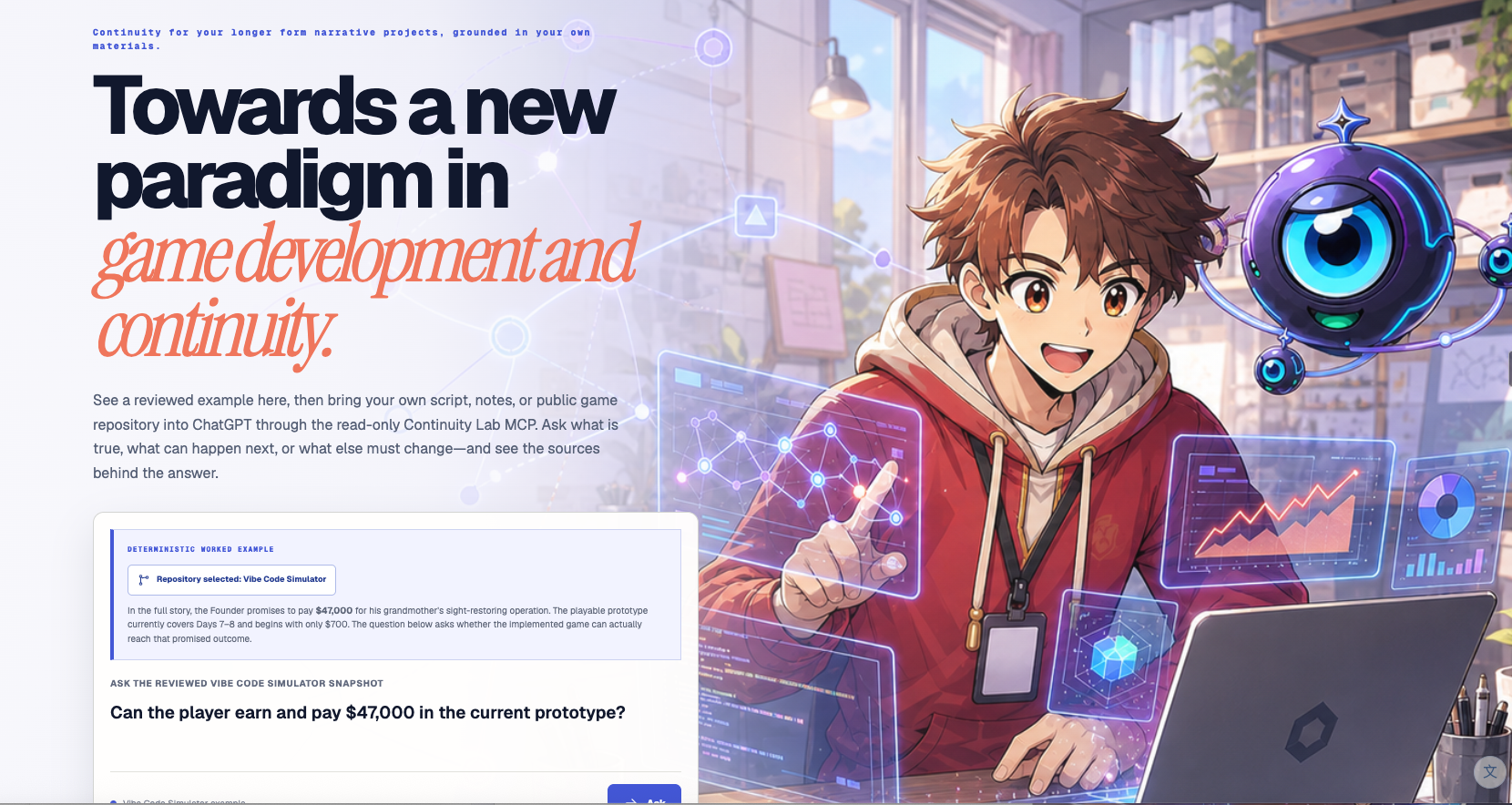
The grounding layer for narrative development: bring project material, ask what is true or reachable, and inspect the evidence.
-
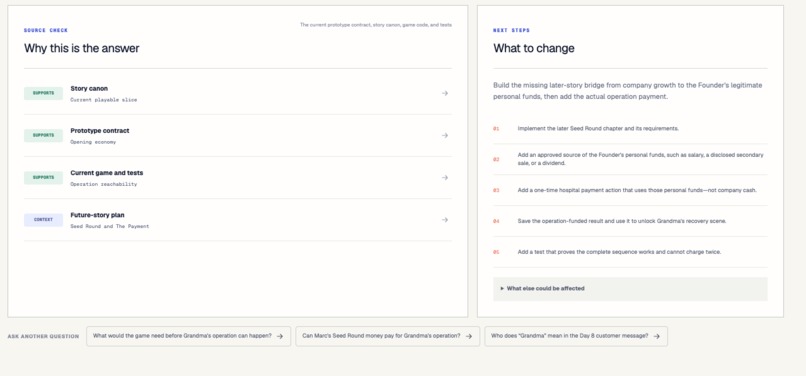
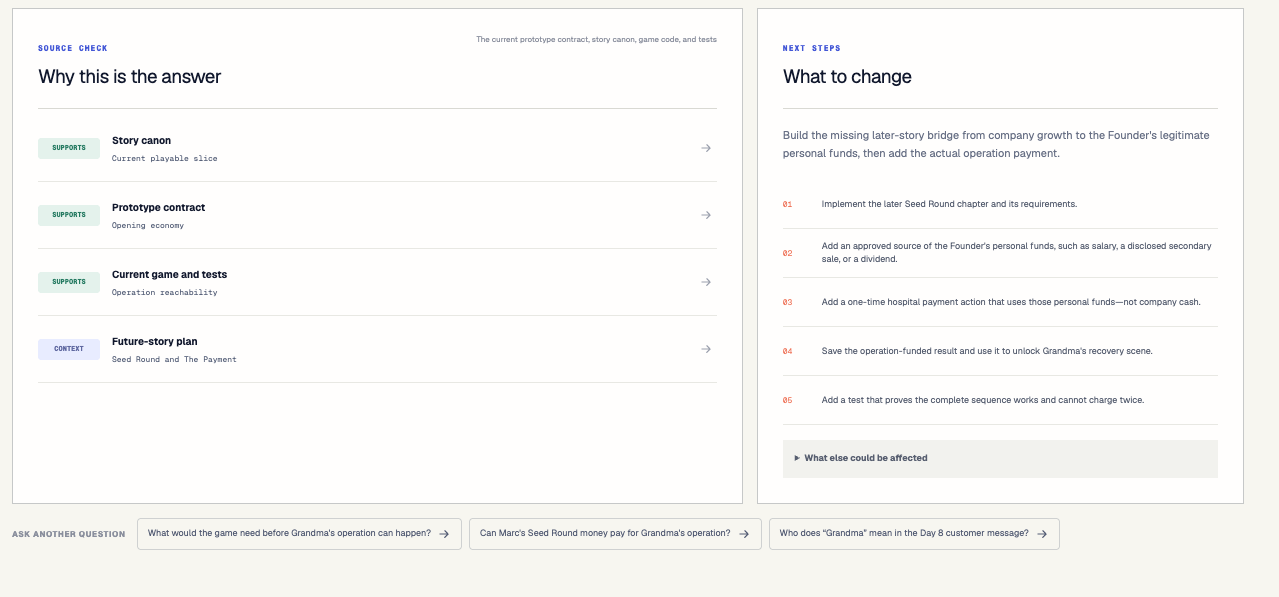
Continuity Lab’s source-check and next-steps panels, showing four supporting source groups and five concrete implementation tasks.
-
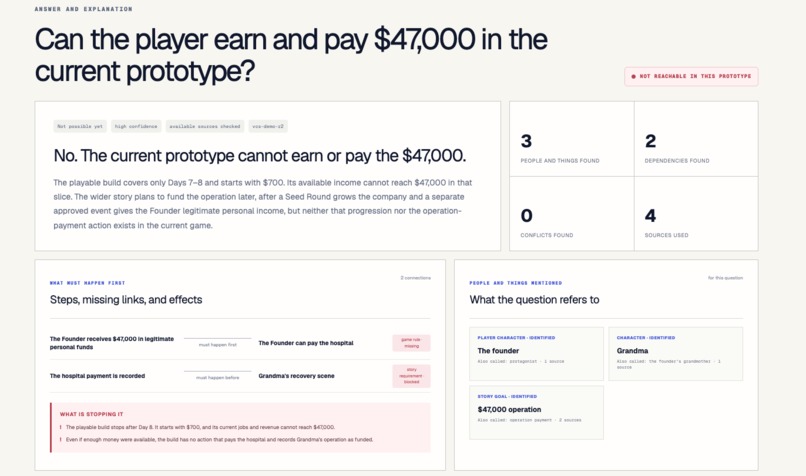
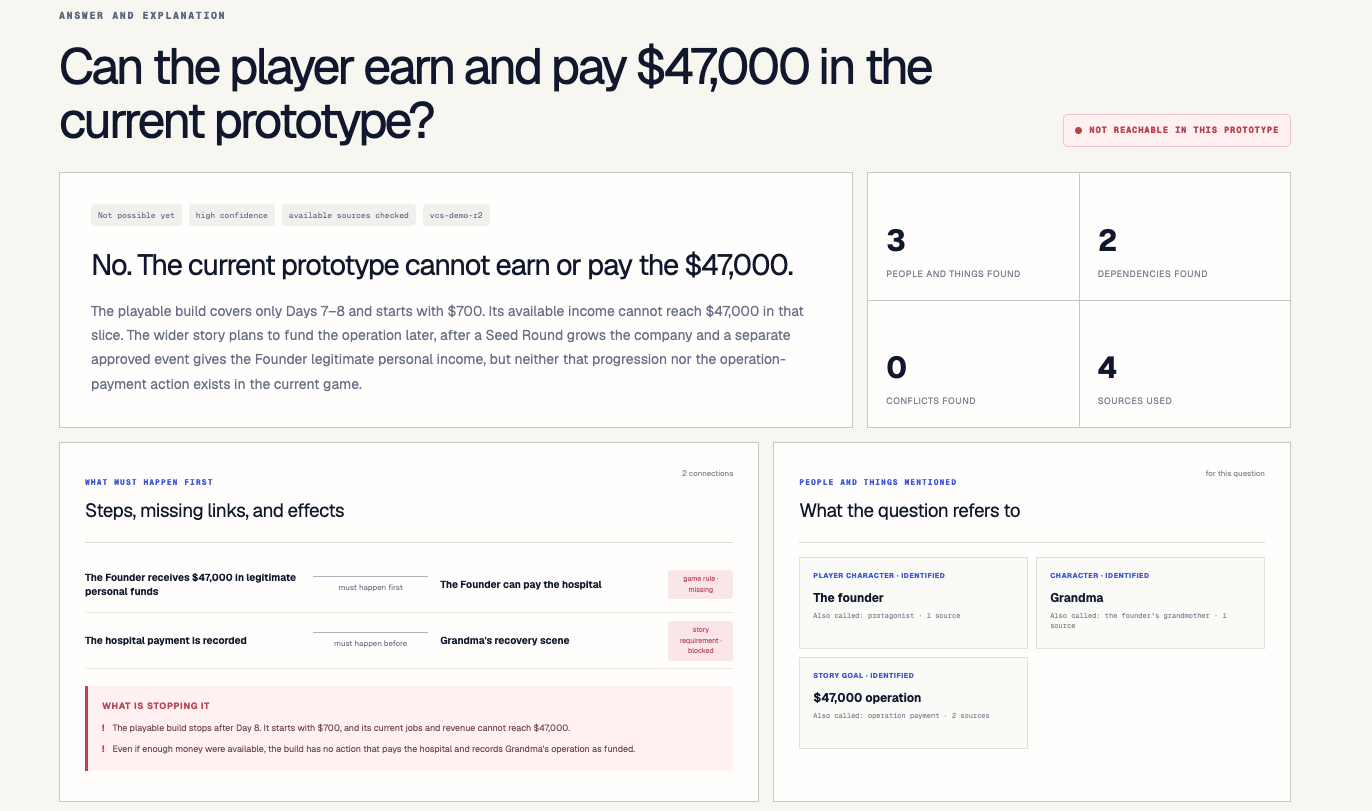
A Continuity Lab result stating that the current prototype cannot earn or pay $47,000, alongside identified entities, cited source counts
-
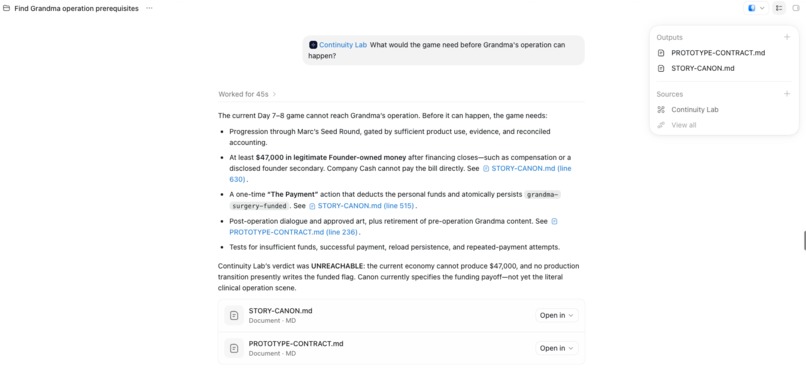
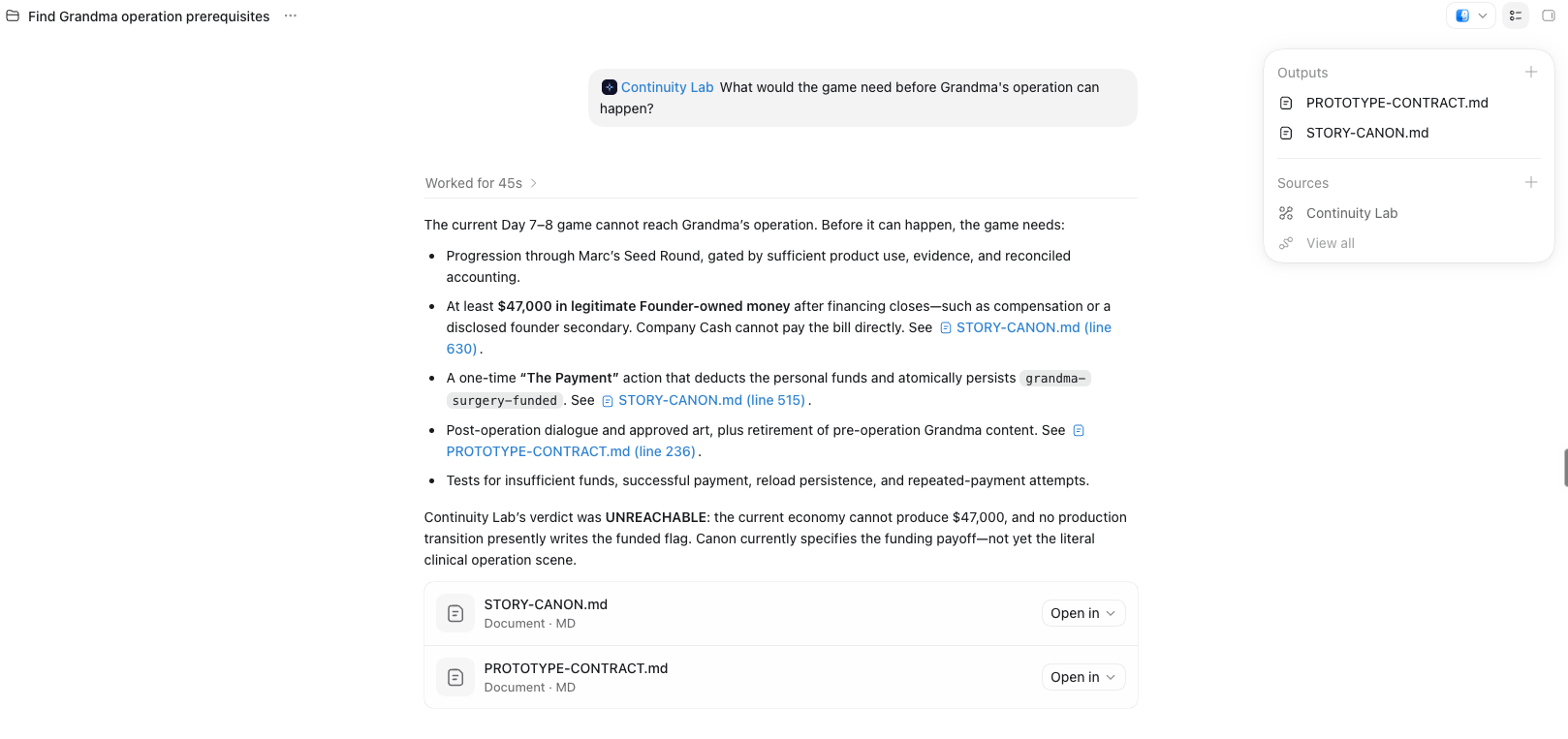
A ChatGPT conversation using Continuity Lab to ask what must happen before Grandma’s operation, with a cited answer.
Inspiration
It has always been a dream of mine to create a game that many people would play, and a story that would mean something deep and abiding to others in the social moment.
Vibe Code Simulator is my attempt to follow that dream; it is my response to a world that seems to have gone ballistic over generative AI and its capabilities. This game is my attempt to link together all the fascinating news, the stories I read and learn about, and my love for RPGs that began so long ago with my attempt to learn how to code, to create something I was never able to create before... With vibe coding.
Continuity Lab? Now, that's a different story.
It is the fruit of realizing that developing a valuable software project of the scale of a story and a production is not an individual endeavor; it is the fruit of trying and failing at vibe coding (more on this later), my experiences of failure, technical debt, and wastage across not just this project but also many other projects, experiences that have simultaneously informed me but also motivated me to negotiate what is possible within that constraint.
After trying to initially code Vibe Code Simulator for a few days, I quickly realized that developing an entire architecture and then extending it into a thousand-day sequence was likely to be difficult; it was in the midst of all of this that I learned about Build Week and therefore aspired to explore the boundary of what autonomous development makes possible, to learn as much as I can about vibe coding and to progress in the direction of autonomously creating something that I currently cannot imagine creating on my own, even as I try to make it easier both for myself and for others who aspire to goals shaped like mine as well.
What it does
Vibe Code Simulator is a story about a young man who wants to build a successful company for the sake of healing his grandmother, who is slowly going blind. It teaches people about best practices in vibe coding, and it brings the world a story about this strange phenomenon at a unique moment in our history where producing code is not the issue, but deciding what is valuable to produce and how to share it with others is. It has a system that emulates the economy, a simulation of the passage of time, and a variety of gaming systems that emulate both product design and the loop of Masukachi Studio games that also serves as a commentary on modern technology and society.
Continuity Lab is a system designed to keep all of the content consistent as it grows. It treats the game’s canon, scripts, structured data, code, assets, and tests as connected evidence, allowing the team, whether composed of humans or possibly agents, to ask ordinary questions—Who is Grandma? Can the player actually fund her operation? Does a map event contradict an established character or timeline?—and receive answers with citations, explicit uncertainty, dependency chains, and reachability checks.
It does not decide canon on the team’s behalf. Instead, it distinguishes what has been approved, proposed, implemented, contradicted, or merely implied, then shows which downstream scenes, systems, assets, and tests would be affected by a change. Vibe Code Simulator is therefore both its first major subject and a demonstration of the same idea: when generative technology makes producing more things easy, the difficult and valuable work becomes preserving meaning, intent, continuity, and accountability across everything that gets made.
How I built it
Vibe Code Simulator's preview was initially the result of very bad prompting that improved over time mashed up between Claude and ChatGPT.
I initially was generating images one by one, but then realized that the game I wanted would require a lot more art, so I started generating art. At this time, I had no concept of what art would actually be needed, so I just randomly started generating art that worked well together, some of which is still in use today. Eventually, I hobbled together a user interface with hard-coded values throughout the ecosystem, using prompts like “Build me a game called Vibe Code Simulator" before eventually learning about technical debt, scoping, and recalling the computer science classes I had taken in university (I had no idea that they would be so relevant until now that I was actually building something I was interested in!).
As time progressed, I learned about the value of repeatable and modular structures in JSON. I progressively developed the capacity to ask for intelligent refactorings, usage of data tables, and a large number of other things. That would not have been possible without repeated failures, iterations, feedback from ChatGPT, and a constant drive to look for solutions.
Clearly, what we have built is not where it should be yet. It is doubtful that it can expand into a full-fledged product without investment of resources or greater thought into architecture and the productivity gains that technology can provide.
This is where Continuity Lab comes in.
Continuity Lab came about because I realized that creating narrative events at scale would be difficult (although possible, may be with JSON and the correct repeating architecture and functions to trigger certain key events, perhaps?), and also, because of a random chat I had in a Malaysian Mensa AI hobbyist group, somebody joked that it would be possible to use AI to create manhua - a project that I have pursued with the project "Slap The Heavens". This was a project that I attempted in the midst of Build Week and am currently pursuing.
It has not succeeded yet either, but it has revealed important context that is shared with Vibe Code Simulator:
Continuity is extremely important in establishing causality for events, and if continuity is not observed, then things will quickly fail to make sense and fall apart.
In a manhwa context, continuity can be very easily violated by AI-generated models and art. Image-prompted art can end up materially different from canon and therefore cause viewers to end up in an uncanny valley - physics and hand positions can be very easily violated by misplaced images. If attention is not paid to what characters are motivated by, or otherwise, then generation passes can be extremely expensive, particularly when a large number of assets is being produced - if there is no system to coordinate and validate production autonomously while simultaneously adjusting to what AI models are capable of, then, quantity need not guarantee quality because it is possible to generate beautiful content that ultimately does not make sense and then have to sustain the cost of redoing.
This was a realization that I attempted to address through a Byzantine system of image production and validator gates across a wide variety of structures; I could go on in a separate pass, although I won't be submitting this for Build Week, though I will be including an example of what I did produce during that project and what I will be producing ahead.
In a game context, particularly in the case of Vibe Code Simulator, the immediate pressure for beat-to-beat continuity is not so extensive, but it is still there. To an extent, this can be averted by retconning, inventing new scenarios, and creating explanations out of nowhere, but there is a level of coherence that needs to remain in the project. Moreover, the challenge that I observed of simulating hundreds of days remains as I realized the inherent difficulty of passing through corpuses and repositories of increasing scale, as measured by the increasing time it took to pass through my own repositories as their size and complexity grew, and the need to operationalize how to navigate them more efficiently.
It is for this reason and in consideration of OpenAI's excellent post about Harness engineering and autonomous development that Continuity Lab came about, that routing was an interesting architecture, I realized that it could be utilized to maintain state truth by providing external intelligence that could potentially help increase the efficiency of creating large-scale projects and minimizing drift over time, in navigating the constraint of finite compute and model intelligence over the desire to create things far greater than the sum of our parts.
Challenges we ran into
Developing the correct art scenarios and writing has definitely not been easy in the course of Build Week, but neither has been dealing with bloat or the habits required for good code production to distinguish what is good from what is merely possible in this hectic whirlwind of learning and development, which I have attempted to make the very best of.
In dealing with this and trying to distinguish myself, I have found myself becoming more discerning and thus developing the mindset of an experimenter who is aware (or at least has a belief) that we live in what Henry Kissinger might have called a Newtonian universe (though that Edward Said may have laughed at him for), where some outcomes can be regarded as superior to others and discerning taste cannot, at least per my standards, be something sacrificed in the name of the mundane, to realize that not every change improves architecture, and that sometimes bloat needs to be removed. To be able to discern how to create systems that allow for that to happen while at the same time ensuring that what is useful is not prematurely retired.
Further, causality is not an easy thing to establish, and often times human beings are not especially good at it; machines and AI models with vast amounts of compute can be trained to be better, but from my experience with our Frontier models, they are far from perfect at it - but this does also bring me to another important point.
I am a non-technical founder, and learning about how things connect and link up with one another has been a learning curve. It has been a challenge of not knowing what I did not know, and then dealing with the consequences of that: extended run times, wastage of resources, and the realization that many of the things that I seek after are things that are yet unsolved.
Lastly, perfectionism is a challenge that I have run into a lot and am running into even today as I assemble this part of the documentation. Vibe coding with frontier technology makes it possible to do things that we might evaluate as subjectively incredible, but in a world where our marginal benefit from what is incredible is far higher than the marginal cost (it's just another prompt!), It is easy to want to go on perpetually and to keep asking AI to make things better without taking a moment to pause, scope, and record what you have actually created.
Accomplishments that we're proud of
- I am proud of thinking objectively about the limits of technology rather than getting completely blown over by what new models are able to provide. I am happy and proud of being able to stand on the frontier of that technology, or at least the feeling of doing so. Even as I acknowledge that I may not be at the vanguard, I am using a tool that no previous civilization had access to, and I at least feel like I am getting the most out of it.
- I am proud of developing new and agentic workflows while thinking much more objectively about the extent to which I need to be present in the flow.
- I am proud of trying to design and test the limits of technology.
- Though it has been brief, I am proud of trying to design an implementation with an idea from my own mind and then bringing it forward into something tangible: an artifact into which I poured my time, now accessible as a game and an MCP server that represent the fruit of my crystallized and human effort, pursued as a dream on my part that I did not give up on but instead endeavoured to bring into reality.
What we learned
- I am proud of learning about agentic coding and of becoming a much better vibe coder than I was before. One cannot create a simulation unless they actually experience it, and building Vibe Code Simulator is like building a flywheel within a flywheel.
- I am proud of creating a playable game loop. It may never become a game unless I gain abilities that I did not have before or partnerships and friends that I did not have before, but I take satisfaction in that.
- I am proud of learning to think in systems, to start asking how machines communicate with one another, and to begin to learn how to coordinate them in order to accomplish better results at a large scale. Even as that native capacity accelerates, it has unveiled to me how to coordinate and manage people as well, which I consider an important skill that is the function of communication planning and coordination, all of which I feel I have learned extensively during this Build Week.
What's next for Vibe Code Simulator + Continuity Lab
I do not believe that I can make Vibe Code Simulator alone, but neither do I think I can make Continuity Lab alone. I look forward to meeting others who have their dreams as well and are also pursuing them, and I look forward to being able to expand my dreams. At the same time, I look forward to calibrating my finite human energies in order to accomplish things rather than spinning my wheels, captivated by being a fox at all times when I should be a hedgehog in some
In particular:
- I want to seek funding or support for the development of Vibe Code Simulator.
- I want to develop Continuity Lab until it can become a valuable service for game studios and also for narrative creators. I also want to potentially seek work in this area that aligns with my interests, or to talk about it more extensively as a creator.
- I want to more deeply understand what is possible with technology and to use it as an aid to my thinking, which has never felt more alive than it has been in this frenzied week of thinking, iterating, and bringing to life in this pursuit of Life of Mind.
Built With
- chatgpt
- claude
- cloudflare
- codex
- css
- d1
- drizzle
- github
- gpt-5.6
- next.js
- orm
- sites
- tailwind
- typescript
- vector
- vinext
- vite
- workers

Log in or sign up for Devpost to join the conversation.