-
-
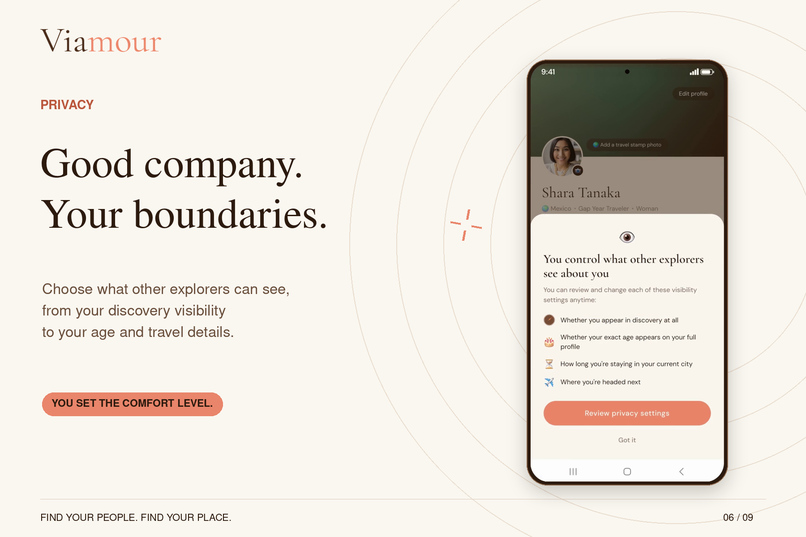
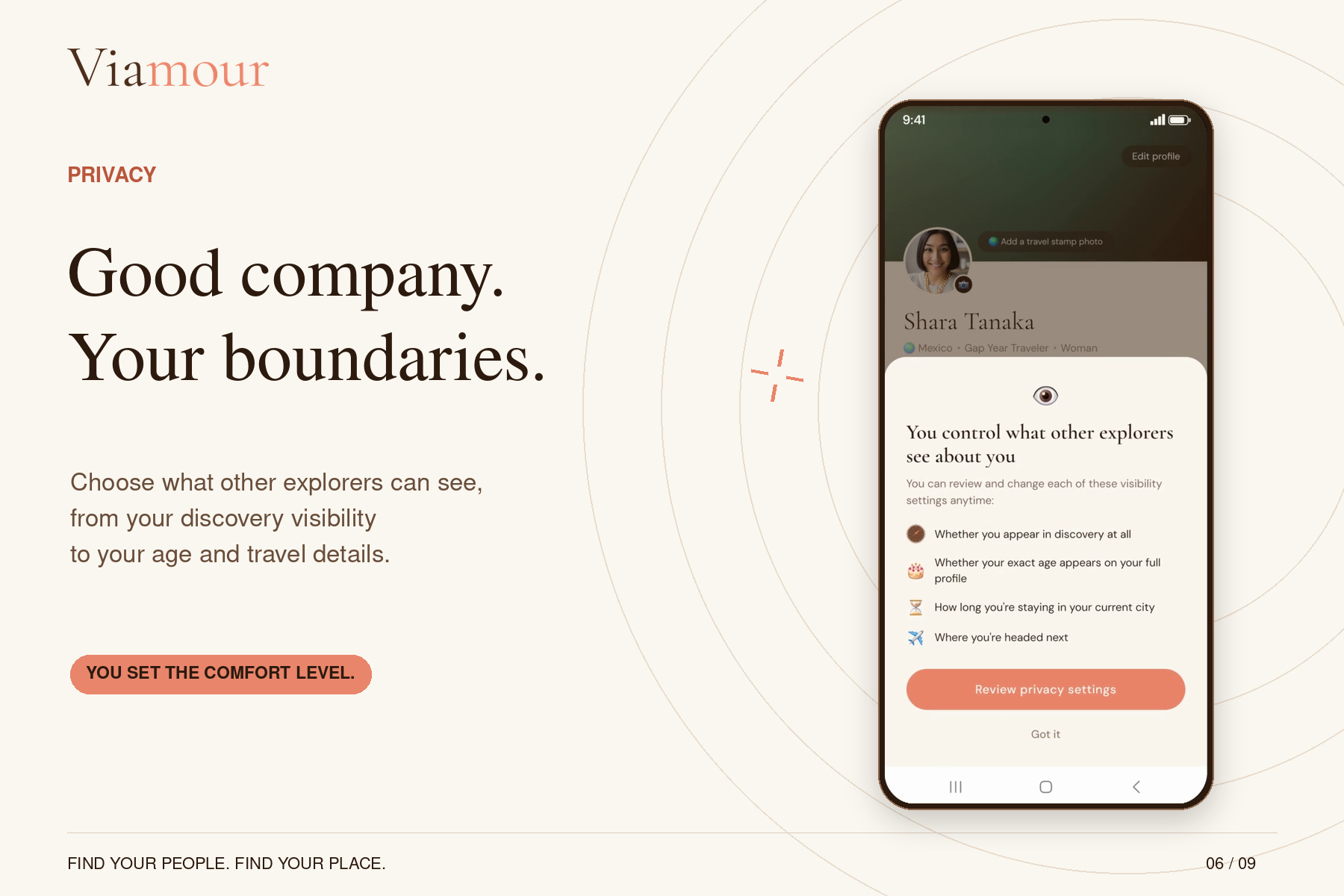
Good company. Your boundaries. Control your discovery visibility and which personal and travel details others see.
-
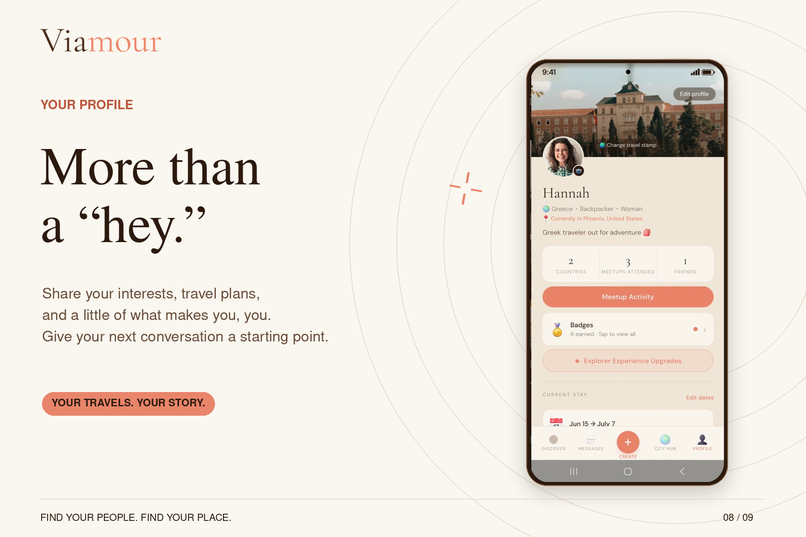
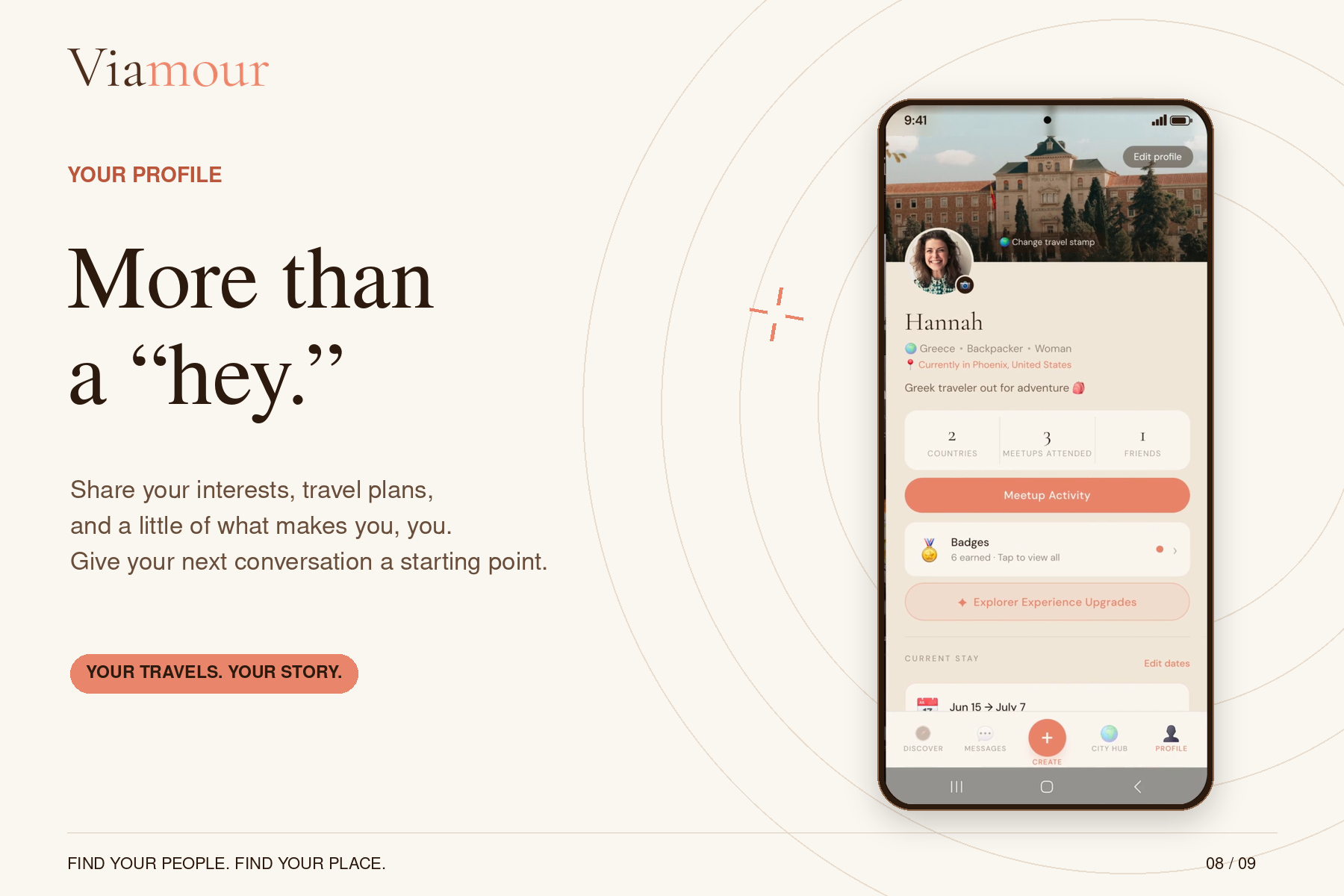
More than a “hey.” Share your interests and travel plans to give your next friendship a starting point.
-
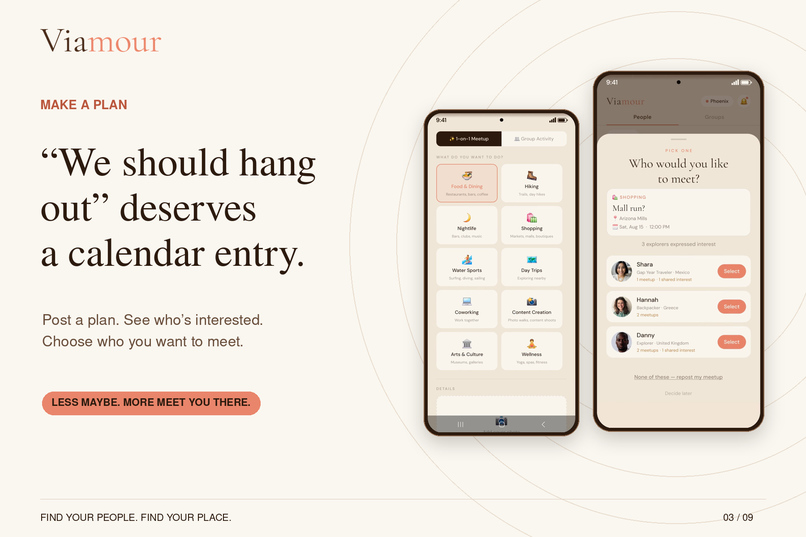
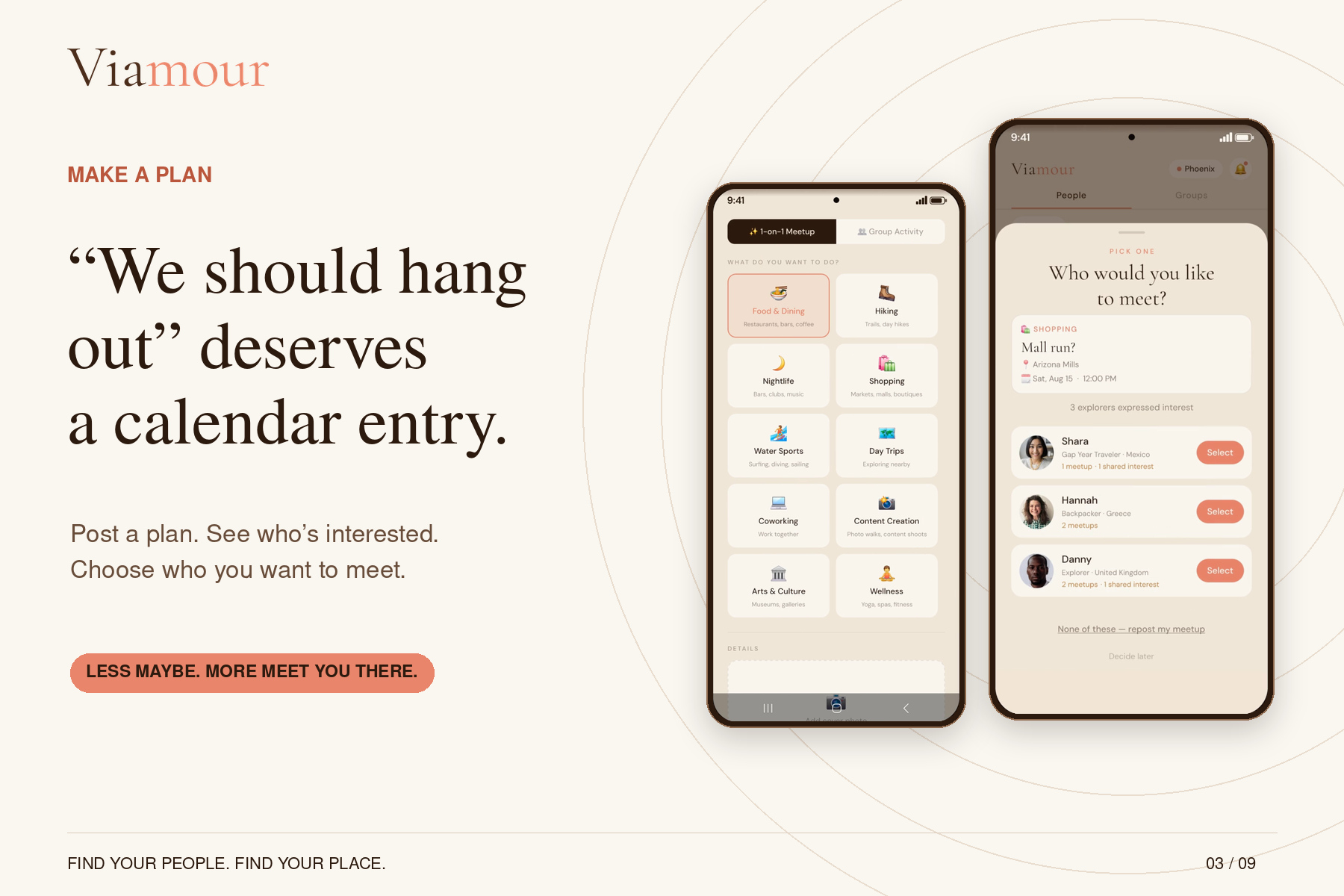
“We should hang out” deserves a calendar entry. Post a plan, see who’s interested, and choose who to meet.
-
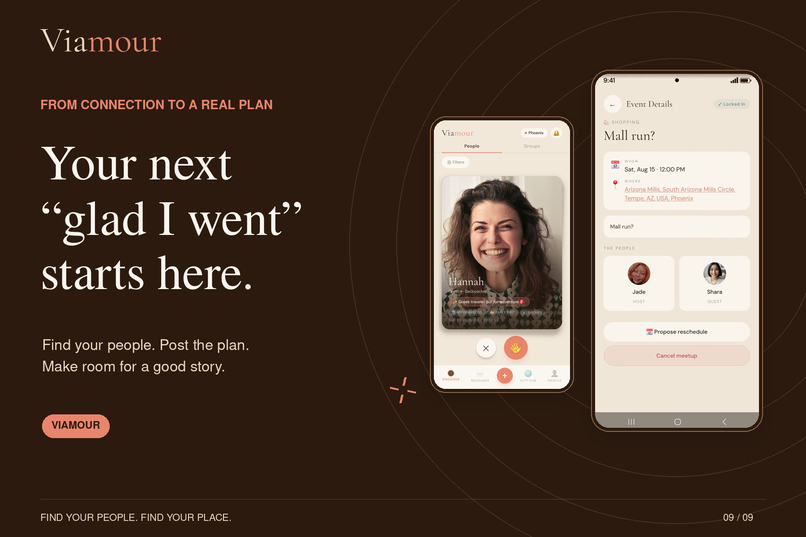
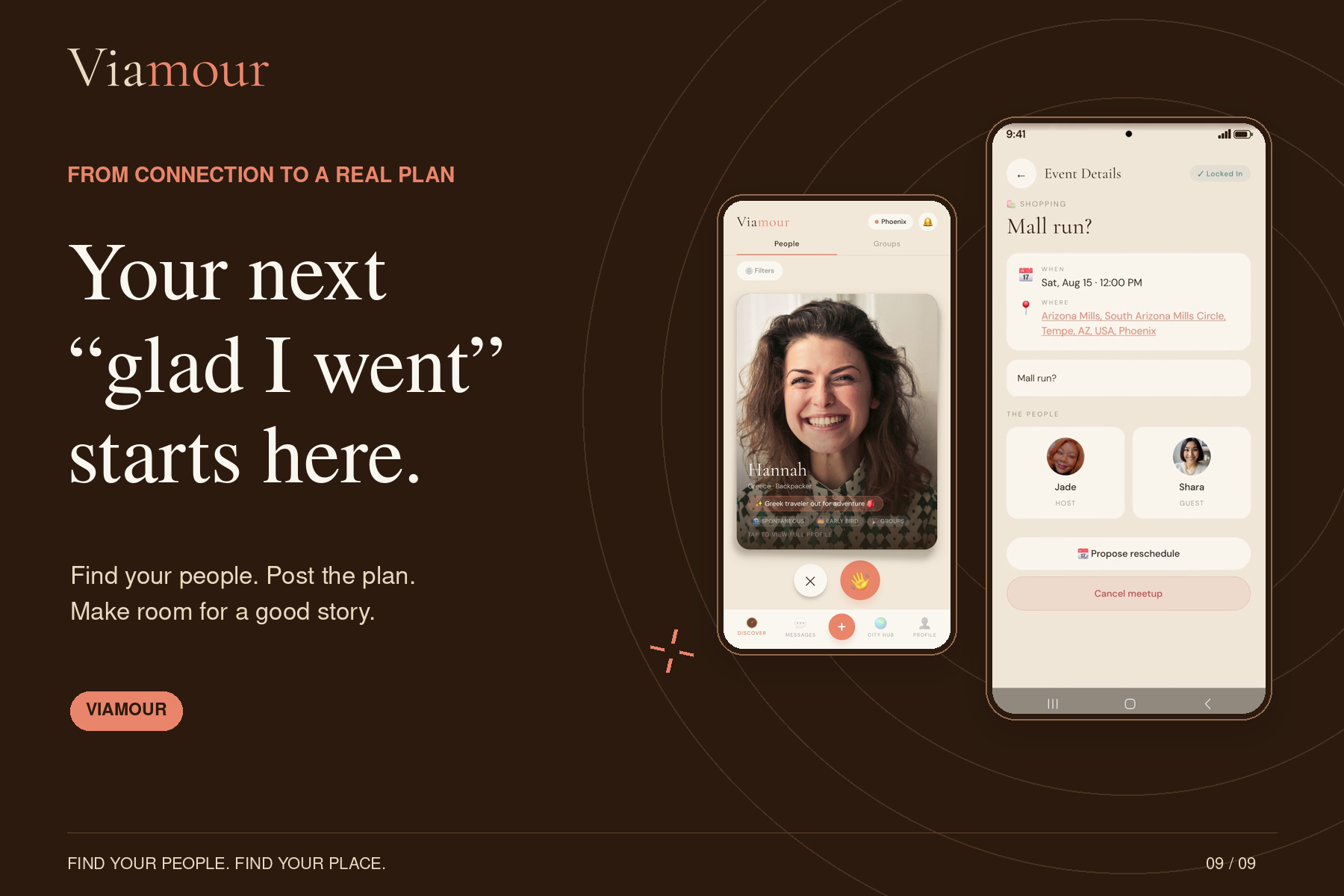
Your next “glad I went” starts with a plan. Turn a new connection into real company with Viamour.
-
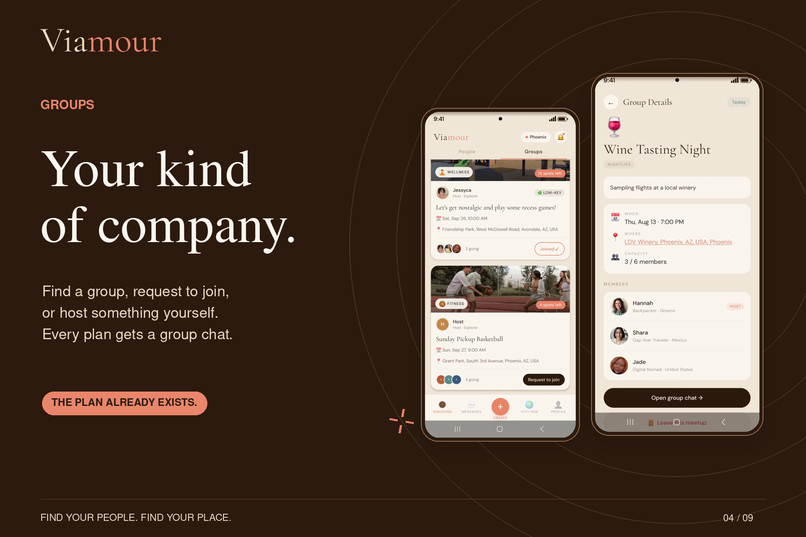
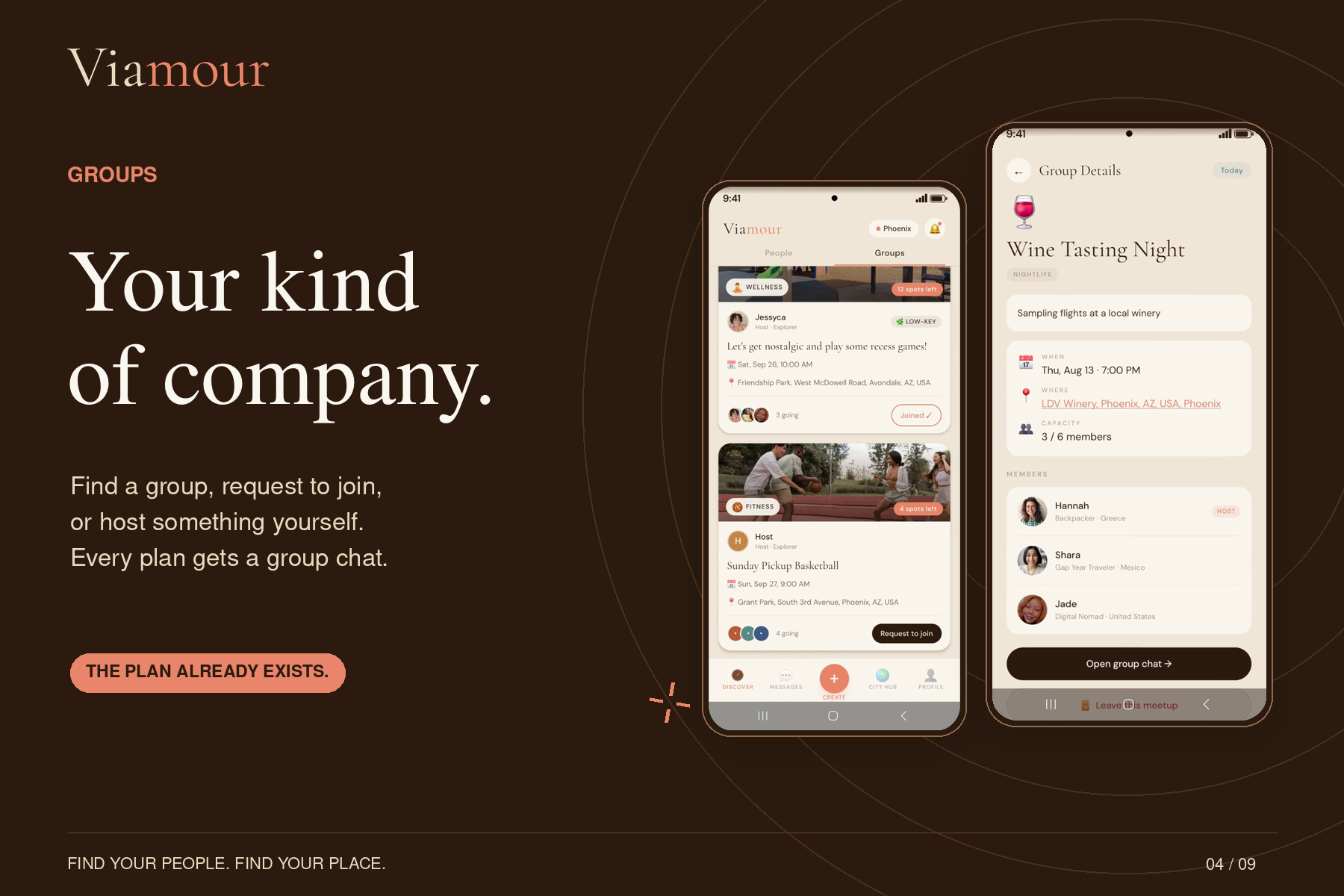
Good plans deserve good company. Join a group or host your own, with a group chat to keep everyone in the loop.
-
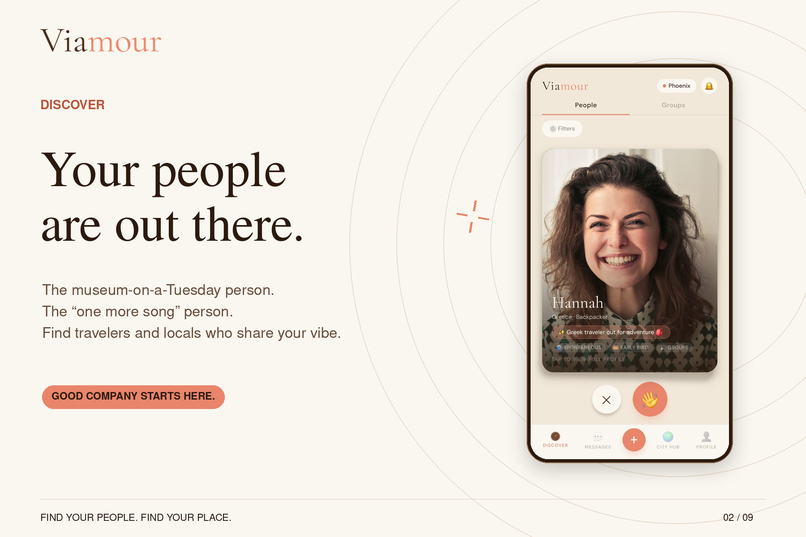
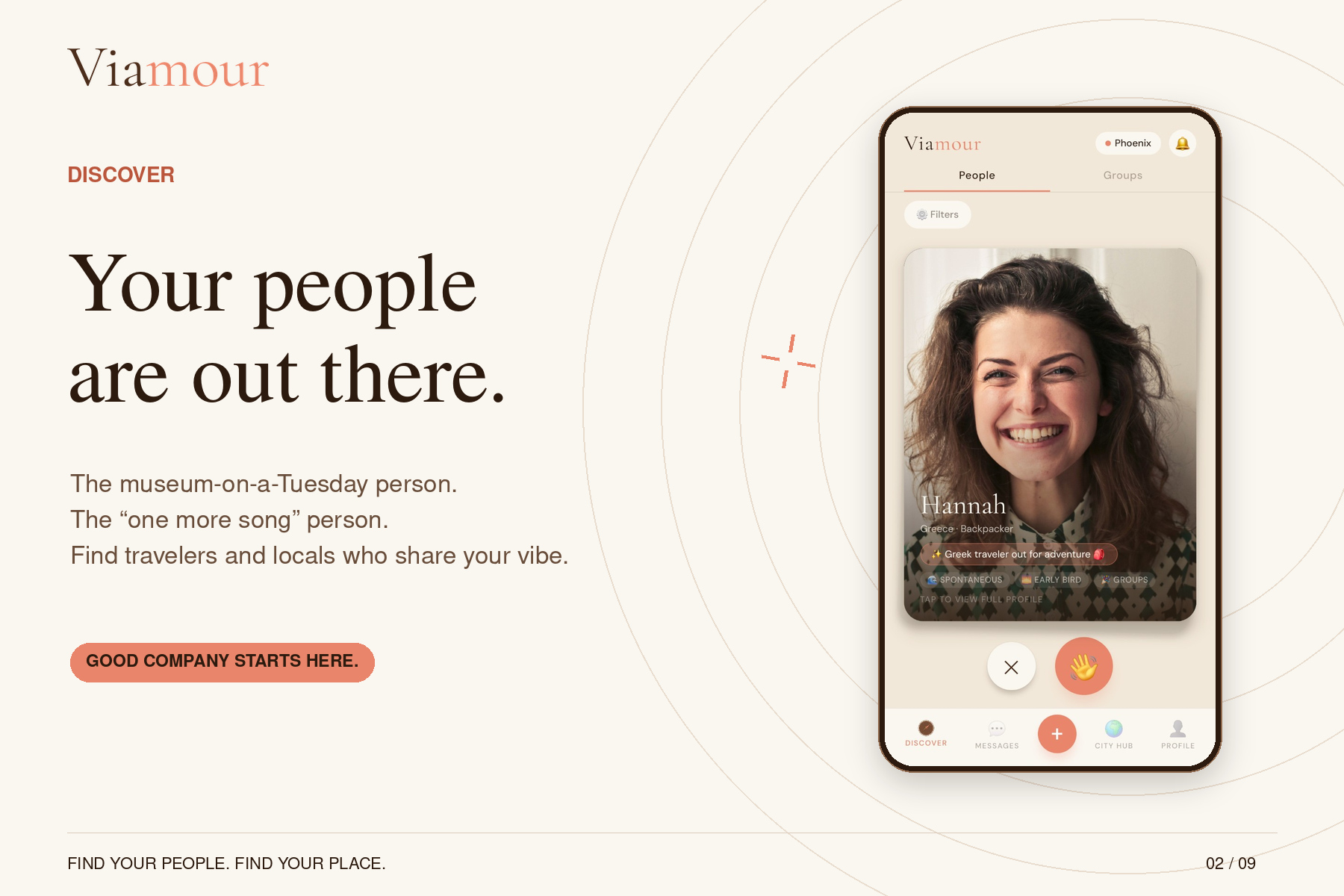
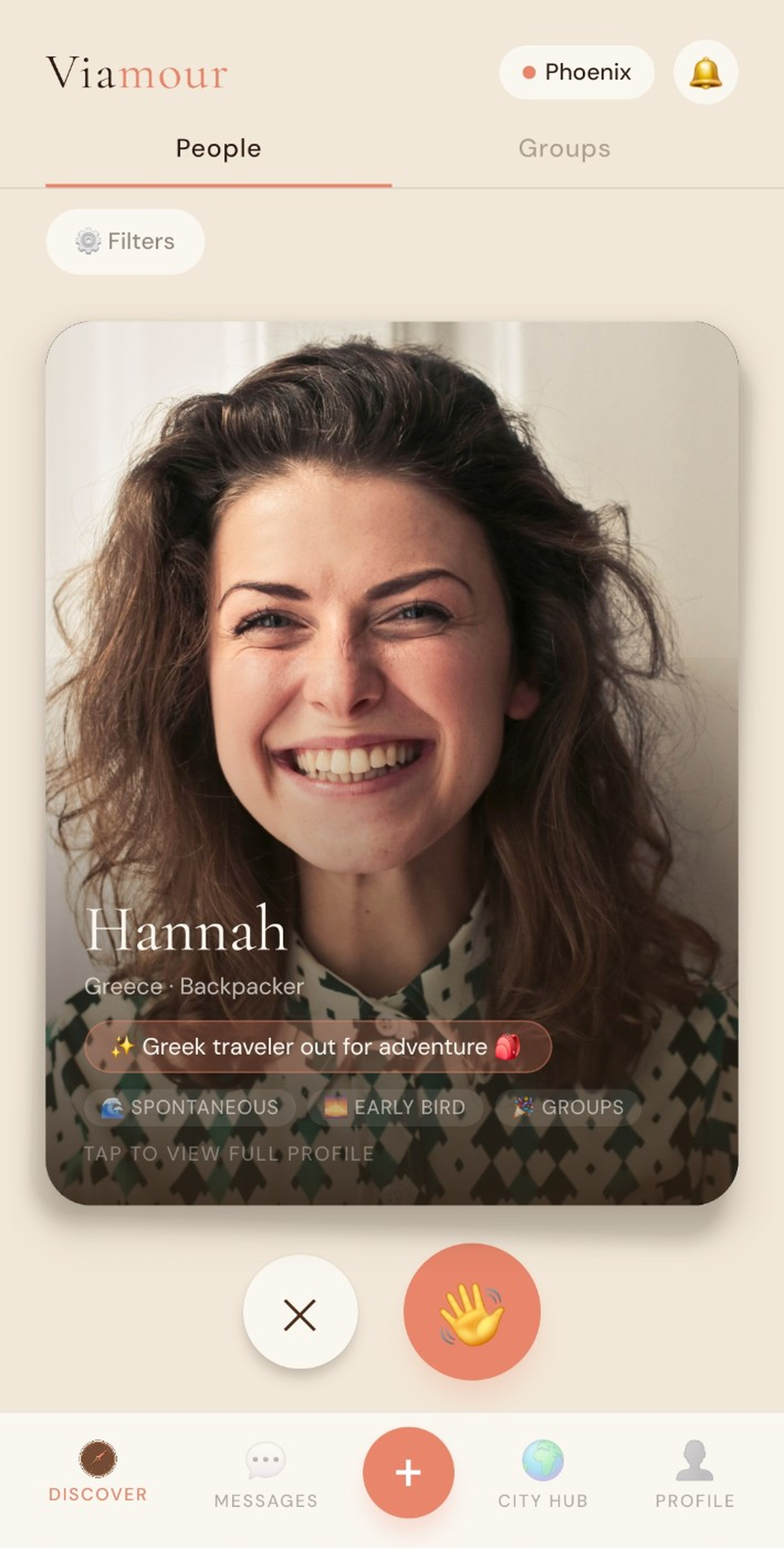
Your museum-on-a-Tuesday person is out there. Discover travelers and locals who share your interests.
-
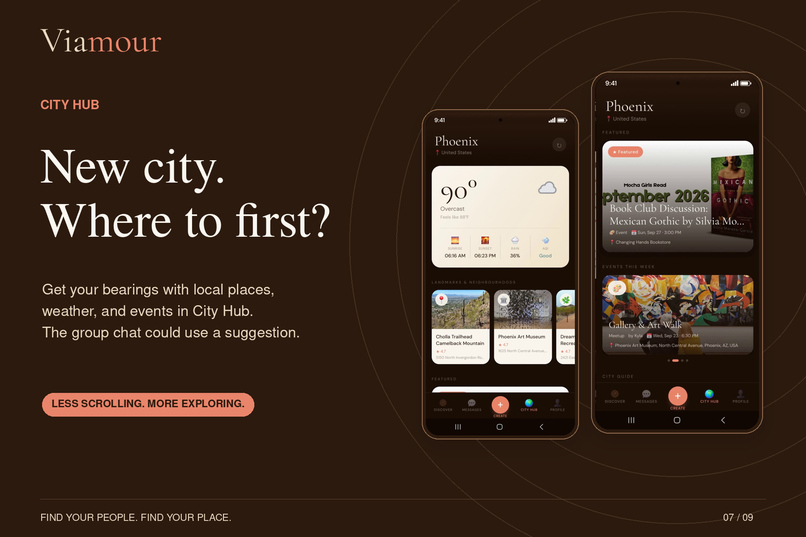
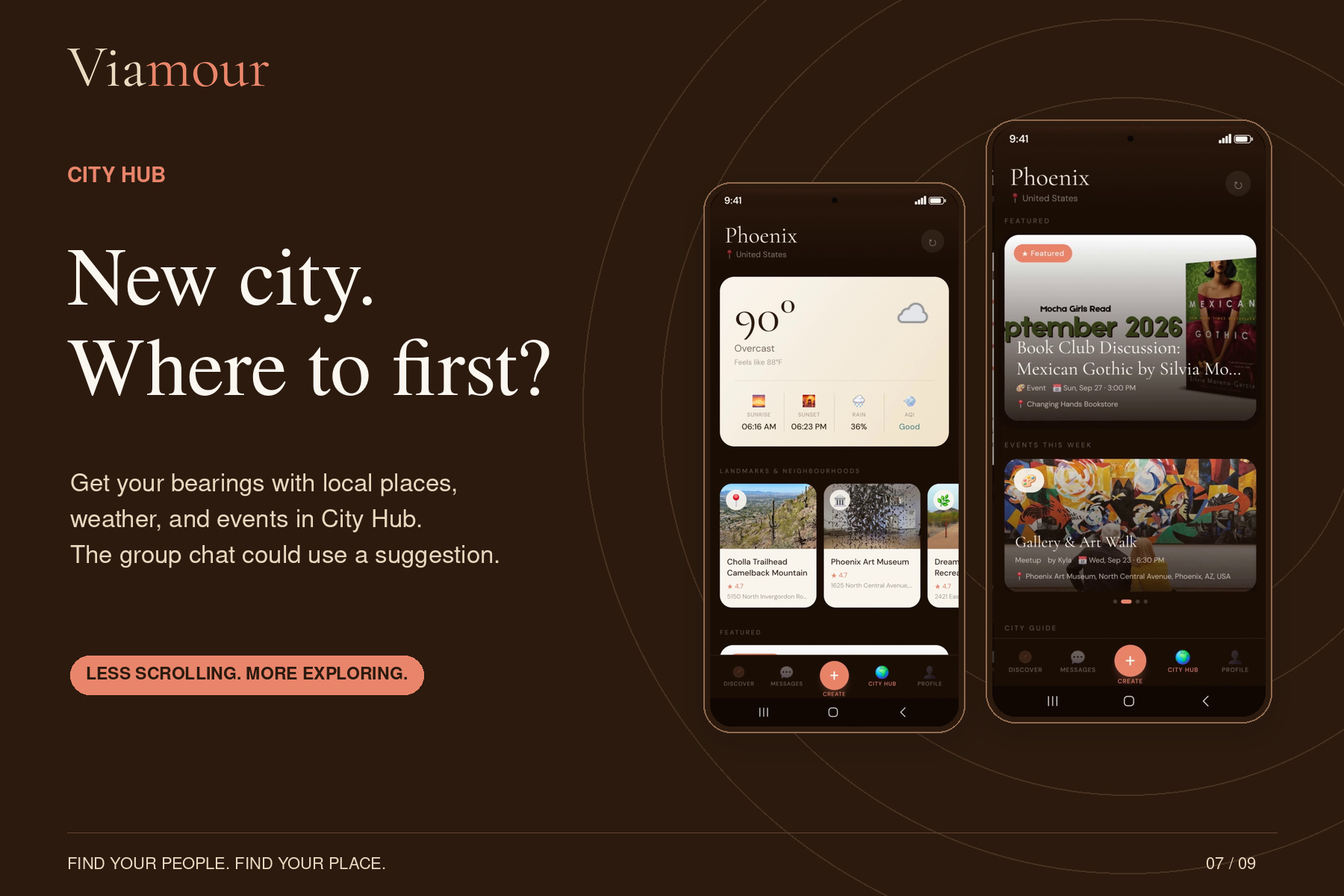
New city, fewer “now what?” moments. Explore local places, weather, and upcoming events in City Hub.
-
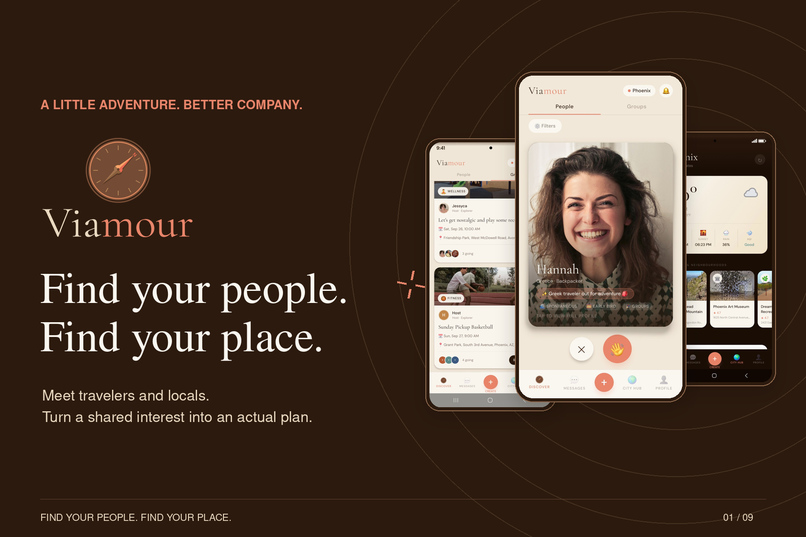
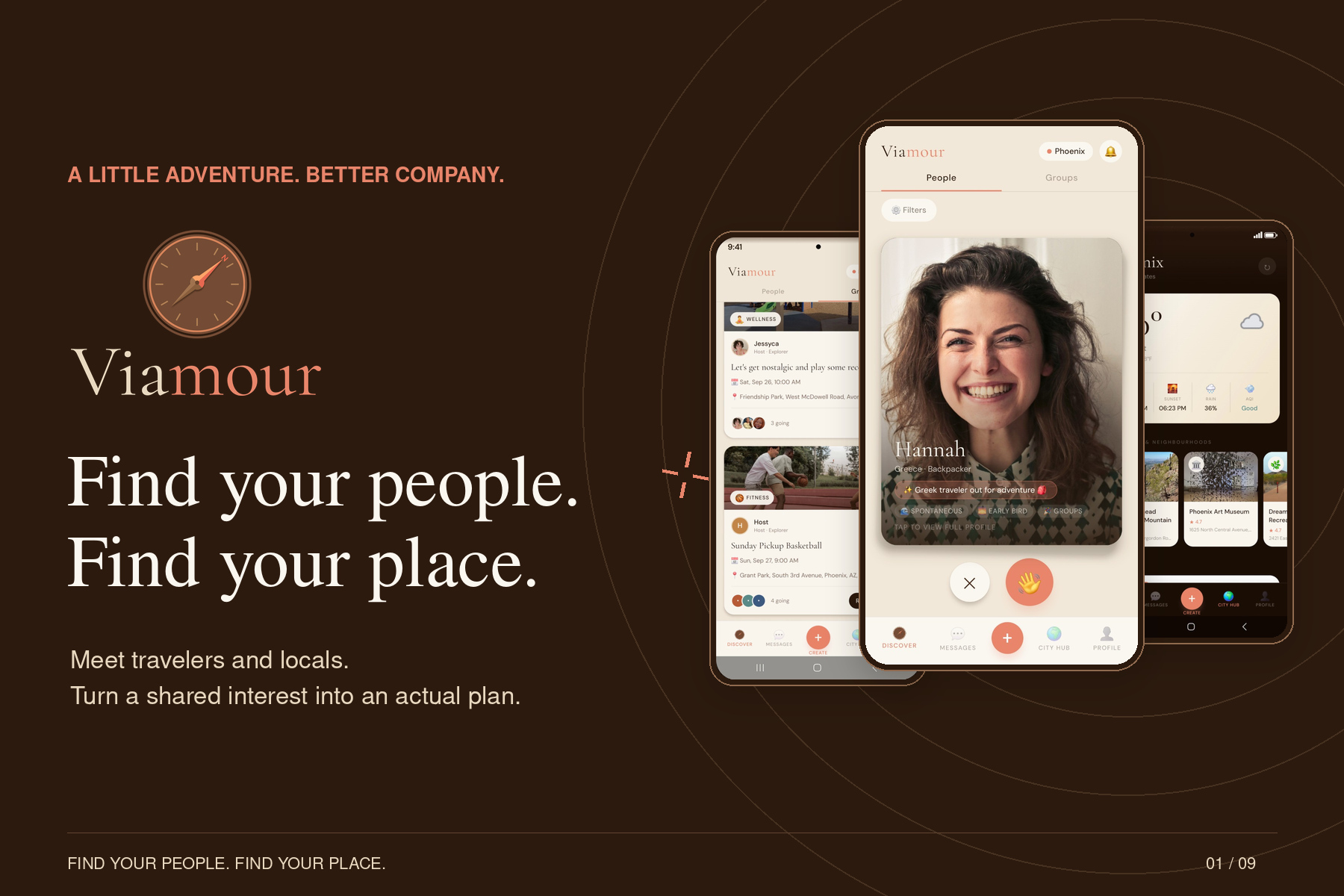
Find your people. Find your place. Viamour connects travelers and locals through shared interests and real plans.
-
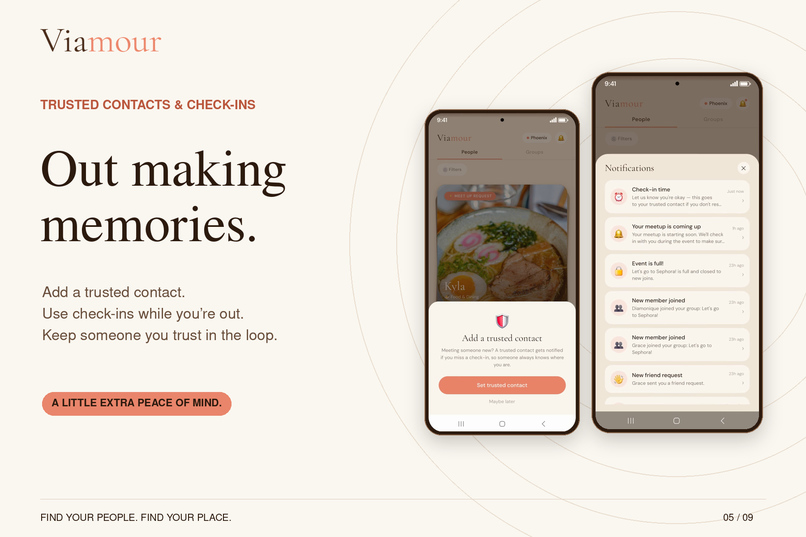
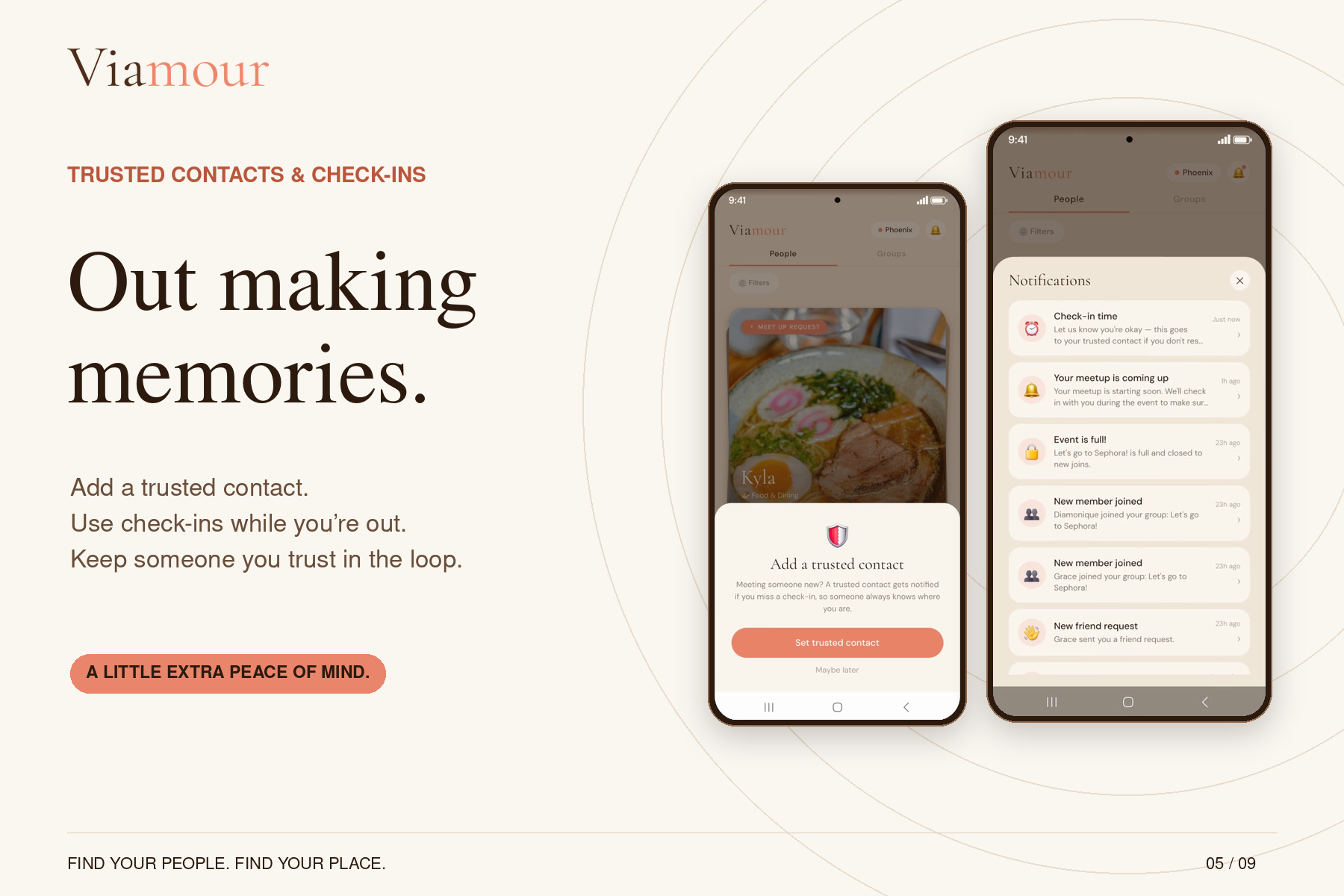
Out making memories? Add a trusted contact and use meetup check-ins to keep someone you trust in the loop.
-
1024x1024 App Icon
-
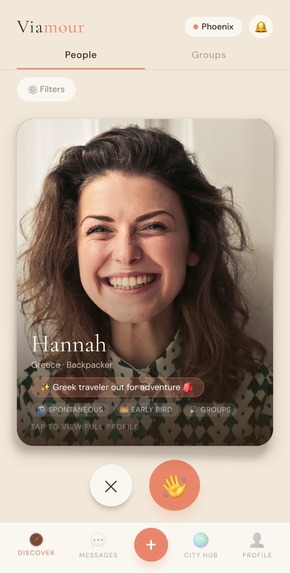
Screenshot with no device frame.

About Viamour
Viamour started with a simple observation: it has never been easier to be surrounded by people and still feel disconnected.
Travelers, expats, digital nomads, newcomers, and even longtime locals often want real friendship and community, but finding it can be surprisingly difficult. Dating apps are built for romance. Social media is built around content. Existing friendship platforms can feel passive, awkward, or too focused on endlessly browsing profiles instead of actually doing something together.
I wanted to build something centered on a different question:
What if finding your people felt less like matching with strangers and more like finding a reason to actually meet?
That became Viamour, a friendship-first social app designed to help people connect through shared interests, local meetups, group experiences, and the places they live or visit.
What inspired me
The idea became increasingly personal while I was building it.
Over the course of development, my own social world changed. I experienced the loss of a friend group that had once been excited about Viamour with me. Building a product about connection while sometimes feeling disconnected myself reinforced why I believed the problem was worth solving.
At the same time, I began sharing the idea publicly. People I had never met responded to posts about loneliness, moving to new places, making adult friendships, and wanting community. Before Viamour was even available to download, people began joining the waitlist.
That helped turn an idea into a conviction: people are not necessarily looking for more social media. Many are looking for a better bridge between being online and having a real life with other people.
How I built it
I built Viamour as a cross-platform mobile application using React Native and Expo, with Supabase powering the backend and RevenueCat handling in-app purchases and entitlements. The app also uses Resend for email and Stripe to process the application fee for our Experience Curator program and payouts for curated experiences.
The product includes:
- Interest-based discovery for finding compatible people nearby
- One-on-one and group messaging
- User-created meetups for things like coffee, walks, game nights, and local activities
- Curated paid experiences hosted by approved local curators
- City-focused discovery designed for travelers, newcomers, and locals
- Profile verification and safety tools
- Reporting, blocking, moderation, and evidence submission
- Location-aware features that help people connect where they actually are
- Optional paid features such as boosts and premium explorer tools
One of the most important architectural decisions was keeping the core friendship experience free. Monetization is designed around optional upgrades and a marketplace for real-world experiences rather than putting basic human connection behind a monthly subscription.
RevenueCat became an important part of that architecture because Viamour has multiple types of optional purchases and entitlements. I needed a system that could keep purchase state consistent across platforms while letting the app remain focused on the user experience rather than recreating subscription infrastructure from scratch.
What I learned
Building Viamour taught me that creating a social app is much more complicated than creating a collection of screens and features.
The hardest questions were often not technical.
How do you rank people in discovery without rewarding inactive profiles?
How do you let someone pay to increase visibility without allowing payment to override basic profile-quality standards?
How do you encourage people to meet in person while still treating safety seriously?
How do you design notifications that encourage connection without creating anxiety?
How do you build reporting systems for messages, images, groups, profiles, and AI-generated content while preserving enough context for moderation?
How do you design monetization that supports the business without making friendship itself feel transactional?
Those questions shaped Viamour as much as the code did.
I also learned the value of challenging my own assumptions. Throughout development I repeatedly audited the product from the perspective of a skeptical user, an App Store reviewer, a safety reviewer, and even a critic trying to explain why the business might fail.
That process resulted in major improvements to account deletion, moderation, reporting, discovery ranking, onboarding, location permissions, profile quality, notification behavior, age controls, privacy, and purchase flows.
Challenges I faced
One of the biggest technical challenges was moving from a development environment to something I trusted enough to put in front of real users.
Viamour touches authentication, real-time messaging, location, push notifications, user-generated content, payments, media storage, moderation, and marketplace transactions. A change in one area can easily affect another.
I dealt with production build failures, database migrations, notification edge cases, state-management bugs, permission behavior, real-time event handling, and platform-specific differences between Android and iOS.
Preparing for the app stores created another category of challenges entirely. A friendship app that facilitates real-world meetings has to think carefully about user-generated content, age restrictions, reporting, account deletion, privacy disclosures, location permissions, subscription rules, and reviewer access.
Rather than treating store review as something to worry about after development, I incorporated those requirements into the product itself.
The nontechnical side was difficult too.
I am an independent founder building a product that depends on network density. Viamour can work perfectly from a technical perspective and still fail if there are not enough relevant people nearby. That is why the initial launch is intentionally focused on building density in Phoenix, Arizona, rather than chasing downloads everywhere at once.
I have also had to think carefully about infrastructure and API costs because a free social product can become expensive before it becomes profitable. That forced me to make deliberate choices about architecture, caching, subscriptions, marketplace revenue, and which expenses actually need to exist at launch.
What comes next
For me, shipping Viamour 1.0 is not the finish line. It is the point where the most important learning finally begins.
The early questions are intentionally simple:
Are people finding someone they actually want to talk to?
Do conversations turn into plans?
Do meetups actually happen?
Do people come back afterward?
Does a person who is new to a city feel a little less alone because Viamour existed?
I do not need Viamour's first launch to produce millions of downloads. I want to prove something smaller and more meaningful first: that a network can begin with a handful of people who genuinely connect.
If Viamour helps someone arrive in a new city, make a friend, join a group, or find the courage to stop spending another weekend alone, then the product is doing what I built it to do.
Find your people. Find your place.
Built With
- claude
- codex
- react-native
- resend
- supabase


Log in or sign up for Devpost to join the conversation.