Inspiration
VIA Band was inspired by one simple idea: the best technology is not always the most powerful — it is the most convenient.
People already use smartphones for almost everything, but phones are not always the fastest way to interact with technology. To ask a quick question, search something, control a device, or get help, users often have to pull out their phone, unlock it, open an app, and tap through screens.
The inspiration came from watches. A phone can tell time, but people still wear watches because they are instant, effortless, and always accessible. VIA Band brings that same convenience to AI by making voice assistance available directly from the wrist.
What it does
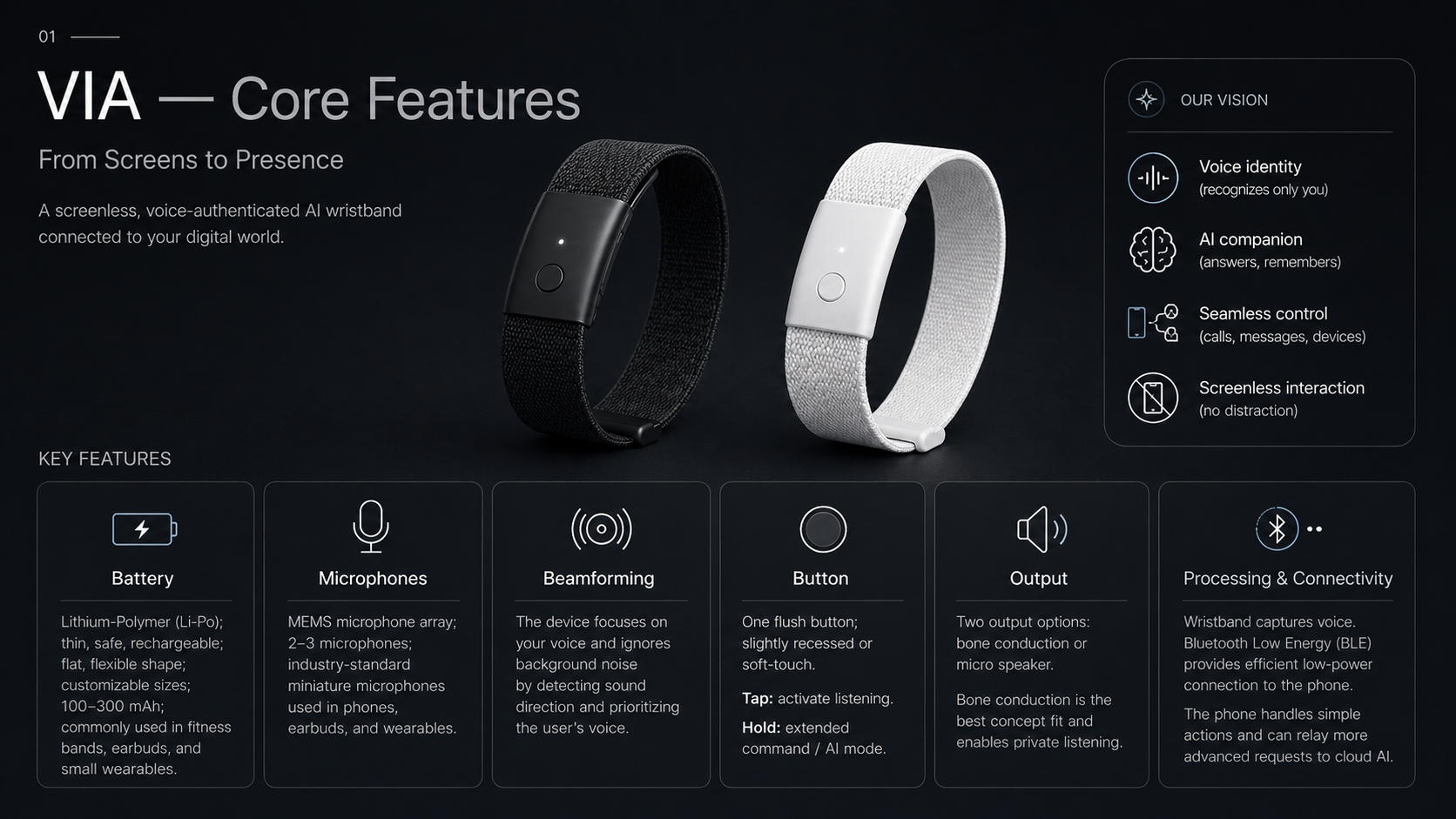
VIA Band is a voice-first AI wristband that gives users fast, hands-free access to assistance.
With one button press, the user can speak a question or command and receive a response through bone conduction audio or a micro speaker. The device is designed for everyday moments when using a phone is inconvenient, such as walking, driving, exercising, cooking, studying, traveling, or multitasking.
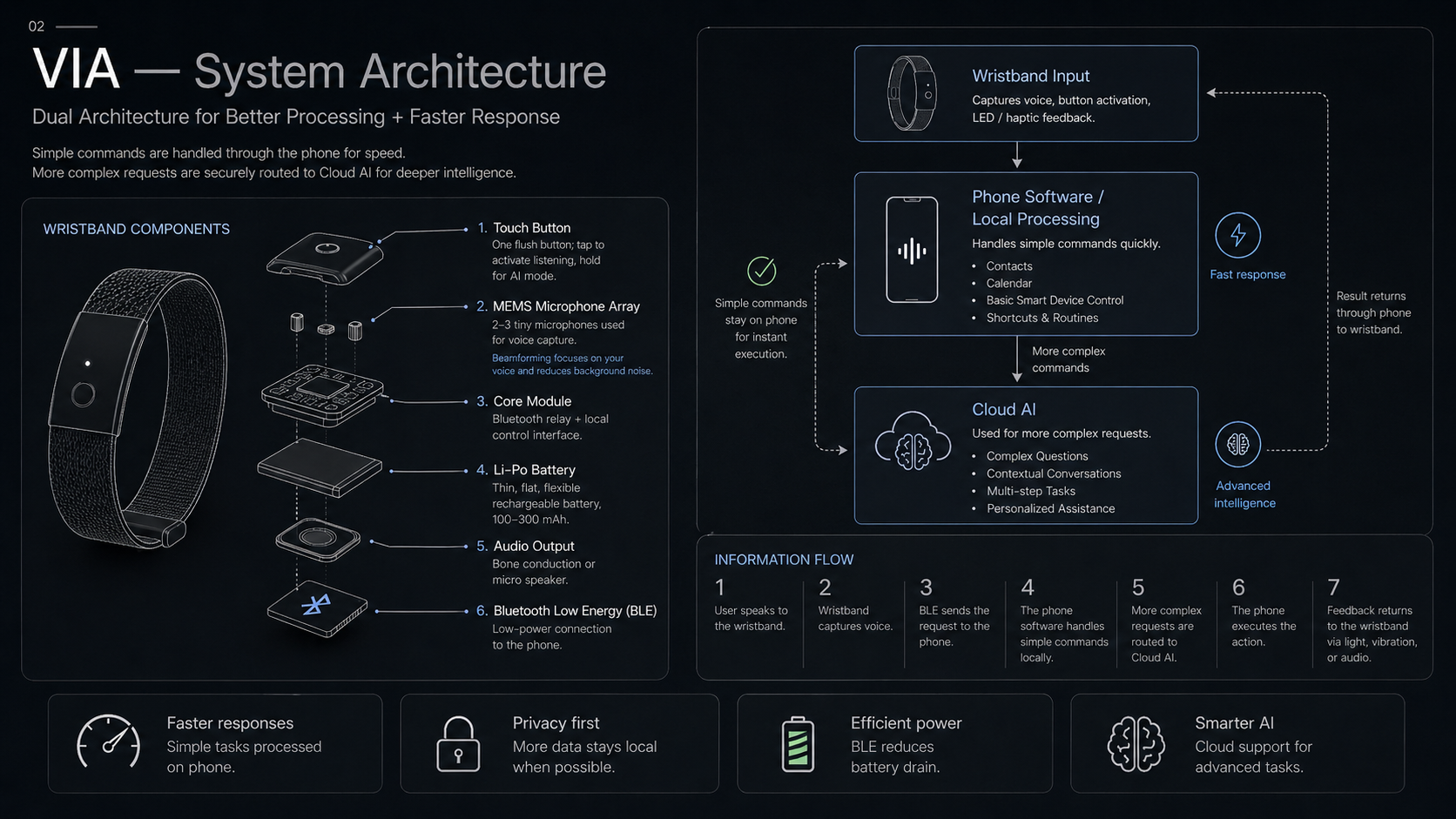
The band uses a MEMS microphone array with beamforming to focus on the user’s voice and reduce background noise. It connects through Bluetooth Low Energy to a phone or companion module, allowing it to process voice requests and connect to AI services.
VIA Band does not replace the phone. It makes the fastest interactions faster.
How we built it
We built VIA Band as a connected wearable system with three main parts: the wristband hardware, the AI voice layer, and the connectivity layer.
The wristband concept includes a one-press button, MEMS microphones, a LiPo battery, and two possible audio outputs: bone conduction or a micro speaker. The voice layer is designed to capture speech, process the request, and connect to an AI assistant. The connectivity layer uses Bluetooth Low Energy to communicate with a phone, car module, or other connected devices.
For the MVP, we focused on the core user experience: press, speak, and receive. The goal was to create a realistic prototype concept that could be developed with funding, tested with users, and improved based on feedback.
Challenges we ran into
The biggest challenge was answering the obvious question: why would someone need this if they already have a phone?
That question became the foundation of the project. The answer is convenience. People still wear watches even though phones tell time. People still use earbuds even though phones have speakers. People adopt products when they make daily actions faster, easier, and more natural.
Another challenge was balancing a big vision with a realistic MVP. VIA Band could eventually support many features, but the first version needs to prove one thing clearly: people want faster access to AI from their wrist.
We also had to think through the hardware challenges, including microphone quality, battery life, background noise, comfort, size, and cost. Since this is a physical product, funding would be required to move from concept to prototype.
Accomplishments that we're proud of
We are proud of creating a product concept that feels both futuristic and practical.
VIA Band is not just another AI app. It is a new interface for using AI in daily life. We built a clear product vision, identified a real user problem, designed a wearable hardware system, and developed an MVP strategy that could realistically be tested.
We are also proud of making the idea desirable. The project is not only about what the technology can do, but about how it makes users feel: faster, freer, more connected, and less dependent on pulling out a phone for every small task.
What we learned
We learned that innovation is not always about inventing something completely new. Sometimes, it is about changing how people access something valuable.
AI is already powerful, but it is often trapped behind screens, apps, and extra steps. VIA Band taught us that the interface matters just as much as the technology itself.
We also learned that convenience creates behavior. When something is easier to use, people are more likely to use it often. The strongest products are not only functional; they fit naturally into everyday life.
What's next for VIA Band
The next step for VIA Band is building a functional MVP.
This would include developing a wearable prototype with a working button, microphone system, Bluetooth Low Energy connection, battery integration, and basic AI voice response. We would also test different audio outputs, including bone conduction and micro speaker options, to understand what feels best for users.
After that, we would run user testing to measure convenience, comfort, accuracy, and daily use cases. The long-term goal is to turn VIA Band into a refined AI wearable that can support personal assistance, smart device control, car interaction, and hands-free productivity.
To move forward, VIA Band would require funding for hardware components, prototyping, software integration, testing, and product design.
Built With
- 3d
- ai-voice-assistant-api
- beamforming
- bluetooth
- bone-conduction-audio
- embedded-hardware-prototyping
- lipo-battery
- mems-microphone-array
- micro-speaker
- mobile-companion-app
- product
- wearable-hardware-design


Log in or sign up for Devpost to join the conversation.