Inspiration
VIA Band was inspired by a simple belief: the future of AI should feel instant, effortless, and wearable.
Today, people use their phones for everything, but phones are not always convenient. To ask one quick question, control a device, or search for something, you usually have to pull out your phone, unlock it, open an app, type or tap, and wait. That is a lot of friction for something that should take one second.
The idea behind VIA Band comes from the same reason people still wear watches. A phone can tell time, but a watch is faster, easier, and always on your wrist. VIA Band brings that same convenience to AI.
Instead of making people reach for their phone every time they need help, VIA Band gives them a direct voice interface on their wrist.
What it does
VIA Band is a voice-first AI wristband that lets users access assistance instantly through speech.
With one button press, the user can ask a question, search for information, control connected devices, or get help hands-free. The response can be delivered through bone conduction audio or a small built-in speaker, depending on the situation.
The band is designed for real everyday moments: walking, driving, studying, working out, cooking, traveling, or multitasking. It makes AI feel less like an app and more like a natural extension of the user.
VIA Band does not try to replace the smartphone. It makes the fastest interactions even faster.
How I built it
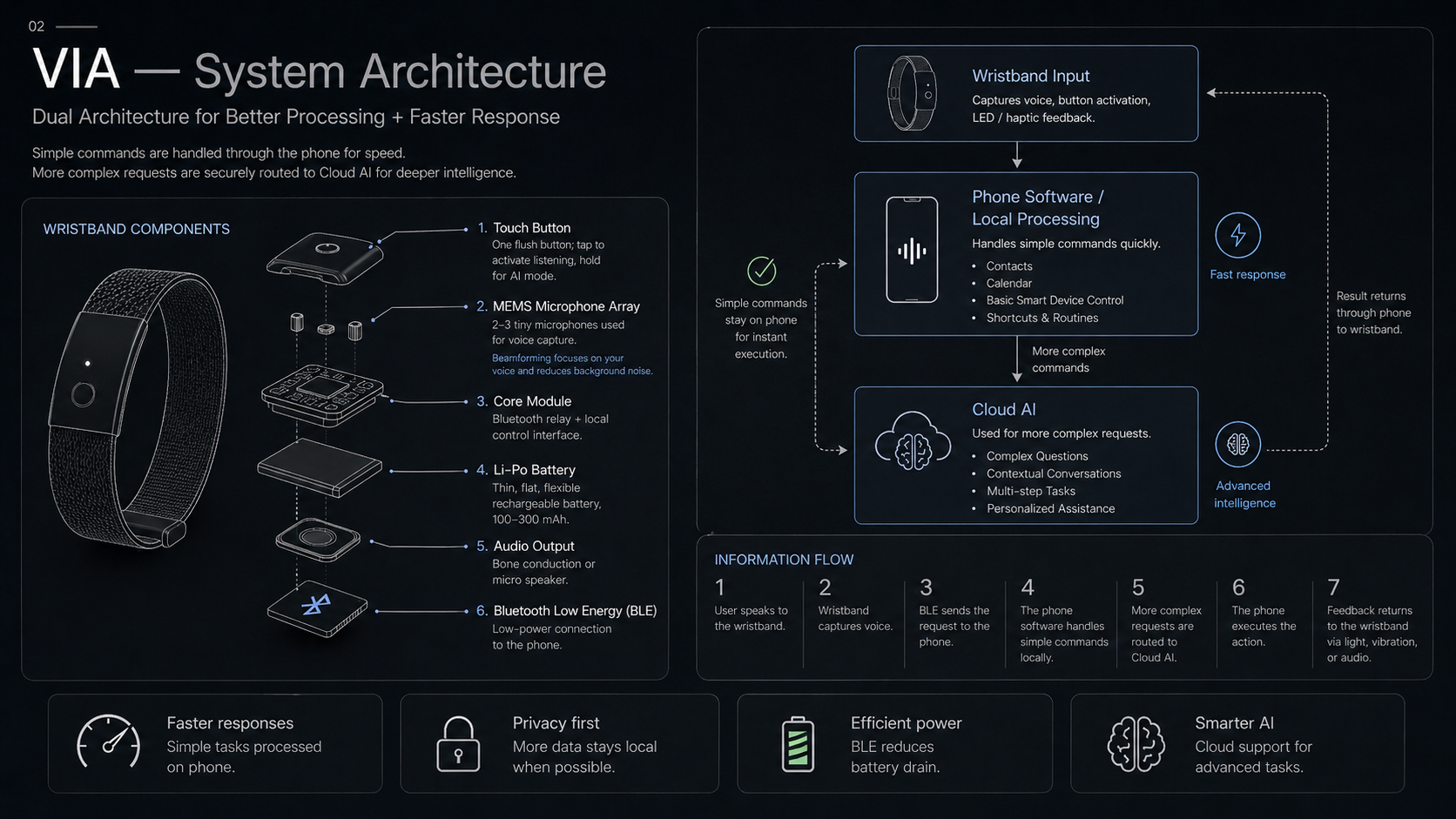
I designed VIA Band as a connected wearable system made of three main layers:
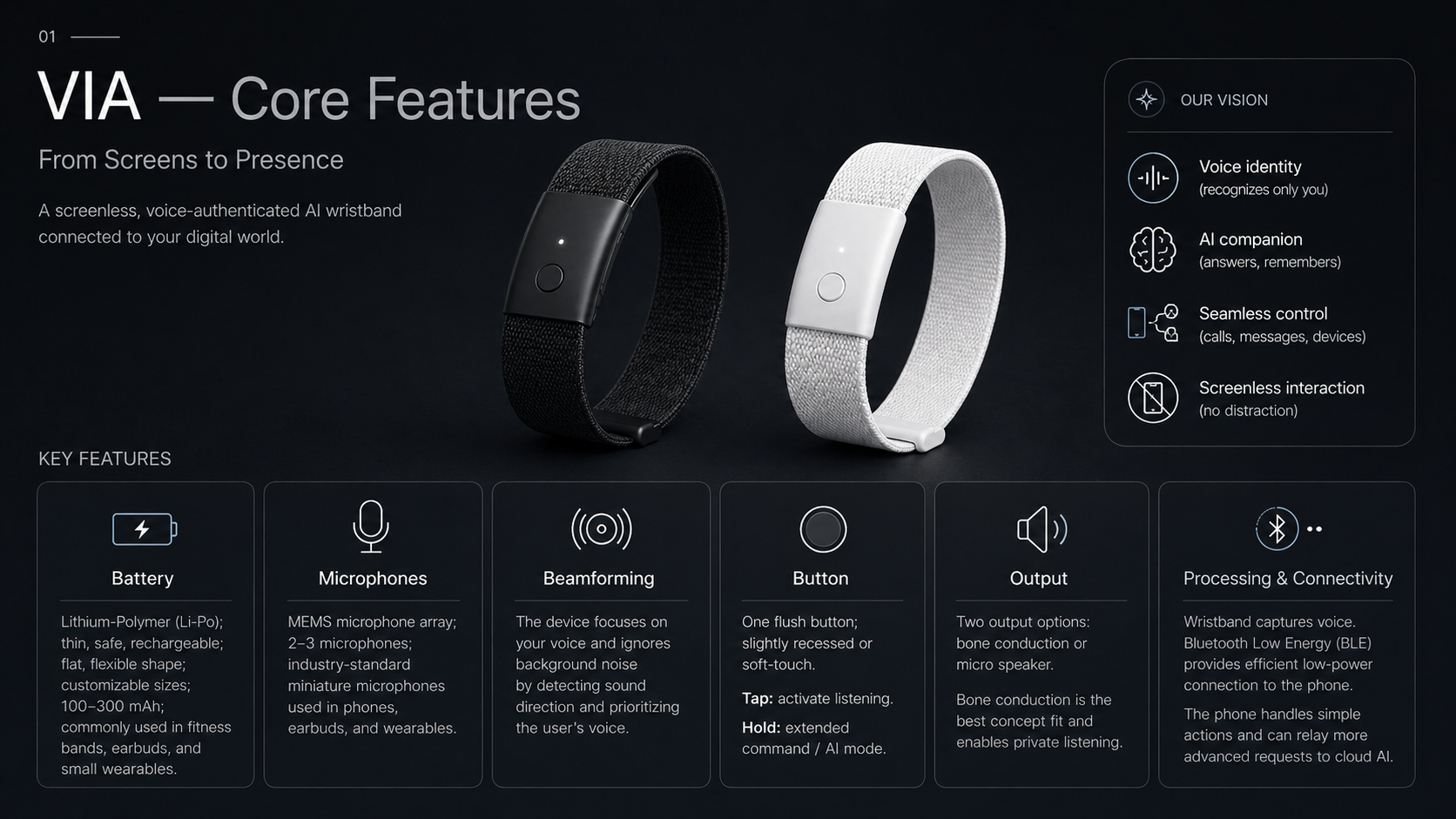
- The wristband hardware — includes a one-press button, MEMS microphone array, LiPo battery, and audio output.
- The voice and AI layer — captures the user’s request, processes speech, and connects to an AI assistant.
- The connectivity layer — uses Bluetooth Low Energy to communicate with a phone, car module, or other connected devices.
The concept includes MEMS microphones with beamforming technology so the device can focus on the user’s voice and reduce background noise. This is important because VIA Band is meant to work in active, noisy, real-world environments — not just quiet rooms where every demo magically behaves. Cute, but not useful.
The MVP focuses on the core experience: press, speak, receive. Simple on purpose.
Challenges I faced
The biggest challenge was answering the obvious question: why would someone need this if they already have a phone?
That question actually became the strongest part of the project. The point is not that phones are useless. The point is that phones are not always the most convenient interface.
People still wear watches even though phones tell time. People use earbuds even though phones have speakers. People adopt products when they remove friction from daily life. VIA Band is built around that same behavior.
Another challenge was turning a big vision into a realistic MVP. A complete AI wearable ecosystem could include many features, but the first version needs to prove one thing clearly: people want faster access to AI from their wrist.
Because this is a hardware product, funding is also an important requirement. The next stage would require capital for product design, prototyping, component testing, software integration, and user trials.
What I learned
I learned that strong innovation is not only about adding more technology. It is about placing technology where people actually want to use it.
VIA Band is valuable because it changes the interaction. It makes AI feel immediate instead of hidden inside a phone. It turns voice assistance into something wearable, accessible, and always ready.
The biggest lesson was that convenience creates desire. When a product makes people feel faster, freer, and more in control, it becomes more than useful — it becomes something they want.## Inspiration
VIA Band was inspired by a simple belief: the future of AI should feel instant, effortless, and wearable.
Today, people use their phones for everything, but phones are not always convenient. To ask one quick question, control a device, or search for something, you usually have to pull out your phone, unlock it, open an app, type or tap, and wait. That is a lot of friction for something that should take one second.
The idea behind VIA Band comes from the same reason people still wear watches. A phone can tell time, but a watch is faster, easier, and always on your wrist. VIA Band brings that same convenience to AI.
Instead of making people reach for their phone every time they need help, VIA Band gives them a direct voice interface on their wrist.
What it does
VIA Band is a voice-first AI wristband that lets users access assistance instantly through speech.
With one button press, the user can ask a question, search for information, control connected devices, or get help hands-free. The response can be delivered through bone conduction audio or a small built-in speaker, depending on the situation.
The band is designed for real everyday moments: walking, driving, studying, working out, cooking, traveling, or multitasking. It makes AI feel less like an app and more like a natural extension of the user.
VIA Band does not try to replace the smartphone. It makes the fastest interactions even faster.
How I built it
I designed VIA Band as a connected wearable system made of three main layers:
- The wristband hardware — includes a one-press button, MEMS microphone array, LiPo battery, and audio output.
- The voice and AI layer — captures the user’s request, processes speech, and connects to an AI assistant.
- The connectivity layer — uses Bluetooth Low Energy to communicate with a phone, car module, or other connected devices.
The concept includes MEMS microphones with beamforming technology so the device can focus on the user’s voice and reduce background noise. This is important because VIA Band is meant to work in active, noisy, real-world environments — not just quiet rooms where every demo magically behaves. Cute, but not useful.
The MVP focuses on the core experience: press, speak, receive. Simple on purpose.
Challenges I faced
The biggest challenge was answering the obvious question: why would someone need this if they already have a phone?
That question actually became the strongest part of the project. The point is not that phones are useless. The point is that phones are not always the most convenient interface.
People still wear watches even though phones tell time. People use earbuds even though phones have speakers. People adopt products when they remove friction from daily life. VIA Band is built around that same behavior.
Another challenge was turning a big vision into a realistic MVP. A complete AI wearable ecosystem could include many features, but the first version needs to prove one thing clearly: people want faster access to AI from their wrist.
Because this is a hardware product, funding is also an important requirement. The next stage would require capital for product design, prototyping, component testing, software integration, and user trials.
What I learned
I learned that strong innovation is not only about adding more technology. It is about placing technology where people actually want to use it.
VIA Band is valuable because it changes the interaction. It makes AI feel immediate instead of hidden inside a phone. It turns voice assistance into something wearable, accessible, and always ready.
The biggest lesson was that convenience creates desire. When a product makes people feel faster, freer, and more in control, it becomes more than useful — it becomes something they want.
Built With
- 3d
- ai-voice-assistant-api
- beamforming
- bluetooth
- bone-conduction-audio
- embedded-hardware-prototyping
- lipo-battery
- mems-microphones
- micro-speaker
- mobile-companion-app
- product

Log in or sign up for Devpost to join the conversation.