Veylora Bridge AI — Securing Agreements, Verifying Work, Empowering Payments
Inspiration
Freelancing has transformed the way people work, allowing professionals and businesses to collaborate across cities, countries, and continents. However, one major challenge remains: trust between freelancers and clients.
Many freelancers find clients through LinkedIn, WhatsApp, referrals, or personal networks. Once they agree to work together, they often rely on informal conversations, manually prepared contracts, and direct payment arrangements.
This creates risks for both sides. Freelancers may face delayed payments, unclear requirements, or unexpected scope changes. Clients may worry about paying in advance without knowing whether the agreed work will be delivered.
We asked ourselves a simple question:
What if freelancers and clients could create transparent agreements, verify completed work using AI, and manage milestone payments through one trusted platform—without needing a traditional freelance marketplace?
That question inspired Veylora Bridge AI.
What It Does
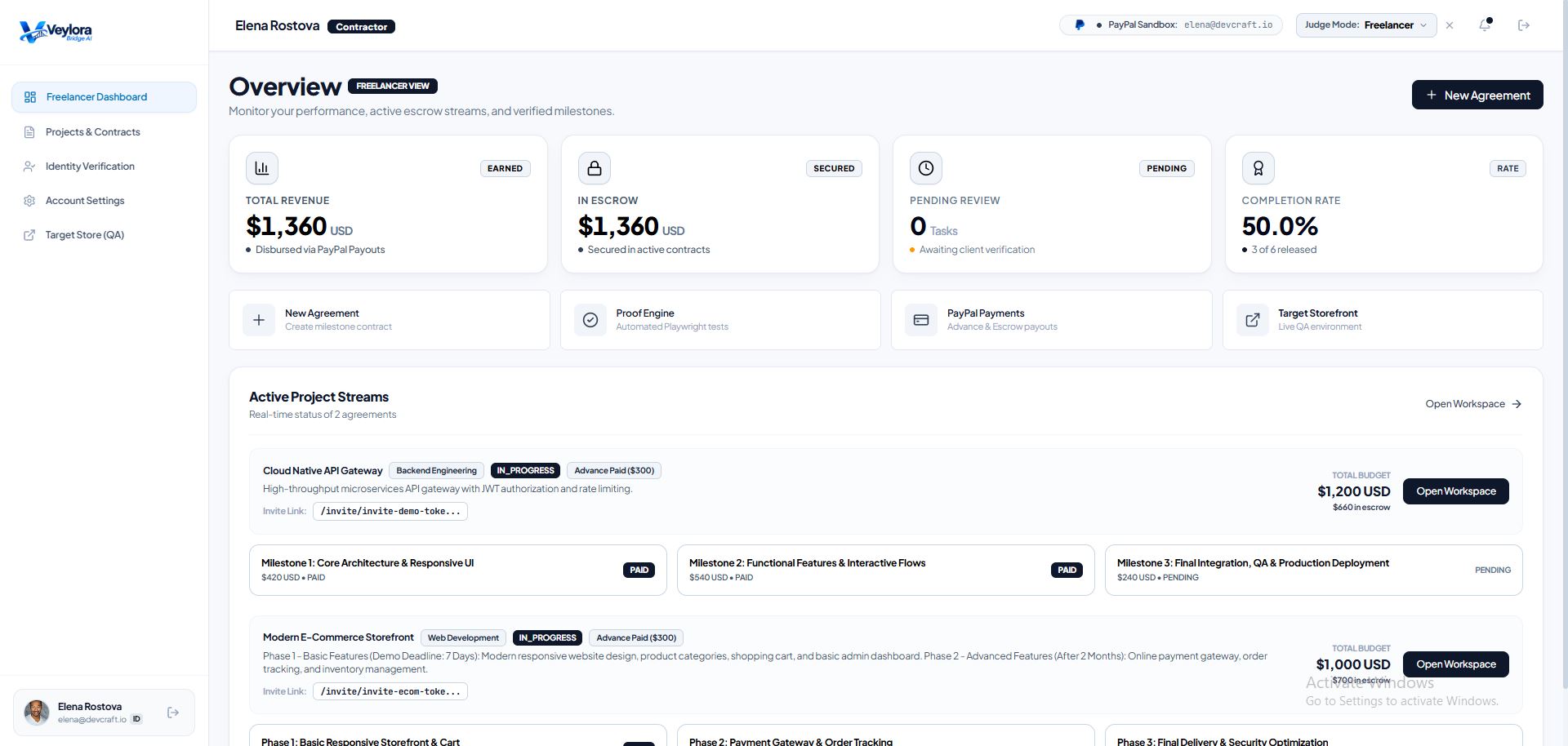
Veylora Bridge AI is an AI-powered freelance agreement, work verification, and payment coordination platform.
Unlike traditional freelance marketplaces, Veylora does not require users to discover clients or freelancers within the platform. Instead, two parties who already know each other can create a project, formalize their agreement, and manage the entire collaboration.
The platform is designed around five core capabilities:
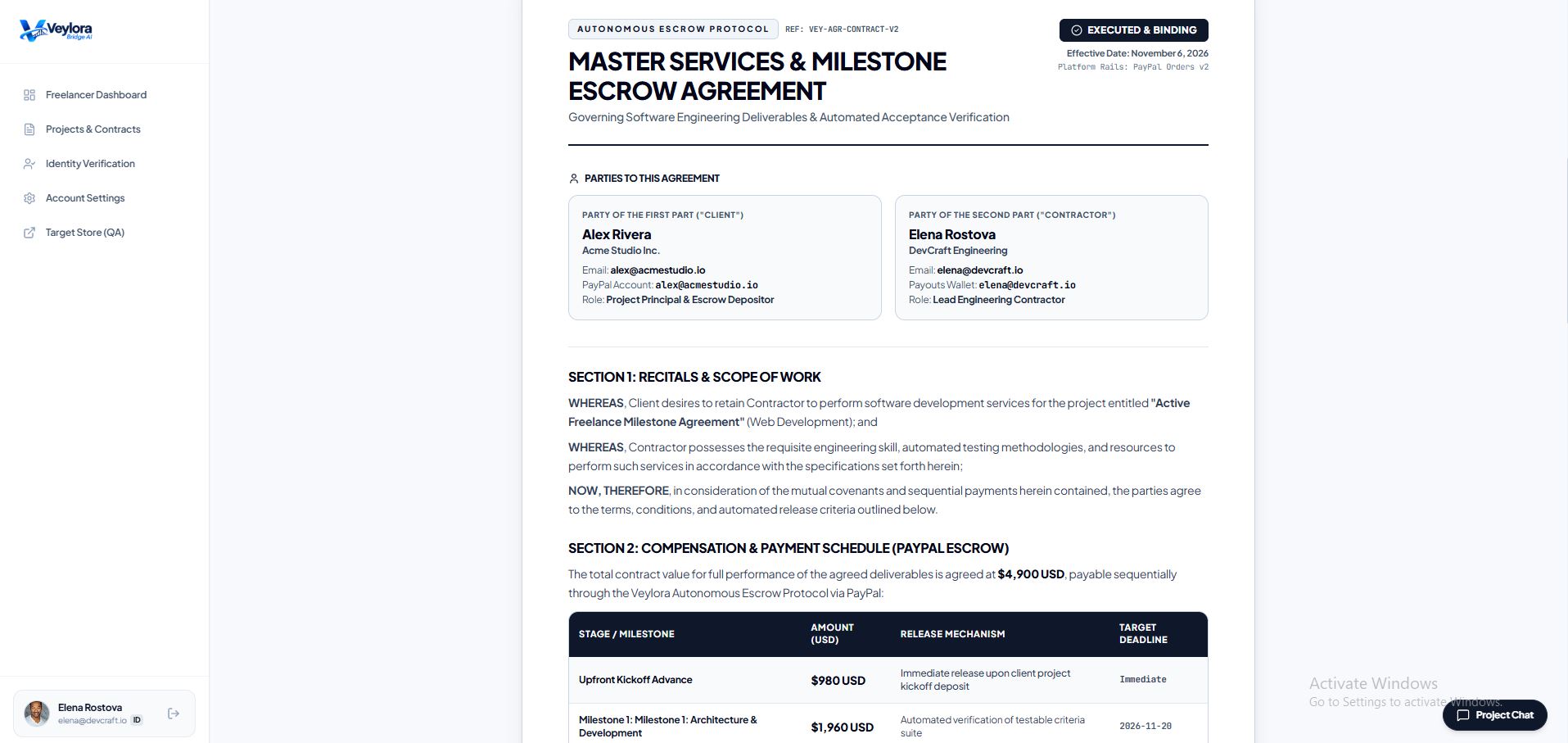
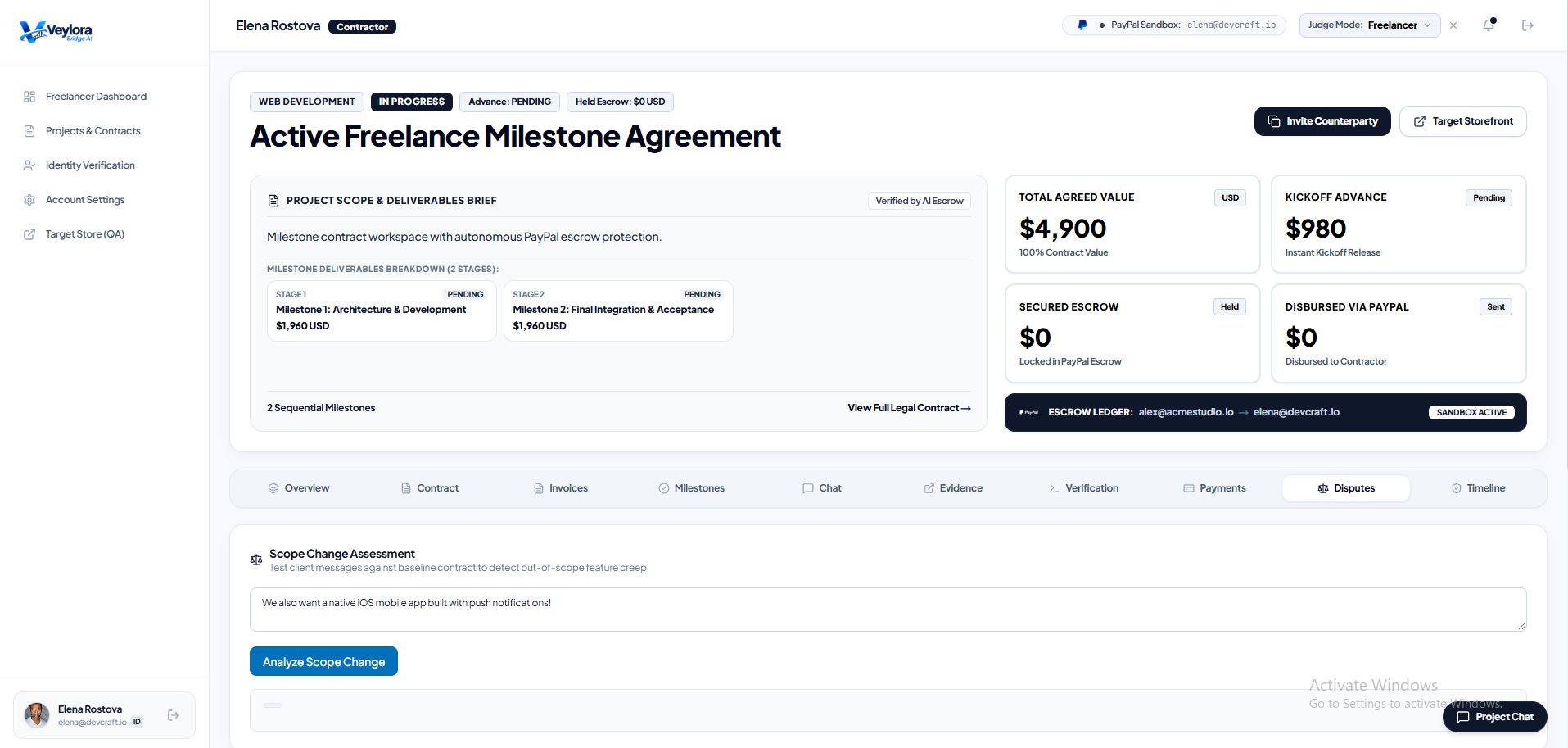
- AI-Powered Agreement Generation: Converts project descriptions into structured contracts with deliverables, deadlines, milestones, and payment terms.
- Mutual Contract Approval: Both freelancers and clients review and accept the same agreement before work begins.
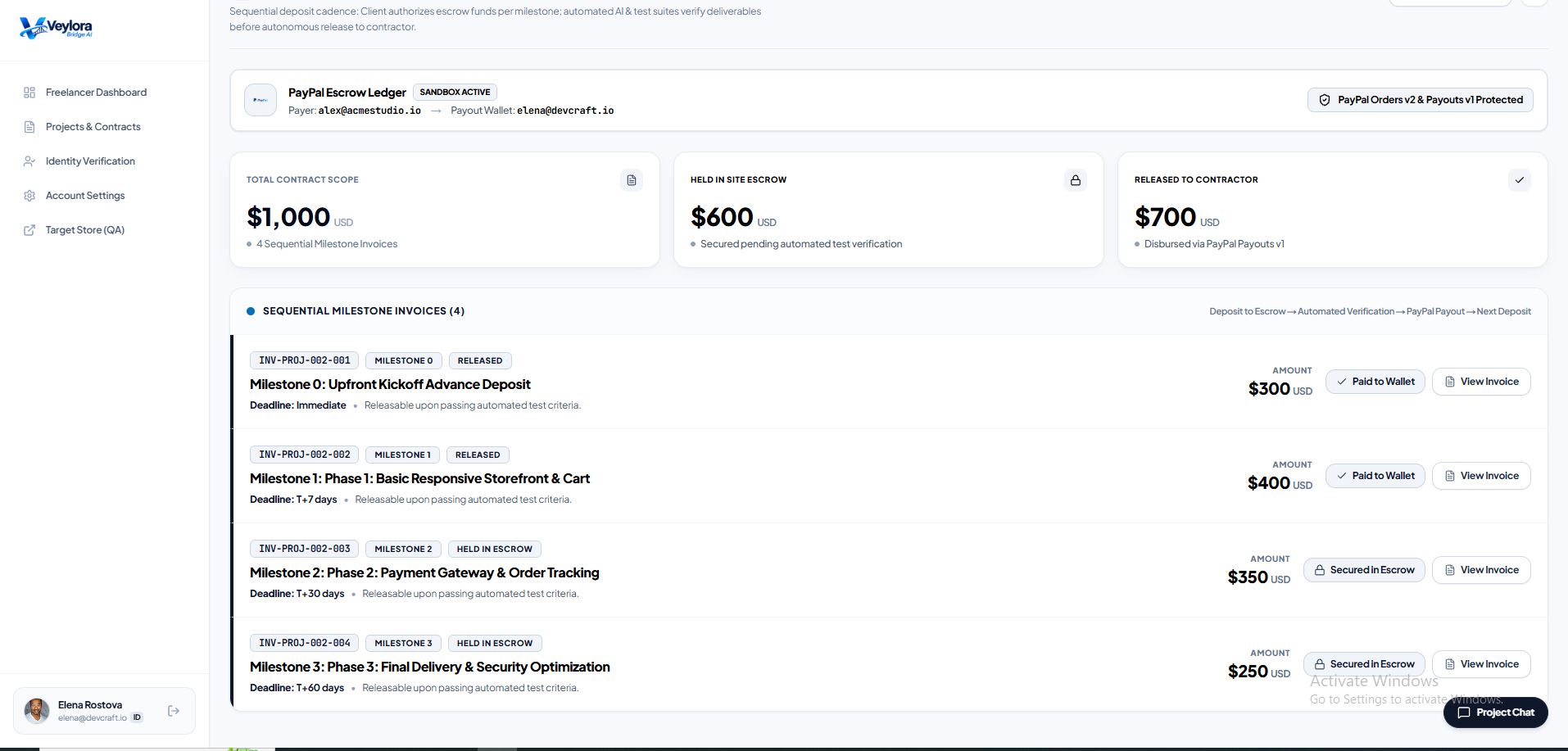
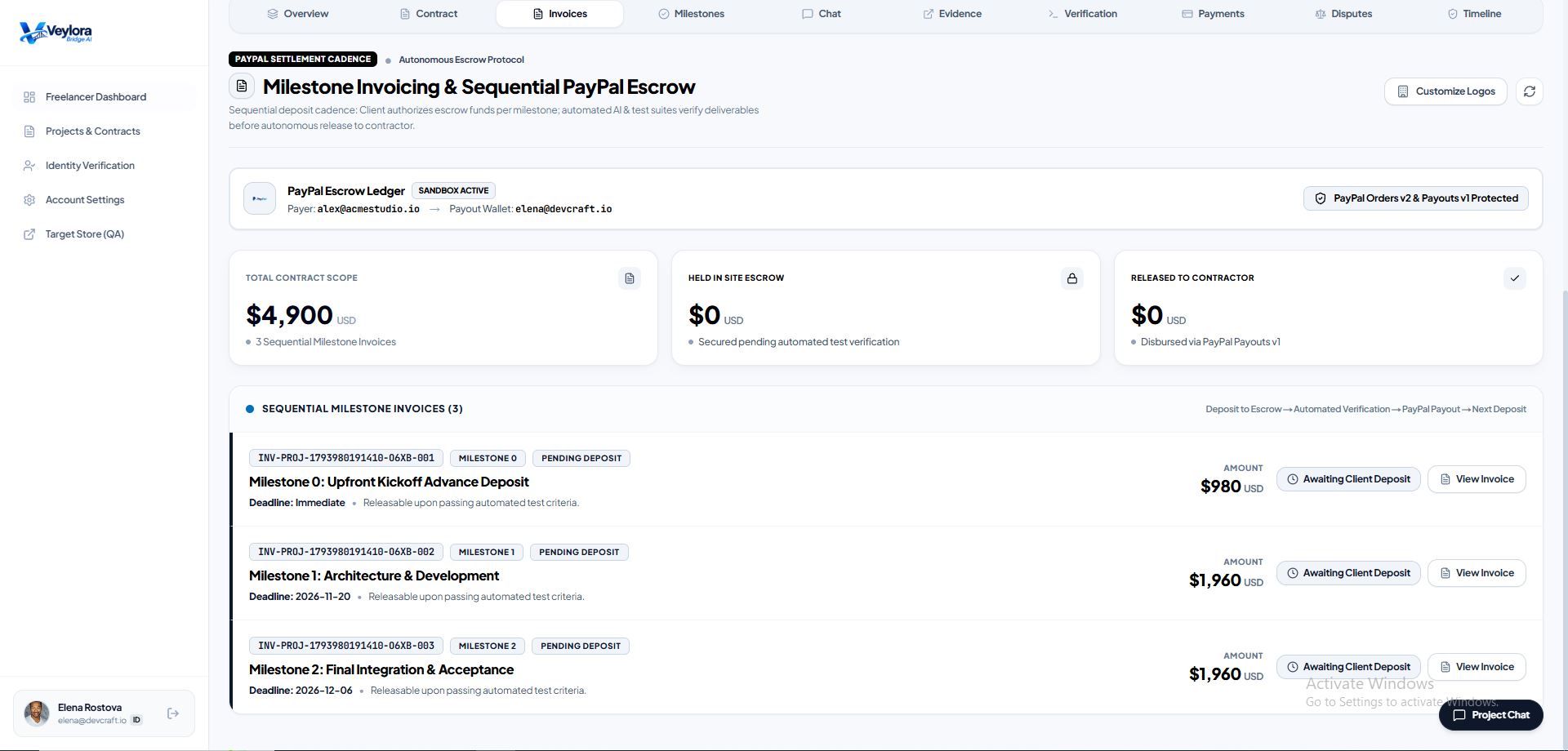
- Hybrid Payment Planning: Supports an advance-payment workflow and a future model where an authorized payment provider secures the remaining balance for milestone-based disbursement.
- AI Work Verification: Evaluates submitted deliverables against agreed requirements and generates evidence-based reports.
- Dispute Assistance: Uses AI to compare contract terms, submissions, and feedback to help both parties understand disagreements.
The platform provides dedicated dashboards for freelancers, clients, and administrators, connected through a shared project workspace.
How We Built It
We designed Veylora Bridge AI around a modular full-stack architecture, combining modern web technologies, artificial intelligence, automated verification, and payment APIs.
Frontend: Next.js, React, TypeScript, and Tailwind CSS for responsive dashboards and project management interfaces.
Backend: Python FastAPI for authentication, agreements, milestones, verification workflows, and payment orchestration.
Database: PostgreSQL with Supabase for storing users, contracts, milestones, payment records, and audit histories.
Artificial Intelligence: LLM-powered workflows for contract generation, risk analysis, requirement extraction, work verification summaries, and dispute assistance.
Automated Verification: Playwright and GitHub integrations designed to inspect supported software deliverables and produce traceable test evidence.
Payments: PayPal Developer Platform and Sandbox for testing authorized payment flows, with a modular provider architecture for future approved holding and disbursement integrations.
The system separates AI recommendations from financial decisions. AI can identify risks, analyze evidence, and recommend next steps, but payment approvals remain under authorized human and payment-provider control.
Challenges We Faced
1. Designing a Fair System for Both Parties
Our first challenge was ensuring that Veylora protects the interests of both freelancers and clients.
We designed mutual agreement approval, versioned contracts, transparent milestone requirements, and evidence-based review processes so neither party controls the entire workflow.
2. Turning Subjective Requirements Into Measurable Deliverables
Freelance requirements are often vague. A request such as "build a modern, professional website" cannot be reliably verified without further clarification.
We addressed this in the design by using AI to translate natural-language requirements into measurable acceptance criteria that can be reviewed or tested.
3. Integrating AI With Real-World Work Verification
AI-generated responses alone are not sufficient proof that a freelancer completed a project.
Our approach combines deterministic verification methods, such as automated browser tests, with AI-generated explanations. The goal is to distinguish verified results from assumptions and tasks requiring human review.
4. Understanding Payment and Escrow Restrictions
One of the most important challenges was designing the hybrid payment model responsibly.
Traditional PayPal Checkout does not automatically provide escrow or indefinite holding of customer funds. We therefore separated standard Sandbox payment integration from the proposed future held-balance functionality, which would require an appropriately authorized payment provider.
5. International Developer Access
Developing from a region without standard PayPal account registration support introduced additional challenges when exploring Sandbox credentials and developer access.
This highlighted the importance of international collaboration, payment-provider eligibility, and flexible integration architecture.
What We Learned
Building Veylora Bridge AI taught us that trust in digital transactions requires more than a payment gateway.
We learned the importance of:
- Designing AI systems that produce explainable, evidence-based recommendations.
- Separating automated verification from human approval.
- Understanding the technical and regulatory limitations of payment platforms.
- Creating transparent workflows for two parties with potentially conflicting interests.
- Designing modular systems that can support different payment providers and future capabilities.
- Treating security, privacy, and financial accountability as fundamental product requirements.
Most importantly, we learned that AI becomes more valuable when it helps people make better decisions rather than making sensitive decisions for them.
What's Next for Veylora Bridge AI?
Our long-term vision is to transform Veylora into a global trust infrastructure for independent professional services.
Planned improvements include:
- Integration with approved escrow or marketplace payment providers.
- More advanced AI-powered deliverable verification.
- Support for designers, writers, marketers, and consultants.
- AI-assisted contract amendments and scope-change detection.
- Multilingual contracts and international collaboration.
- Advanced fraud detection and project risk analysis.
- Mobile applications and agency collaboration tools.
We envision a future where freelancers and clients can work together confidently, regardless of where they originally connected.
Veylora Bridge AI is not another freelance marketplace. It is the bridge between agreements, verified work, and confident payments.
Built With
- agents
- antigravity
- claude
- css
- fastapi
- gemini
- generative
- github
- javascript
- llm
- next.js
- paypal
- playwright
- postgresql
- python
- react
- rest
- sandbox
- supabase
- tailwind
- typescript

