-
-
Vextis
-
Vextis-ERP
-
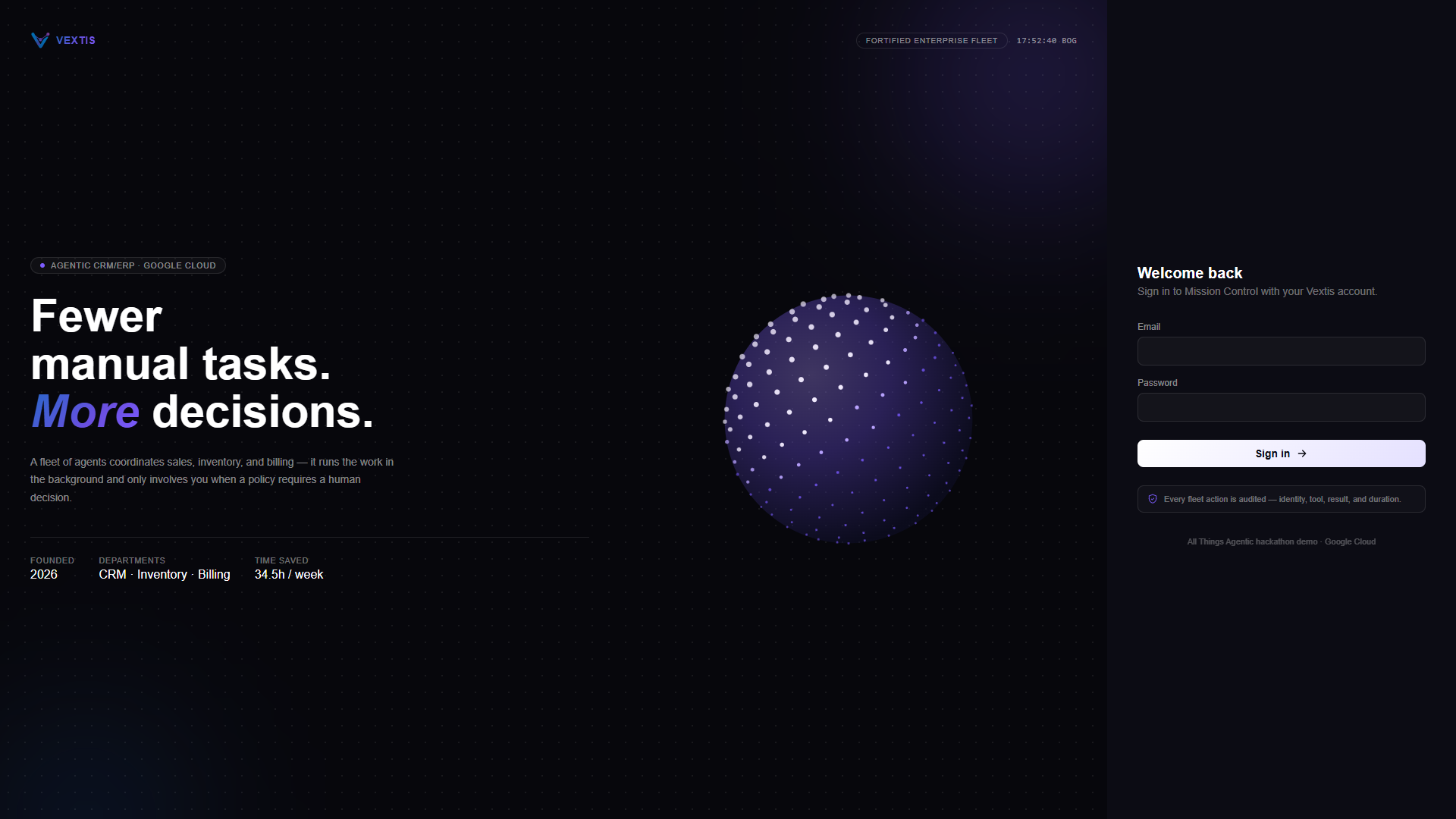
Login
-
Dashboard
-
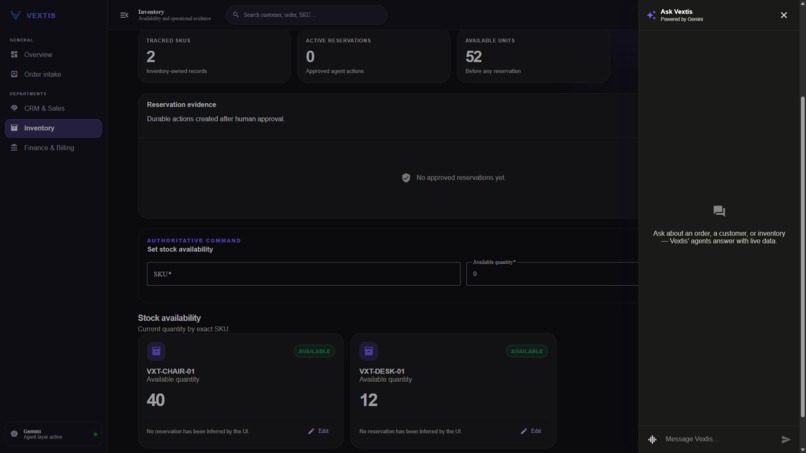
Chat view
Inspiration
Enterprise teams still process purchase orders, customer requests, inventory checks, credit validations, and invoices through fragmented systems, spreadsheets, emails, and manual coordination.
At the same time, introducing autonomous AI agents into these workflows creates what we call the Rogue Agent Dilemma: an LLM can reason creatively, but giving it unrestricted database access is too dangerous for real enterprise operations.
Vextis was inspired by a simple question:
Can an enterprise agent fleet be autonomous enough to create real operational value while remaining governed, auditable, and safe?
We built Vextis to demonstrate that AI agents do not need unrestricted authority to be useful. They can plan and coordinate work, while deterministic enterprise software remains responsible for authorization, validation, and transactional consistency.
What it does
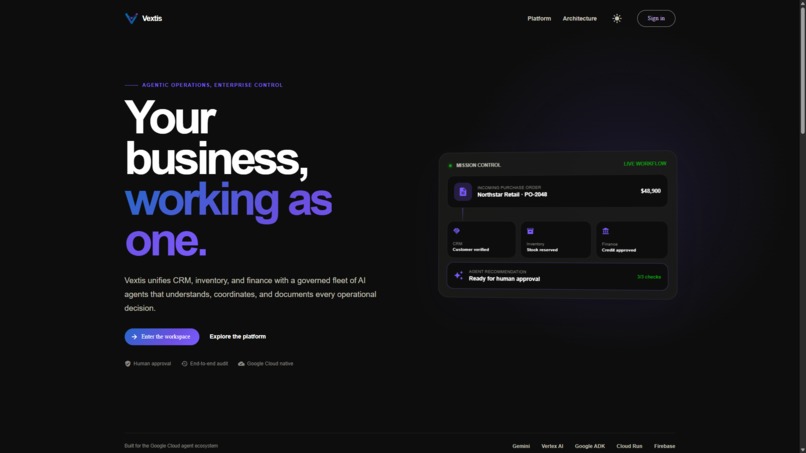
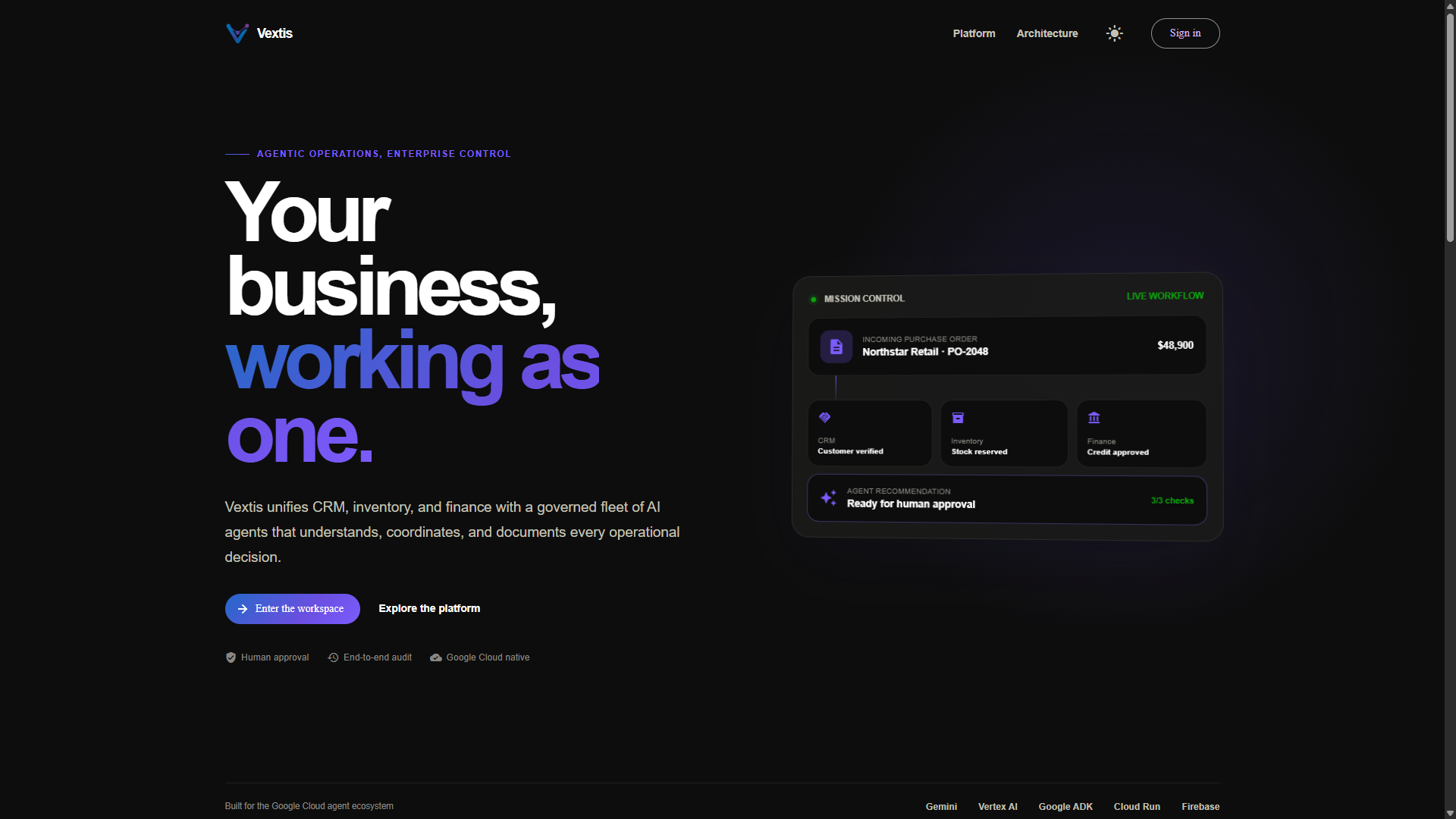
Vextis is a governed, Gemini-powered enterprise operating system that coordinates Sales, Inventory, and Finance through a fortified fleet of specialized agents.
A user can submit an unstructured purchase order PDF. Vextis then:
- Stores and processes the document securely.
- Uses Gemini 3.5 Flash to extract structured order information.
- Creates a bounded order-to-cash execution plan.
- Coordinates CRM, Inventory, and Billing agents.
- Validates the customer and commercial context.
- Checks and reserves real inventory.
- Evaluates credit and payment terms.
- Pauses for human approval when a sensitive decision is required.
- Produces a durable audit trail for every agent, tool call, decision, and result.
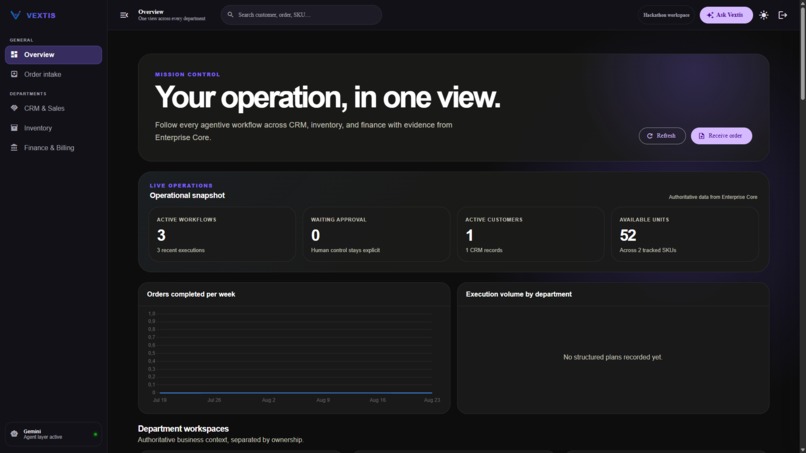
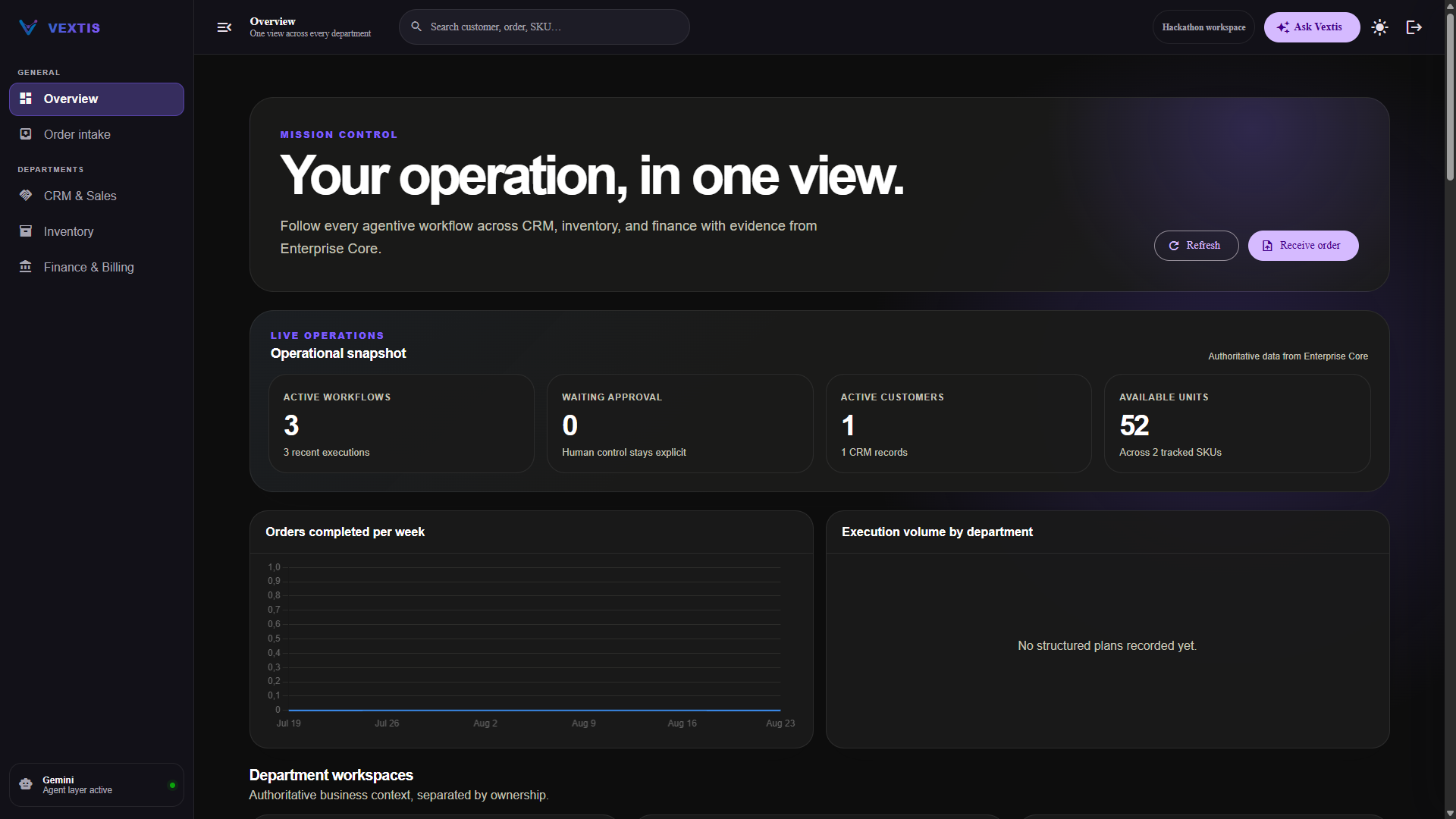
Mission Control displays the active agent registry, model and prompt versions, capabilities, tool allowlists, workflow status, and recent activity.
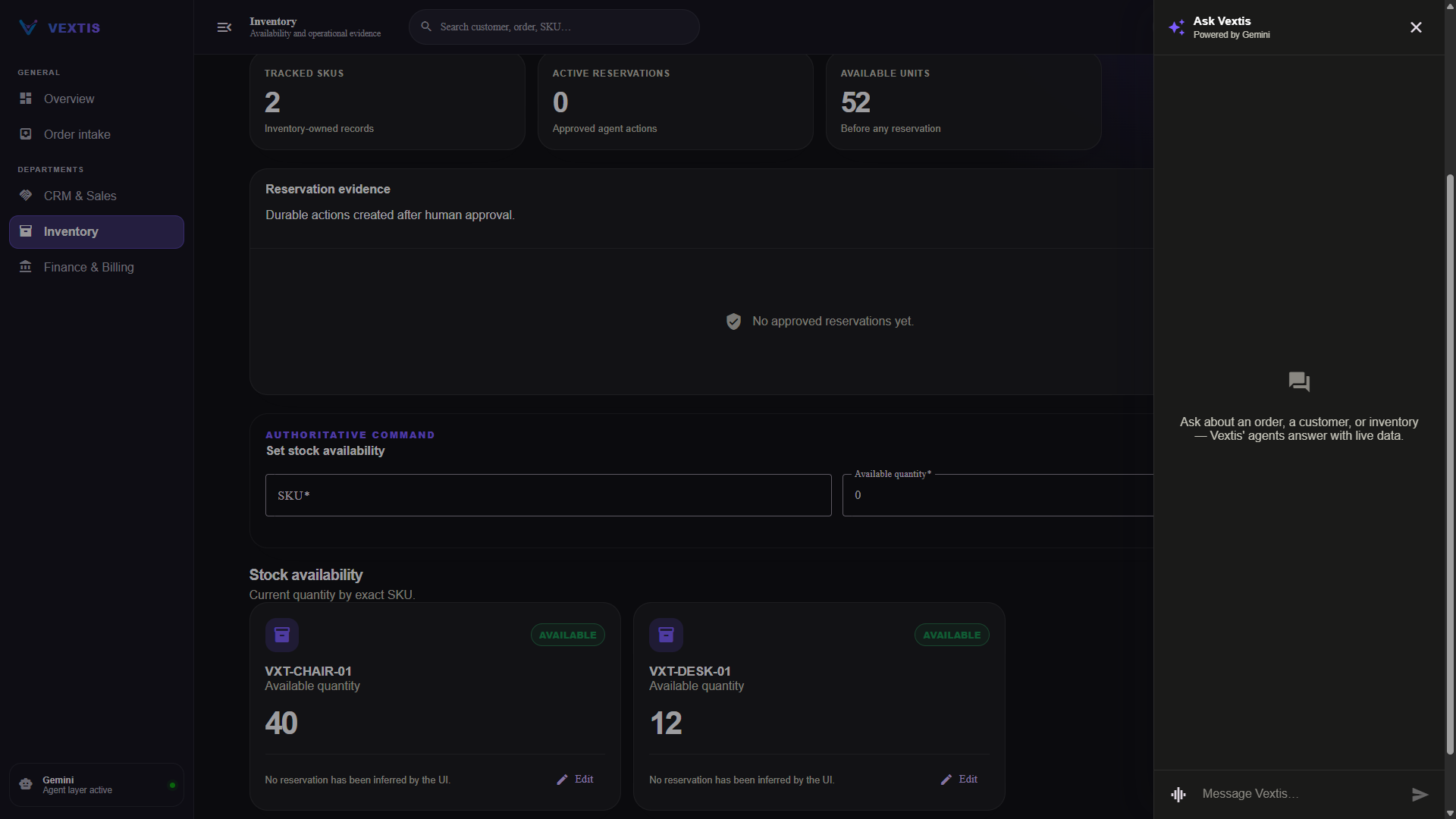
Vextis also includes Ask Vextis, a conversational interface supporting grounded enterprise Q&A through PostgreSQL and pgvector, plus real-time voice interaction through Gemini Live.
How we built it
Vextis uses a dual-runtime architecture designed around a strict separation between probabilistic reasoning and deterministic business execution.
The frontend is an Angular application deployed through Firebase Hosting. It provides Mission Control, purchase-order intake, CRM, Inventory, Finance, approvals, audit views, search, and the Ask Vextis assistant.
The Enterprise Core is a modular Java 21 and Spring Boot application deployed to Cloud Run. It is the sole transactional authority. Agents never write directly to business tables. Every mutation passes through authenticated tools, tenant isolation, business rules, idempotency controls, and server-side authorization.
The Agent Runtime is built with Python 3.13, Google Agent Development Kit, and Gemini 3.5 Flash. It coordinates the specialist fleet, processes documents, generates structured plans, performs grounded retrieval, and invokes only the tools permitted to each registered agent.
The two runtimes communicate asynchronously using a transactional outbox and Google Cloud Pub/Sub. Cloud SQL for PostgreSQL stores business state, audit records, workflow executions, and vector embeddings. Cloud Storage holds source documents and generated assets, while Secret Manager protects service configuration.
Our contracts are version-controlled using GraphQL, OpenAPI, AsyncAPI, and JSON Schema. Terraform provisions the Google Cloud infrastructure, and selective CI/CD pipelines independently validate and deploy the Web, Enterprise Core, and Agent Runtime.
Challenges we faced
The largest challenge was defining a safe boundary between AI autonomy and enterprise authority. Prompt instructions alone are not security controls, so we implemented deterministic tool policies inside the Java Enterprise Core. Even if an agent requests an unauthorized action, the Core rejects it and records the attempt.
Reliable asynchronous execution was another major challenge. Pub/Sub provides at-least-once delivery, which means every workflow operation must be idempotent and resilient to retries. We introduced stable event IDs, correlation IDs, transactional outbox publishing, and durable workflow state.
Structured model output also required careful engineering. Pydantic, Google ADK, and the Google GenAI SDK do not support every JSON Schema constraint in exactly the same way. We created regression tests against the actual SDK transformation layer while keeping important business invariants enforced at runtime.
Finally, coordinating authentication, multi-tenant isolation, Cloud Run service identities, PDF processing, real-time audio, and a coherent user experience within a hackathon timeline required us to prioritize thin, demonstrable vertical slices.
What we learned
We learned that trustworthy enterprise AI is primarily an architecture and governance problem, not only a prompting problem.
Google ADK and Gemini are powerful for planning, extraction, routing, and multi-agent coordination, but business authority should remain in deterministic services. This separation allowed us to combine flexible AI reasoning with auditable and predictable ERP behavior.
We also learned that observability is part of the product. Agent identity, tool scope, model version, workflow state, approvals, and correlation IDs must be visible to users if an enterprise is expected to trust autonomous systems.
Most importantly, we learned that autonomy and control are not opposites. With explicit contracts, bounded tools, human approval checkpoints, and durable audit evidence, they reinforce each other.
What’s next
Next, we want to add B2B EDI connectors, predictive inventory replenishment, richer proposal media, stronger workflow recovery controls, and a mobile Gemini Live experience for warehouse teams.
Our long-term goal is to evolve Vextis into an enterprise platform where organizations can safely deploy, supervise, and scale specialized AI agent fleets without surrendering control of their operational data or business rules.
Built With
- angular.js
- cloud-pub-sub
- cloud-run
- cloud-sql
- cloud-storage
- fastapi
- firebase-hosting
- gemini-3.5-flash
- gemini-live
- google-agent-development-kit
- google-cloud
- google-gen-ai-sdk
- graphql
- imagen-3
- java
- postgresql
- python
- secret-manager
- spring-boot
- terraform
- typescript
- vertex-ai

Log in or sign up for Devpost to join the conversation.