Inspiration
Hand-arm vibration from power tools causes permanent nerve, blood-vessel and joint damage (hand-arm vibration syndrome, HAVS). UK employers manage it with the HSE points system: points = 2 × a² × T, where a is the tool's vibration in m/s² and T is trigger time in hours. 100 points is the exposure action value and 400 points is the exposure limit value.
The formula is easy. T is the weak input. Observed workers overestimated their own exposure time by a median 2.5× (Palmer et al., 2000), and questionnaire times reached a median 9× (McCallig et al., 2010), so most paper HAV records are guesses. In the US, NIOSH estimated about 1.45 million workers use vibrating tools, and OSHA has no hand-arm vibration limit.
Existing answers add dedicated hardware: RFID tags fitted to every tool, sensor gloves, separate wearables. Sites already hand power tools out from a crib. We asked: what if the checkout started the exposure clock, and the band the technician already wears did the timing?
What it does
Vexora turns a Vexo Open wrist band (band 07) into a vibration-exposure and job assistant for conveyor maintenance technicians, seeded on overland conveyor CV-102.
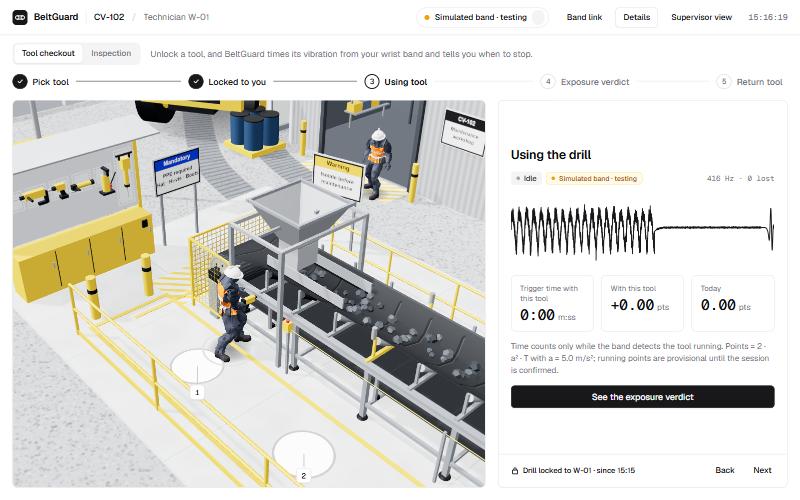
- Tool checkout locks a tool to the worker. The technician picks a tool from the crib (a card, the 3D tool wall, or by voice). Each tool shows its HSE reference vibration magnitude (drill 5, hammer drill 11, impact wrench 5, angle grinder 7, breaker hammer 14 m/s²; the power jack uses a conservative 2.5). Only that worker's trigger time counts toward the checkout.
- The band times real tool use. The band streams accelerometer and gyroscope data at 416 Hz. A detector marks when the tool is running, and trigger time comes from the band's own sample clock. Points rise only while the tool runs and stay "provisional" until the session is confirmed.
- Staged alerts on the band and the screen. One clear verdict with the minutes left to 100 and to 400 points: "Within the safe limit", "Action value reached: take a break or rotate", "Limit reached: stop using vibrating tools today". The band's LED and the screen escalate at each stage.
- The always-on band mic runs the job. The band's mic streams to Deepgram. Commands start with the wake word "Vexora" (for example "Vexora, how long can I keep going?") and cover station, tool checkout and return, exposure questions and job done, with spoken answers. What the technician says builds the job checklist, a clear defect report ("return idler seized") becomes a structured defect, and Vexora drafts the work order as a PDF for the supervisor. Code validates the station, and if it isn't clear, Vexora asks instead of guessing. Vexora never closes work, never authorizes isolation and never reassigns anyone: "job done" only moves a work order to awaiting supervisor verification. Team chat is recorded and marked ignored.
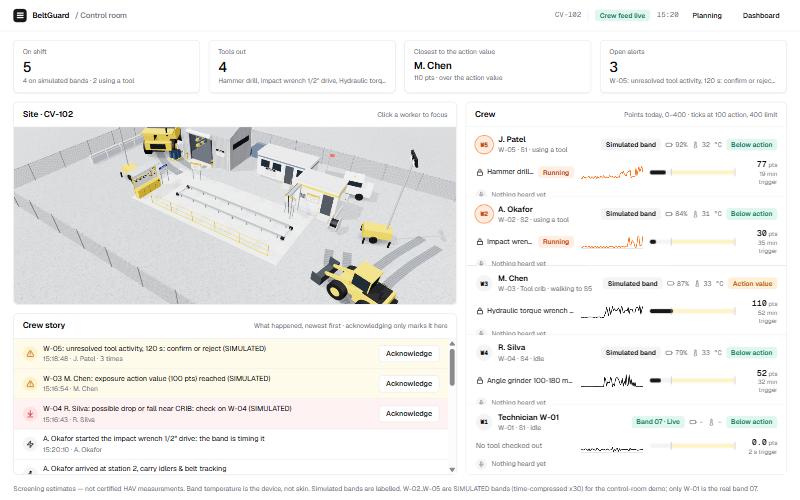
- Supervisor control room. Five workers against the exposure limits, with KPIs, the 3D site, a card per worker (tool, trigger time, 0–400 bar, verdict), alerts and a compliance report. W-01 is the real band 07. W-02 to W-05 are simulated, labelled "Simulated band" on screen, run in memory at 30× time and are never written to the database.
Why the band is essential
Take the band off and T goes back to a guess, with the same 2.5–9× error. The signal starts at the hand: the wrist moves with the tool from trigger pull to release. A phone in a pocket doesn't feel it, and no fixed camera follows a technician along a conveyor. Hands are busy and gloved, so the band's mic replaces the clipboard. And there are no tool tags: the tool comes from the crib checkout.
How we built it
- Hardware: Vexo Open band 07 (beta firmware 1.1.0): accelerometer and gyroscope at 416 Hz (16 g / 2000 dps), the 16 kHz always-on mic, the double-tap and free-fall events, and the RGB LED.
- Band link: Web Bluetooth in Chrome with the kit's JavaScript SDK, plus the official vexo_open Python SDK. One owner holds the band's single Bluetooth link; everything else reads from the backend.
- Backend: Python, FastAPI and uvicorn, an asyncio event hub broadcasting over WebSocket, and SQLite (every row has an id, a timestamp and a source).
- Tool-use detector: Python and numpy, with states idle, walking, gesture, possible tool use, tool running and unresolved, and a confidence score per session. Thresholds were set from band 07 recordings.
- Exposure engine: HSE points against 100/400, minutes left to each, a verdict per tool; every tool profile records its source.
- Voice: Deepgram nova-3 streaming speech-to-text, a deterministic intent parser for the wake word "Vexora" and the commands, a rules-based extractor that turns defect reports into structured defects, and work orders rendered to a one-page PDF.
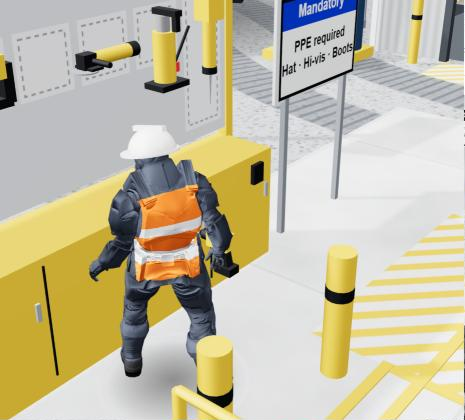
- Front end: vanilla JavaScript; a Three.js 3D conveyor site where the worker walks to the tool wall, picks the checked-out tool and works at the station; live wrist signals; the supervisor control room; spoken replies through the browser's speech API.
Challenges we ran into
- An always-on mic in a loud room. Commands need the wake word "Vexora", unaddressed speech only counts when it's a clear defect report, and a stray "yes" only counts right after Vexora asks a question.
- The band locks its LED while the mic is on. To flash an alert, Vexora pauses the audio, blinks, then resumes listening.
- The band holds one Bluetooth link. One owner holds it, and a second band-link page refuses to connect.
- Real sample rates drift. 416 Hz actually runs at 407–423 Hz, so every duration uses the band's clock, never sample counts.
- Keeping automation safe around isolation and work orders. Vexora drafts, code validates, people decide.
Accomplishments that we're proud of
- We measured band 07 directly instead of trusting the docs: 0 lost samples at 416 Hz on both sensors, and at 208 Hz with audio streaming at the same time.
- The voice end-to-end suite passed 87 of 88 checks with 0 failures (the one warning was fixed afterwards).
- The tool-use detector passes 21/21 synthetic tests and a 25-seed sweep with zero failures.
- Every number is labelled with its source, "provisional" or "confirmed", and "screening estimate".
What we learned
- The hard part of hand-arm vibration isn't the formula. It's trigger time.
- Keep the two inputs separate: the wrist is good at when, and the tool's reference value supplies how hard. Mixing them would turn a screening tool into a fake meter.
- Always-on voice needs a wake word, or the room's chat becomes data.
What's next
- Validate: compare trigger time against video and a reference ISO 5349 meter on real hammer drills, grinders and breakers.
- Connect: take checkouts from the real tool crib and the work-order system (SAP PM, Maximo), and write back exposure and defects.
- Grow: run on a phone instead of a laptop, and pilot with a conveyor maintenance contractor.
Honest limitations
- A screening estimate, not a certified HAV meter. The band times trigger use; it never measures vibration at the hand. a is an HSE reference value for the tool type, not the specific tool.
- In the demo, a phone on vibrate stands in for the power tool. We haven't tested on real power tools. Reaching 100 points takes about 25 minutes of real hammer-drill trigger time, so the live demo stays below the action value.
- W-02 to W-05 in the control room are simulated. Only W-01 is a real band.
- The band never names the tool; the checkout does.
- Always listening has a cost: audio streams to Deepgram and chat is stored (marked ignored). A deployment would need consent and data-retention rules.
- The laptop speaks the replies (the band has no speaker) and bridges Bluetooth. There's no phone app or cloud yet.
- Built in one day at VexoHacks; first commit at 10:00 AM on 2026-11-14.
Sources
HSE, Vibration risk assessment (points system, 100/400, Table 1 tool magnitudes); Control of Vibration at Work Regulations 2005; Palmer KT et al., Occup Environ Med 2000;57:237–241; McCallig M et al., Applied Ergonomics 2010;42(1):37–45; NIOSH Pub. 89-106; Safe Work Australia, guide to hand-arm vibration (2.5 m/s² floor).
Built With
- deepgram
- fastapi
- javascript
- numpy
- python
- sqlite
- three.js
- vexo-open
- web-bluetooth
- web-speech-api
- websockets
