-
-
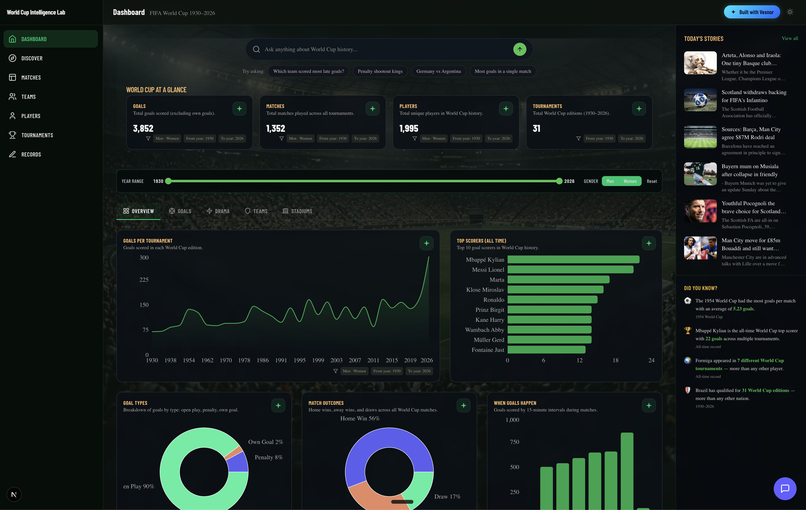
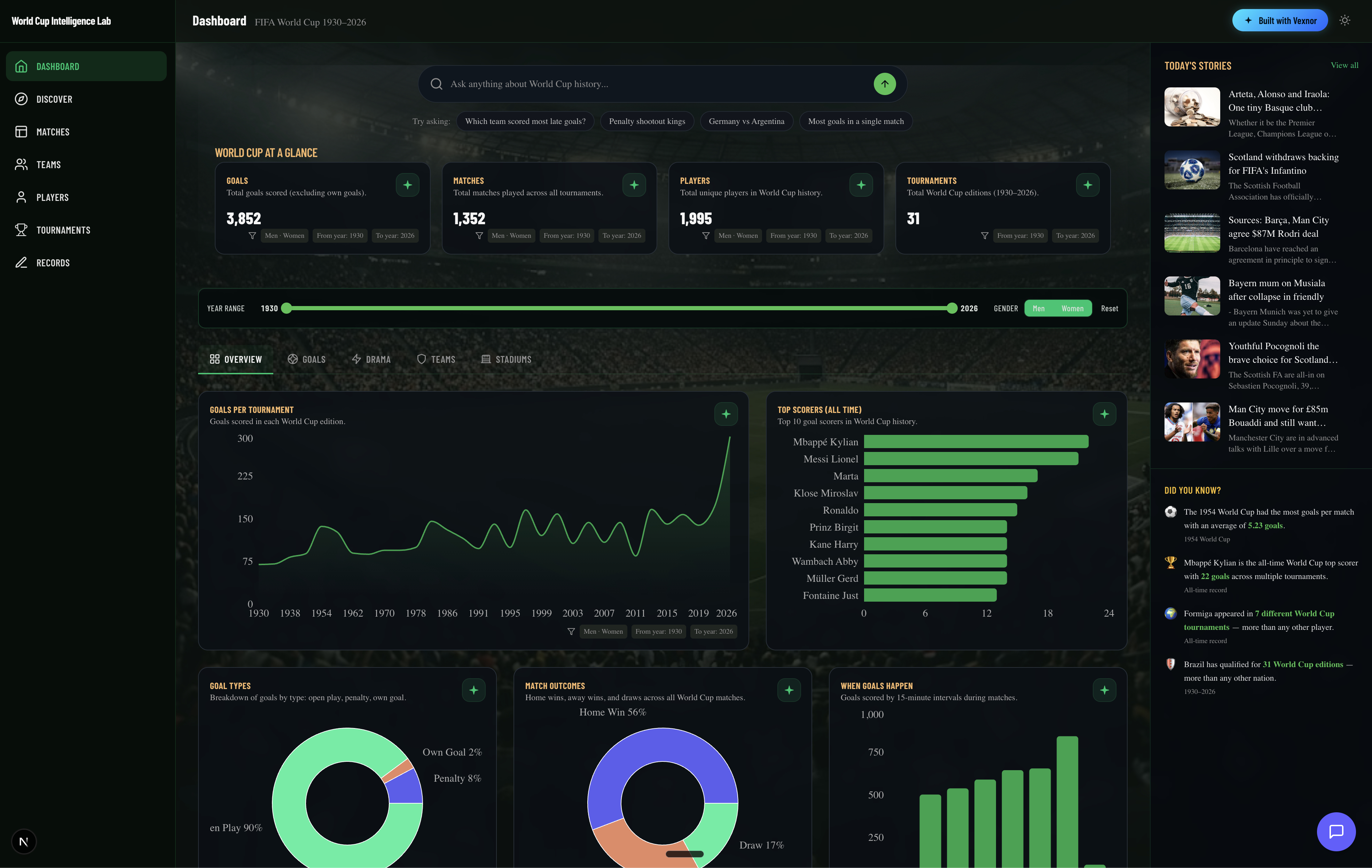
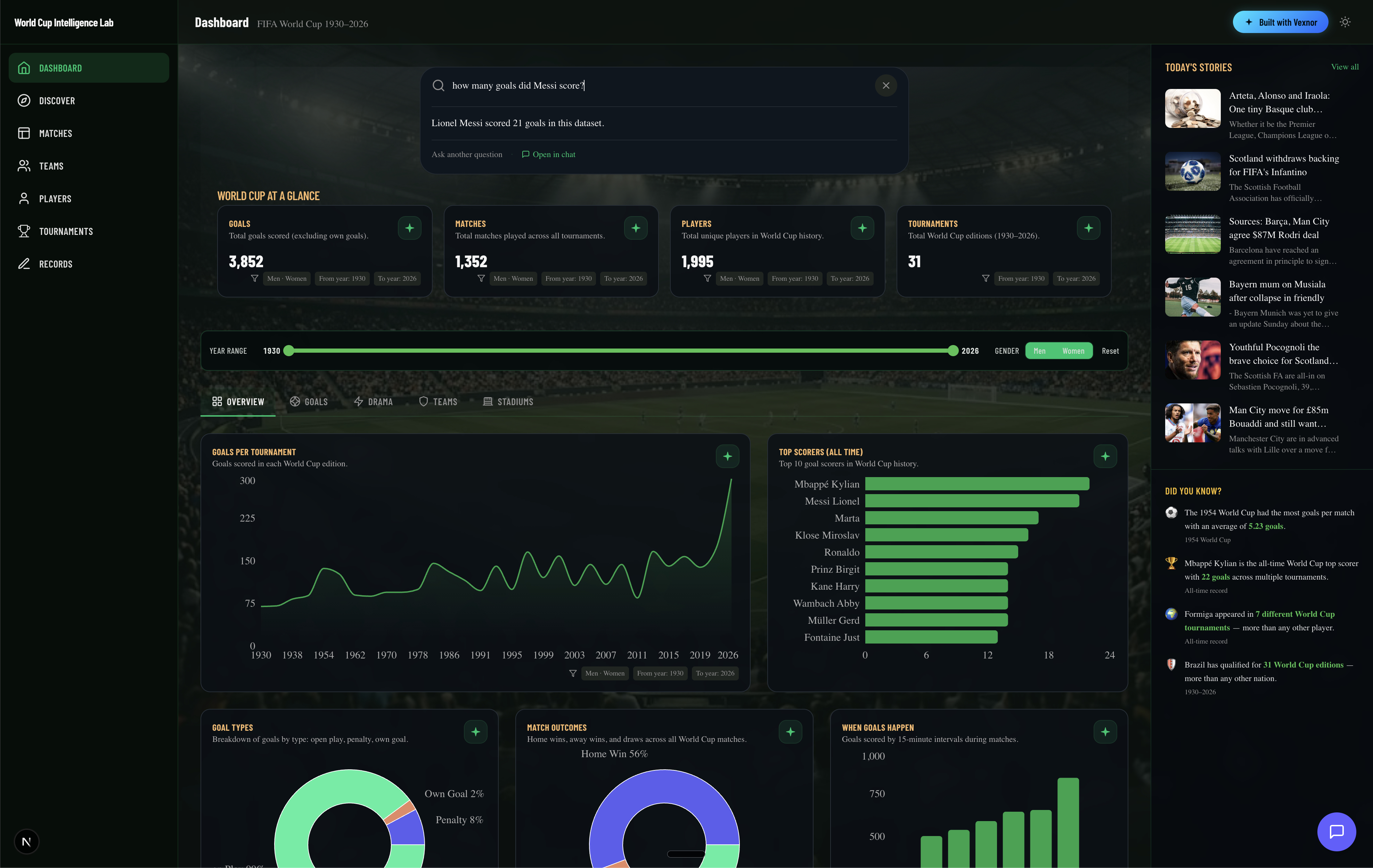
Built with Vexnor: an AI-generated, AI-native app that turns World Cup data into interactive insights and natural-language discovery.
-
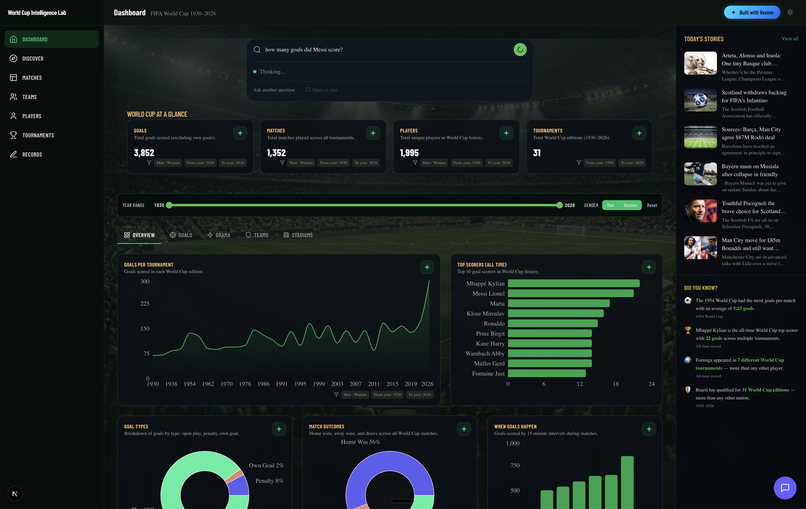
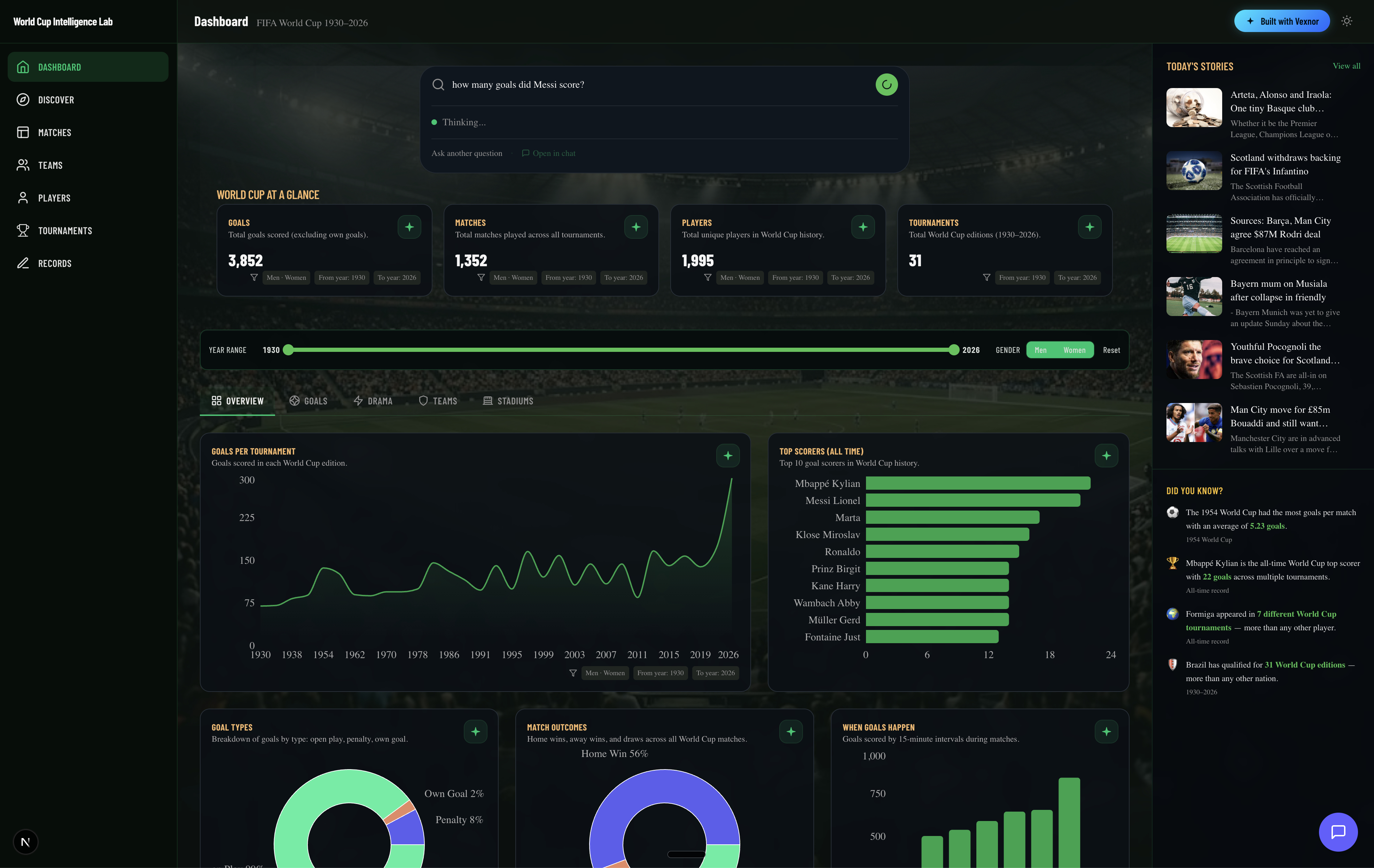
Vexnor generates AI-native apps where users can ask questions and explore their data in plain language.
-
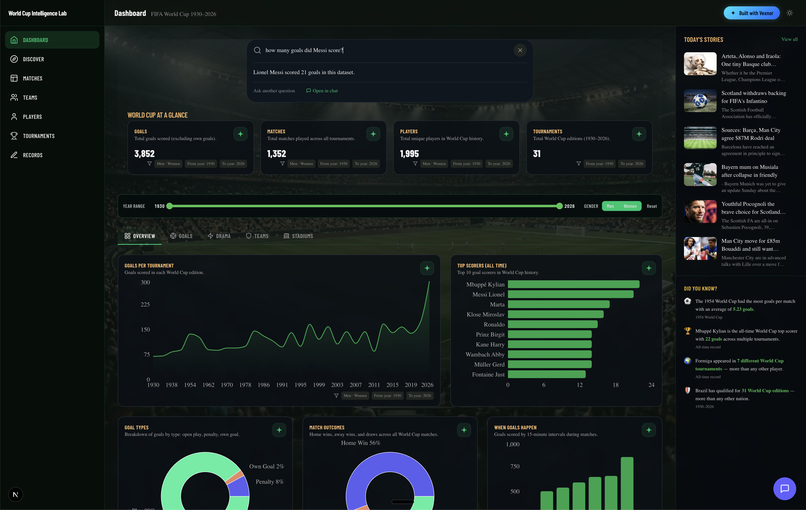
From question to answer: Vexnor’s AI-generated app understands natural language and retrieves insights directly from the dataset.
-
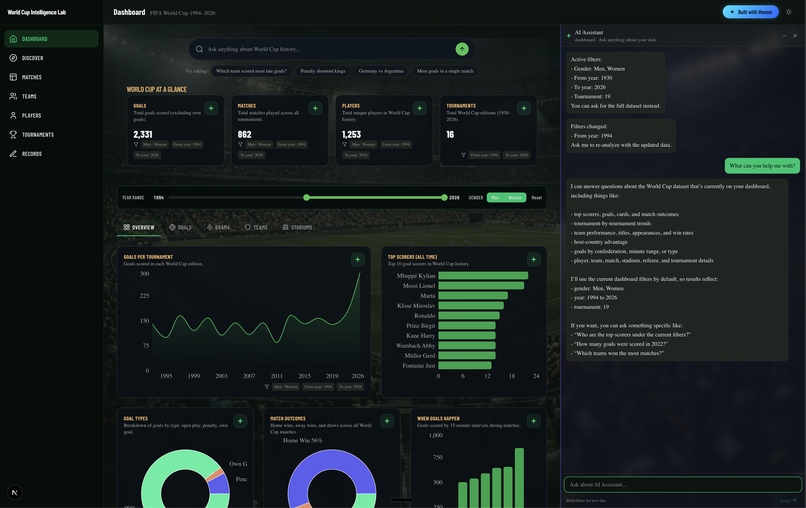
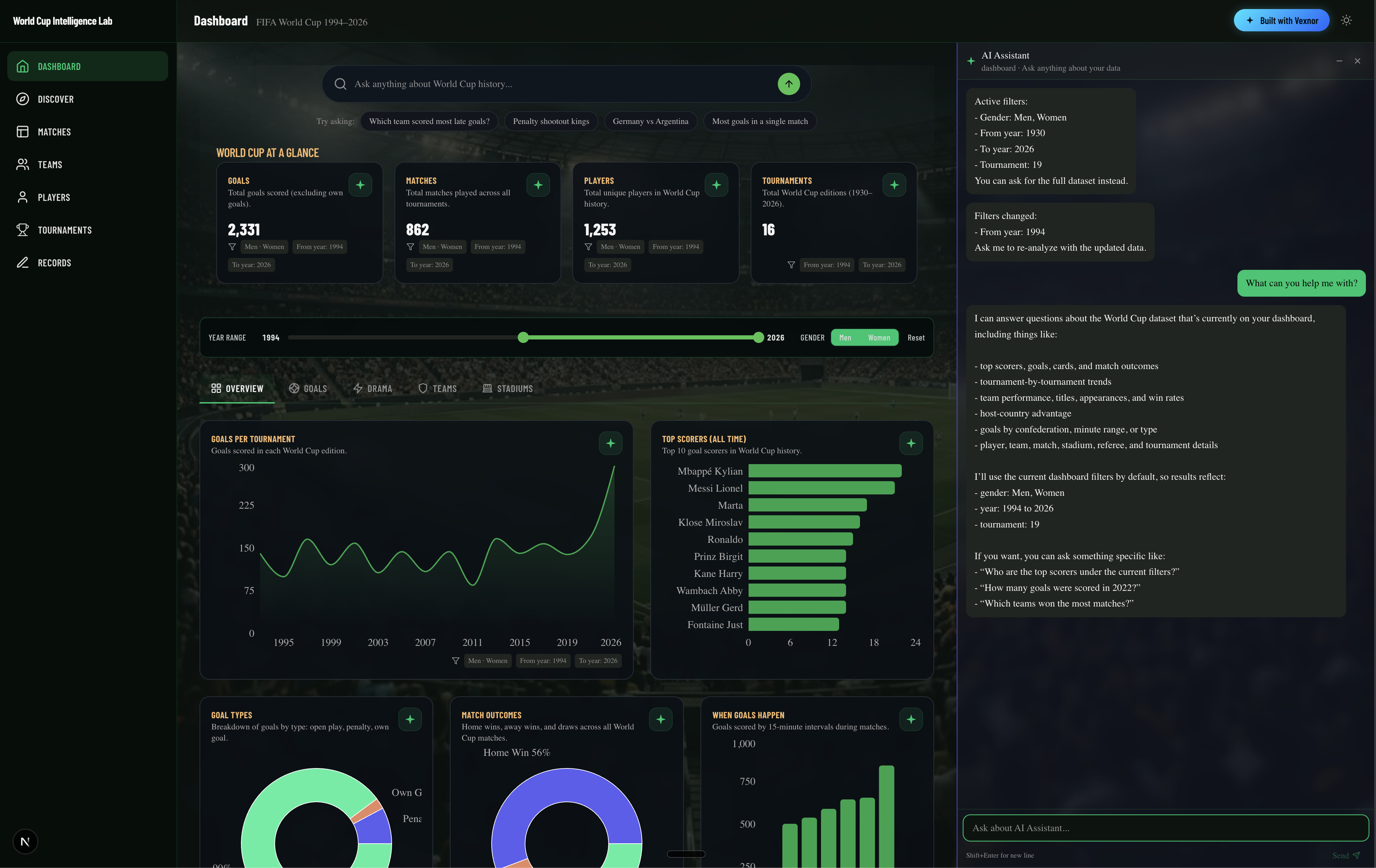
Vexnor generates context-aware AI assistants that understand active filters and make self-service analytics conversational.
-
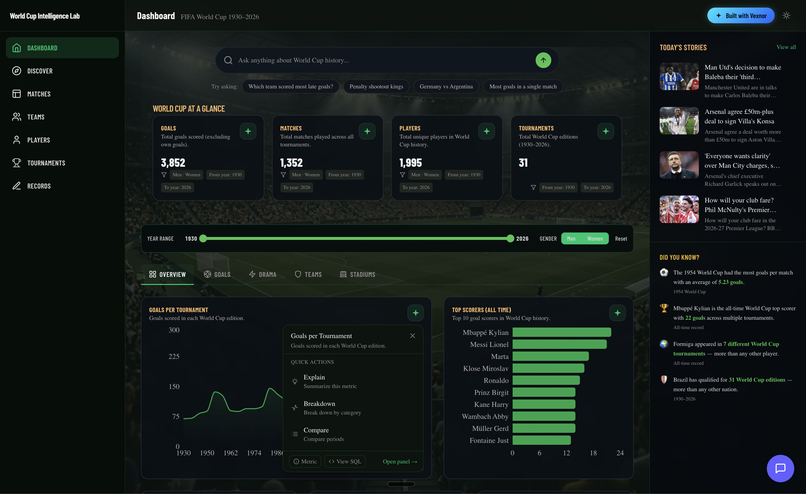
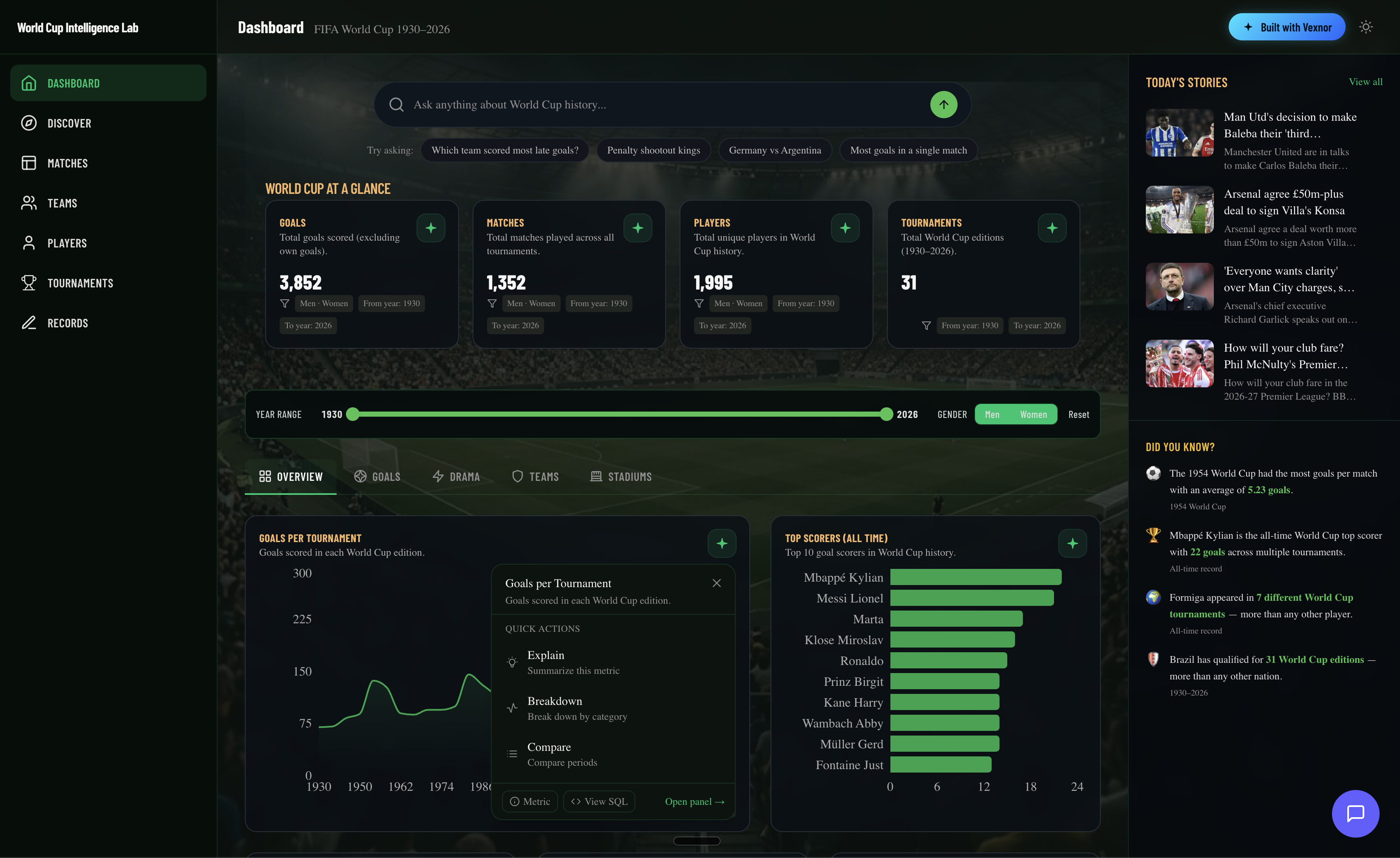
AI at every data point: explain, break down, compare, or inspect the SQL behind any metric in a Vexnor-generated app.
-
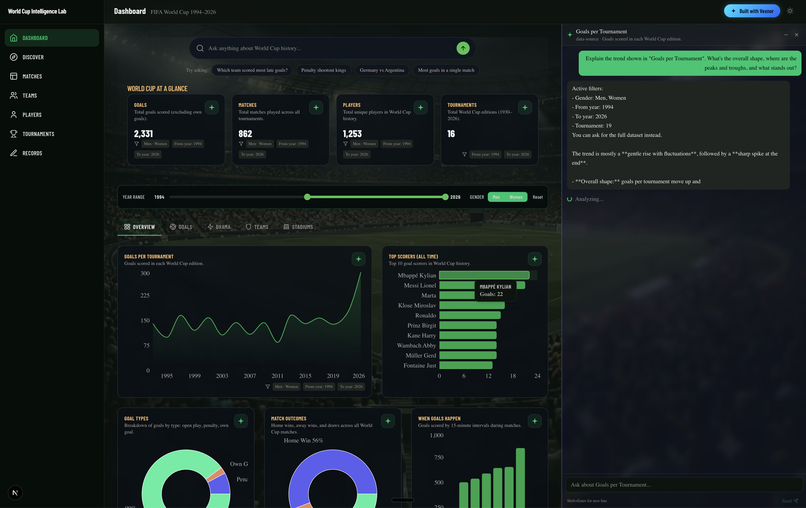
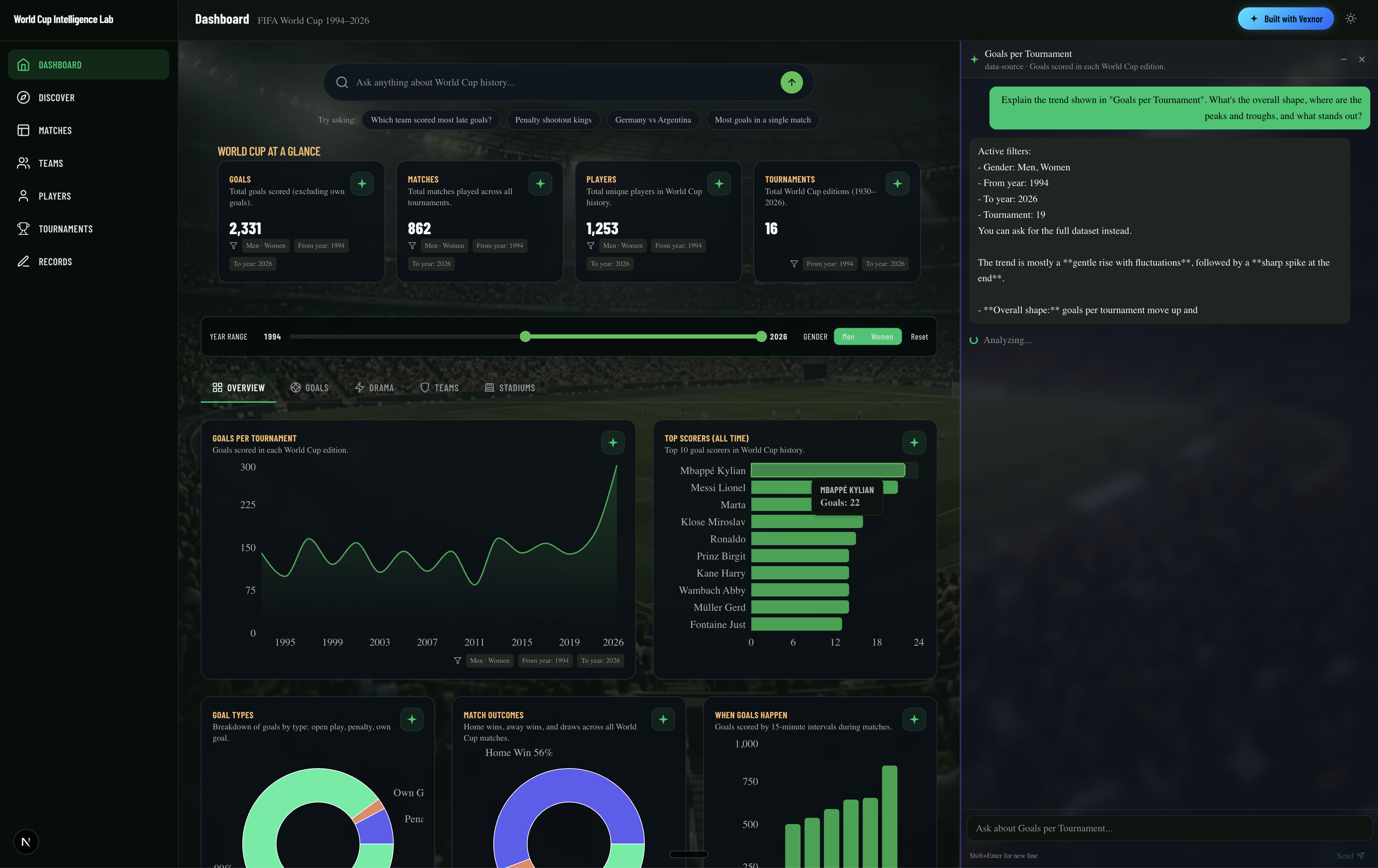
Vexnor turns every chart into a conversation: AI explains trends and surfaces peaks, troughs, and anomalies in context.
Inspiration
Small and medium businesses should not have to assemble a large data team before they can become AI-native. In the future, people, applications and agents should work from the same governed business definitions, metrics and context. Today, that knowledge remains fragmented across databases, spreadsheets, files, APIs and operational systems.
Vexnor is the data brain for that future. It turns fragmented business data into governed, AI-ready intelligence that can power applications today and give AI agents dependable context tomorrow, without forcing customers to surrender control of their data or infrastructure.
That vision grew from a pattern I saw across 20 years in software engineering: valuable analytics repeatedly fell to the bottom of product backlogs because they were necessary but rarely the core product. Vexnor turns that recurring gap into reusable infrastructure for smaller businesses.
What it does
Vexnor uses AI-assisted semantic discovery to understand a business domain, identify concepts and relationships, and propose useful metrics and filters. Those proposals become a governed semantic foundation that the customer can review.
From that foundation, Vexnor creates interactive data applications with dashboards, filters, drill-downs and conversational analysis. The same governed capabilities can also be exposed to existing applications and AI agents through APIs and the Model Context Protocol.
The World Cup demonstration turns a complex football dataset into an interactive data application with governed metrics, coordinated filters, visual exploration and conversational analysis. It demonstrates the core Vexnor thesis: AI should understand the business question while tested platform capabilities execute the experience predictably.
AI is used where reasoning adds value: understanding a domain, proposing semantics and shaping the desired experience. Vexnor handles repeatable application behavior through tested platform capabilities and a structured application definition. This makes the result more predictable than asking a model to regenerate an entire analytics application for every customer.
Privacy and portability are central. Vexnor is designed for hosted, customer-hosted and on-premises deployment models. Generated applications can be containerized so customers can operate them in their chosen environment without surrendering permanent control of their data or intelligence.
How I built it
I built Vexnor Studio around a reusable TypeScript SDK, a structured AppDefinition contract and a schema graph that represents data sources and relationships. Reference applications helped me identify the stable capabilities that belong in the platform, including filtering, visualization, data access, responsive layouts and conversational context.
The codebase integrates Gemini through Vertex AI for conversational data capabilities. The Google Cloud deployment architecture is designed around Cloud Run, Cloud SQL and Artifact Registry, with EU-focused resources in europe-west1.
By the submission deadline, the World Cup analytics demonstration will be available at worldcup.vexnor.app. A basic Vexnor deployment will also be available at app-dev.vexnor.com, clearly identified as the development environment. Both will remain accessible during judging.
The project builds on the pre-existing open-source Vexnor data-access library, whose research began in 2021. I disclose that library as an existing technical foundation. Vexnor Studio, the commercial product, generated application platform, Studio-specific SDK, application definitions and AI-assisted workflows are part of the new business and product developed during the hackathon period.
AI is part of my daily workflow. I used Gemini, Kiro, OpenAI Codex, ChatGPT and Google Antigravity to explore designs, challenge assumptions, draft implementations, generate tests, review code and investigate failures. This let a solo founder move at a pace that previously required a larger engineering team.
The division of responsibility remained explicit. AI proposed options and accelerated execution. I remained responsible for product direction, architecture, security and privacy decisions, semantic correctness, customer conversations, final code review and every claim made in this submission. Customer-specific meanings and governed metrics require human approval because technically valid output can still represent the wrong business concept.
Challenges I ran into
The hardest challenge was balancing flexibility with predictability. Business domains vary, but reliable applications cannot depend on unrestricted code generation. I addressed this by separating AI reasoning from deterministic platform behavior.
Semantic correctness was another major challenge. Tables and columns do not explain what revenue, retention or operational efficiency mean to a particular company. Vexnor therefore treats semantic definitions as governed business assets rather than disposable prompt context.
Privacy created a third constraint. Useful AI must coexist with environments where credentials, operational data or metadata cannot leave customer infrastructure. That requirement shaped the product's deployment choices and portable architecture.
Validation and economic opportunity
Vexnor is not yet generally available, and its early-access partners are not presented as production users. During the hackathon, three businesses paid to join the early-access program and agreed to help shape the product: ASTARION TECH, KLARIFAI BUSINESS INNOVATION and EverReal.
Together they represent traditional enterprise environments, consulting-led data and AI transformation, and an established software company pursuing an AI-first roadmap. Their participation validates both direct adoption and a partner-led route to market.
That partner model can create economic opportunities beyond the founder. Consultancies and systems integrators can introduce Vexnor, model customer domains, implement integrations, manage deployments, train users and provide ongoing services. Domain experts can turn their knowledge into reusable governed definitions, while smaller businesses gain access to capabilities that would otherwise require dedicated data and AI teams. The goal is to augment employees with better information and create higher-value work around implementation, governance and business improvement.
Accomplishments and lessons
I am proud that the hackathon produced more than a concept. It produced a newly incorporated business, a working product foundation, reusable generated-application capabilities, Gemini integration, an EU-focused cloud architecture and three paying design partners.
I learned that AI is most valuable when paired with clear contracts, reusable engineering and human judgment. I also learned that the semantic layer may become one of a company's most important AI-era assets. People, applications and agents should share reviewed definitions rather than repeatedly infer meaning from raw data.
What's next
The next step is to onboard the three design partners, validate their highest-value use cases and turn their feedback into a focused early-access roadmap. I will continue hardening the generation workflow, expanding the tested component catalog, improving deployment automation and refining partner workflows.
Beyond dashboards, Vexnor will extend the same governed foundation into data mining, process mining and scenario modeling. The long-term goal is to become the shared business brain through which people, applications and agents understand current operations, test possible futures and make better-informed decisions.
Built With
- chatgpt
- cloud-run
- cloud-sql
- code-generation
- data-federation
- docker
- duckdb
- gemini-api
- github-actions
- google-antigravity
- google-cloud
- jetbrains-webstorm
- kiro
- mcp
- next-js
- node.js
- openai-codex
- postgresql
- react
- redux-toolkit
- terraform
- typebox
- typescript
- vertex-ai
- vite-js

Log in or sign up for Devpost to join the conversation.