-
-
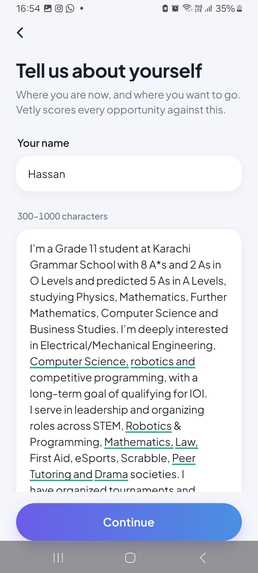
free onboarding screen
-

welcome screen
-
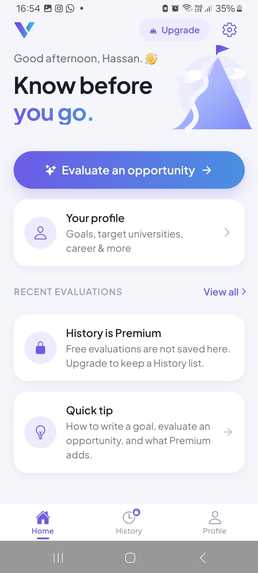
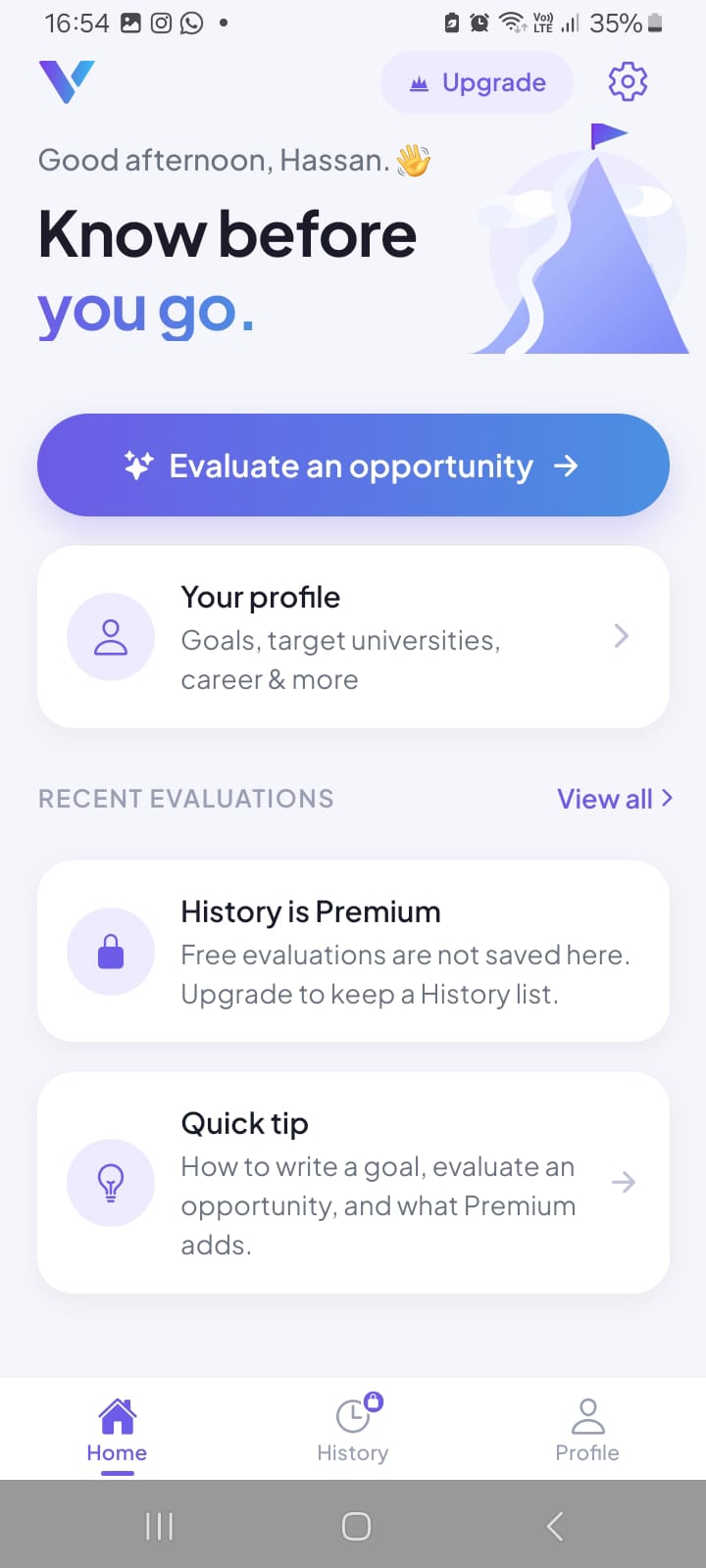
home screen
-

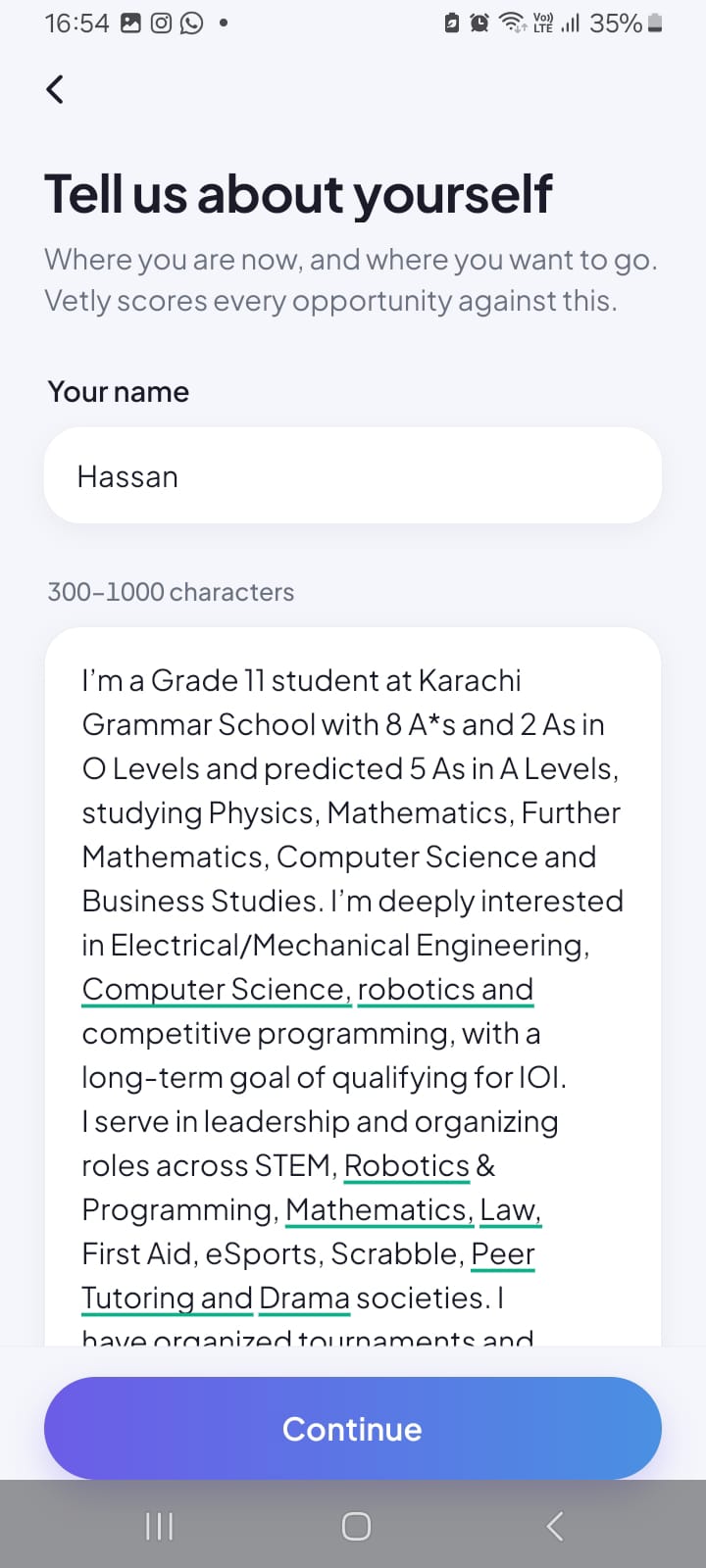
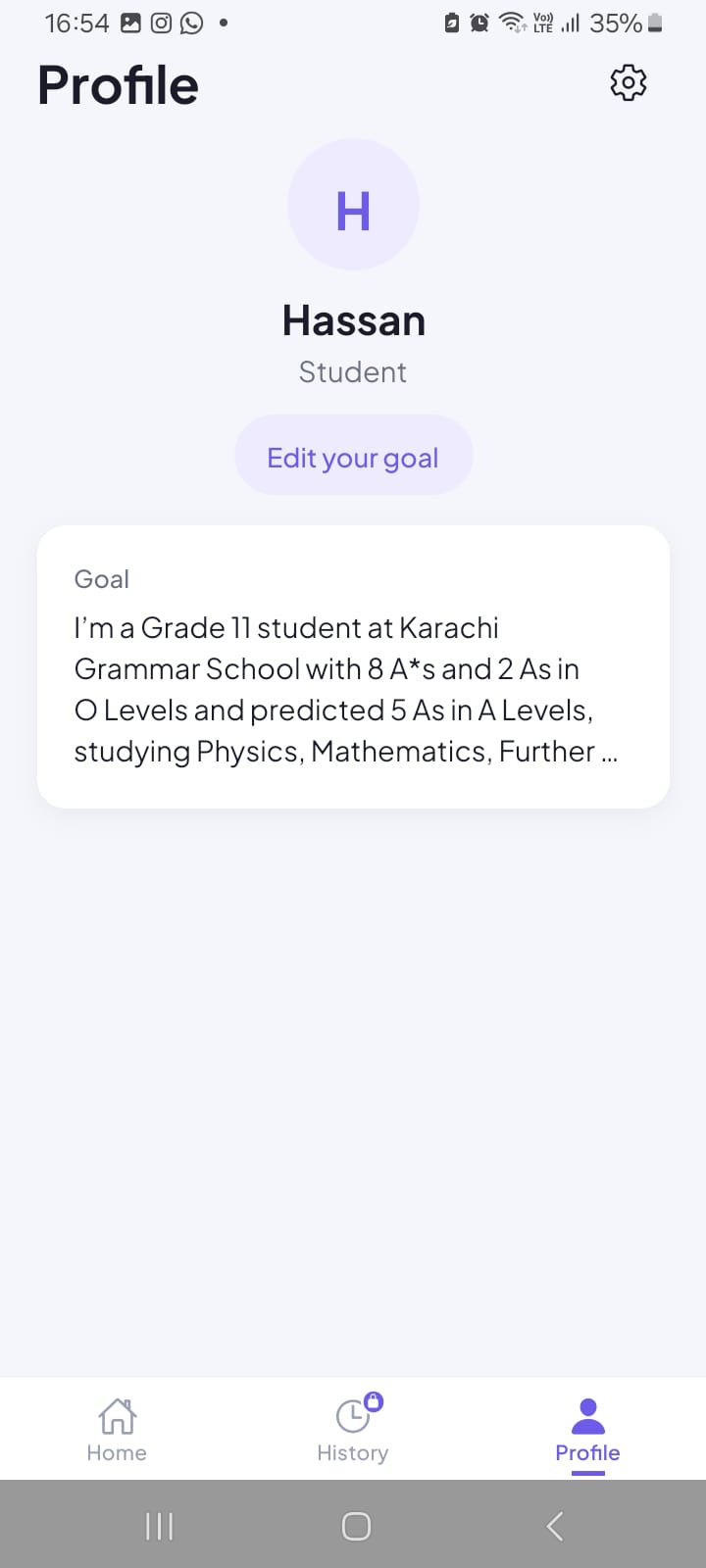
edit profile screen
-
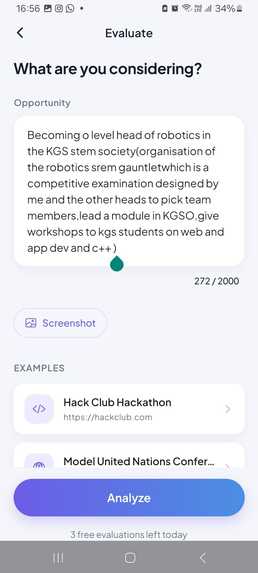
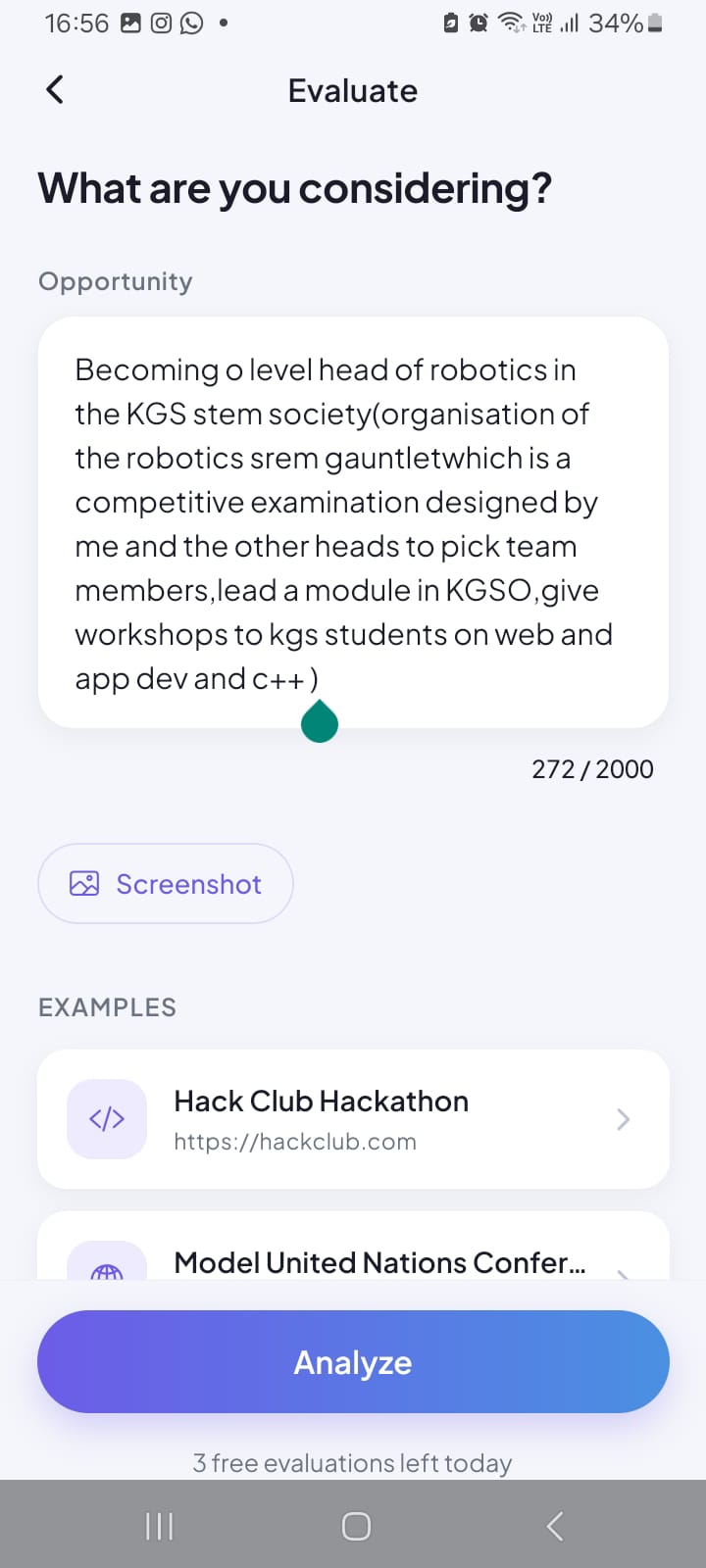
evaluate screen
-
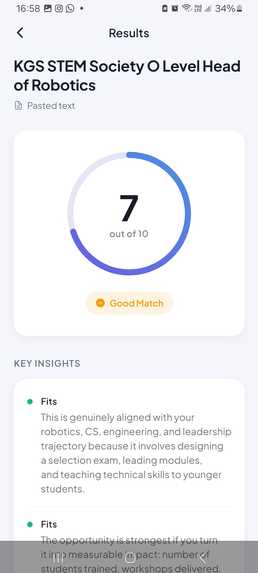
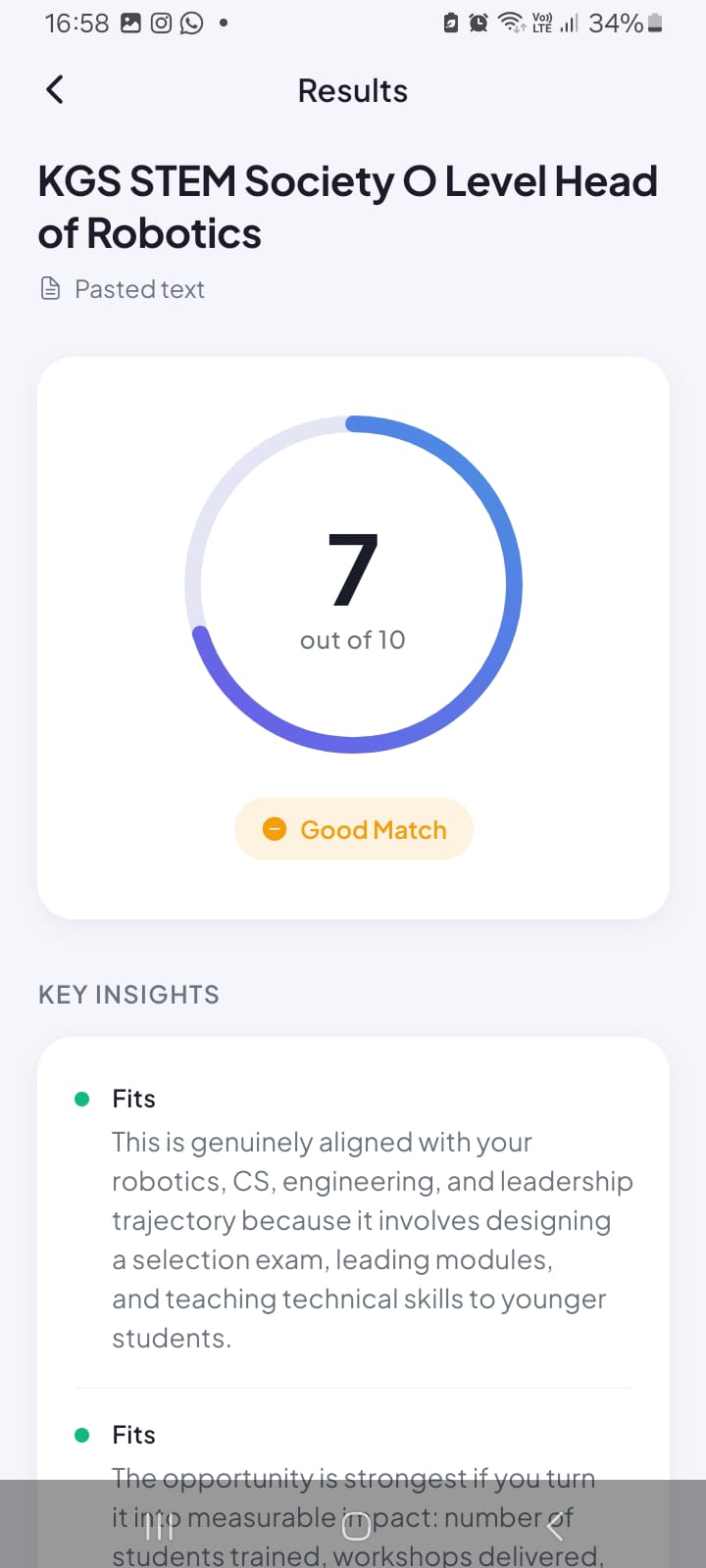
score/reason for score screen
-
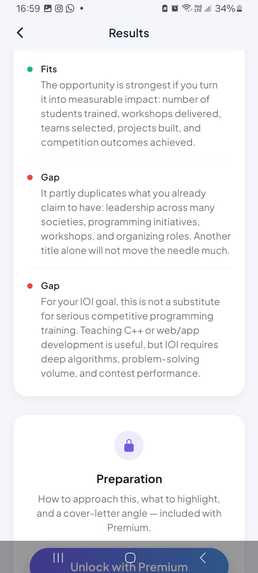
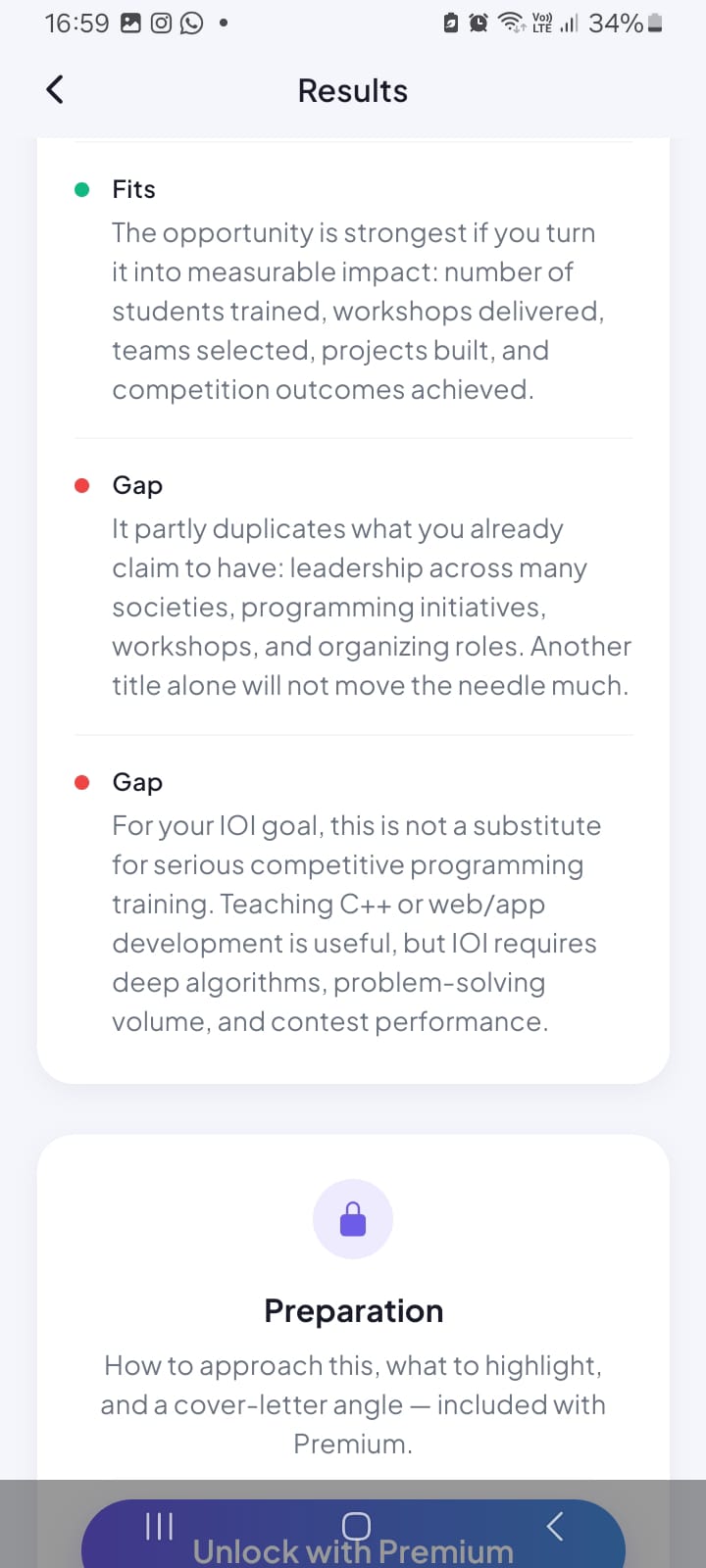
continuation of previous screen
-
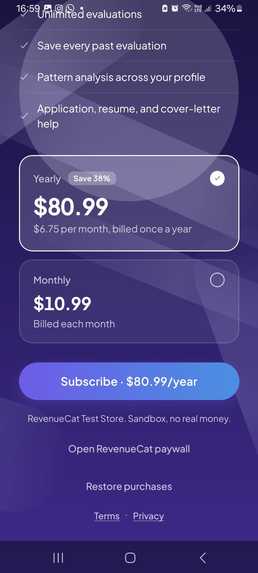
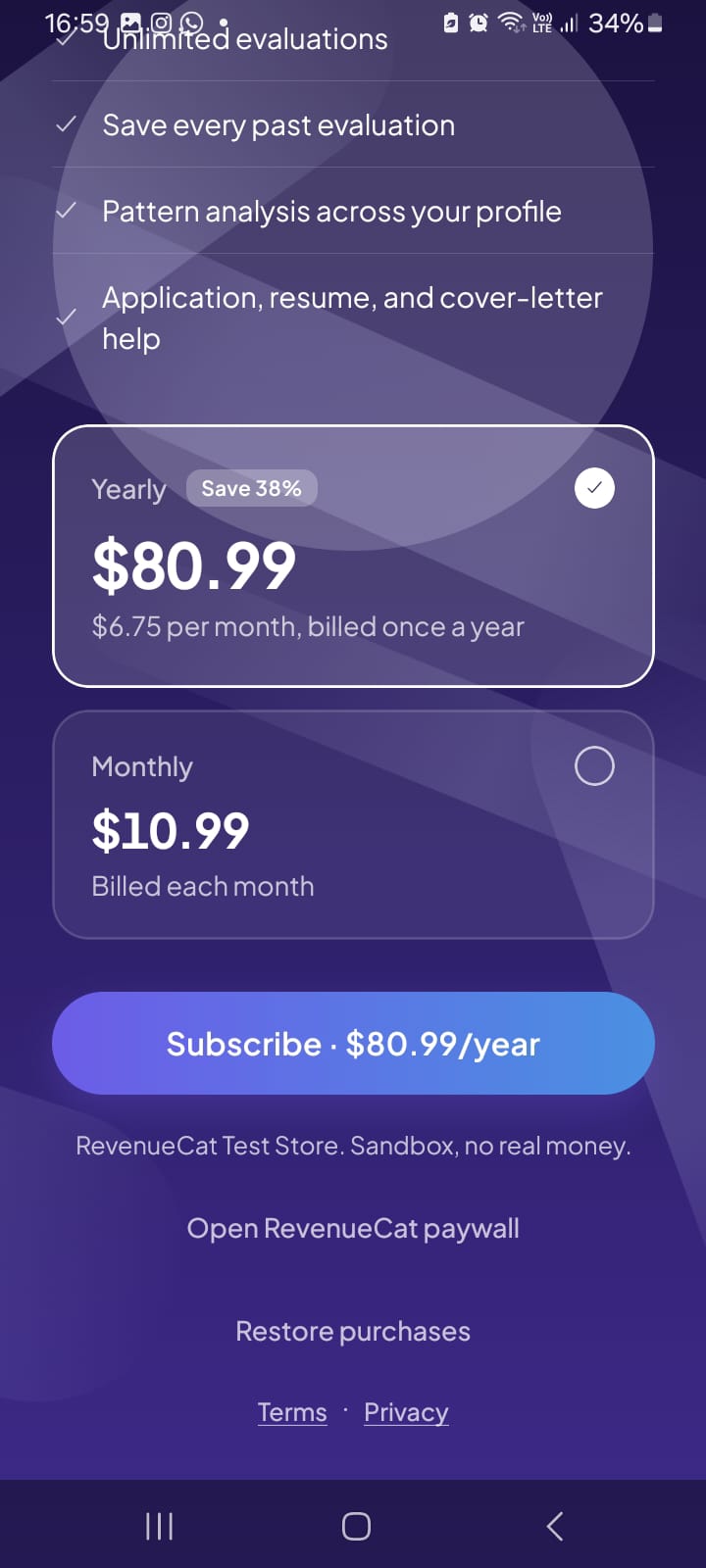
paywall screen
-
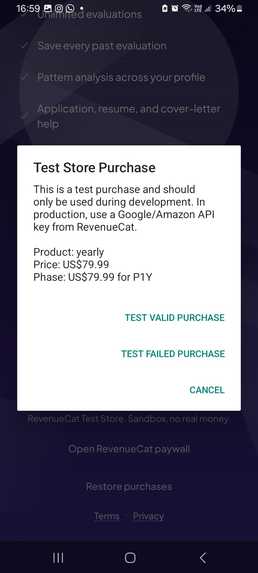
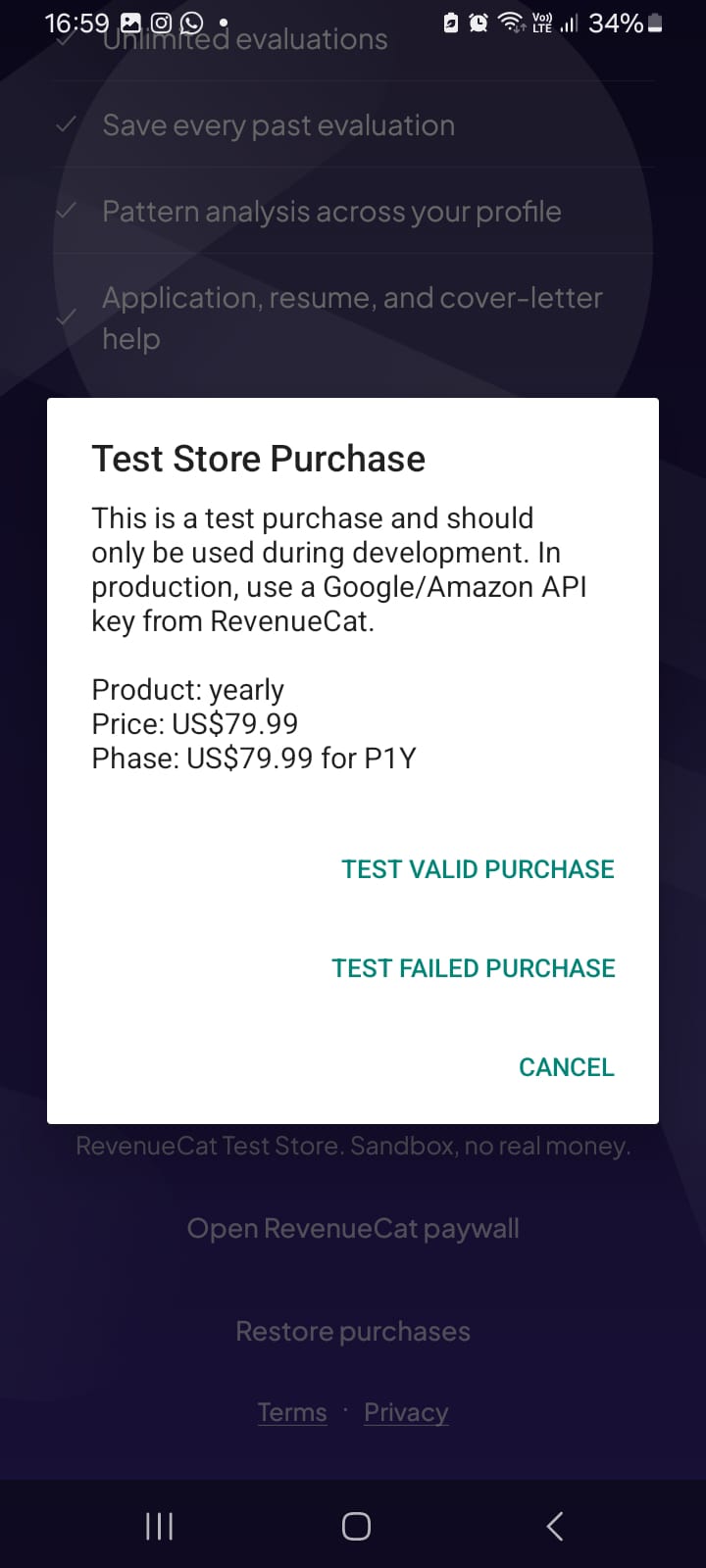
since its a sandbox paywall right now this pops up however dont worry the revanuecat sdk is integrated into the app this is just for testing
-
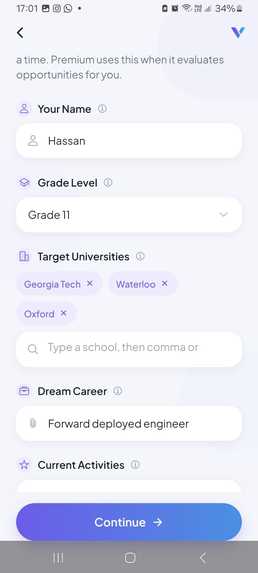
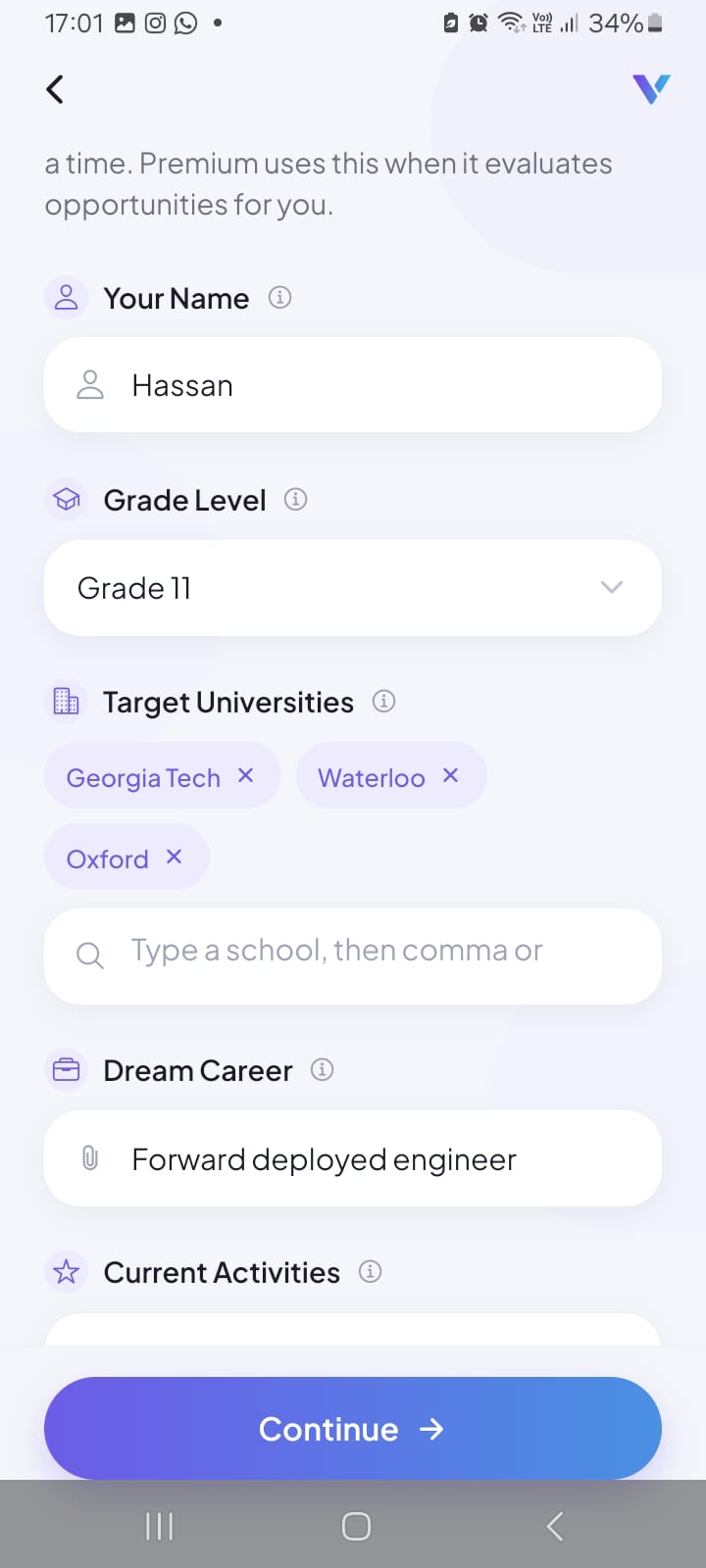
premium onboarding screen
-
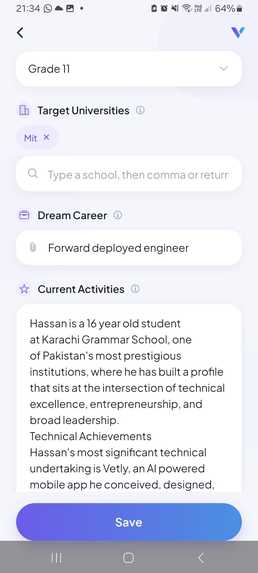
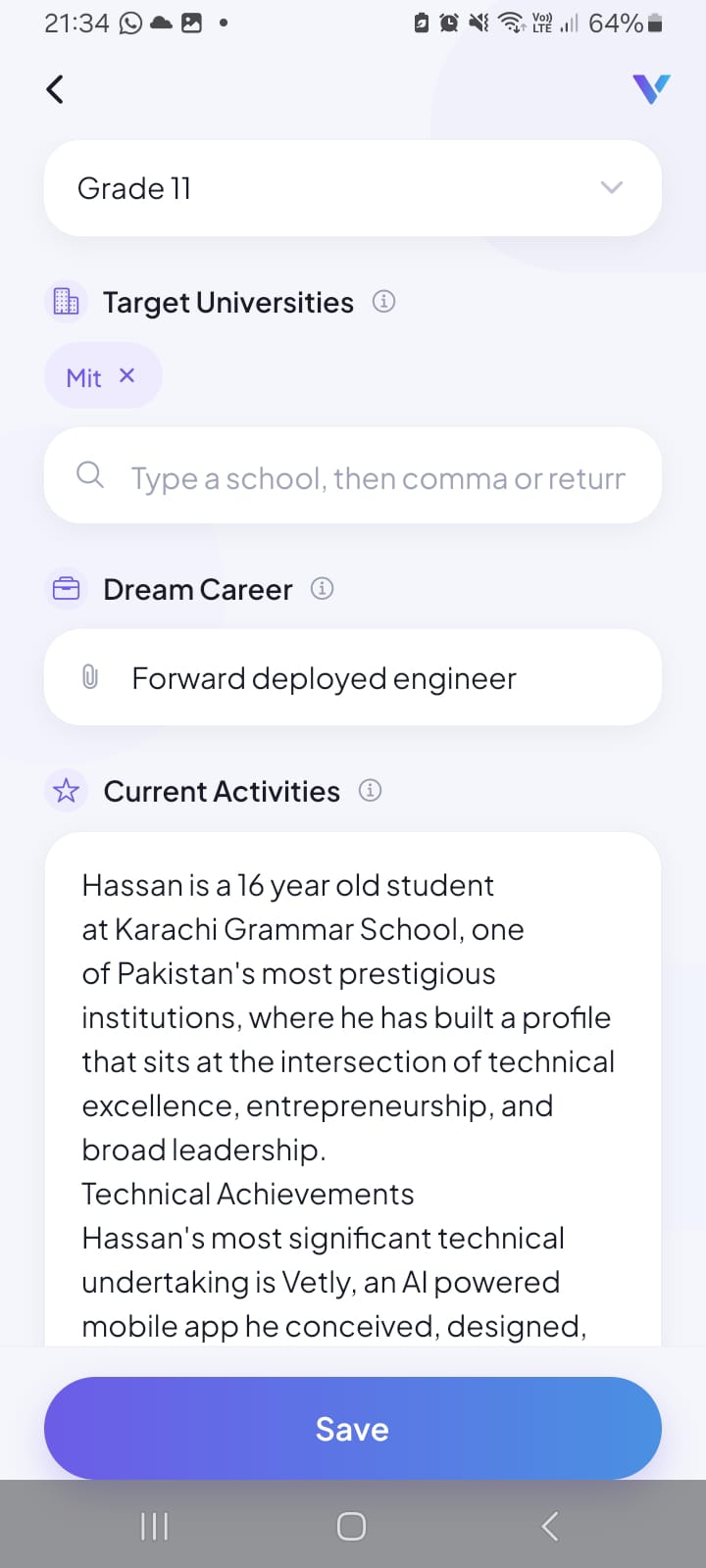
premium onboarding(continuation)
-
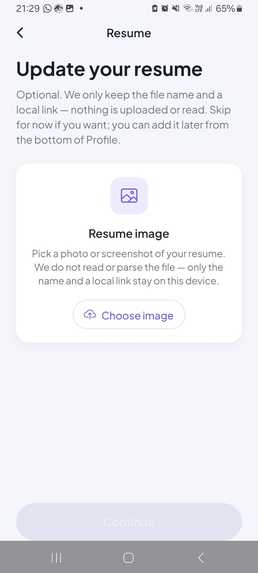
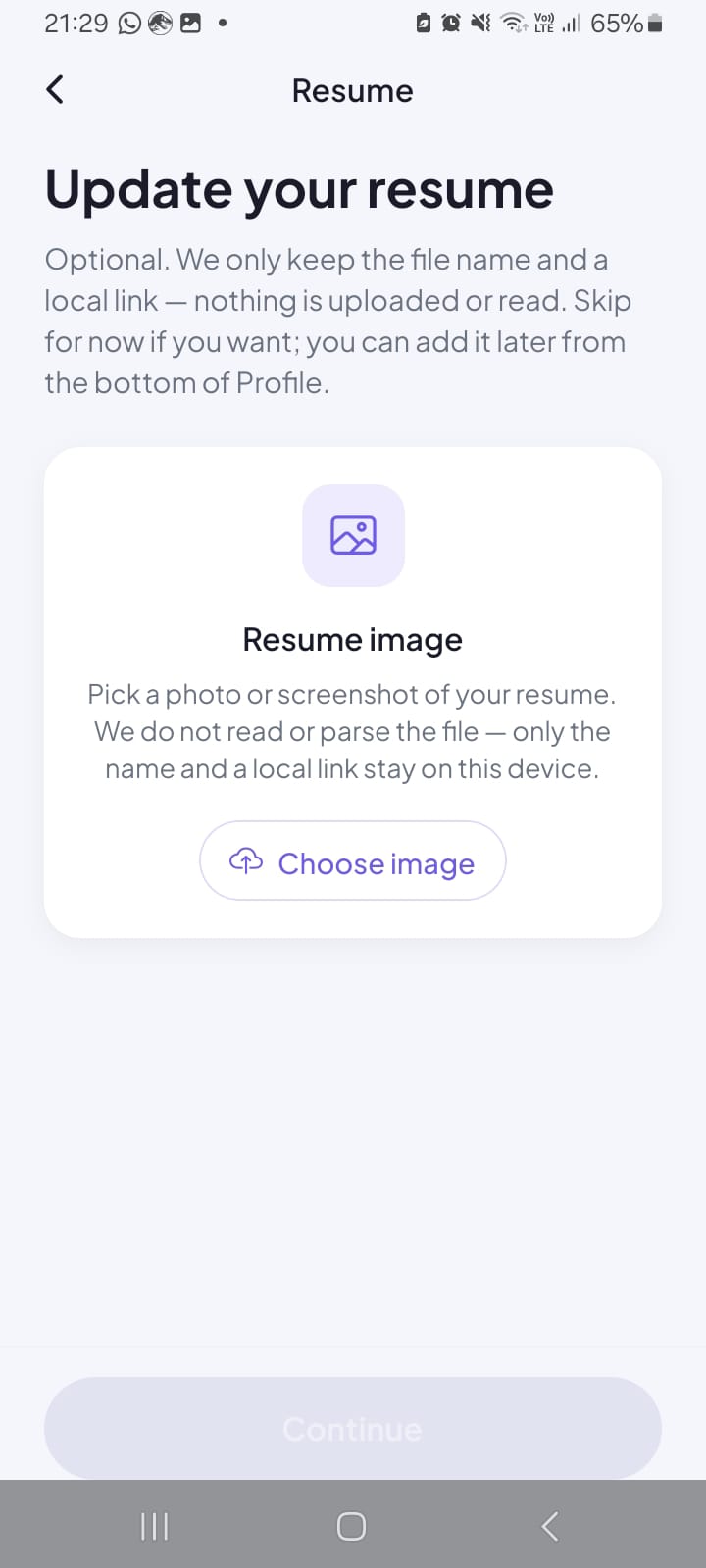
add your resume(optional in premium)
-
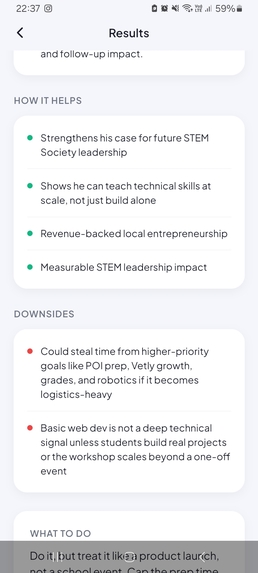
premium evaluation
-
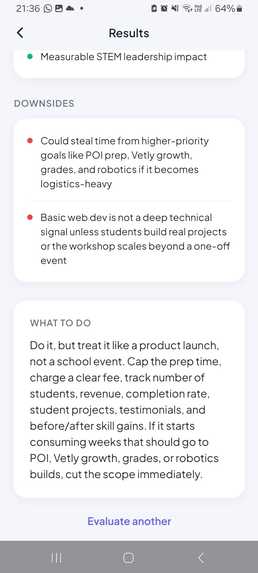
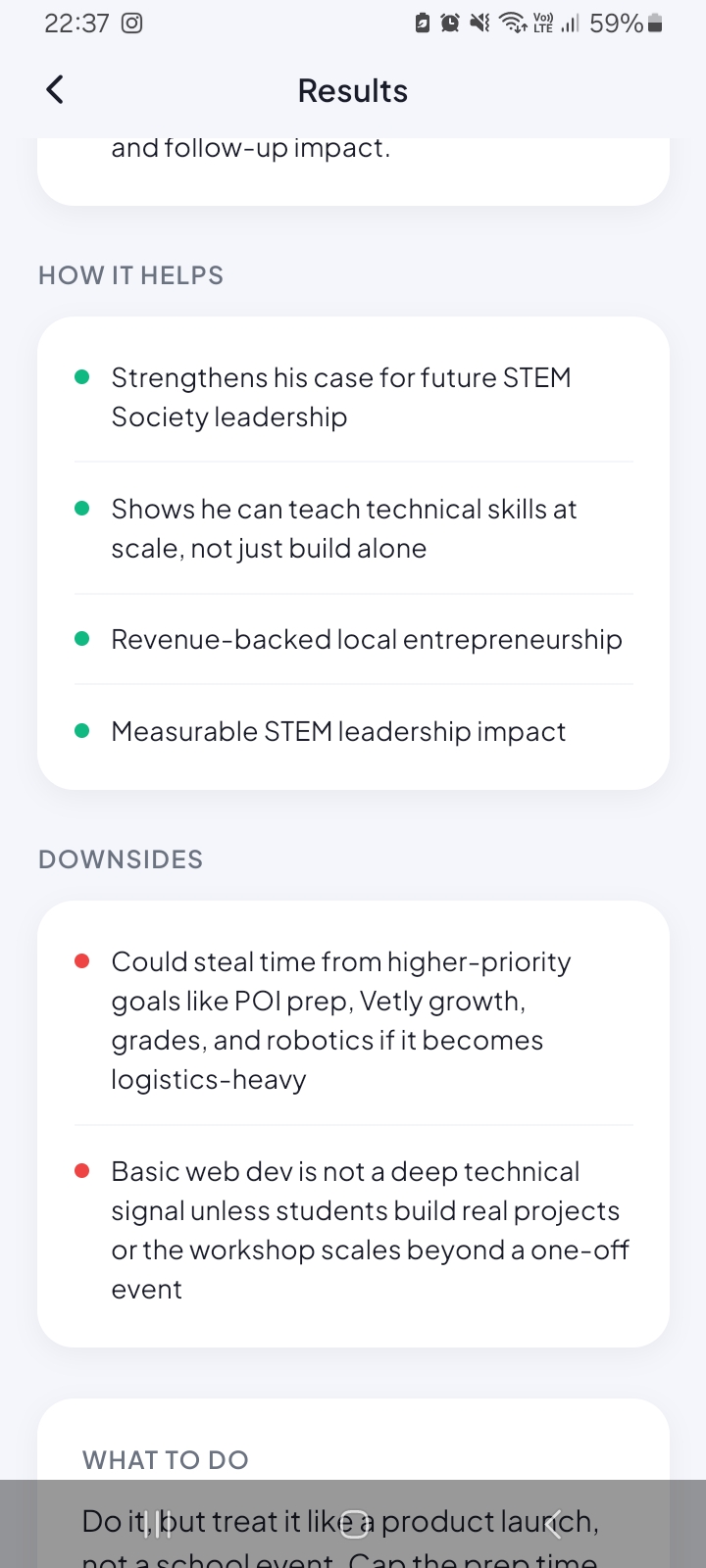
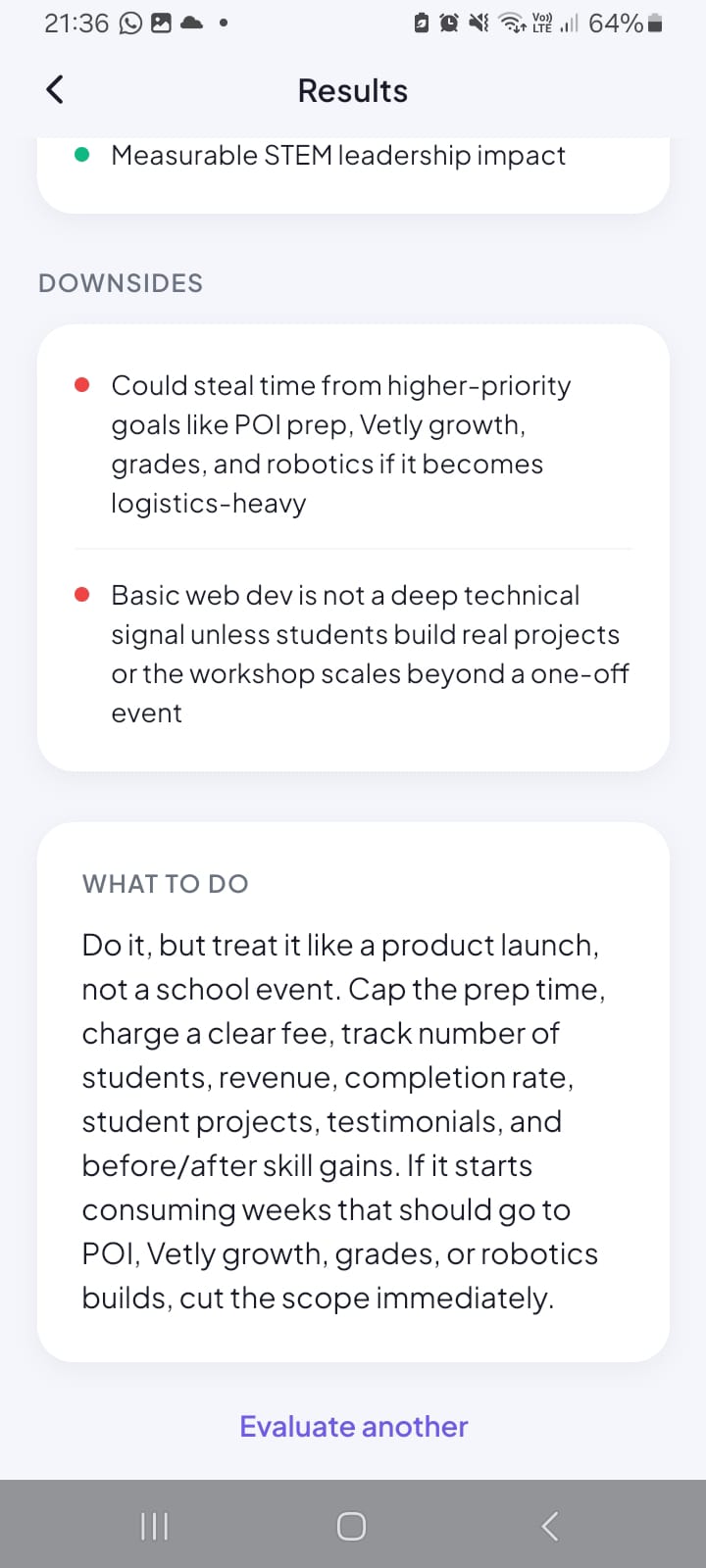
premium evaluation conclusion with constraints
-
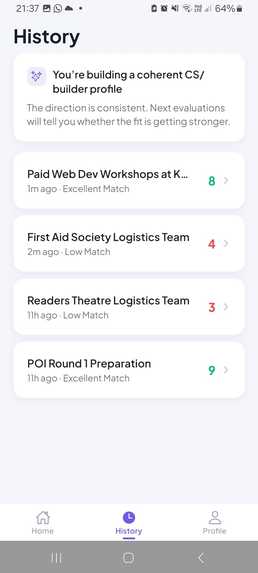
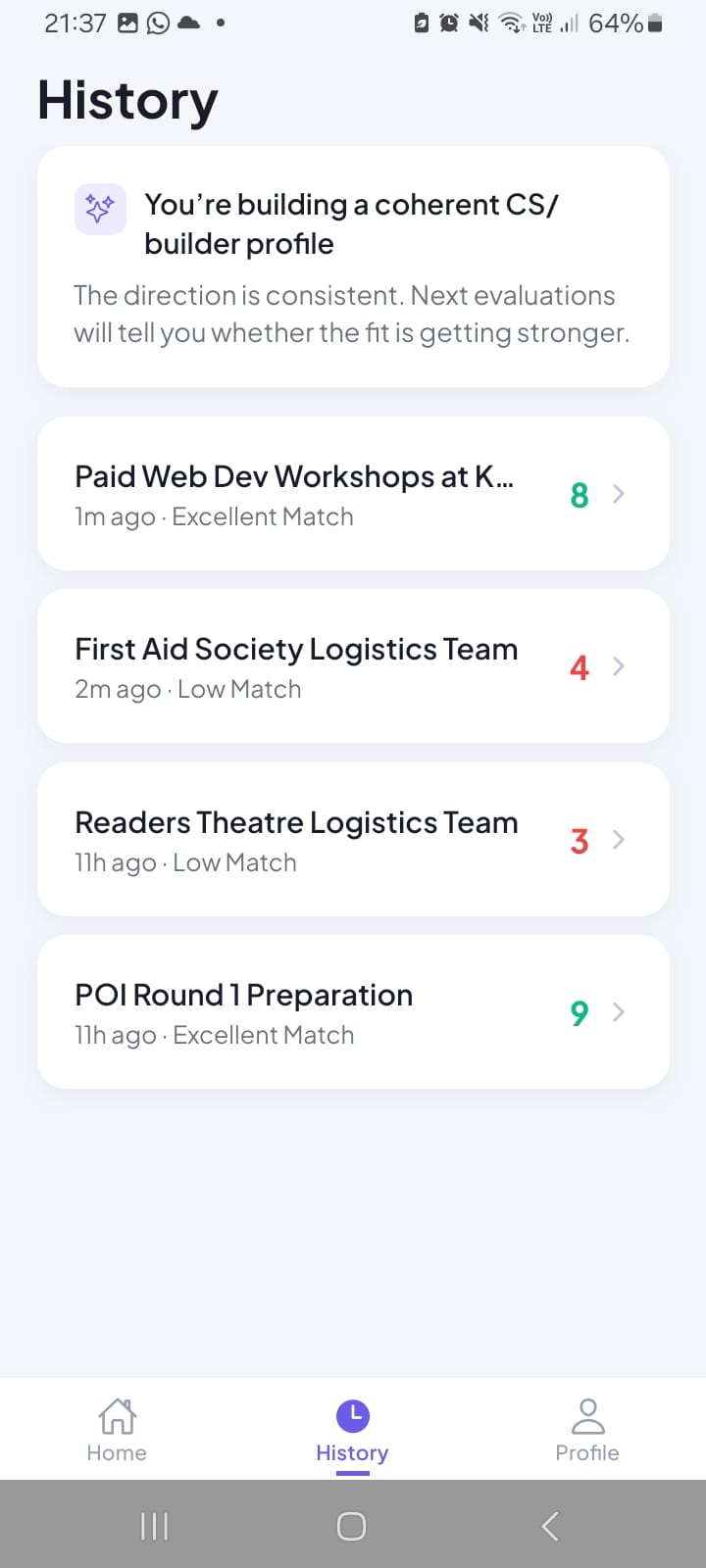
history(unlocked with premium)
Inspiration
Let me paint you a picture. It is the start of a new school year, and I have just spent the last few months grinding through applications for ten different society councils at KGS. Ten. I wrote essays, prepared answers, showed up to trials, and got in. Big win, right? Wrong. I am a STEM kid and halfway through the year I had a realisation that hit harder than any exam ever could. Why does the Scrabble Club logistics team belong on my university application? It does not. The Drama Society logistics team? Also no. The First Aid Society logistics team? Genuinely, what was I thinking? I was burning hours every week on things I could not care less about, and nobody told me until I was already knee deep in commitments I could not escape. Here is the thing though. This is not just a me problem. Students everywhere, in Karachi, London, Toronto, New York, are drowning in opportunities with no structured way to figure out what actually matters. The ones who get it right are usually the ones whose families can afford a university counsellor. And these counsellors are not cheap. In Pakistan alone, they charge upwards of 30 lakhs. In other countries the numbers are just as brutal. For the vast majority of middle class students globally, that kind of guidance is completely out of reach. I built the thing I wish had existed. That thing is Vetly.
What it does
Let's be honest. You could use ChatGPT or Claude for this. And if you really know how to prompt them well, they are decent. But decent is not good enough when your university application is on the line. Here is the problem with generic AI assistants. They are biased. They do not want to hurt your feelings. They will hype up your mediocre opportunity and call it a great fit because that is what feels good to say. They also cannot give you structured onboarding, and while they can hold context within a conversation, they cannot keep a specific timestamped history of every opportunity you have ever evaluated and let you visualise your own trajectory over time. Vetly does all of that. Free tier gives you a 2000 character onboarding where you describe your goals and current situation. From there, you get three evaluations per day. Paste any opportunity as text or a screenshot, and Vetly's AI, currently powered by GPT 5.5, will run it through our system prompt against your full onboarding and give you a brutally honest score. Not a hype job. An actual assessment. For example, if you are a STEM student gunning for Georgia Tech and you are considering becoming the O-Level head of the Conservation Society, Vetly will acknowledge that it shows leadership and initiative and looks good on paper. And then it will rate it a four or five out of ten, because your time is genuinely better spent on competitive programming or engineering competitions. That is the kind of answer a 30 lakh counsellor gives you. Vetly gives it for free. You can also edit your goal anytime because you are not a static person and your goals evolve. Premium tier takes everything further. Your onboarding expands dramatically. Name, university targets, current class, dream university, a 5000 character description of your current situation, a 5000 character goal statement, and a resume upload. The AI cross references all of it every single time it evaluates an opportunity for you. You also get unlimited evaluations, and every single one is saved to your history with a timestamp.It also give you feedback in terms of preperation guidance for that specific opertunity. Over time you can visually compare what you have been evaluating, what you have taken, what you have passed on, and whether that pattern actually lines up with the vision you set for yourself at the start. It is basically a mirror for your ambitions. And unlike a mirror, it talks back.
How we built it
I came into this with a solid foundation. I know React Native, JavaScript, HTML, CSS, Python, and FastAPI. I have experience with system design, Git, and GitHub. Building a backend from scratch for a hackathon timeline would have been overkill, so I used Supabase for the database and auth layer, which gave me everything I needed without reinventing the wheel. The actual development workflow was me paired with Cursor, an AI coding tool. But this was not just vibing blindly and hoping for the best. I designed the architecture myself first, wrote detailed instructions for Cursor on how to structure the code so it would not turn into a bloated mess, specified exactly what to put in the gitignore, and handled all the security considerations myself. I treated Cursor like a very fast junior developer who needed clear direction, not a magic box. For RevenueCat, I created an account, set up the SDK, built the paywall and billing configuration in their dashboard, then gave Cursor the exact integration instructions and told it precisely where in the codebase it needed to live. Same process for the OpenAI API. I created the account, set my usage limits, got the key, and instructed Cursor to integrate it at exactly the right point in the evaluation flow. The system prompt that powers Vetly's evaluations I wrote entirely myself. That was not Cursor's job. The brutal honesty, the structured output, the way it weighs opportunities against a user's specific goals, that logic is mine. Tech stack: React Native with Expo, Supabase for database and auth, OpenAI API for evaluations, RevenueCat for subscription management, AsyncStorage for local data, Git and GitHub for version control.
Challenges we ran into
The two things that genuinely gave me trouble had nothing to do with writing code. The first was configuring the RevenueCat SDK. On paper it should be straightforward. In practice it was one of those things where everything looks right and nothing works. I had to lean on AI guidance more than I would have liked on that one, but eventually it clicked and the integration landed clean. The second was the system prompt. This took longer than I expected and was honestly the most important engineering decision in the entire project. A bad system prompt means biased, unhelpful evaluations and the whole product falls apart. I went back and forth for a long time, consulting both Gemini and Claude, pushing back on their suggestions, testing outputs, iterating. The recipe I ended up with was not something any single AI gave me. It came out of a long argument between me, the tools, and my own instincts about what brutal honesty actually looks like in a structured output. The code itself was relatively smooth. I barely wrote any manually, and the minor bugs that came up were quick fixes. The hard problems were not in the syntax. They were in the decisions.
Accomplishments that we're proud of
The thing I am most proud of is the system prompt. And I do not mean that as a throwaway line. The system prompt is the product. Everything else, the UI, the database, the subscription logic, is just scaffolding around it. It took a week of building and arguing to get right. I was going back and forth with Claude and Gemini, pushing back on their suggestions, testing outputs against real scenarios, and iterating until the reasoning felt genuinely intelligent rather than just pattern matched. Here is what I mean. A naive opportunity evaluator would see someone applying for the International Olympiad of Informatics and rate it 10 out of 10. And for most STEM students it probably is. But what if that student is in their second year of A-Levels with no competitive programming background and exams in three months? Vetly rates that a 1 out of 10. Because context is everything, and blind optimism is not advice. The same logic works in the other direction. A STEM student joining the First Aid Society logistics team might seem off brand on the surface, and a dumb evaluator would tank the score. But Vetly reasons through it. It shows universities you care about people beyond your own lane. It demonstrates leadership and health awareness. It rounds you out. So it rates it a 6 or 7, not a 4, and explains exactly why. That kind of nuanced, contextual reasoning is what took a week to build. And I think it is genuinely the hardest part of the whole project.
What we learned
What's next for Vetly
Built With
- androidapk
- async-storage
- expo-application-services
- expo-router
- expo-sdk-57
- github
- netifly
- openai-api
- react-native
- revennuecat-sdk
- supabase
- typescript


Log in or sign up for Devpost to join the conversation.