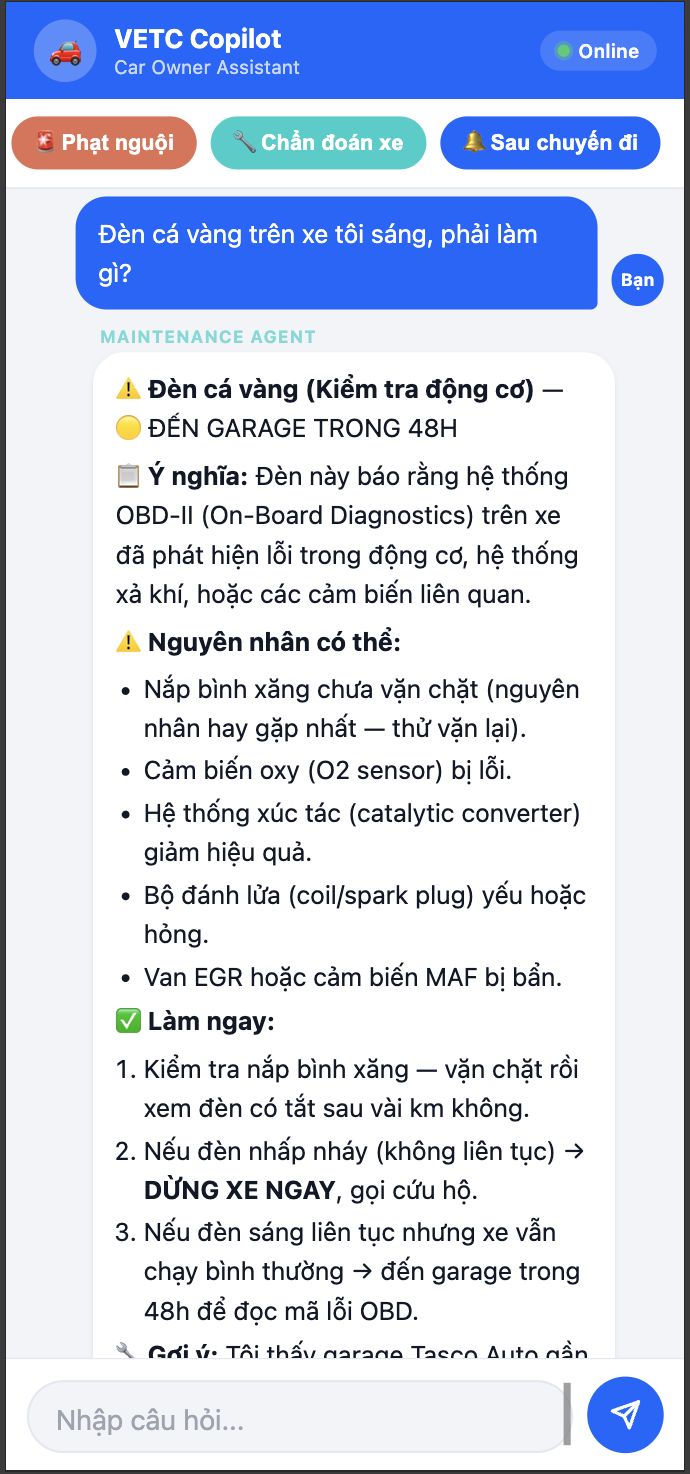
VETC AI Agent Platform
Car Owner Copilot — Pitch Deck
Slide 1 — Headline
The AI Copilot for Every Vietnamese Car Owner
Turn the mandatory VETC e-tag into the smartest assistant a driver has ever had.
Slide 2 — The Problem
Vietnam has 4.5M+ registered cars and growing. Every car owner deals with the same fragmented chaos:
| Pain Point | Reality Today |
|---|---|
| Toll & trip costs | Manually check VETC app. No context, no history. |
| Car wash | WhatsApp the garage. Hope for a slot. |
| VETC wallet | Runs out mid-highway. No warning. |
| Traffic fines (phạt nguội) | Discovered by accident — weeks late, accruing interest. |
| Warning lights | Google "đèn cá vàng là gì". Get Reddit. |
| Maintenance | Call 3 garages to find one with availability. |
The car ownership experience in Vietnam is broken into six disconnected apps, two hotlines, and a prayer.
Slide 3 — The Insight
Tasco already owns the fix. They just haven't connected the dots.
Tasco Group owns:
  ✓ VETC e-tag  →  real-time GPS + toll + mileage data on 2M+ vehicles
  ✓ WASH3000    →  largest car wash network in Vietnam
  ✓ Tasco Auto  →  6 service centers, roadside rescue, OBD diagnostics
  ✓ Carpla      →  used car marketplace
  ✓ VETC Wallet →  payments, balance, transaction history
  ✓ Insurance partner network
Every piece is there. The missing layer is intelligence.
Slide 4 — The Solution
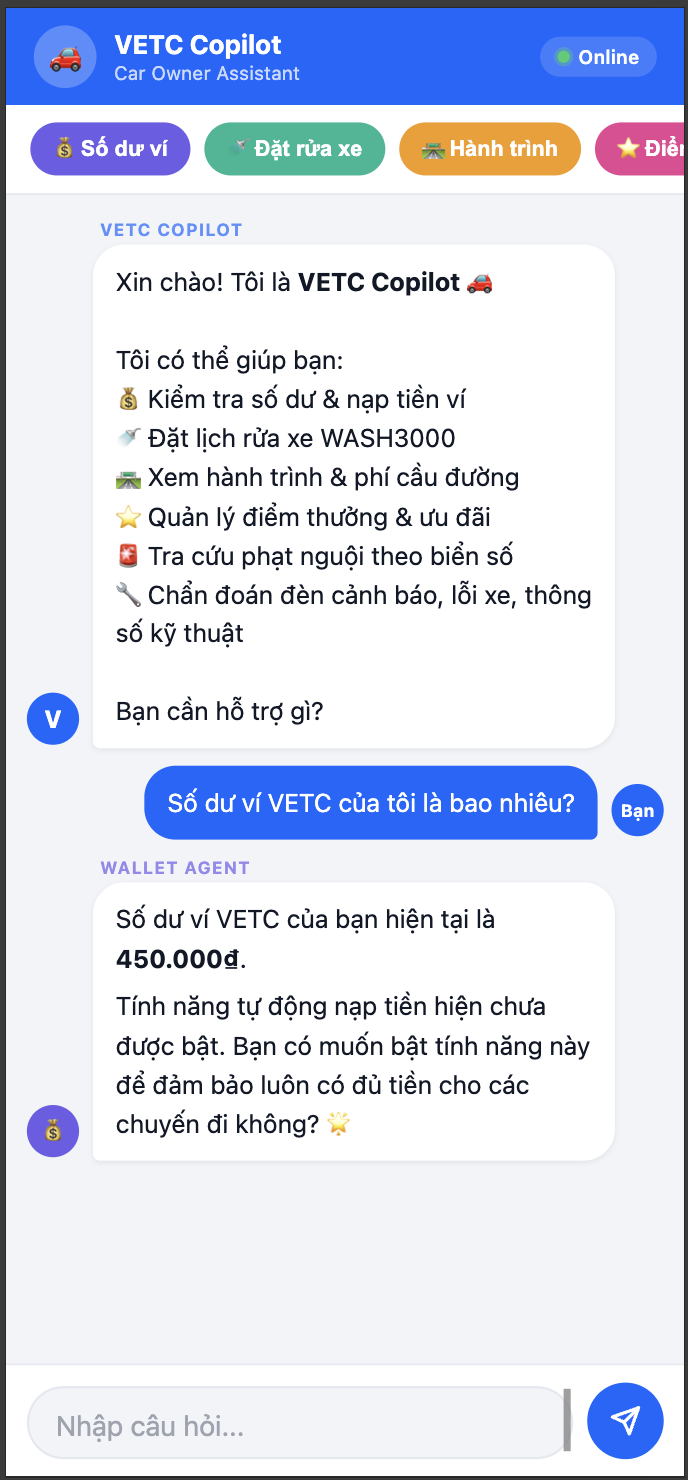
VETC AI Agent Platform — a multi-agent AI system that unifies every car service into a single conversational interface.
One message. Six expert agents working together.
User: "Vừa chạy cao tốc xong, rửa xe gần nhất đi, và ví đủ tiền không?"

→ Trip Agent:   Hành trình HN→HP: 175,000₫ phí cầu đường. +150 điểm.
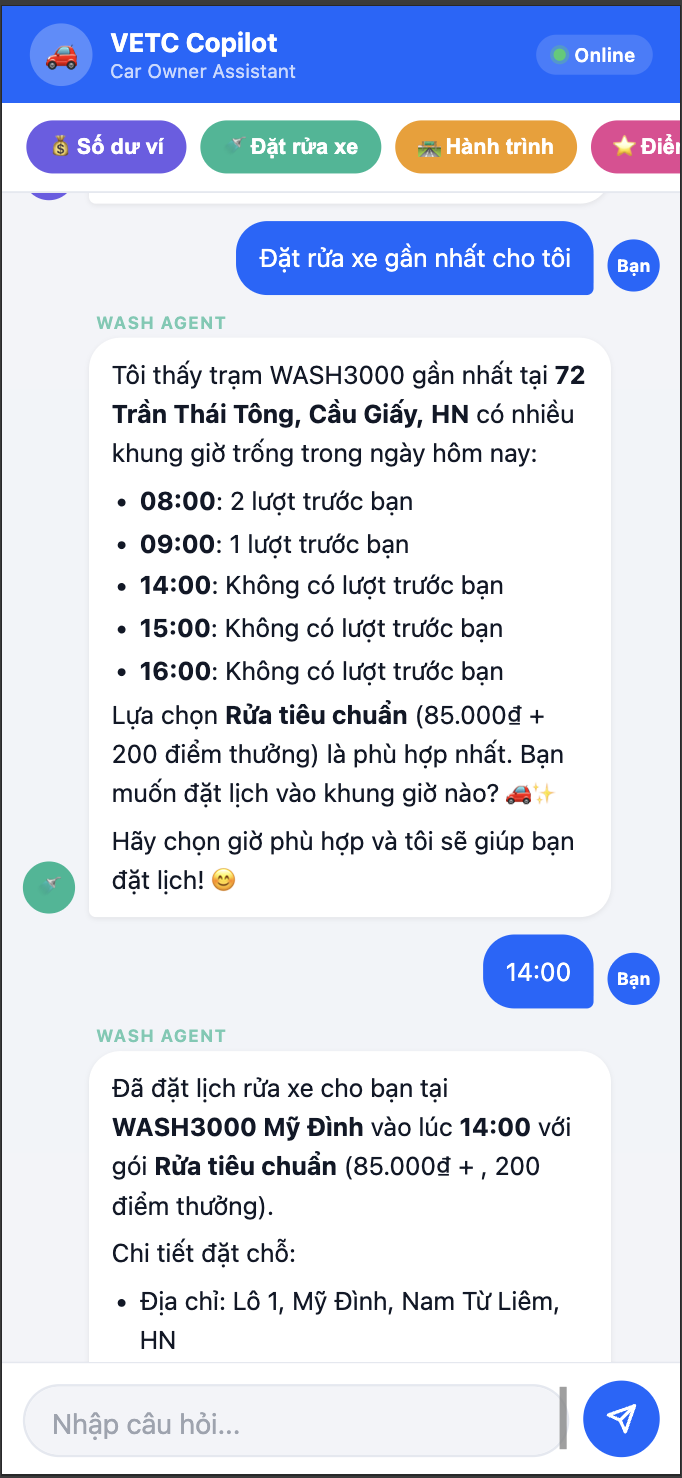
→ Wash Agent:   WASH3000 Mỹ Đình có slot 16:00, 85,000₫.
→ Wallet Agent: Ví còn 420,000₫ — đủ. Trừ tự động?
→ Response:     "Đặt rửa xe lúc 16:00 nhé? Tổng 85,000₫ từ ví VETC, bạn nhận thêm 200 điểm."
Slide 5 — Product Demo
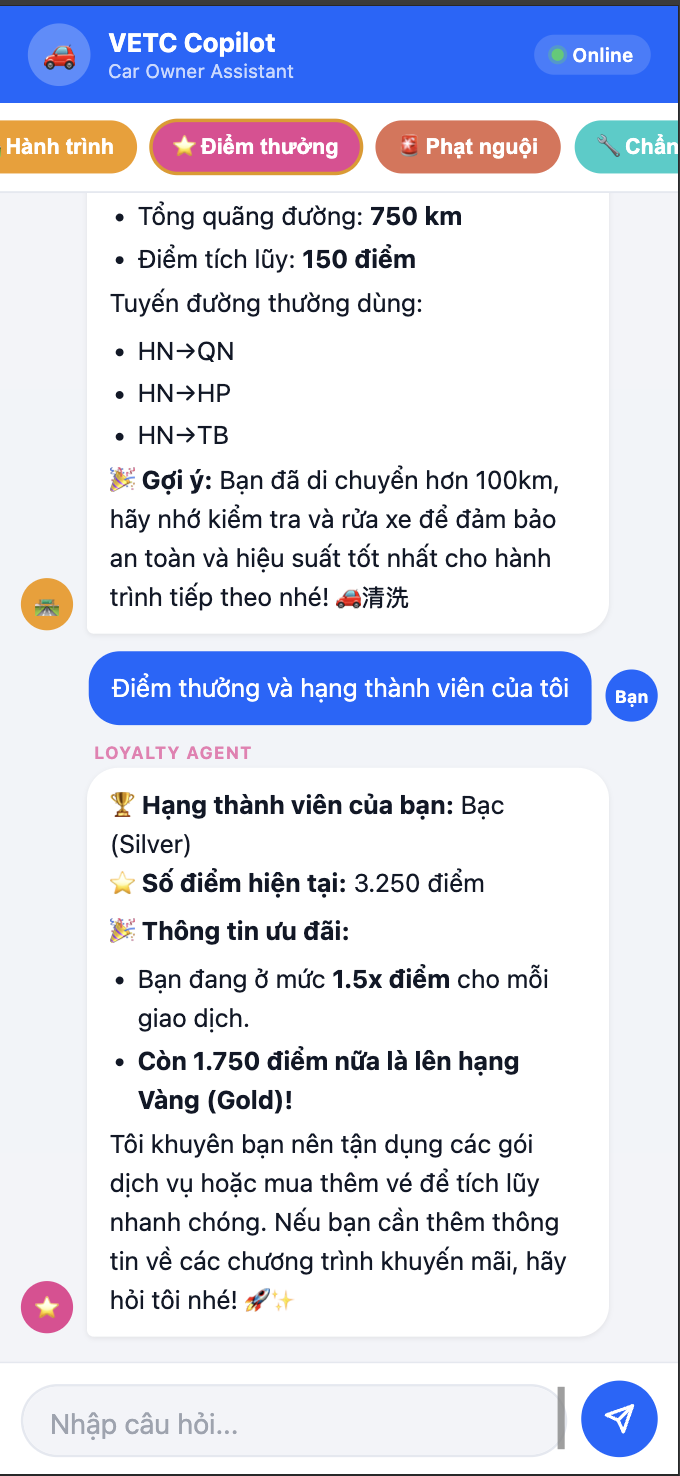
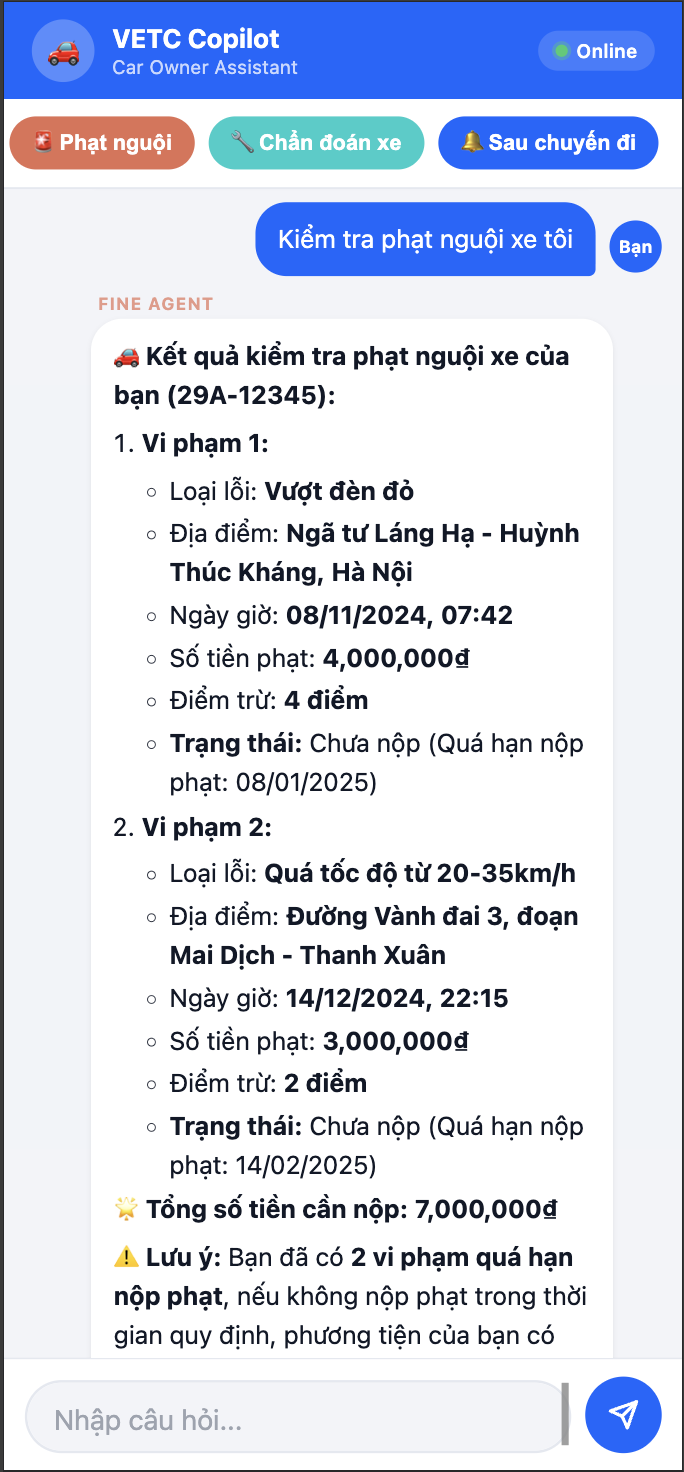
6 Specialist Agents, 1 Interface
| Agent | What it does | Example query |
|---|---|---|
| 🛣️ Trip | Toll costs, route history, spending patterns | "Tháng này tôi tốn bao nhiêu phí đường?" |
| 🚿 Wash | WASH3000 slots, booking, subscriptions | "Đặt rửa xe gần nhà tôi" |
| 💰 Wallet | Balance, top-up, transaction alerts | "Nạp 500k vào ví VETC" |
| ⭐ Loyalty | Points, tiers, promotions | "Tôi còn bao nhiêu điểm? Đổi được gì?" |
| 🚨 Fine | Traffic violation lookup, payment guidance | "Biển 29A-12345 có bị phạt nguội không?" |
| 🔧 Maintenance | Warning lights, OBD codes, garage booking, rescue | "Đèn cá vàng sáng, tôi phải làm gì?" |
Execution Patterns
Pattern A — Single agent (default): One question → one expert answers in <2s.
Pattern B — Sequential chain: Fine Agent checks violations → Wallet Agent confirms if balance covers payment → merged answer.
Pattern C — Parallel fan-out: Post-trip event fires all agents simultaneously → single push notification with trip summary, wash suggestion, balance, and points earned.
Pattern E — Proactive nudge: Wallet drops below 100k₫ → agent pushes alert before user hits a toll booth.
Slide 6 — Market Opportunity
Vietnam Automotive Market
| Signal | Data |
|---|---|
| Registered vehicles | 4.5M+ cars, growing 8% YoY |
| VETC e-tag installs | 2M+ vehicles (mandatory for all highways) |
| WASH3000 addressable | ~5M car washes/month market in Vietnam |
| Traffic fine market | 10M+ fines issued/year via Nghị định 100/2019 |
| Car maintenance market | $2B+ annually |
VETC as Distribution
The e-tag is already in 2M cars. No cold-start problem. No user acquisition cost for the core base.
No competitor can replicate this captive distribution.
Slide 7 — Business Model
Outcome-based pricing — charge per transaction facilitated, not per message or token.
Benchmarked against Sierra AI (~$1.50/resolution at $100M ARR):
| Transaction Type | Price per Event | Volume Target (Year 1) |
|---|---|---|
| Wash booking via agent | ~35,000₫ (~$1.40) commission | 500 bookings/week |
| Service appointment booked | ~50,000₫ (~$2.00) commission | 200 bookings/week |
| Wallet top-up facilitated | ~5,000₫ (~$0.20) per top-up | 2,000/week |
| Traffic fine payment guided | ~20,000₫ (~$0.80) per case | 300/week |
| Insurance lead generated | ~150,000₫ (~$6.00) per lead | 50/week |
Year 1 Revenue Target: ~5B₫/month (~$200K/month) at scale Unit economics: >70% gross margin (no physical costs, AI inference ~$0.02/query)
Future: Platform Licensing
Phase 3 opens the MCP server layer to 3rd parties (parking lots, petrol stations, EV charging). Platform fee: 15% of transactions facilitated through the agent network.
Slide 8 — Traction
Built in Sprint 0. Working today.
✅ 6 specialist agents — fully functional
✅ 5 mock MCP servers — Vietnamese data (Nghị định 100, OBD-II, WASH3000, Tasco Auto)
✅ 4 execution patterns — A, B, C, E
✅ Cross-agent unified memory — episodic store, 24h TTL, context-aware responses
✅ Streaming UI — mobile-first, SSE, markdown rendering
✅ 33/33 automated test cases passing — AI judge (Qwen) validates responses
✅ Vercel deployment ready
Test Suite Results (last run)
Group     Cases   Result
────────────────────────
Trip        3     3/3 ✓
Wallet      3     3/3 ✓
Wash        3     3/3 ✓
Loyalty     3     3/3 ✓
Fine        3     3/3 ✓
Maintenance 14    14/14 ✓
Pattern B   3     3/3 ✓
────────────────────────
TOTAL      33     33/33 (100%)
Slide 9 — Technology
Stack
| Layer | Choice | Why |
|---|---|---|
| LLM | Qwen2.5-14b-instruct | Fastest response (1.2s), native Vietnamese, OpenAI-compatible API |
| Backend | FastAPI + SSE | Streaming responses, async tool execution |
| Agent framework | Custom tool-use loop | Full control, no framework lock-in |
| Tool protocol | Mock MCP servers | Production-ready swap: real APIs in same interface |
| Memory | Episodic store (24h TTL) | Cross-agent context without user repeating themselves |
| Frontend | Vanilla JS | Zero-dependency, mobile-first, instant load |
Architecture Principles (from Sierra + Decagon playbook)
- Agents own domains, not conversations — orchestrator routes, agents execute
- MCP for tools, A2A for agents — loose coupling, independent deployment
- Outcome-based metrics — bookings and payments, not messages
- Data flywheel — every interaction enriches the user profile → better recommendations → more engagement
LLM Strategy
Don't lock to one model. Use Qwen for classification (cost + Vietnamese), Claude/GPT-4o for complex reasoning (quality), fine-tuned Qwen for domain-specific tasks (accuracy).
This is exactly Decagon's "model constellation" approach — the same pattern that got them to $1.5B valuation.
Slide 10 — Competitive Moat
What Exists Today
| Company | Valuation | ARR | What they built |
|---|---|---|---|
| Sierra AI | $10B | $100M | Enterprise AI agent platform |
| Decagon | $1.5B | $35M | Customer support agent OS |
| CrewAI | — | — | Open-source multi-agent framework |
All of them are platform-only. None of them own the services.
What VETC AI Has That They Can't Copy
① DATA + SERVICE OWNERSHIP (unique)
   Tasco owns the data layer (e-tag = trips, spending, mileage)
   AND the service supply (WASH3000, Tasco Auto, Carpla, Insurance)
   → Sierra/Decagon are middleware. We're the whole stack.

② CAPTIVE DISTRIBUTION (2M vehicles, zero CAC)
   VETC e-tag is legally required on every highway vehicle in Vietnam.
   The install base is already there. No cold start. No user acquisition cost.
   → No competitor can replicate this. It's government-mandated distribution.

③ COMPOUND CHAIN VALUE (defensible flywheel)
   Trip data → better Wash recommendations
   Wash frequency → better Maintenance predictions
   Maintenance history → better Insurance pricing
   Insurance savings → platform stickiness
   → Each domain makes every other domain smarter. No single competitor touches all.

④ VIETNAMESE MARKET SPECIFICS (local moat)
   Qwen fine-tuned on Vietnamese = language moat
   Nghị định 100/2019 fine database = regulatory moat
   Tasco's physical presence (service centers) = offline-online moat
   → A US AI company cannot replicate this in 12 months.
The AI is the glue. The ecosystem is the moat.
Slide 11 — Go-to-Market
Phase 1: Internal Beta (Month 1-2)
- Deploy to Tasco employees + VETC power users (top 1% by trip frequency)
- Focus: Wash booking and wallet top-up conversion
- Measure: Agent resolution rate, booking conversion, NPS
Phase 2: Soft Launch (Month 3-4)
- 10% of VETC user base (~200,000 users)
- Proactive nudges enabled (Pattern E) — low balance, post-trip wash
- A/B test: users with agent vs without
- Target: 15% post-trip wash conversion, +25% auto-topup activation
Phase 3: Full Launch + Platform (Month 6-12)
- All 2M+ VETC users
- Open MCP layer to 3rd-party services (petrol stations, parking)
- Insurance Agent + Marketplace Agent live
- Platform licensing to other fleet operators
Slide 12 — Success Metrics
| Metric | Baseline | 6-Month Target |
|---|---|---|
| Daily active users | ~X% of VETC base | +40% |
| Wash bookings via agent | 0 | 500/week |
| Auto-topup activation | ~Y% | +25% |
| Avg agent response time | N/A | <2s |
| Agent resolution rate (no human) | N/A | >70% (Decagon benchmark) |
| Post-trip wash conversion | 0% | 15% |
| User NPS delta | baseline | +15 points |
| Revenue per user per month | toll-only | +30% |
Slide 13 — Roadmap
NOW (Sprint 0) ✅
  6 agents, 5 MCPs, 4 patterns, memory, streaming UI, test suite

SPRINT 1 (next 4 weeks)
  Real VETC wallet API integration
  Real WASH3000 booking API integration
  Server-side Redis session store (replace client-carried history)
  Watchtower QA — auto-flag low-confidence wallet mutations

SPRINT 2 (Month 2)
  Insurance Agent + Marketplace Agent (Carpla trade-in, VETC Go rental)
  Pattern D — escalation chain (Maintenance → Insurance → Marketplace)
  Voice channel (in-car usage while driving)
  Metrics dashboard

SPRINT 3 (Month 3-4)
  LangGraph migration for stateful workflows + checkpointing
  A2A event bus (Redis Streams) for loose agent coupling
  Fine-tuned Qwen classifier on Tasco intent data
  OBD-II hardware integration for predictive maintenance

SPRINT 4 (Month 5-6)
  A/B launch to 10% of VETC users
  Open platform: 3rd-party MCP server registration
  Agent Studio: ops team tunes agents without code deploy
Built With
- python
- qwen

Log in or sign up for Devpost to join the conversation.