Inspiration
The idea for VESSEL came from a single, uncomfortable truth: the people who are best at holding emotional space for others are the worst at holding it for themselves. Therapists. Nurses. Caregivers. Parents of children with special needs. These are people who have been professionally and personally trained to put others first — and who, as a result, experience compassion fatigue and burnout at disproportionately high rates. The tragedy isn't just that it happens. It's that it always comes as a surprise. We kept asking: why don't they see it coming? The answer was that the signals were always there — in their heart rate, their voice, their stillness — but there was no tool that could translate those signals into something legible and actionable before the crisis hit. That gap is what VESSEL was built to close.
What It Does
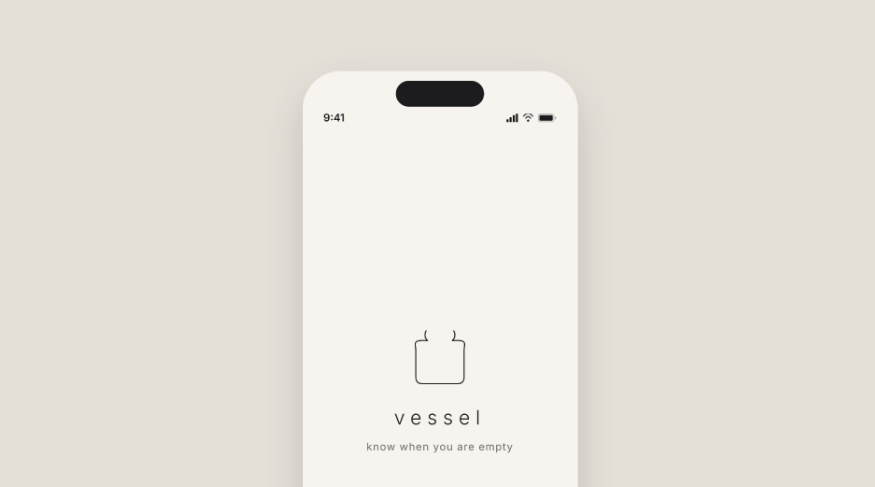
VESSEL is a speculative wellness tool — a lightweight wearable ring paired with a native iOS app — that makes your Empathic Reserve visible for the first time. It passively reads three biometric signals: your Heart Rate Variability (HRV), your Voice Warmth Index (vocal tone flattening), and your Somatic Movement patterns. These three signals are distilled into a single number — your Empathic Reserve Score from 0 to 100 — visualised as a glass jar that fills and empties in real time. When your reserve drops, VESSEL surfaces a gentle nudge before the breakdown — not after. It offers guided Refill Protocols (breathing exercises, body scans), tracks your weekly patterns to reveal your personal depletion triggers, and escalates compassionately when it detects multiple consecutive heavy days. Emergency resources are always one tap away. All data is processed on-device. No logging. No journaling. No extra steps.
How We Built It
VESSEL was built as a fully interactive Figma Make prototype, designed to simulate a production-ready native iOS experience. The design system was built ground-up in Figma following Apple Human Interface Guidelines 2024, with a custom component library including the signature VesselJar animated component, GlassCard surfaces, a native TabBar, and a StatusBar with Dynamic Island support. The colour system — Forest Green #4A7C59, Amber #E8B55F, Burnt Orange #C0522A — was chosen deliberately to communicate reserve states with zero cognitive overhead. The product logic, sensor architecture, and the Empathic Reserve Score algorithm were developed through deep research into interoceptive neuroscience, affective science literature (Garfinkel, Critchley et al.), and clinical frameworks around compassion fatigue. The full design brief, use cases, and safeguards were documented in a structured Word document and presentation deck built to submission standards.
Challenges We Ran Into
Defining the right sense. With 22–33 human senses identified by science, choosing the right one required genuine research — not just picking something that sounded novel. We needed a sense that was real, clinically significant, currently unmeasurable at consumer scale, and deeply relevant to a specific underserved population. Arriving at Interoceptive Coherence — and specifically Empathic Reserve as a sub-dimension — took several rounds of refinement. Avoiding the self-monitoring trap. Our target users are already prone to hypervigilance and over-responsibility. Designing a biometric tracking tool for this population without inadvertently worsening their anxiety required careful, deliberate decisions — the Usage Limits setting, the Quiet Mode, the maximum-3-nudges-per-day rule, and the choice to show patterns over points rather than raw real-time data. Making the invisible feel human. Translating clinical biometric data into something emotionally resonant — the jar metaphor, the warm colour palette, the language of "refilling" rather than "optimising" — was harder than any of the technical architecture. The framing had to feel like a trusted friend, not a medical device.
Accomplishments That We're Proud Of
The jar. It sounds simple, but the decision to use a vessel — something that fills and empties — as the central metaphor was the moment the whole project clicked. It made the abstract science tangible, personal, and immediately understandable to anyone. Designing for a population that wellness tech ignores. The vast majority of health and wellness tools are built for people who want to optimise performance. VESSEL is built for people who want to stop collapsing. We're proud of the intentionality behind every safeguard, every nudge, and every piece of language in the app. The sensor architecture. Combining HRV, vocal warmth, and somatic movement into a single composite score — the Empathic Reserve — is a genuinely novel sensing model. The Voice Warmth Index in particular, using vocal tone flattening as an early depletion signal, is a design decision grounded in real affective science that we haven't seen in any existing consumer product. The emergency layer. Building crisis resources directly into the core alert experience — not buried in Settings — and designing the mental health escalation prompt with clinical sensitivity is something we're especially proud of. It treats the user as a full human being, not just a data source.
What We Learned
We learned that the hardest part of speculative design isn't imagining the future — it's earning trust in the present. A tool that monitors your body's most intimate signals needs to justify every design decision with radical transparency. Privacy, consent, and the right to silence aren't features. They're the foundation. We also learned how much the framing of a metric changes behaviour. Calling it a "Reserve" rather than a "Score" or a "Level" subtly shifted the entire user relationship with the number — from judgment to resource management. Words matter enormously in wellness design. And we learned that the people who most need wellness tools are often the most resistant to them — because every tool asks something of them, and they are already over-asked. The solution isn't to simplify the interface. It's to make the tool ask less, give more, and know when to disappear entirely.
What's Next for VESSEL
Clinical validation. The Empathic Reserve model needs to be tested against validated clinical instruments — the Professional Quality of Life Scale (ProQOL), standardised HRV benchmarks, and interoceptive accuracy tasks. A partnership with a university wellbeing research lab is the logical next step. The Vessel Ring hardware. The wearable sensor architecture needs to move from concept to prototype. We're exploring partnerships with biosensor manufacturers to build a ring that reads HRV, voice warmth via bone conduction, and somatic movement in a single, comfortable, always-wearable form factor. Workplace integration. Hospitals, therapy group practices, and social work organisations are natural institutional partners — environments where compassion fatigue is endemic and where a group-level reserve monitoring tool (with strict individual privacy) could meaningfully change culture and scheduling. Expanding the audience. The Empathic Reserve model applies beyond professional caregivers — to teachers, community organisers, first responders, and parents. The next phase would adapt the onboarding, language, and pattern recognition for each of these populations. Research on the Voice Warmth Index. The vocal tone depletion signal is the most novel element of VESSEL's sensing model and deserves dedicated research to establish its accuracy, reliability, and correlation with subjective burnout experience.
Built With
- react-router
- tailwind
- typescript/jsx
- vite


Log in or sign up for Devpost to join the conversation.