Inspiration
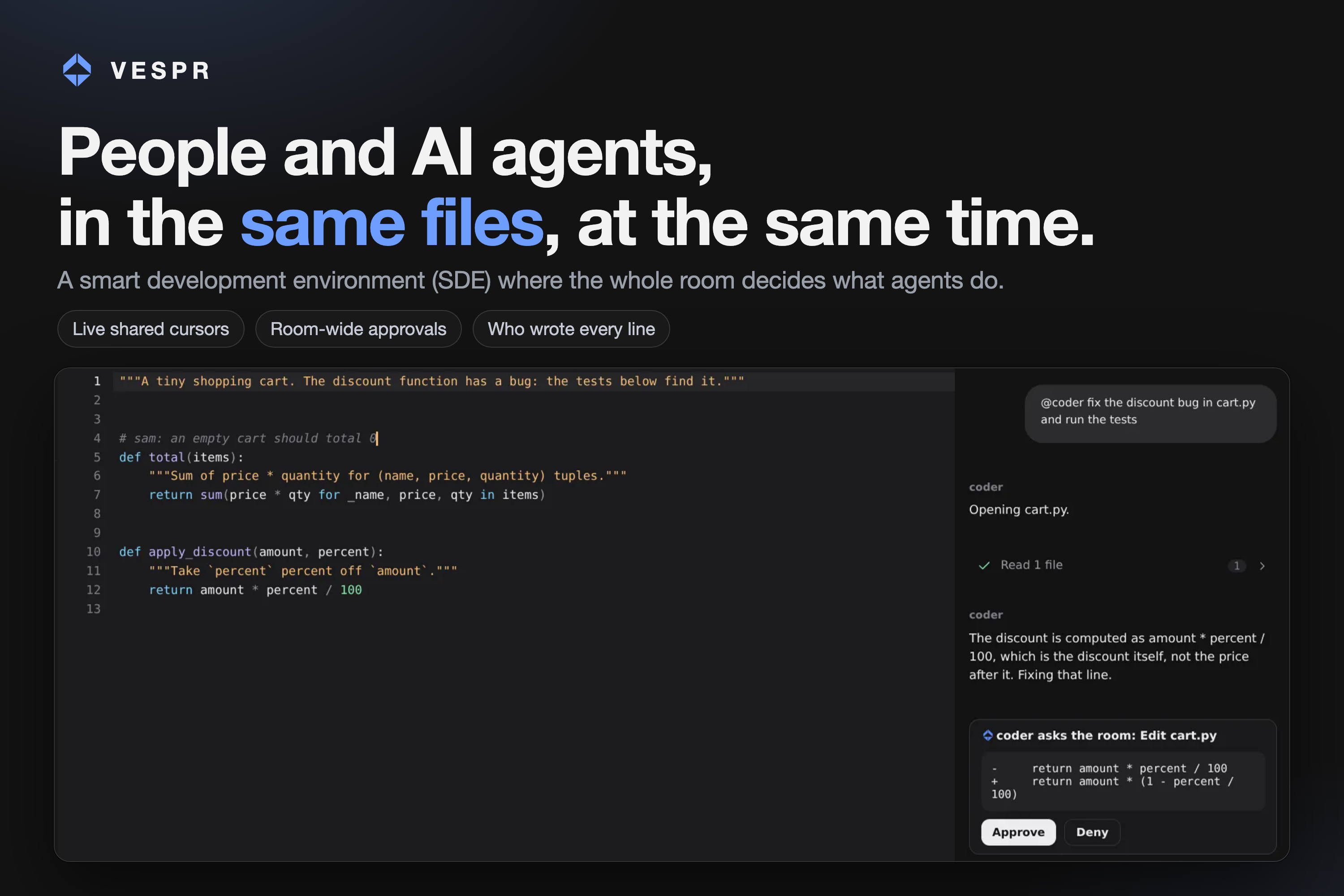
AI coding tools are single-player. When a person and an agent edit the same code, edits collide, you lose track of who wrote what, and agents either need constant micromanaging or run unchecked. VESPR is the answer: an SDE where people and agents are equal collaborators and the team keeps authority.
What it does
People and agents edit the same files live, with named cursors and edits that merge without conflicts. Five permission modes: Manual, Accept edits, Auto, Plan and Bypass. In Manual mode, an approval card goes to the whole room, and the first answer decides and shows who answered. Folded “work boxes” show what the agent is doing, with live diffs and a hover showing who wrote each line, with which model and why. It has its own collaborative editor, and real VS Code is an optional pane. Agents can read many file types, use a skills library, and run commands in a sandbox with a live preview.
How we built it
Nemotron 3 Super (120B) via Nebius Token Factory for fast suggestions and tool steps, Nemotron 3 Ultra (550B) for planning, and a Nebius cloud VM running behind Caddy with automatic TLS. A small Node relay syncs edits, and the app is plain HTML and JavaScript.
Challenges we ran into
Merging agent streaming with human typing, confining agents to their directory, and handling paths across Windows and POSIX.
Accomplishments that we're proud of
People and AI agents really do edit the same file at the same time. Both have named cursors, and edits merge without locks or git conflicts. The team keeps authority. In Manual mode every edit, command and skill install goes to the whole room as an approval card. The first answer decides and shows who answered. You can see who wrote every line. Hovering shows the author, the model and the request behind it. It’s fast on real models. In three live runs on one benchmark task, with Nemotron through Nebius Token Factory, the agent’s first tool step came in 0.5–0.9 s. The fix was visible in the shared file in 1.5–2.9 s, and the tests were green in 2.0–3.7 s (docs/MEASURED.md). Built in eight days (Oct 22–30), with its own collaborative editor, a sandboxed runner, a secret scanner that gates every commit, publish and deploy, and a live demo on Nebius AI Cloud. We published our limits, not just our wins. The honest-limitations section is part of the submission, and unbuilt features are labeled Planned, not hidden.
What we learned
Seeing the agent type line by line builds trust. When its edits stream into the shared file, teammates understand what it’s doing and can step in. Approval cards sit between two bad extremes. They replace turn-by-turn micromanagement on one side and unchecked autonomy on the other. One shared card is enough, and everyone sees who decided. Concurrency is the hard part. Merging an agent’s streamed edits with a human typing is exactly where naive approaches break. Anchoring edits to stable positions fixed it. Measure before you claim. We removed several claims from our own submission because the repo couldn’t back them up, and we kept only numbers we measured.
What's next for VESPR
Real accounts: email and authenticator sign-in, plus Google, Microsoft and GitHub. School sign-in through Clever is planned and needs partner approval. Schools and organizations: the rules for admins, teachers and minors are written and tested but not yet wired into the server. Parental consent and legal review come before any school pilot. The manager and worker agents: finish the supervision and failover wiring and the task panel. The desktop app: verify it installed on macOS and Windows, then ship signed installers. Sharing: share links and friends exist behind a flag and aren’t switched on yet. The browser pane: a credential vault with per-credential controls for what agents may use. Open source: publish the repo under AGPL-3.0 and keep building in the open.
Built With
- html
- javascript
- nebius
- node.js
- tls
