
VerseForge: AI Music Studio (Project Overview)
Tagline: Create polished songs in seconds: lyrics, vocals, and mixes generated from a simple description.
1. Inspiration & Vision
Our goal is to give everyone a personal AI music studio — a place where anyone can turn an idea into a finished song simply by describing their vision. VerseForge was created from a passion for AI, creativity, and building tools that allow people to express themselves musically with minimal friction.
2. Key Features
- Artist-style lyrics generated by a fine-tuned Llama 3.3 model
- Professional-quality vocals produced using a custom TTS engine
- Customizable BPM, vocal balance, and creativity settings
- Automatic generation of multiple song variants
- Support for custom album cover uploads
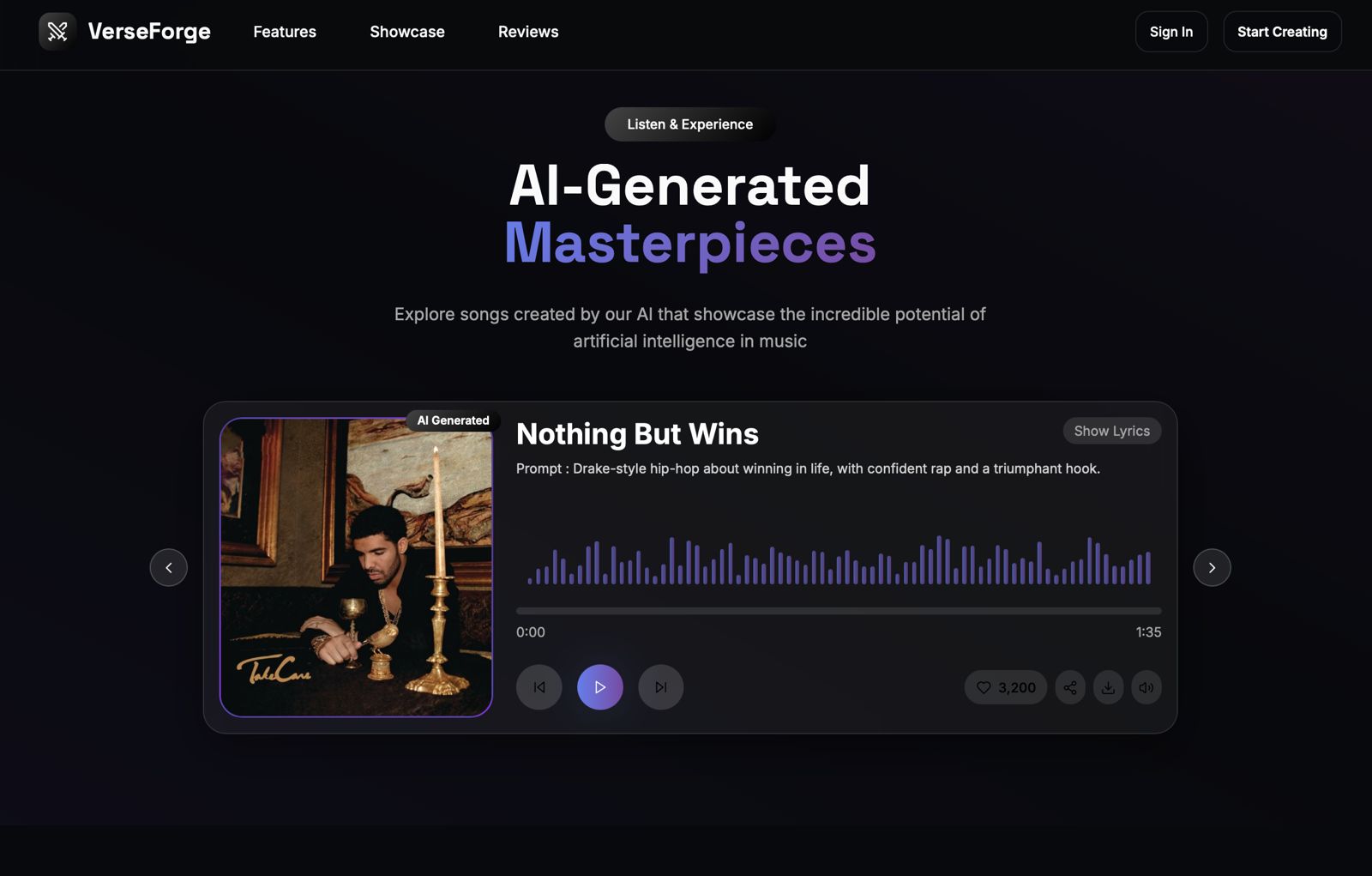
- Integrated audio player with waveform visualization and synced lyric display
- Persistent sessions and saved projects supported by secure authentication
3. Architecture & AI Pipeline
A multi-stage pipeline powers each generated song:
- Prompt preprocessing (LSTM) — generates “cloud words” to expand context and guide lyrical style.
- Lyric generation (fine-tuned Llama 3.3) — produces coherent, artist-style lyrics based on the prompt.
- Vocal production (custom TTS) — uses more than 1,000 expressive tags to render realistic, musical vocals.
- Post-processing and playback — mixes audio, normalizes levels, and renders waveform and lyric synchronization.
Tech Stack
- Frontend: React, TypeScript, Vite, Tailwind CSS
- Backend: Express.js (Node.js)
- Authentication & persistence: Clerk + secure storage
4. Major Challenges
- Preventing hallucinations from LSTM-generated “cloud words” while preserving creative context
- Fine-tuning Llama 3.3 to consistently match specific genres and artist styles
- Achieving low audio latency during TTS streaming and preview
- Designing a clean, intuitive, and responsive studio-grade interface
5. Achievements
- Developed a full end-to-end music generation pipeline from prompt to final song
- Created realistic AI vocals through advanced TTS tag engineering
- Built a modern interface with waveform animations and lyric synchronization
- Implemented secure session management and persistent project storage
- Produced multiple, audibly distinct song variants
- Achieved production-grade architecture capable of handling heavy AI workloads
6. Key Learnings
- Preprocessing using LSTM models can significantly improve creative output quality
- Fine-tuning foundation models for creative tasks requires careful dataset design
- Low-latency audio streaming demands specialized optimization techniques
- Tag-based TTS conditioning enables nuanced and expressive vocal rendering
- Strengthened understanding of React and TypeScript architecture patterns
7. Roadmap
- AI voice cloning to allow users to generate songs in their own voice
- Instrumental generation, including beats, harmonies, and full arrangements
- Community features such as sharing, profiles, and playlists
- Mobile application for quick music creation
- Advanced mixing tools: reverb, EQ, autotune, and professional effects
- Improved multi-genre model support
- Cloud library for large-scale storage of user creations
- Live microphone input with real-time AI voice conversion
Built With
- api
- clerk
- context
- css
- express.js
- node.js
- node.js-ui-components:-radix-ui
- react-18
- react-hooks
- shadcn/ui-authentication:-clerk-styling:-tailwind-css-with-custom-design-system-icons:-lucide-react-state-management:-react-hooks
- tailwind
- tailwind-css-backend:-express.js
- typescript
- vite
