-
-
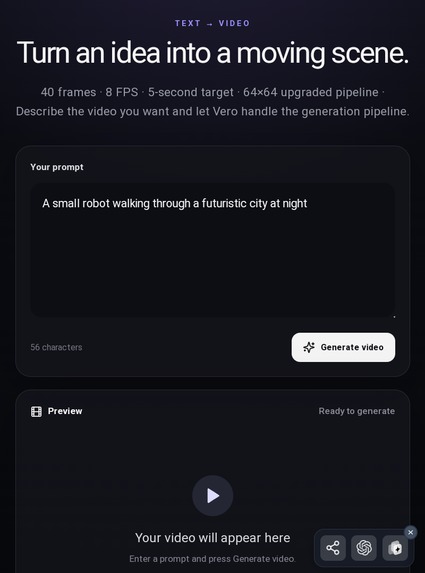
It is still undergoing problems because I don't have a physical GPU or a laptop or a good phone
Inspiration
VERO started from a simple goal: explore whether a small, understandable AI video-generation pipeline could be built without depending entirely on massive proprietary systems.
I wanted to learn how the major components of a generative video system work by building them myself and progressively improving the architecture.
What I built
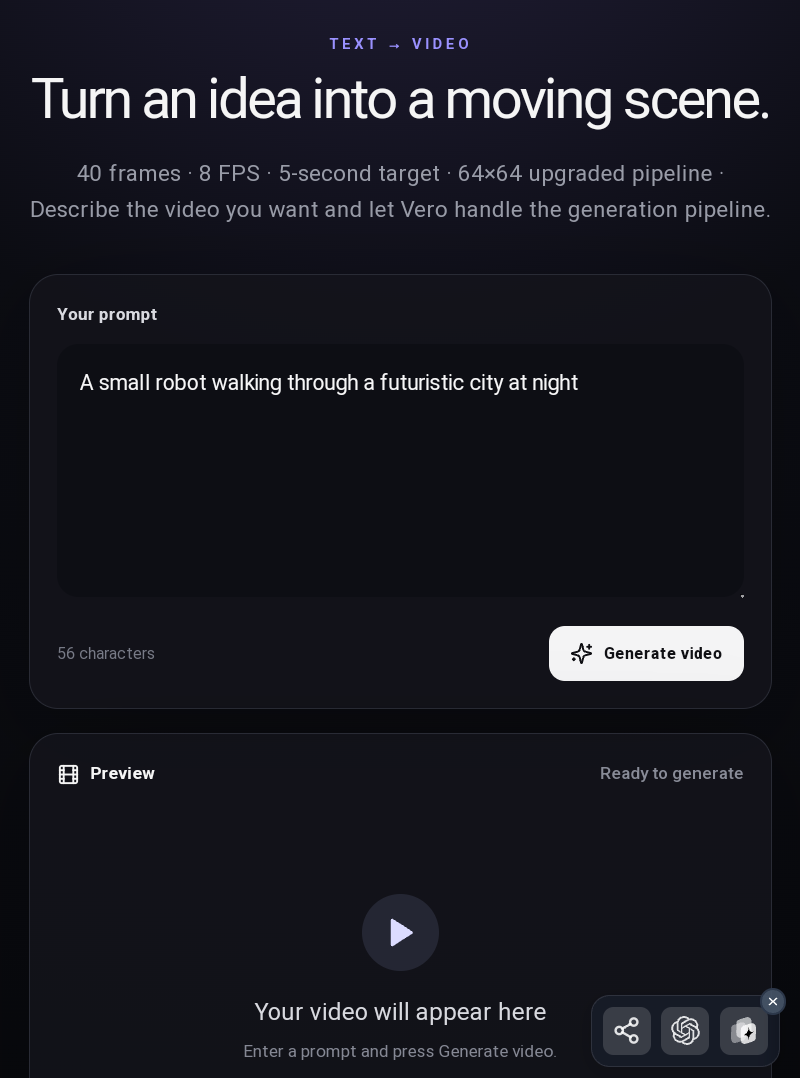
VERO is an experimental text-to-video research project. The current pipeline combines text conditioning, a neural denoising network, latent representations, and a video decoder.
The system has been developed incrementally, with improvements to temporal duration, spatial resolution, latent representation, and text conditioning.
I also built and tested a latent bridge so that the generation components could communicate with the video decoder.
What I learned
Building VERO taught me how different parts of a generative AI pipeline interact, including:
- Text conditioning
- Latent representations
- Video autoencoders
- Neural denoising
- Tensor shapes and dimensionality
- Model training and checkpointing
- GPU-based experimentation
- Connecting separate neural-network components into one pipeline
A major lesson was that increasing video resolution and duration quickly increases computational requirements. This motivated my interest in making AI systems more efficient and accessible.
Challenges
The biggest challenges were keeping the different components compatible while changing the model architecture. I had to solve issues involving latent-channel dimensions, tensor shapes, data types, text conditioning, and connecting the denoiser output to the video decoder.
I also had to work within limited computing resources, which made efficiency an important part of the project.
What's next
For this challenge, I want to investigate how VERO can be optimized for resource-constrained hardware and measure its real performance rather than relying on theoretical estimates.
The goal is to make the system smaller, more efficient, and easier to experiment with on hardware that is much less powerful than a large cloud-GPU setup.

Log in or sign up for Devpost to join the conversation.