-
-
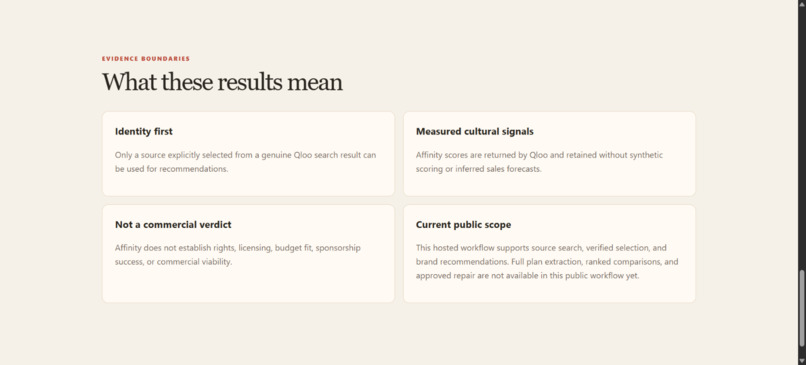
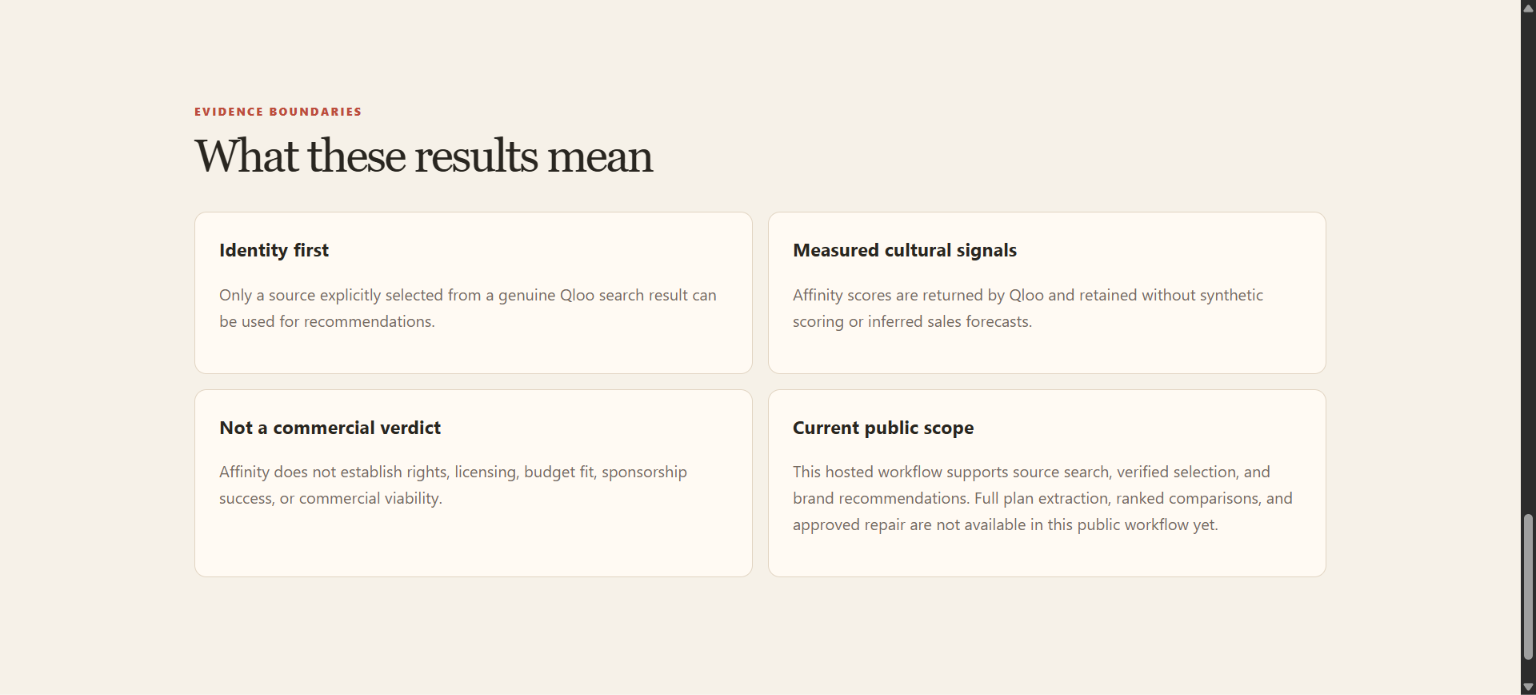
Evidence boundaries
-

Ranked recommendations
-
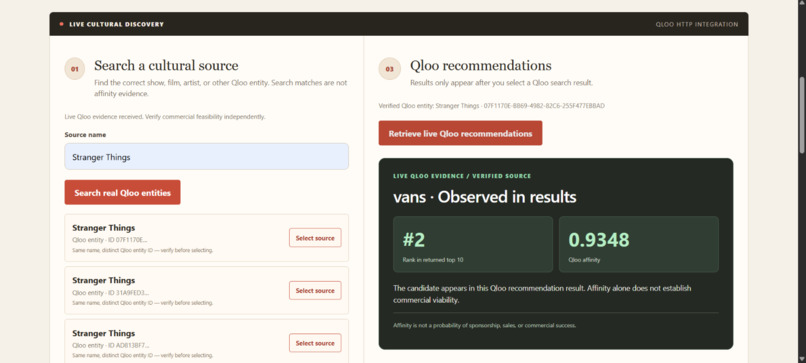
Qloo search and verdict
-
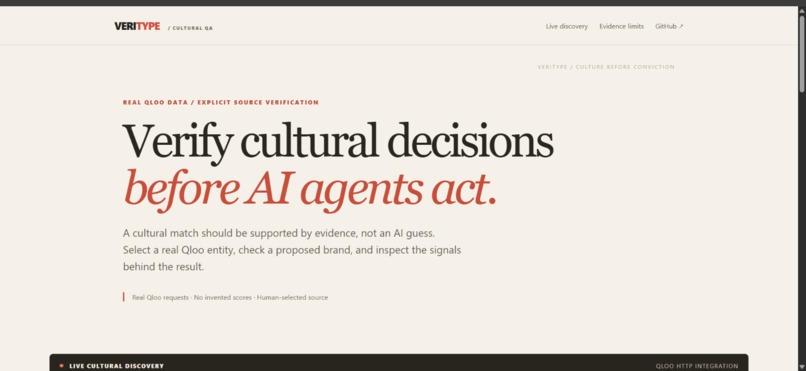
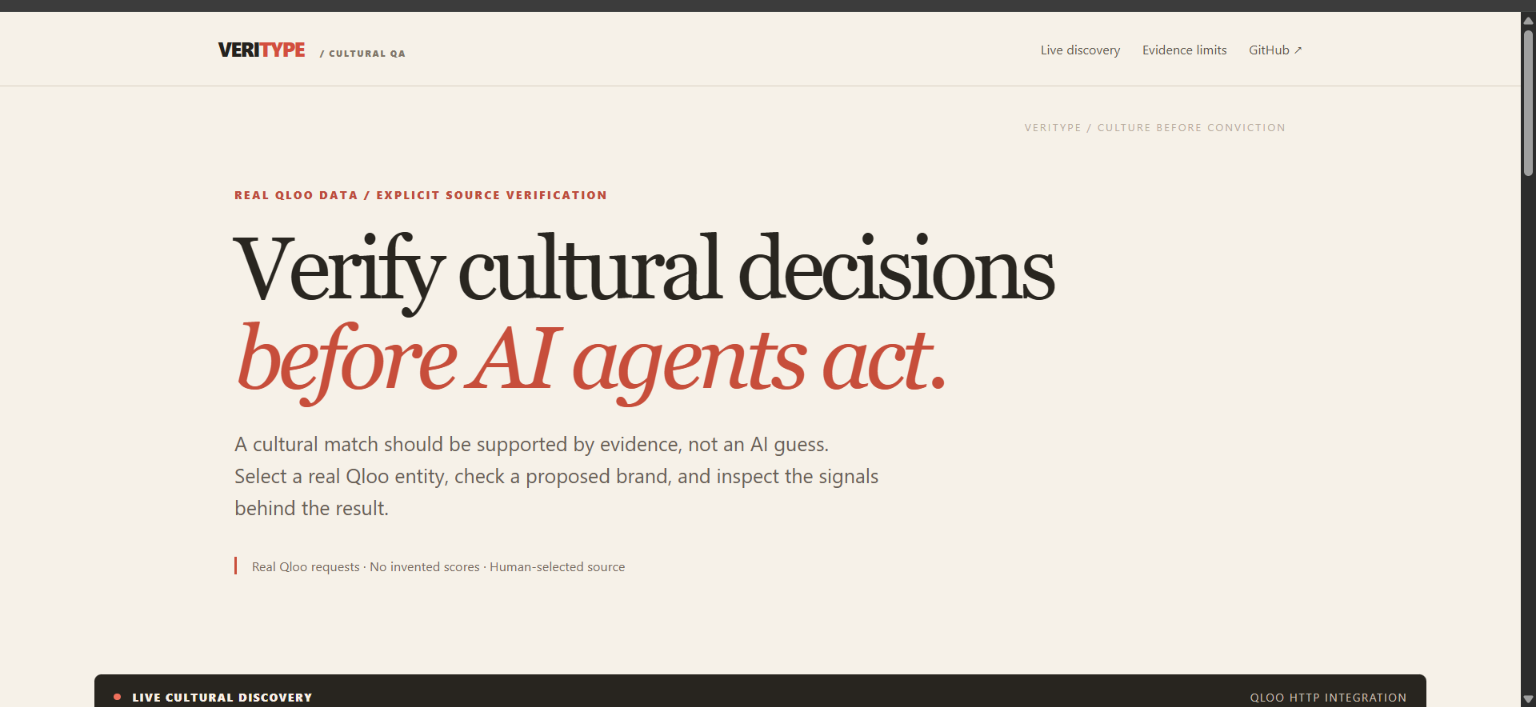
Homepage

Veritype Verify Before Acting
Cultural Quality Assurance for AI-Driven Decisions
Live Application: https://veritype.ajepleasant.workers.dev/
Source Code: https://github.com/0xaje/Veritype
Inspiration — When AI Sounds Certain, Who Checks the Evidence?
AI agents are becoming increasingly capable of researching markets, generating campaign strategies, and recommending partnerships.
Imagine an AI agent advising a marketing team to collaborate with a particular brand because it supposedly shares a strong cultural connection with a television series.
The recommendation sounds convincing. The explanation is polished. The agent appears confident.
But there is a critical question:
Where is the cultural evidence?
A fluent AI-generated explanation is not the same as an independently inspectable cultural signal.
A recommendation can sound persuasive without demonstrating whether the proposed brand appears in relevant cultural recommendation data.
That gap inspired Veritype.
We wanted to build a practical way to question AI-driven cultural recommendations before people rely on them.
Instead of treating an AI's confidence as proof, Veritype introduces an evidence-checking workflow powered by real Qloo cultural intelligence.
Our guiding principle is simple:
Before AI agents influence cultural decisions, verify the evidence.
What Veritype Does
Veritype is a web application for investigating cultural associations and evaluating proposed brand recommendations using genuine Qloo data.
It helps users answer questions such as:
- Does this proposed brand appear in Qloo's recommendations for a particular cultural entity?
- How does the brand rank among the returned recommendations?
- What affinity value does Qloo report?
- Can we inspect the underlying source identity and explainability information?
- What conclusions can—and cannot—reasonably be drawn from the result?
Rather than presenting an unsupported yes-or-no judgment, Veritype shows the evidence behind its assessment.
The Verification Workflow
1. Search for a cultural entity
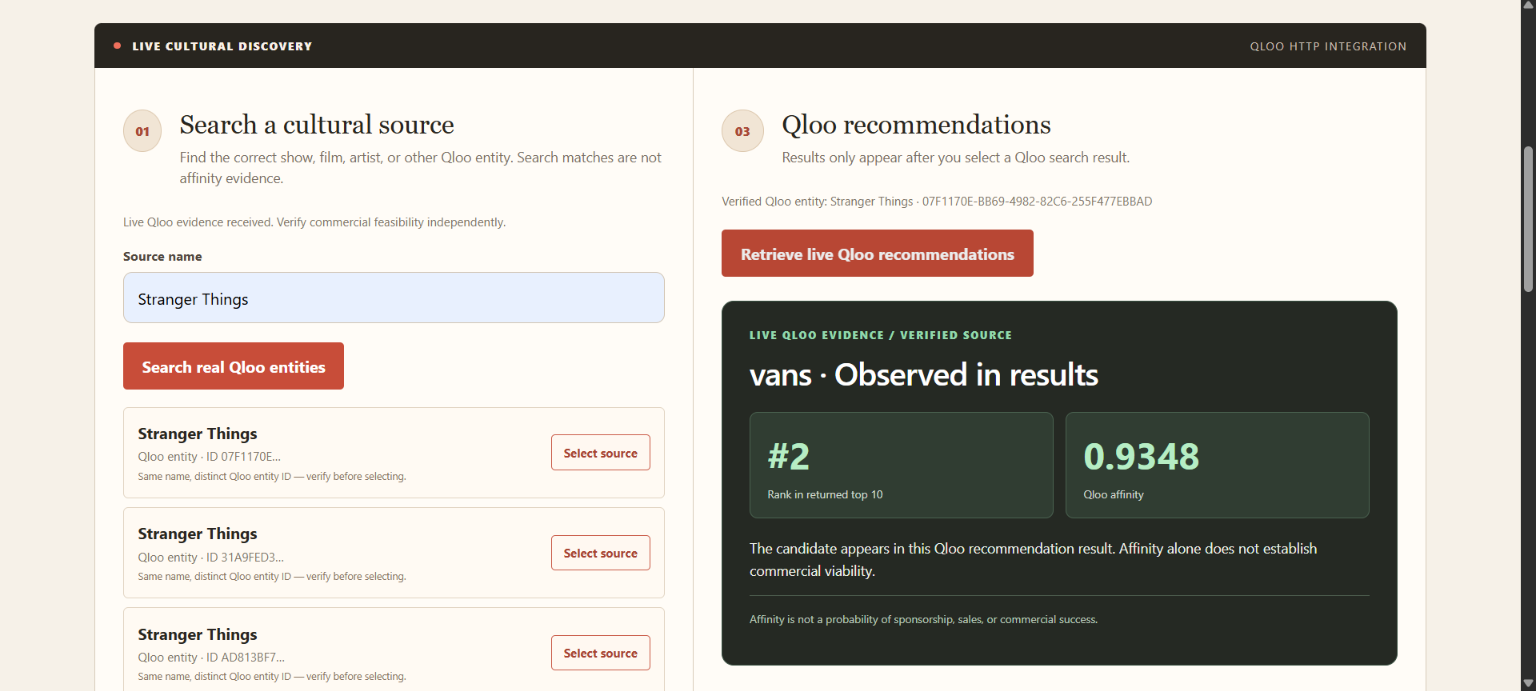
A user searches for an entertainment or cultural source, such as Stranger Things.
Veritype queries Qloo's entity search API and displays matching entities.
2. Verify the source identity
The user explicitly selects the intended Qloo entity.
This step matters because a text search can return multiple possible matches. Veritype does not silently assume that the first result is correct.
3. Evaluate a proposed brand
The user enters a candidate brand, such as Vans.
Veritype retrieves real brand recommendations associated with the selected source through Qloo Insights.
4. Examine the evidence
The application presents the candidate's observed status, ranking where applicable, affinity values, and available explainability and provenance information.
5. Make an informed decision
Veritype distinguishes what the returned evidence supports from what remains uncertain.
The user retains responsibility for the final decision.
A Real Example: Stranger Things × Vans
One of our live verification workflows investigates whether Vans appears among Qloo's brand recommendations associated with Stranger Things.
In a verified Qloo response during development, Vans appeared second among ten returned brand recommendations, with an affinity value of approximately 0.9348.
Veritype surfaced this information through its evidence interface rather than inventing a score or relying on a language model's opinion.
The important distinction is that 0.9348 is a Qloo affinity value, not a 93.48% probability that a partnership will succeed.
Similarly, if a brand is absent from a limited recommendation result, that absence alone does not prove cultural incompatibility.
The results are evidence for investigation, not automatic commercial approval.
Because Veritype retrieves live Qloo data, rankings and values may vary between requests.
How We Built It
Veritype combines a browser-based verification interface with a server-side Qloo integration and a lightweight edge deployment.
Frontend
The public interface provides:
- Cultural entity search.
- Explicit entity selection.
- Proposed brand assessment.
- Ranked recommendation results.
- Candidate evidence cards.
- Affinity and explainability views.
- Clear distinctions between observed evidence and unsupported conclusions.
The design focuses on making technical cultural intelligence understandable to users who are not data scientists.
Backend and Infrastructure
Cloudflare Workers hosts the deployed application and handles server-side requests.
Qloo API supplies genuine entity search results and cultural recommendations through its Search and Insights endpoints.
Cloudflare D1 supports verification sessions and request quota management.
The Qloo API key remains server-side rather than being exposed in browser JavaScript.
The application uses deterministic interpretation of returned evidence instead of generating artificial affinity values.
Simplified Architecture
User / AI-Assisted Decision
          |
          v
    Veritype Interface
          |
          v
    Cloudflare Worker
          |
          +---- D1 Sessions / Quotas
          |
          v
     Qloo Search API
     Qloo Insights API
          |
          v
    Evidence Assessment
          |
          v
  Rankings / Affinity /
  Explainability / Limits
          |
          v
    Human Review
Why Qloo Matters
Qloo is not a decorative integration in Veritype. It provides the cultural data on which the application's assessments depend.
The integration serves two distinct purposes.
Entity search helps establish which real cultural entity is being investigated.
Insights recommendations provide the brand recommendations and associated affinity evidence used in the candidate assessment.
Veritype then makes those returned results inspectable through a focused verification interface.
Without Qloo's data, the core cultural evidence workflow would not function.
Challenges We Faced
1. Entity ambiguity
Searching for a cultural title can produce multiple possible results.
Automatically choosing an entity risks building an entire assessment around the wrong source.
We addressed this by requiring explicit user selection before proceeding with brand discovery.
2. Separating evidence from interpretation
An affinity value can look like a definitive score, especially when displayed in a polished dashboard.
But affinity does not establish commercial success, sponsorship suitability, or causal relationships.
We designed the assessment to preserve that distinction and avoid overstating what the data proves.
3. Building with genuine external data
We wanted the working application to demonstrate real Qloo requests and responses, not fabricated recommendations.
This required integrating the actual endpoints, handling their returned structures, and presenting the results meaningfully.
4. Deploying a usable public experience
A local demonstration is not enough for judges who need to test a submission themselves.
We deployed the application on Cloudflare Workers, with server-side API access and D1-backed session and quota support, so the core workflow is available through a public URL.
5. Making technical evidence understandable
Raw API responses can be difficult to interpret.
We worked on turning the returned information into clear source-selection steps, evidence cards, rankings, and explanations without hiding the underlying data.
What We Learned
Building Veritype reinforced an important lesson:
Responsible AI is not only about producing better answers. It is also about making the basis of those answers inspectable.
We learned to treat source identity as part of the verification process, preserve the meaning of third-party metrics, and communicate uncertainty rather than replacing it with false precision.
We also learned that a useful verification experience must balance technical transparency with simplicity.
An application can expose real evidence without requiring every user to understand the underlying API response format.
What Makes Veritype Different?
Veritype focuses on the space between an AI-generated cultural recommendation and a human decision.
Its approach combines:
- Real cultural intelligence: Qloo supplies the recommendation evidence.
- Explicit source verification: Users confirm which cultural entity is being investigated.
- Inspectable results: Rankings, affinity values, and explainability remain visible.
- Deterministic evidence assessment: The application does not invent its own cultural affinity metrics.
- Honest limitations: The interface avoids treating correlation as commercial certainty.
- Public accessibility: Judges can test the deployed application directly.
Veritype's current public implementation is a human-operated cultural verification workflow. Its broader direction is to make this kind of evidence checking available within AI-agent decision processes.
What's Next
Our longer-term vision is to expand Veritype from a focused verification interface into a more complete cultural quality-assurance layer for AI agents.
Potential next steps include:
- Structured checks of multi-part AI-generated campaign plans.
- Evidence-backed recommendations for revising unsupported assumptions.
- Retesting revised plans against relevant cultural signals.
- Additional cultural categories and comparison workflows.
- Integrations that let agent developers request verification before presenting or executing recommendations.
These are future directions, not claims about functionality already available in the public deployment.
Try Veritype
Live demo: https://veritype.ajepleasant.workers.dev/
GitHub: https://github.com/0xaje/Veritype
Suggested Judge Walkthrough
- Open the live application.
- Search for Stranger Things.
- Select the intended Qloo entity.
- Enter Vans as the proposed brand.
- Retrieve the live Qloo recommendations.
- Inspect the candidate verdict, rankings, affinity values, and explainability.
The complete workflow uses real Qloo data.
Final Thought
As AI agents become more capable of recommending actions, the quality of the evidence behind those recommendations becomes increasingly important.
Veritype explores a simple but essential idea:
AI can recommend. Evidence should help us decide.
Veritype — Verify Before Acting.
Built With
- ai-agents
- cloudflare-d1
- cloudflare-workers
- css3
- cultural
- html5
- intelligence
- javascript
- node.js
- qloo
- qloo-api
- rest-api
- web-apis

Log in or sign up for Devpost to join the conversation.