-
-
Verity — Proof-Carrying Release Gates
-
Order creation requires an authenticated customer
-
Critical Risk
-
Cedar Storefront
-
Verity is a local-first Node.js developer tool
-
Evidence
Inspiration
AI coding agents can create a convincing, multi-file pull request in minutes. The difficult question is not only “do the tests pass?” but “which real release promise do these tests prove?” A green suite and an agent-written “done” message force a reviewer to reconstruct that link from scratch.
What it does
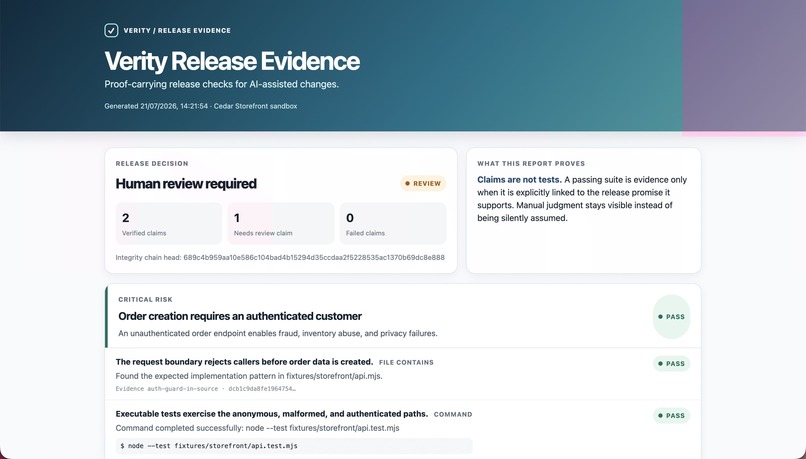
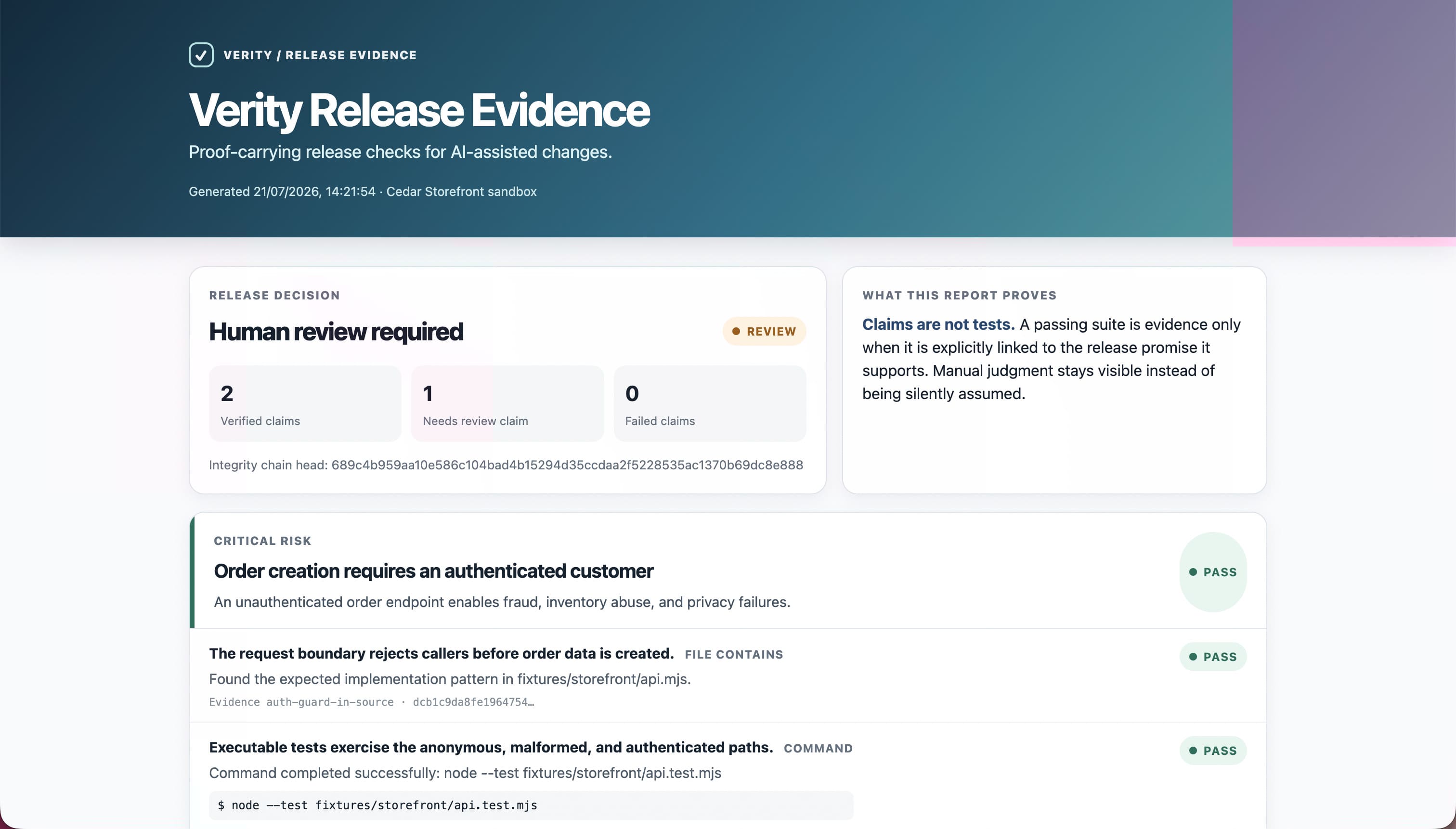
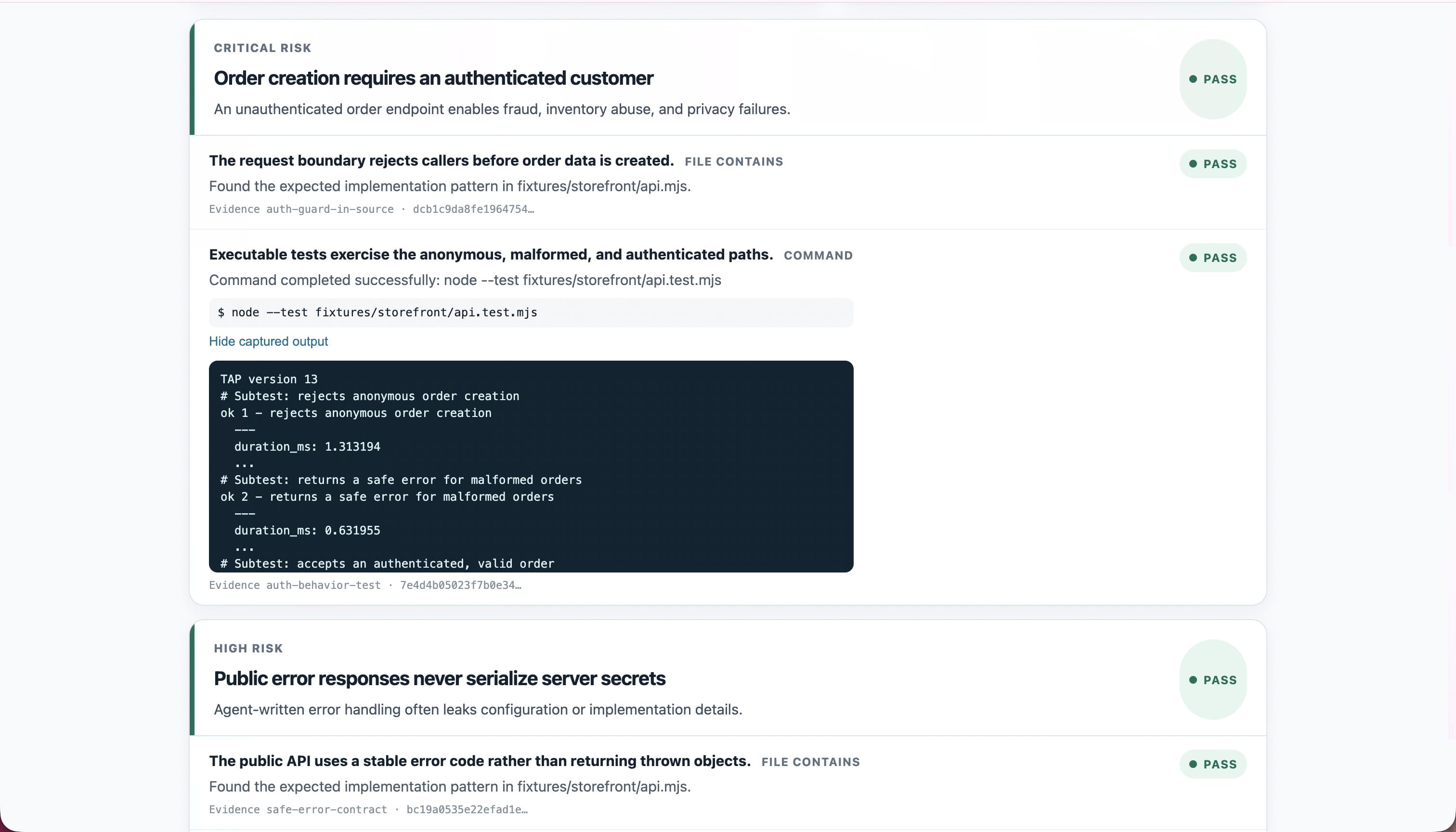
Verity is a proof-carrying release gate for AI-assisted code changes. A team writes important release claims—such as “order creation requires an authenticated customer”—then attaches reproducible evidence to each claim.
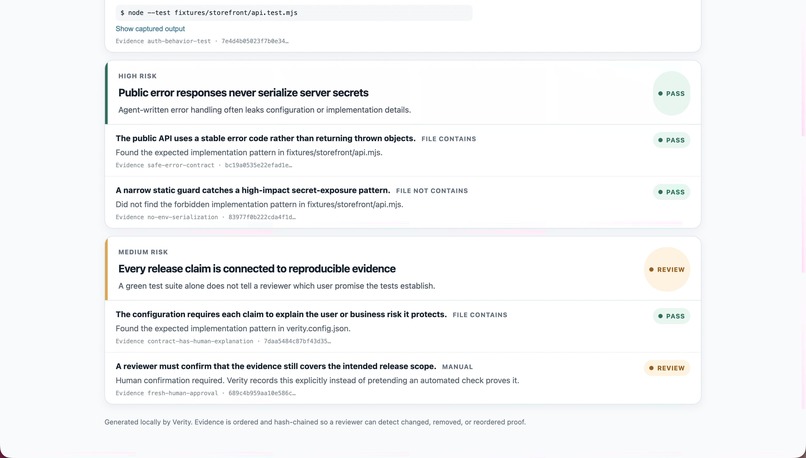
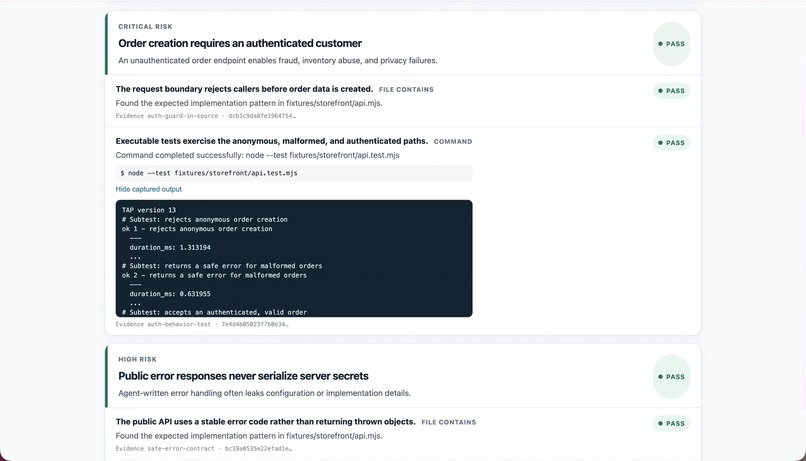
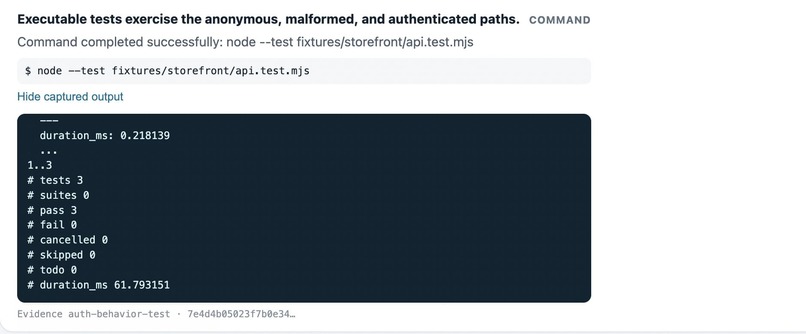
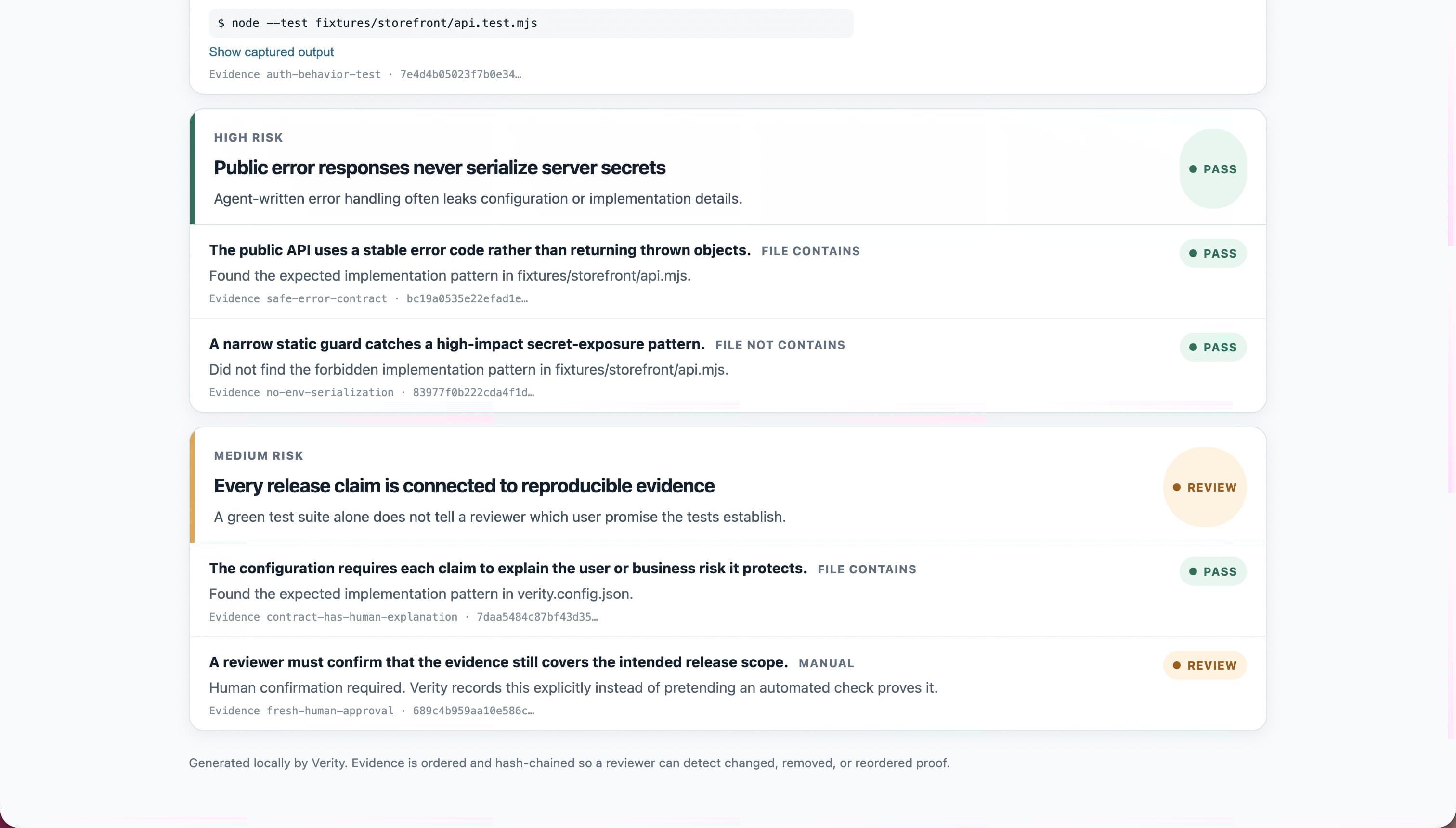
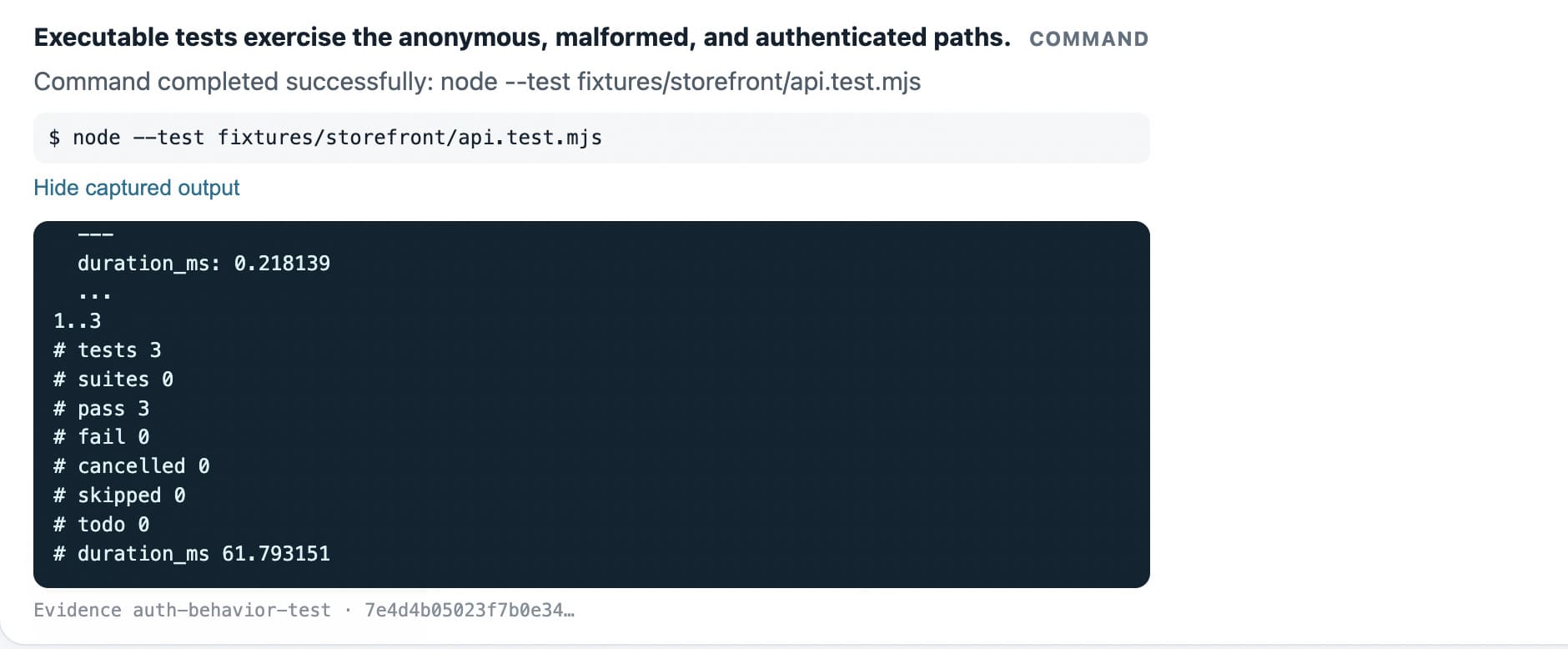
Verity can evaluate source-pattern checks, executable test commands, and explicit manual review. It generates a standalone HTML report and portable JSON evidence record. Each evidence result is ordered and SHA-256 hash-chained, so a reviewer can detect a changed, removed, or reordered item with verity verify.
The key distinction is simple: a test is not a claim. It becomes evidence only when it is explicitly connected to the customer, security, or product promise it supports. If a decision requires a human, Verity shows REVIEW instead of silently turning it green.
How we built it
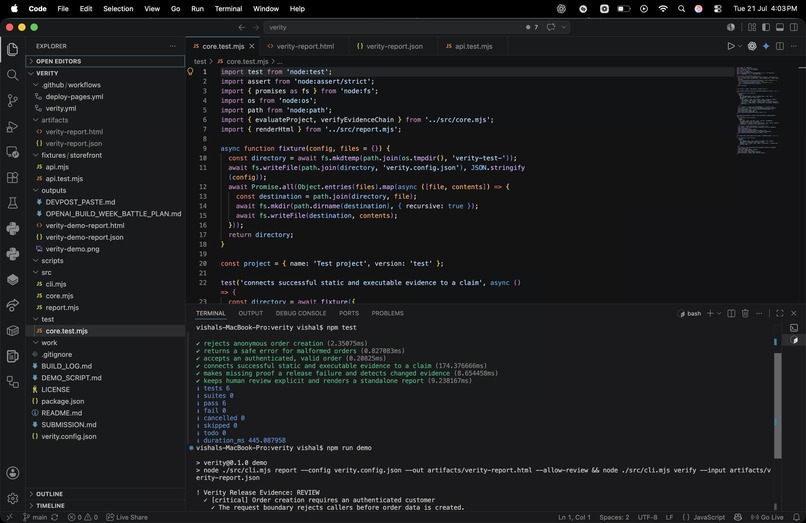
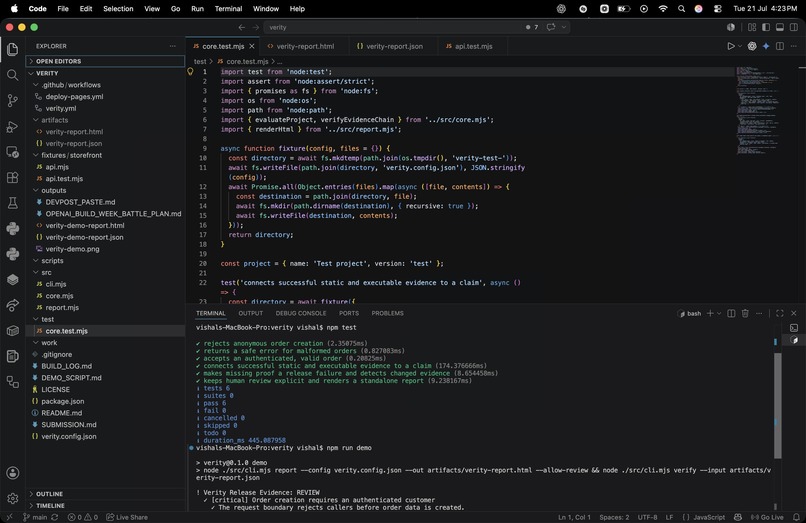
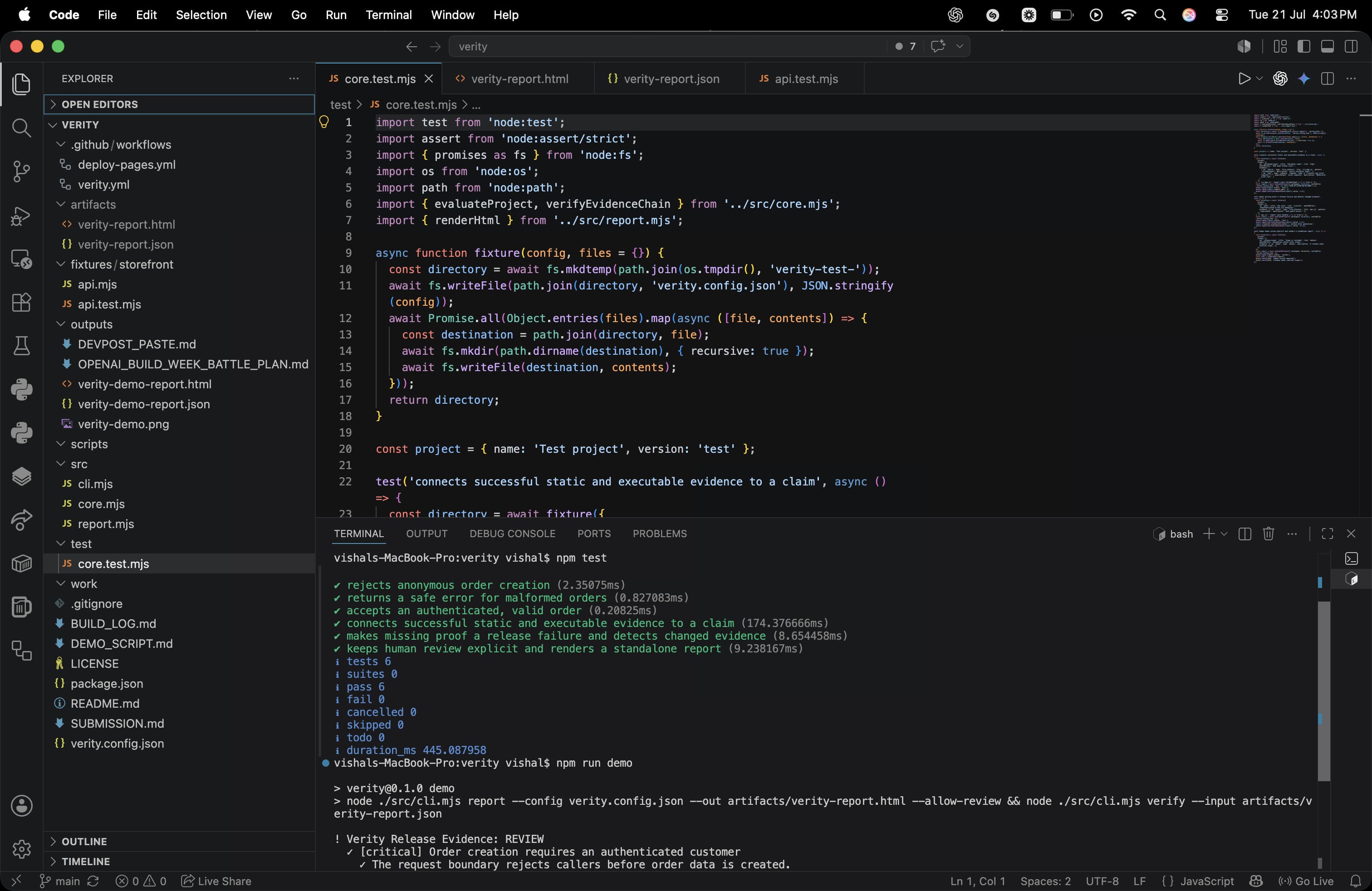
We built Verity in Codex using GPT-5.6 during OpenAI Build Week. Codex accelerated the complete engineering loop: translating the judging rubric into a product thesis, designing the configuration contract, implementing the evaluator and CLI, creating the standalone report UI, building the sample API and tests, and verifying the one-command judge path.
The project is intentionally local-first: Node.js 20+, no dependencies, no API key, no account, and no network connection are needed to run the demo. GitHub Actions runs the same validation and publishes a live static demo through GitHub Pages.
Challenges we ran into
The hard product decision was resisting a false “AI-approved” result. Static checks and tests are valuable, but they cannot infer whether a change actually matches a release owner’s intent. Verity therefore treats human sign-off as a first-class REVIEW state, not an automated pass.
Accomplishments that we're proud of
- A runnable CLI with static, executable, and manual evidence types.
- A transparent failure path: remove the authentication guard in the sample API and the critical release claim blocks immediately.
- Portable HTML and JSON artifacts that are easy for a reviewer to inspect.
- Evidence integrity verification that detects changed, removed, or reordered proof.
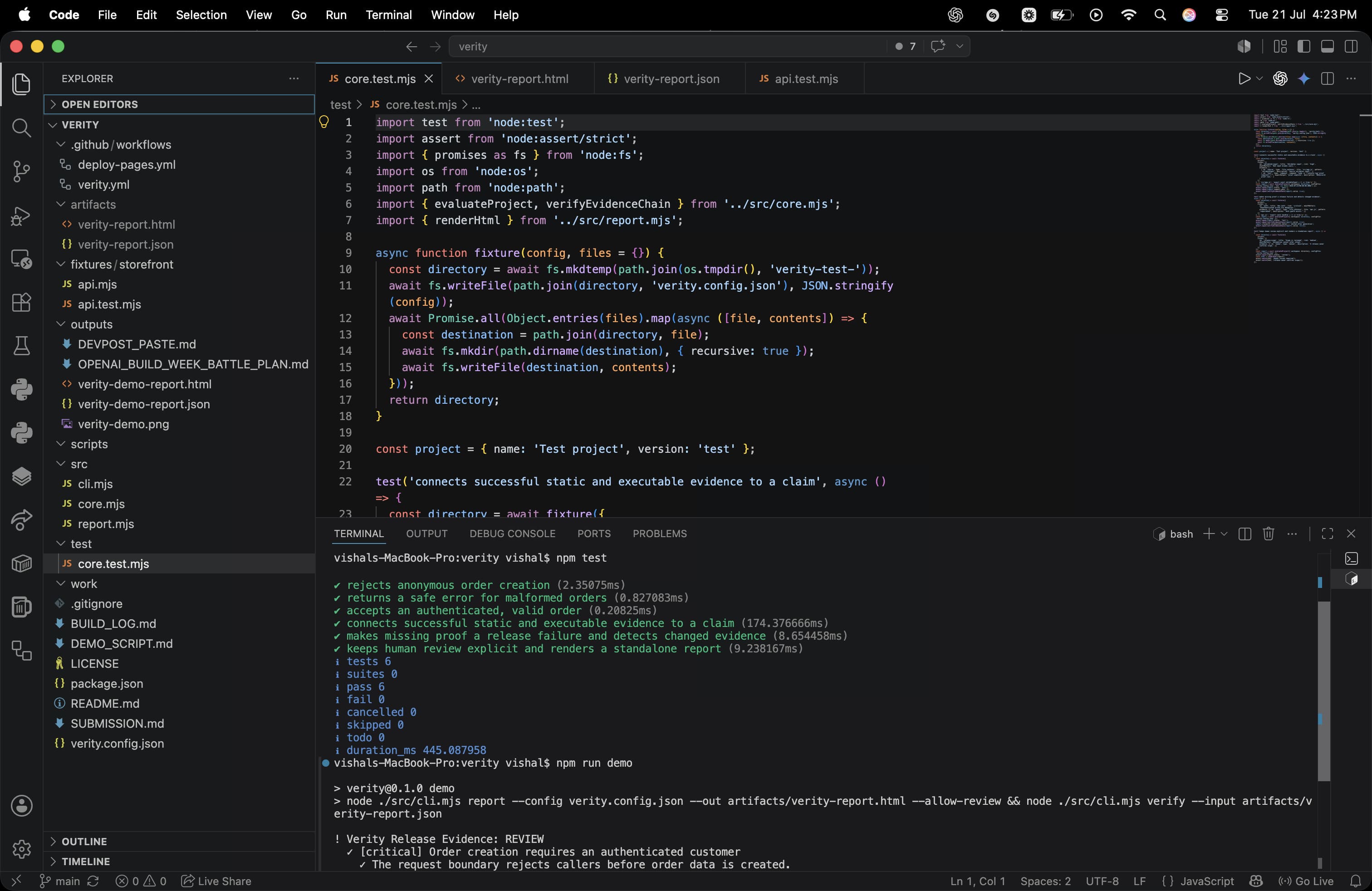
- A zero-install judge path:
npm test, thennpm run demo.
What we learned
Agentic engineering changes the bottleneck from writing code to establishing trustworthy evidence. Product-level traceability—promise to proof—is as important as generating a correct-looking diff.
What's next for Verity
We will add first-class integrations for pull requests and CI annotations, richer evidence adapters for API and browser tests, policy templates for common release risks, and signed/attested evidence artifacts for team handoff.
Built With
- automated-testing
- cli
- devops
- github
- github-actions
- gpt-5.6
- javascript
- node.js
- openai-codex
- security


Log in or sign up for Devpost to join the conversation.