-
-
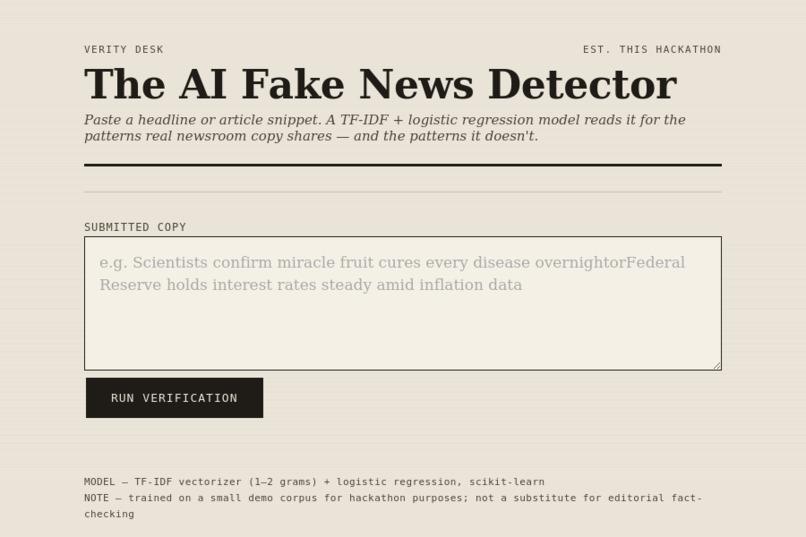
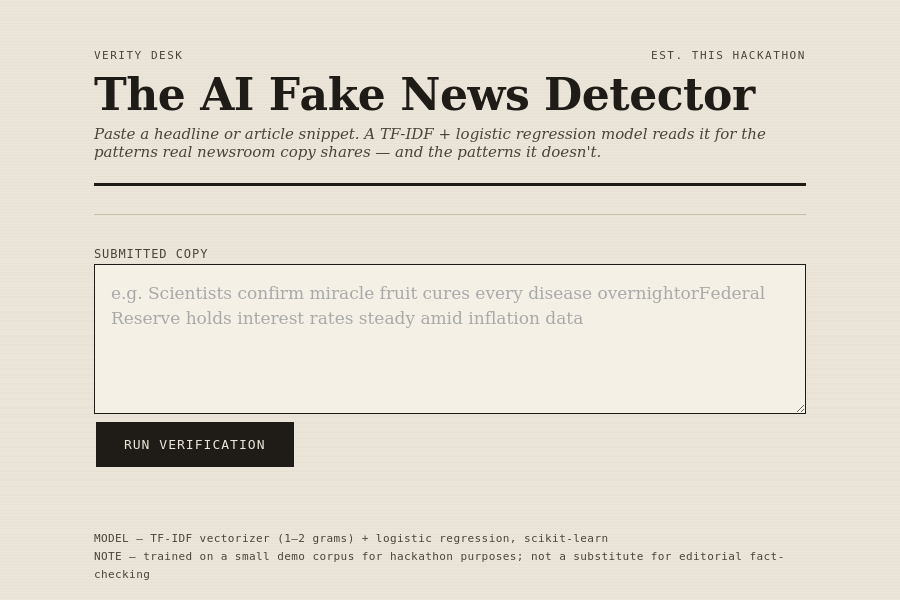
Verity Desk's input screen — paste a headline or article snippet to check.
Inspiratio## Inspiration
Misinformation spreads faster than fact-checkers can keep up with it. We wanted to build a quick, automated first-pass tool that could flag suspicious news text before it spreads further — something lightweight enough to run instantly, without needing a human reviewer for every single claim.
What it does
Verity Desk takes a news headline or article snippet and classifies it as REAL or FAKE using a machine learning model, along with a confidence score. It's meant as a triage step, not a final verdict — a fast signal to help readers pause and think critically.
How we built it
We built a TF-IDF + Logistic Regression pipeline using scikit-learn to turn news text into features and classify it. The model is trained on a labeled dataset of real and fake news examples. We wrapped it in a Flask web app with a simple, newsroom-styled interface where users paste text and get an instant verdict.
Challenges we ran into
Balancing a small hackathon-scale training dataset against getting meaningful accuracy was the biggest challenge. We also had to think carefully about presenting the confidence score honestly, since this is a first-pass signal and not a guaranteed fact-check.
What we learned
We learned how much of an ML pipeline's success depends on data quality and feature representation (TF-IDF) rather than model complexity alone. We also learned how to turn a model into something usable through a simple, fast web interface.
What's next for Verity Desk
Training on a large real-world dataset, adding source credibility checks, and integrating with fact-checking APIs for stronger accuracy.Python Flask scikit-learn HTML CSSn

Log in or sign up for Devpost to join the conversation.