-
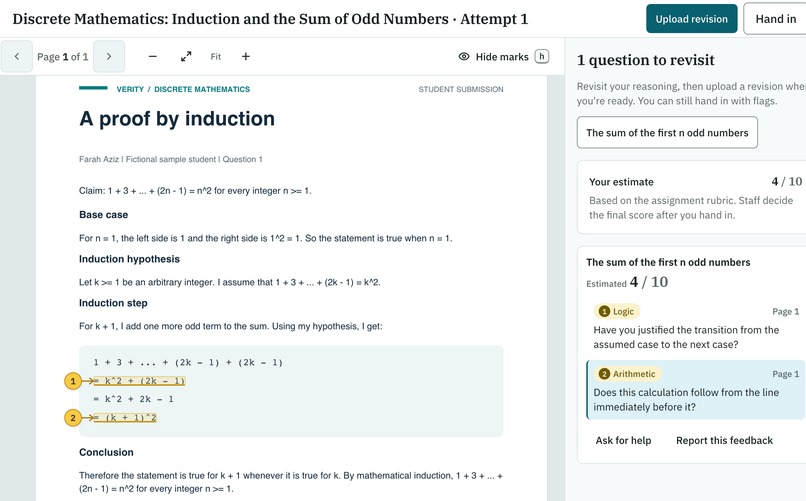
reviewing feedback immediately after submission
-
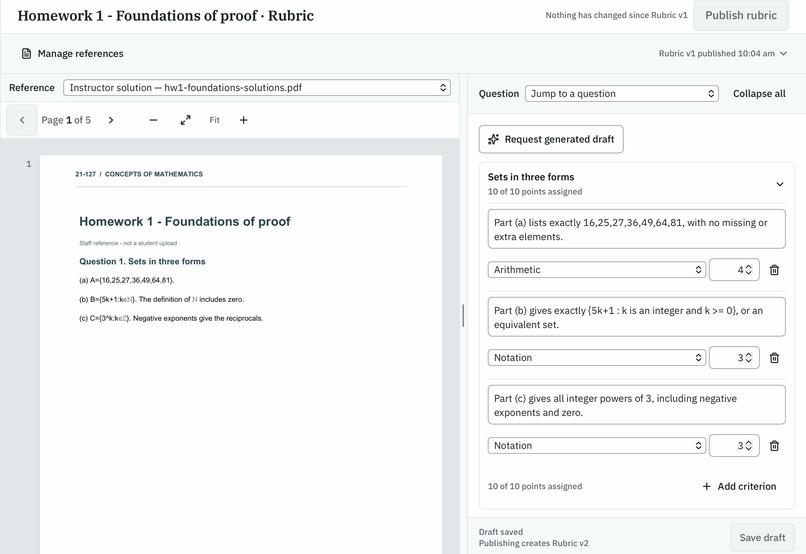
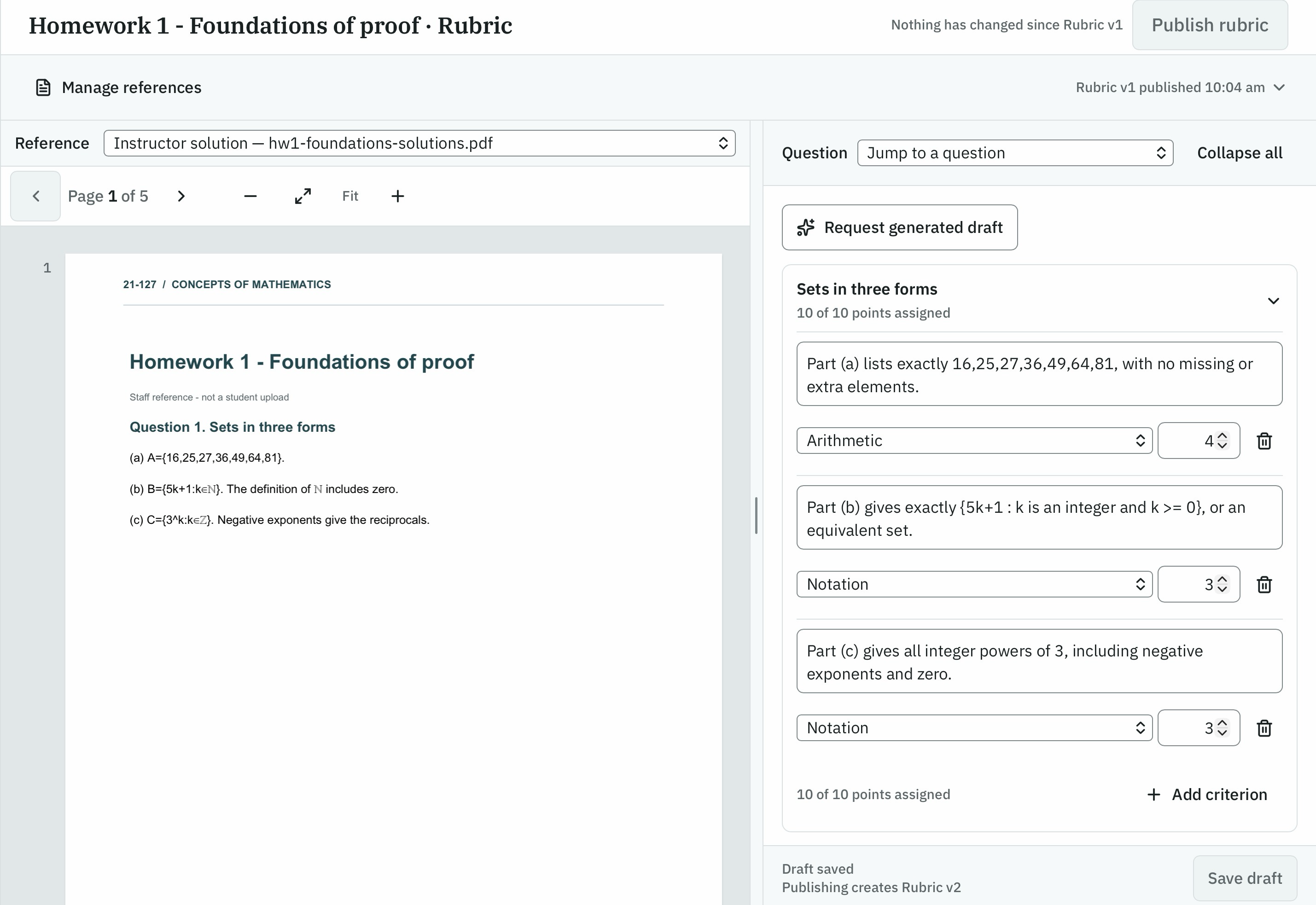
creating rubric for assignment
-
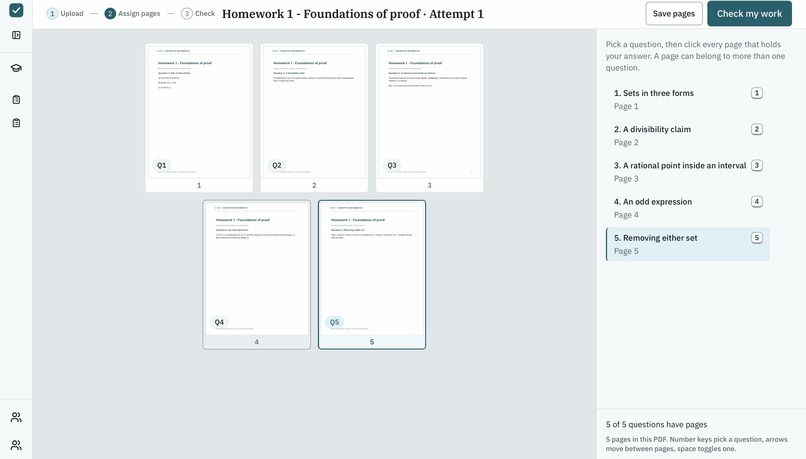
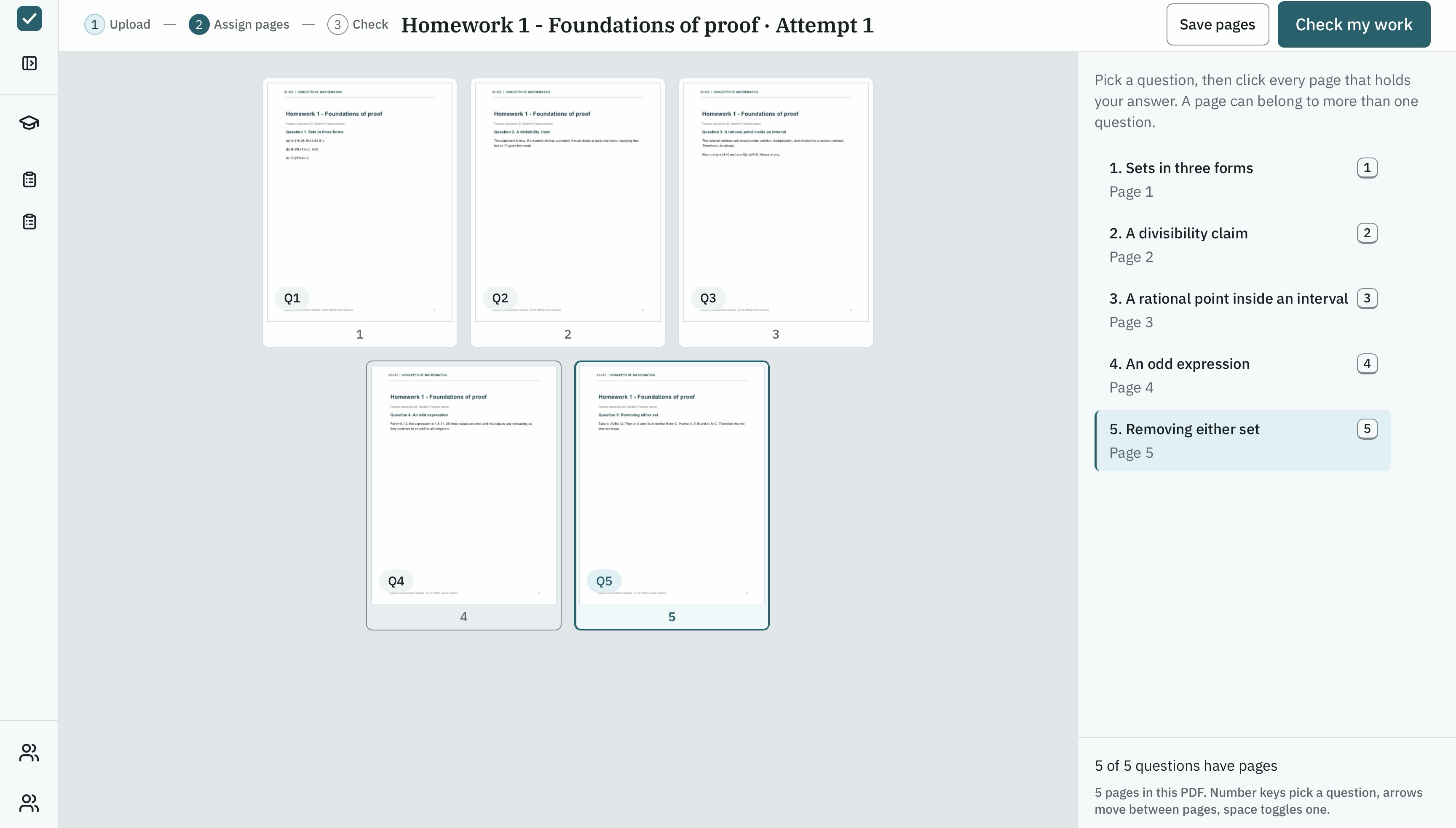
assigning question to pages
Inspiration
You spend hours working through a math assignment, submit it, and move on. Days later, the feedback arrives, and you finally see where your reasoning went off track. By then, you’re already tackling the next topic.
We built Verity to bring that moment of understanding forward.
We wanted students to get useful guidance while they still have time to revise, and instructors to have a clearer view of where their class needs help. That meant building around the instructor’s expectations, preserving the thinking that makes homework valuable, and keeping educators involved in every final grade.
What it does
Verity brings practice, feedback, revision, and grading into one workspace.
Students upload a PDF, match its pages to assignment questions, and check their work against an instructor-approved rubric. They receive an estimated score and short coaching prompts linked to relevant pages, pointing them toward possible issues in arithmetic, logic, notation, or justification. The prompts encourage students to revisit their reasoning without revealing worked solutions.
Students can upload revisions, revisit earlier attempts, and hand in their final submission when ready.
Instructors and TAs can create assignments, write or generate rubric drafts, and review papers with the original PDF beside the grading criteria. They can adjust scores, correct suggested explanations, and leave comments for students. Every final paper receives human review before its scores are released.
Class-level views also surface questions attracting feedback flags, giving instructors a starting point for deciding what to revisit in class.
How we built it
We built Verity with React, TypeScript, and Vite on the frontend and Python and FastAPI on the backend. SQLite stores assignments, rubric versions, submissions, and reviews, while PDF.js brings students’ papers directly into the workspace.
We integrated NVIDIA Nemotron through OpenRouter for assessment, rubric drafting, and selecting student hints. The model proposes criterion-level findings; the backend validates their structure and evidence, then calculates estimated scores from the rubric.
Student hints follow a separate process that selects from reviewed coaching prompts without receiving private solutions or staff rationales.
We used Codex and Claude Code to help implement and iterate on the application, with our team directing the product and engineering decisions.
Challenges we ran into
A central challenge was making feedback useful without taking the learning out of the assignment. A student needs enough direction to make progress while still doing the reasoning themselves. We addressed this with concise coaching prompts and a clear separation between student guidance and private grading explanations.
Uncertainty also needed careful handling. Unreadable or inconclusive work should lead to clarification or review. We built explicit states for missing evidence, unavailable assessment, and uncertain findings.
Keeping the workflow consistent across revisions introduced another challenge: each attempt needed to preserve the rubric and feedback used at that moment, while the handed-in paper remained fixed for final review.
Accomplishments that we're proud of
We’re proud of connecting the full assignment journey: creating a rubric, checking work, revising, handing in, reviewing, and releasing scores.
We also made the paper itself central to the experience. Feedback links back to its pages, and staff can review the original work alongside the rubric.
Behind that interface, we covered permissions, private solution access, revision history, failed assessment jobs, and grading conflicts with automated tests. Those details help make the workflow dependable.
What we learned
Building Verity taught us how much educational feedback depends on context. A useful response needs to reflect the assignment, the instructor’s expectations, and what the student should think through next.
We also learned that uncertainty deserves a place in the interface. Clearly distinguishing an estimated score, a request for review, and a final grade is part of making the product understandable and trustworthy.
What's next for Verity
Next, we want to improve support for handwritten and scanned work through OCR, evaluate feedback quality with instructor-reviewed examples, and run classroom pilots to understand how students use the guidance.
We also want to connect Verity with learning management systems and help instructors identify recurring difficulties across assignments.
Our goal is to make every revision a chance to understand something more deeply—and give students that chance before they press “Hand in.”
Built With
- openrouter
- react
- vite
