Inspiration
We built VeriTrace because people constantly see health claims, finance hype, greenwashing, fake reviews, and viral misinformation online, but usually have no fast way to verify them at the exact moment they read them. We wanted to turn "read first, verify later" into "verify before you believe."
What it does
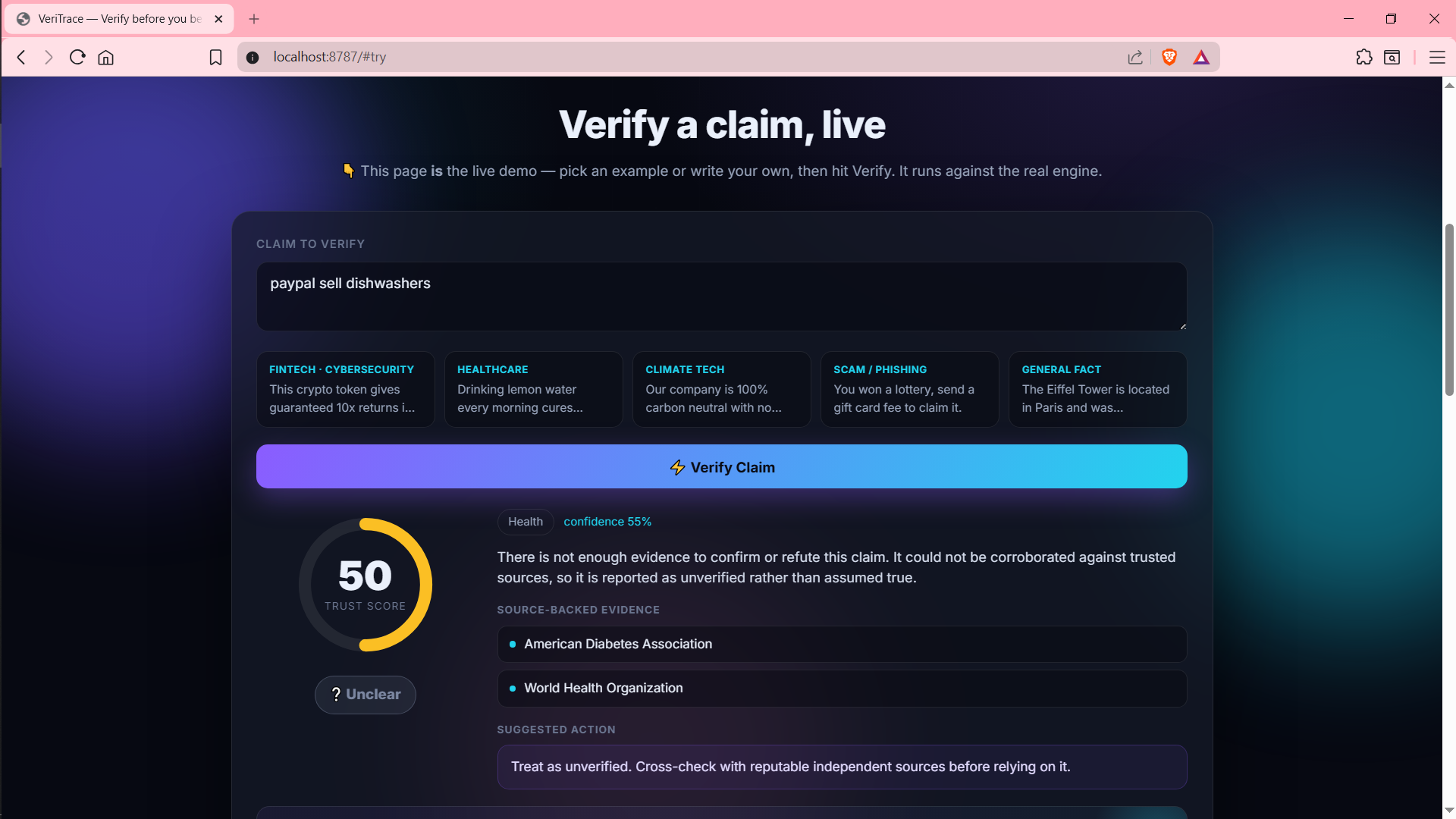
VeriTrace is a browser-based claim verification tool. A user highlights any suspicious claim on a webpage, clicks the extension, and gets an instant verdict such as Likely True, Likely False, Misleading, Scam Risk, or Unclear. It also shows a trust score, confidence score, explanation, risk signals, source links, and a tamper-evident proof receipt that can be re-verified later.
How we built it
We built VeriTrace as a Chrome Manifest V3 extension with a Node.js + Express backend. The extension captures highlighted text from any page and sends it to the backend. On the backend, a lightweight custom TF-IDF + cosine similarity classifier assigns a category and risk score, then an AI adapter generates the final explanation and verdict. For integrity, we create a SHA-256 proof receipt and generate a real CIDv1-style IPFS content ID, so every result is portable and tamper-checkable.
Challenges we ran into
One challenge was handling the browser-extension flow cleanly in Manifest V3, especially passing the selected text between the page, the popup, and the background service worker. Another challenge was keeping the demo reliable even without external APIs, so we had to design a strong offline-first fallback using a deterministic mock verifier. We also had to generate cryptographic receipts and IPFS-style content IDs without adding heavy external dependencies.
Accomplishments that we're proud of
We are proud that VeriTrace works as a real end-to-end prototype, not just a concept. It verifies live highlighted claims inside the browser, supports multiple domains like health, finance, scams, climate, and general misinformation, and produces a proof receipt that can be verified for tampering. We are also proud that the project stays lightweight, explainable, and demo-friendly while still combining AI, ML, cybersecurity, and Web3-style proof concepts in one workflow.
What we learned
We learned that trust products need more than just a label; users also need context, evidence, and a clear next action. We also learned that deterministic fallbacks are extremely important for demos and hackathons, because they make the product stable even when APIs or networks fail. On the technical side, we learned how to connect browser-extension UX, lightweight ML scoring, AI verification, and cryptographic proof into one coherent pipeline.
What's next for VeriTrace
Next, we want to improve the evidence layer by connecting VeriTrace to stronger trusted-source retrieval and live fact-checking pipelines. We also want to expand beyond text into image and media verification, strengthen the history and dashboard experience, and optionally anchor proof receipts to real decentralized storage or testnet blockchain infrastructure. Longer term, VeriTrace could become a broader trust layer for the web, helping people verify claims before they share, buy, invest, or believe.
Built With
- chrome-extension-manifest-v3
- cosine-similarity
- css
- express.js
- html
- ipfs
- javascript
- node.js
- sha-256
- tf-idf


Log in or sign up for Devpost to join the conversation.