-
-
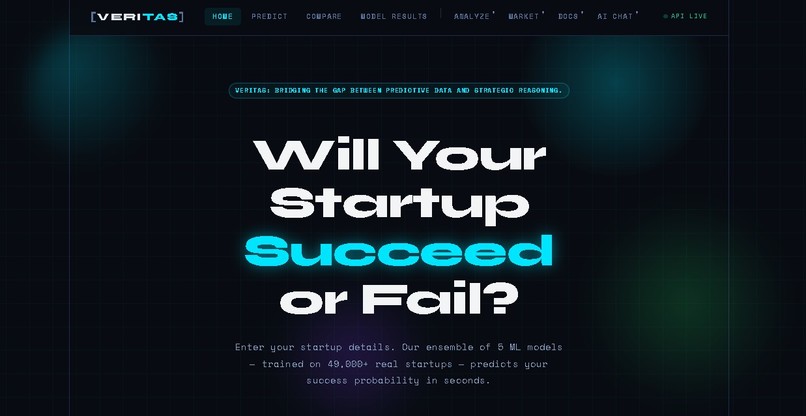
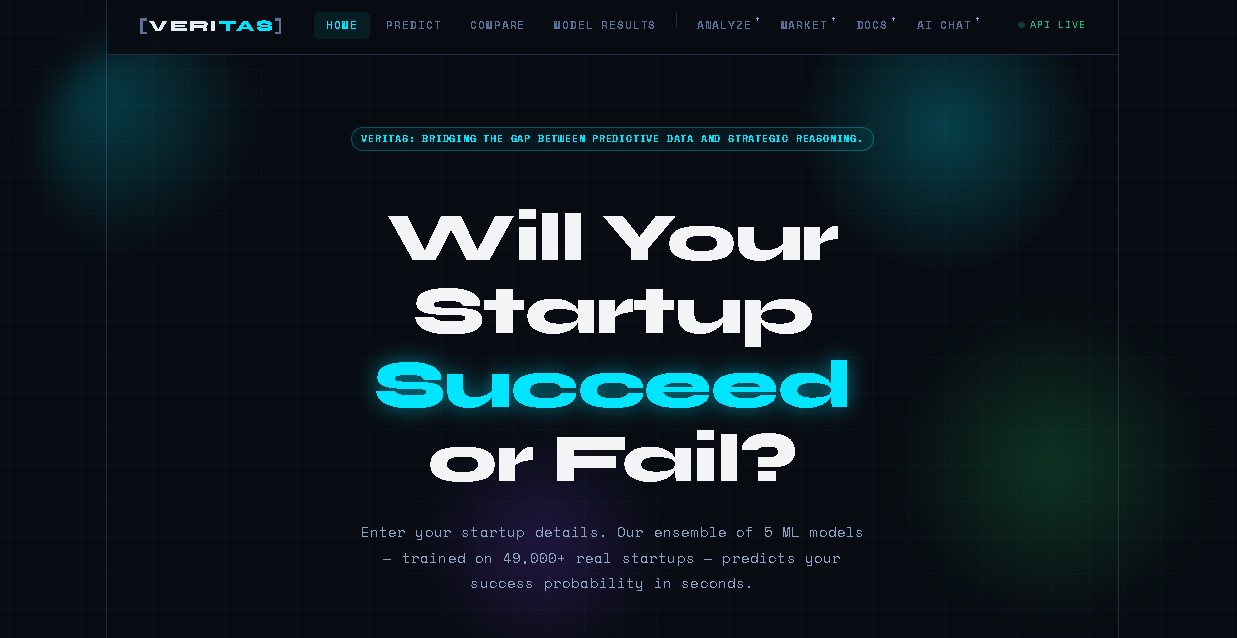
Veritas Landing page
-
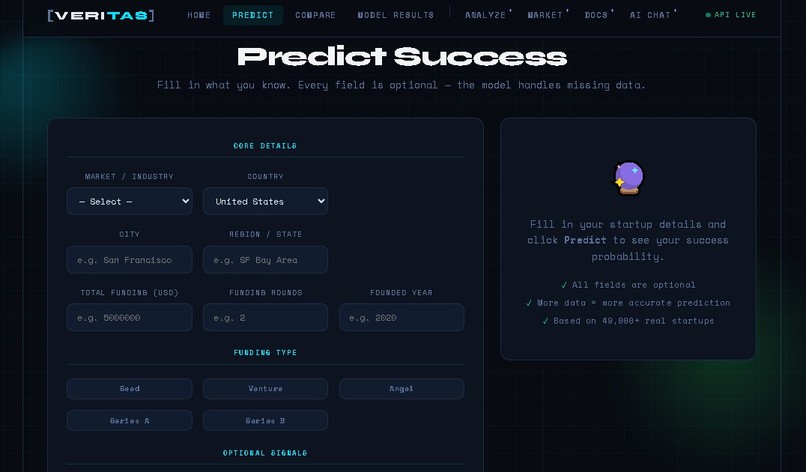
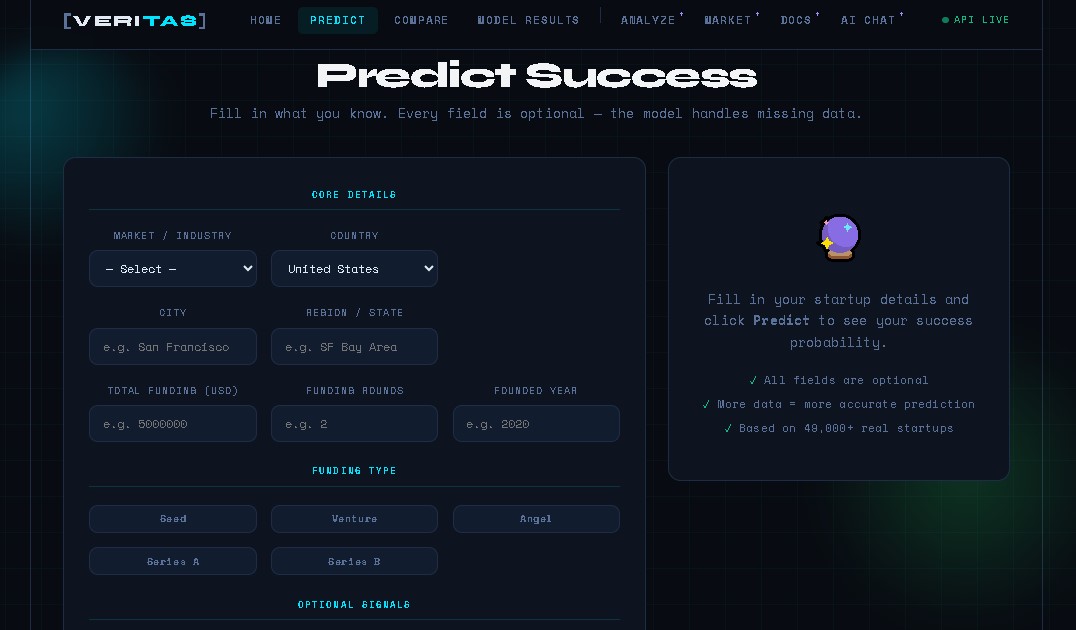
The Veritas Prediction Engine: A high-fidelity interface where users input startup parameters
-
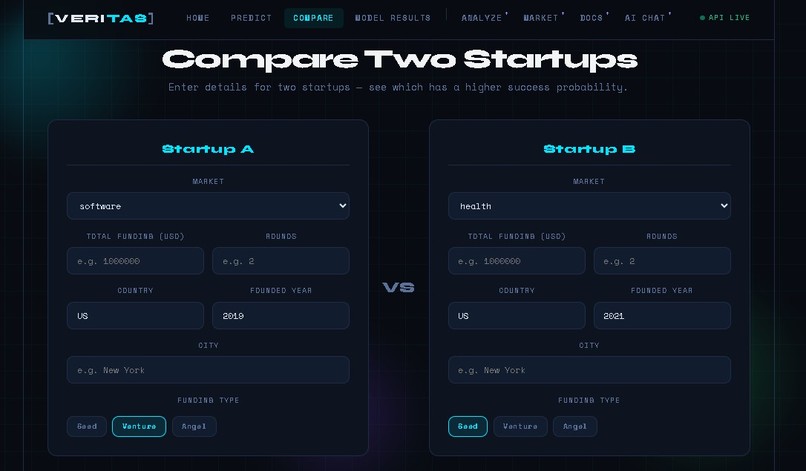
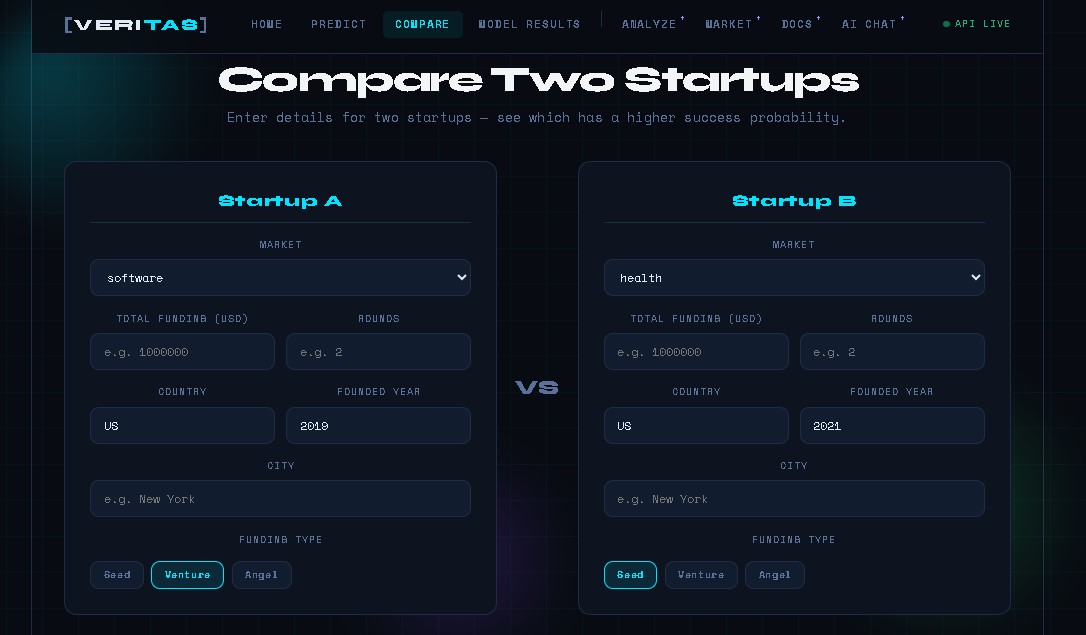
Side-by-side ML comparison: Input two startup profiles to see which has the higher mathematical success probability.
-
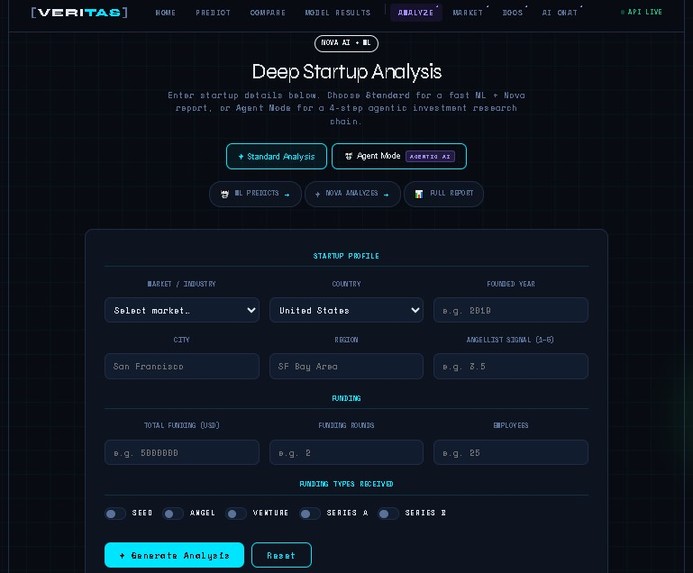
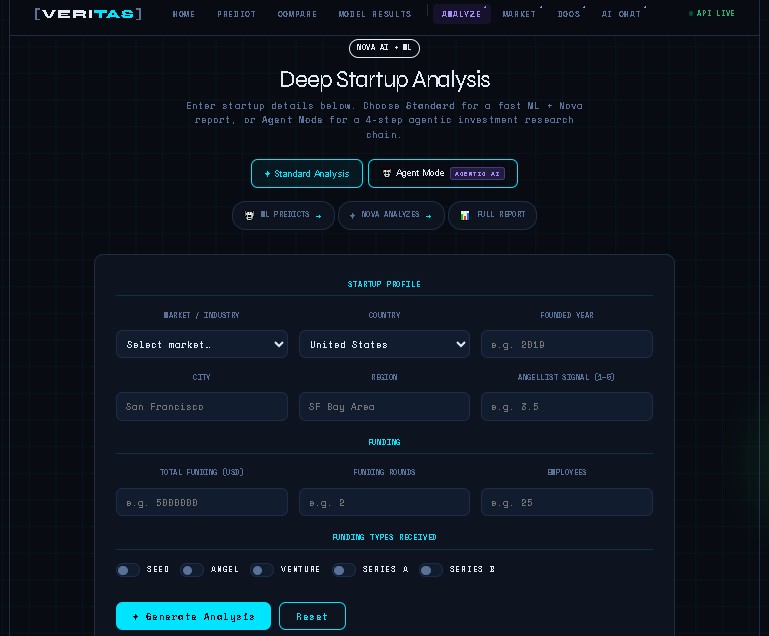
Agentic Intelligence: Veritas uses a 4-step Amazon Nova chain to analyze risk and strategy beyond simple ML scores.
-
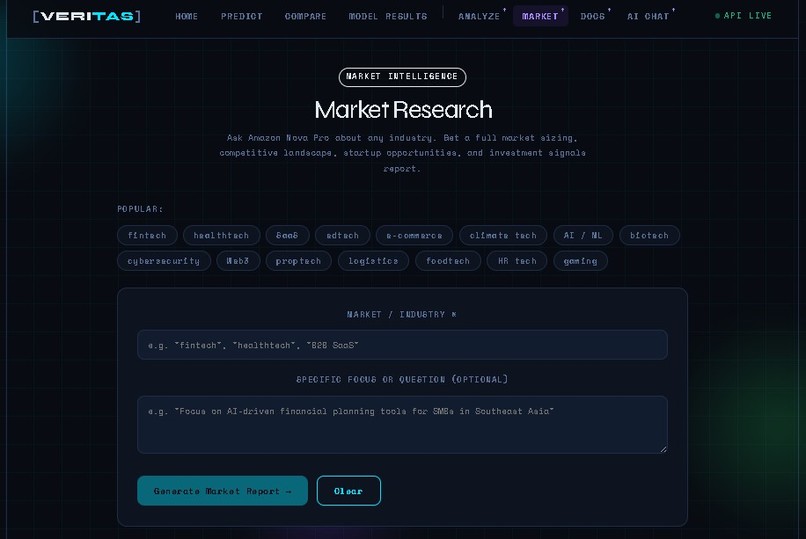
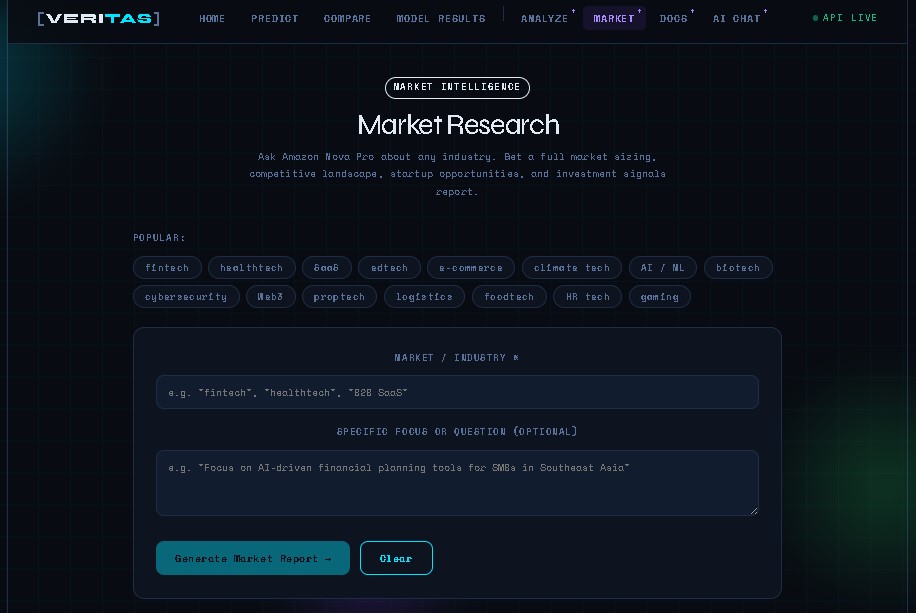
Market Intelligence: Generate deep-dive reports on any industry using Amazon Nova’s global sector insights.
-
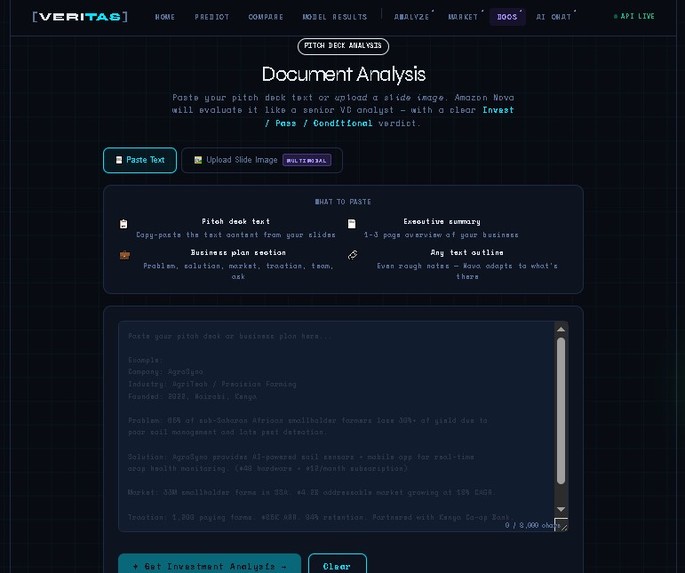
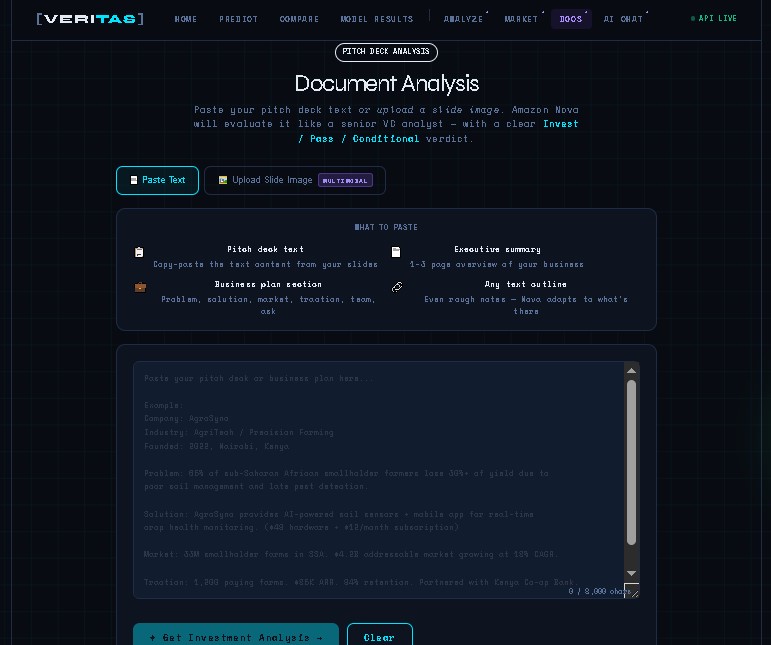
Multimodal Due Diligence: Upload pitch slides or paste text for an instant Invest/Pass verdict from Amazon Nova.
-
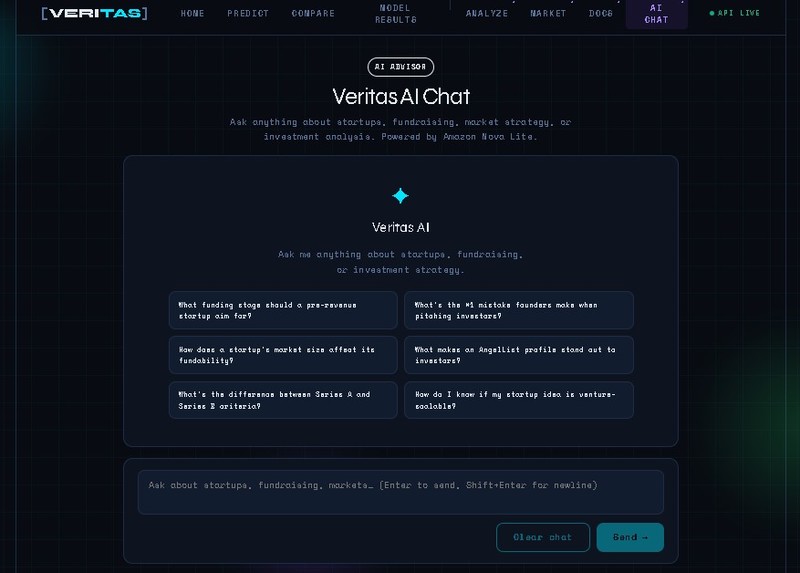
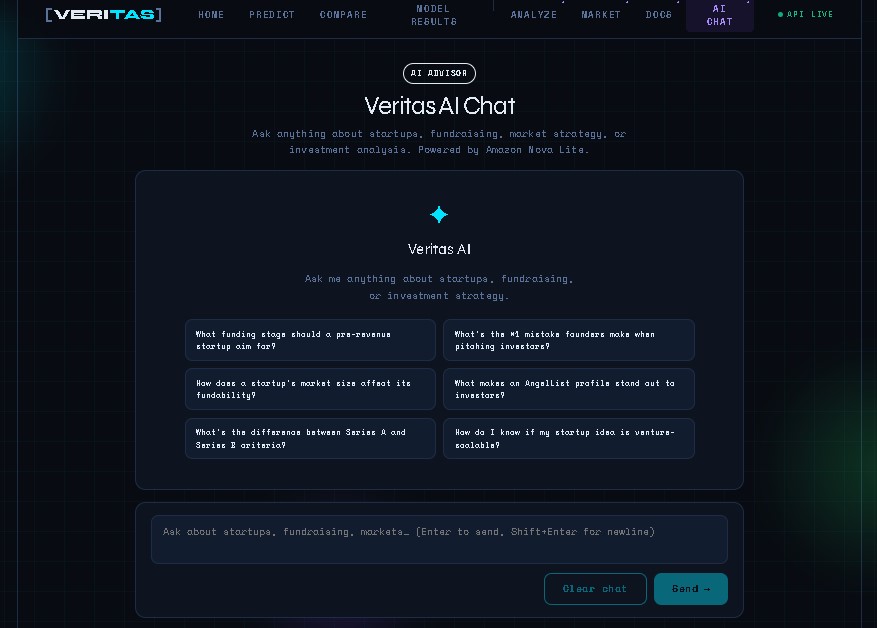
Veritas AI Chat: A real-time conversational advisor for fundraising, market strategy, and investment due diligence.
Inspiration
The startup world is often governed by “gut feelings” and hype, which contributes to an extremely high startup failure rate.
As AIML students, we identified a clear gap: although there is vast historical data about startup success and failure, this information is rarely accessible or understandable to everyday founders.
This motivated us to build Veritas — a platform designed to democratize institutional-grade investment intelligence.
Instead of providing only simple “pass/fail” predictions, Veritas focuses on delivering explainable insights, helping founders understand why a prediction was made and what factors influence success.
What It Does
Veritas is an AI-powered decision-support platform that evaluates a startup’s likelihood of success.
It accepts structured startup inputs such as:
- Funding stage
- Market sector
- Geographic region
- Startup age
- Business characteristics
The system performs a two-stage analytical process.
1. Quantitative Prediction
An ensemble of machine learning models, trained on 49,000+ real-world startup records, generates a startup success probability score.
2. Qualitative Reasoning
The prediction score is then passed to Amazon Nova (via AWS Bedrock), which simulates a virtual investment committee that analyzes the startup from multiple perspectives.
The platform runs an Agentic AI workflow that evaluates:
- Risk factors
- Market dynamics
- Competitive positioning
- Pitch deck content
Finally, the system produces a comprehensive Investor Brief, explaining the startup’s strengths, weaknesses, and potential path to success.
How We Built It
Veritas was developed using a modern production-grade architecture.
Machine Learning Engine
Implemented in Python using:
- XGBoost
- Scikit-Learn
- Pandas
Key design elements include:
- A custom preprocessing pipeline for high-cardinality categorical features
- Techniques to address class imbalance in startup outcomes
- Feature engineering to improve predictive performance
The AI Reasoning Layer
We integrated Amazon Nova (Pro and Lite) via AWS Bedrock to handle:
- Complex reasoning
- Multi-turn advisory chat
- Multimodal pitch deck analysis
This layer acts as an AI investment committee interpreting the machine learning outputs.
Backend Infrastructure
The backend was implemented using FastAPI, providing:
- High-performance inference endpoints
- ML model orchestration
- Integration with Bedrock agent workflows
- Asynchronous request handling
Frontend Dashboard
The user interface was developed using:
- React.js
- GSAP animations
- A dark-themed data dashboard
The interface provides:
- Interactive startup analysis
- Visual probability indicators
- Investor brief generation
- Real-time AI advisory interaction
Mathematical Model Reliability
Our best-performing model (XGBoost) was optimized using the ROC-AUC metric, which measures the model’s ability to distinguish between successful and failed startups.
AUC = \int_{0}^{1} TPR(FPR^{-1}(x)) , dx
This ensures that the predicted probabilities are well-calibrated and reliable for decision support.
Challenges We Ran Into
Data Mismatch
Training on 49,000 historical startup records required careful alignment with live user inputs.
Differences in feature representation caused inconsistencies between:
- training data
- real-time inference data
We solved this by implementing a strict feature alignment pipeline.
Multimodal Latency
Processing pitch deck images through AI vision models introduced latency challenges.
To address this we implemented:
- asynchronous API calls
- optimized Bedrock request handling
- timeout and retry mechanisms
These optimizations ensured a smooth user experience despite heavy AI processing.
Accomplishments We’re Proud Of
Seamless AI + ML Integration
We successfully bridged the gap between:
- Black-box ML predictions
- Transparent AI reasoning
Agentic AI Orchestration
We designed a 4-stage autonomous AI agent workflow capable of:
- analyzing startup risk
- evaluating market conditions
- reviewing pitch material
- generating an investor-grade brief
In some cases the agent can even challenge the ML model’s prediction based on market context.
System Robustness
Our platform achieved a 94.4% pass rate across the end-to-end validation suite, ensuring stability across the entire AI pipeline.
What We Learned
This project reinforced an important principle:
AI is most powerful when it is interpretable.
A prediction such as “80% chance of success” has limited value on its own. However, a detailed report explaining why that score was produced and how the startup can improve it becomes a practical decision-making tool.
Through this project we gained deep experience in:
- AWS Bedrock orchestration
- Agentic AI workflow design
- Prompt engineering
- Multimodal AI integration
- Clean architecture for full-stack AI systems
What's next for Veritas
Live Data Integration: Connect with APIs such as Crunchbase and LinkedIn to automatically track real-time startup updates like funding, hiring trends, and market activity.
AI Pitch Deck Generator: Use Amazon Nova to help founders improve their pitch decks by identifying weaknesses in their startup profile and suggesting stronger slides, metrics, and storytelling.
Collaborative Mode: Introduce a shared workspace where teams of investors can interact with the AI agent together, discuss startup analyses, and generate joint investor insights.


Log in or sign up for Devpost to join the conversation.