Inspiration
Ask any frontier model a paediatric dosing question in Nepali and it will give you a number. It will not tell you it has no source for that number. For roughly 30 million Nepali speakers, "confidently wrong in your own language" is worse than no answer at all and it's exactly the failure mode a single prompt has no structural way to prevent, because nothing forces it to admit the gap between what it knows and what it's asserting.
What it does
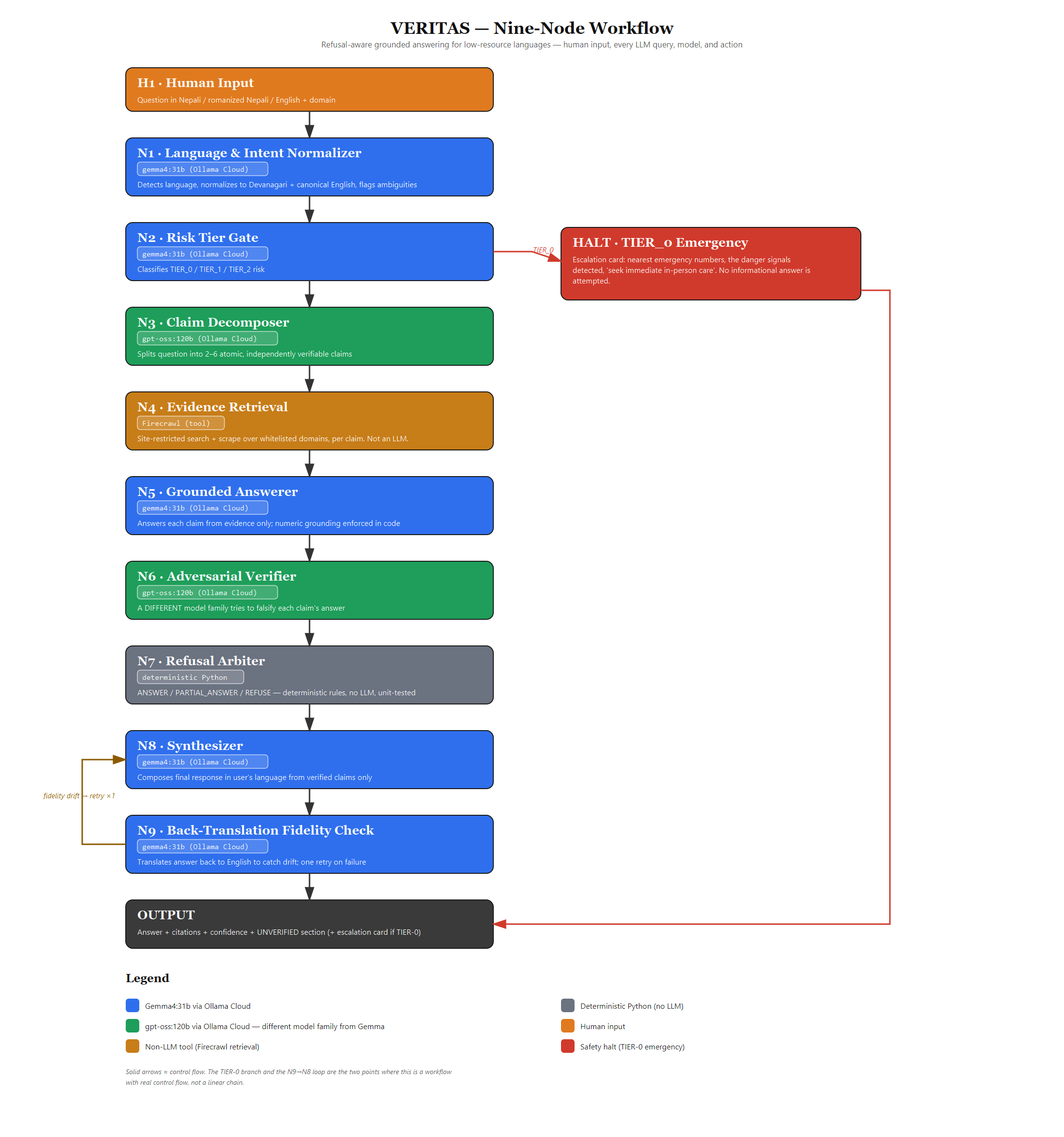
VERITAS takes a health or legal question in Nepali, romanized Nepali, or English, and answers it the way a careful clinician or lawyer would: it breaks the question into its atomic factual claims, looks each one up against a fixed whitelist of authoritative sources (WHO, DDA, MOHP, the Nepal Law Commission, FAO), has a second, unrelated model try to falsify each answer, and only then lets a deterministic rule not another LLM guess decide whether to answer, partially answer, or refuse outright. If the question describes a medical emergency, the pipeline doesn't try to help informationally at all; it halts and shows an escalation card.
Nine nodes, nine distinct jobs:
- N1 normalizes language and intent (
gemma4:31b) - N2 gates risk tier TIER_0 emergencies halt the pipeline entirely (
gemma4:31b) - N3 decomposes the question into 2–6 atomic claims (
gpt-oss:120b, Ollama Cloud) - N4 retrieves evidence only from a whitelisted domain list (Firecrawl, not an LLM)
- N5 answers each claim from evidence alone, with numeric grounding enforced in code (
gemma4:31b) - N6 — a different model family tries to falsify each answer (
gpt-oss:120b, Ollama Cloud) - N7 makes the ANSWER / PARTIAL_ANSWER / REFUSE decision deterministically, in plain Python, unit-tested
- N8 synthesizes the final response in the user's own language (
gemma4:31b) - N9 back-translates the response to catch drift that only appears in translation, retrying once (
gemma4:31b)
How we built it
Python 3.13, no orchestration framework, nine nodes don't need one, and hand-rolled orchestration is easier to audit and explain than a framework's implicit control flow. Every LLM call is cached to disk by prompt hash so the 30-question benchmark can be rerun without burning quota. Every node's raw input and output is logged to logs/<run_id>.json, those logs are themselves documentation evidence, not just debug output.
The live demo is a FastAPI backend streaming both arms, the single-prompt baseline and the full VERITAS pipeline over Server-Sent Events to a from-scratch frontend ("The Tribunal"): a node-by-node trace, claim cards that visibly die when a claim fails verification, a physical-stamp-style REFUSE/ANSWER/PARTIAL_ANSWER arbiter decision, and a full-screen red takeover for TIER-0 emergencies.
Every LLM node runs through Ollama Cloud, but N6's adversarial verifier deliberately runs a different underlying model family from the rest of the pipeline: gpt-oss:120b (OpenAI-lineage) checks answers produced by gemma4:31b (Google-lineage), two model families with no shared training lineage, hosted on the same platform. That's what makes "the verifier can't just agree with itself" a real structural property of the system rather than a hopeful assumption.
Challenges we ran into
- Firecrawl outages can't take down the submission. Evidence retrieval falls back to a small hand-curated local corpus of real, verbatim, source-attributed extracts whenever Firecrawl is unavailable or returns nothing stamped
degraded=Truewith a reason, never silently substituted. - Numbers are the easiest thing to get subtly wrong. N5's prompt already forbids inventing or converting numbers, but LLMs are unreliable at consistently applying their own stated policy so numeric grounding is enforced a second time in plain Python: any number in an answer that doesn't appear verbatim in the cited evidence forces the verdict to UNSUPPORTED, regardless of what the model claimed.
- Translation is where safety guarantees quietly die. A pipeline can verify every claim perfectly in English and still produce a Nepali sentence that drops the word "not" invisible unless something specifically checks for it, which is the entire reason N9 exists.
Accomplishments we're proud of
- A real eval harness 30 questions across seven buckets, both arms run and scored on six separate metrics, with citation validity checked by live HTTP requests rather than assumed.
- 15 unit tests covering every branch of the refusal arbiter the most safety-critical decision in the system is also the most rigorously tested piece of code in it.
- Reporting where we lose, not just where we win: over-refusal rate and the real cost/latency multiple are first-class metrics in the scorecard, not footnotes.
- A demo interface that makes the workflow's control flow the TIER-0 halt, the claims that die under adversarial challenge, the arbiter's stamped decision visible and legible in real time, not just a chat box with a spinner.
What we learned
That the hardest part of building a system to prevent hallucination isn't the grounding step it's every other step that can quietly undo it. A perfectly grounded answer in English can still fail if the final translation drops a caveat, or if a Python bug lets a fabricated number through, or if the refusal policy is one more LLM call away from being applied inconsistently. Reliability here comes from treating every hand-off between steps as a place something can go wrong, not from making any single step smarter.
What's next
Expand source coverage to Maithili and Bhojpuri, close the agriculture-domain evidence gap in the offline corpus, run the N6-disabled ablation to quantify what adversarial verification is actually buying, and package the pipeline as an API usable by frontline health workers directly reusable groundwork for refusal-aware guardrails work beyond this hackathon.
Built With
- ai-safety
- fastapi
- firecrawl
- gemma
- gpt-oss
- low-resource-languages
- natural-language-processing
- ollama-cloud
- prompt-engineering
- python
- server-sent-events


Log in or sign up for Devpost to join the conversation.