-
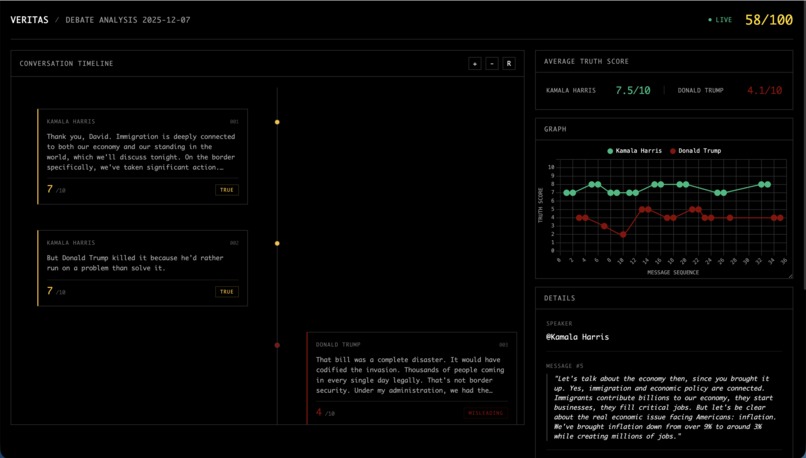
Timeline + main dashboard
-
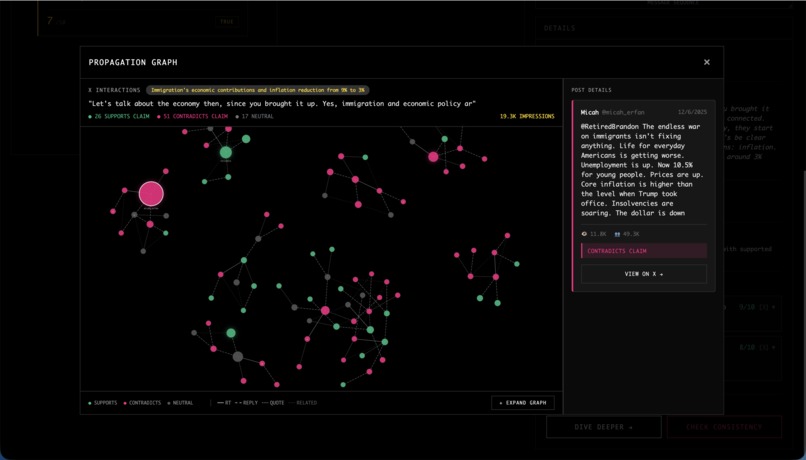
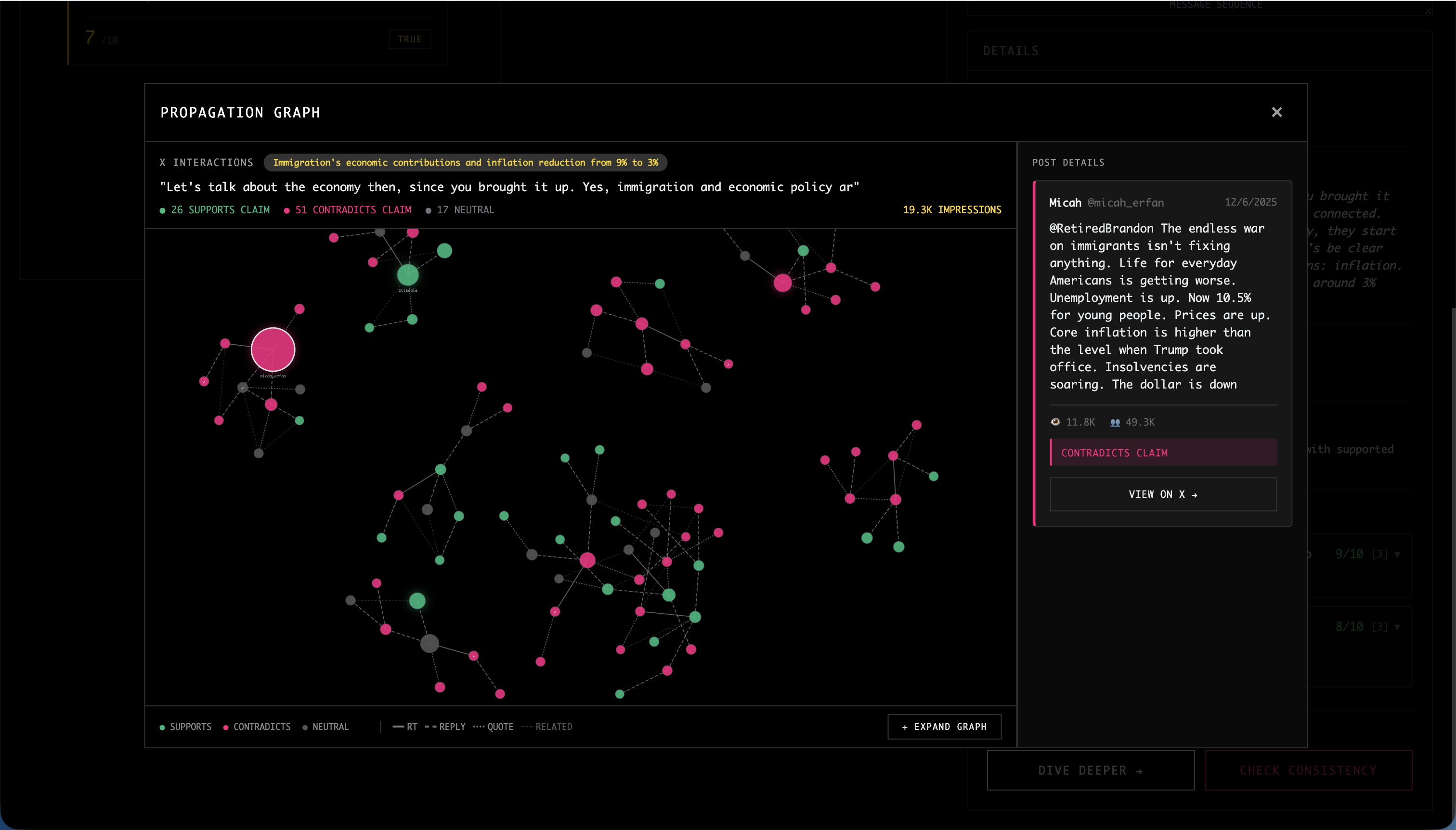
X graph propagation
-
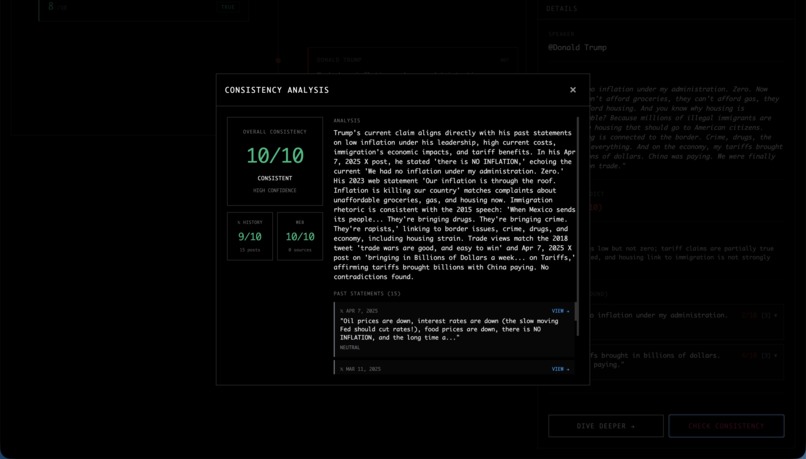
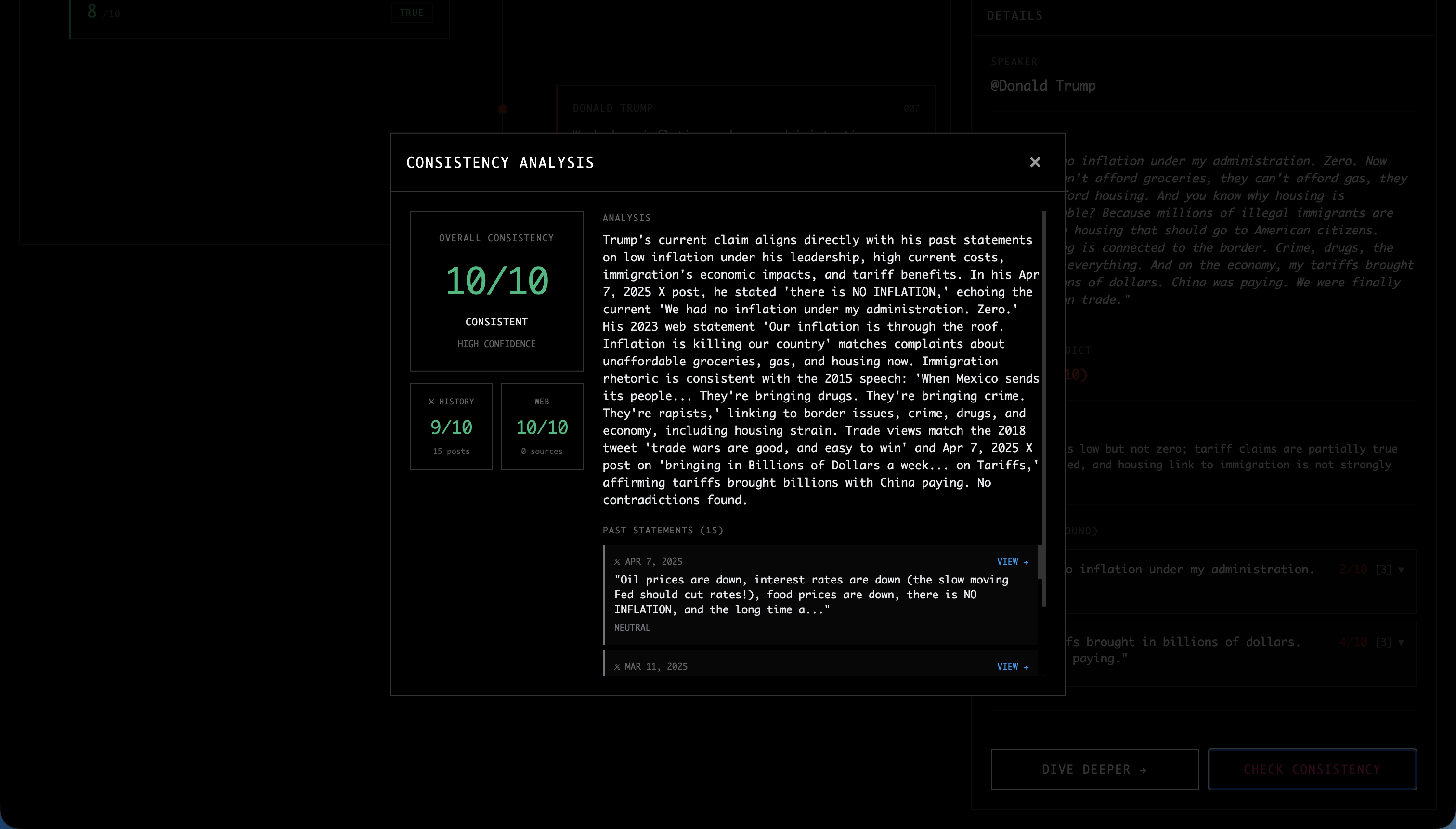
Consistency score verification
Veritas - Real-Time Fact-Checking for X
Inspiration
In an era where misinformation spreads faster than ever, X Spaces has become a powerful platform for live discussions on critical topics—from politics to health to economics. However, listeners have no way to verify claims in real-time, leading to the rapid spread of false information.
We were inspired to build Veritas (Latin for "truth") to empower users with instant, AI-powered fact-checking directly in their X Spaces experience. Our goal is to make truth verification as seamless as scrolling through a feed—no need to leave the conversation to fact-check claims.
What it does
Veritas is a Chrome extension that provides real-time fact-checking for X Spaces conversations. Here's what it does:
Real-Time Fact-Checking
- Live Caption Monitoring: Automatically captures and processes captions from X Spaces as they appear
- AI-Powered Analysis: Uses Grok AI to extract factual claims and verify them against trusted sources
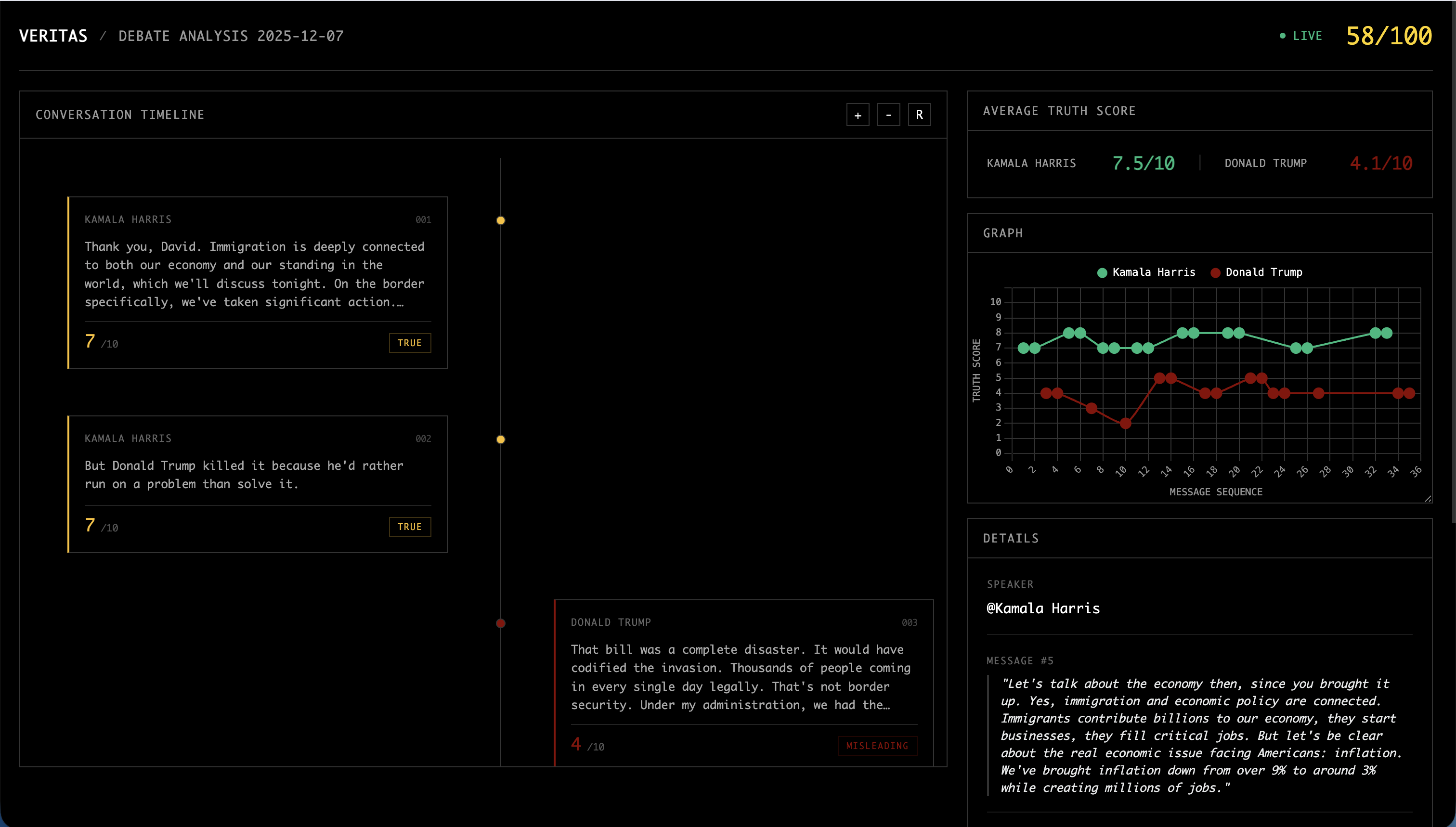
- Instant Credibility Scoring: Assigns truth scores (1-10) to each claim and tracks overall space credibility
- Visual Overlay: Displays fact-check results directly on the X Spaces page with a sleek, minimal UI
Comprehensive Analytics Dashboard
- Conversation Timeline: Interactive D3.js visualization showing truth scores over time
- Speaker Comparison: Compare average truth scores between different speakers
- Propagation Graphs: Visualize how claims spread across X with network graphs
- Detailed Claim Analysis: Dive deep into each claim with explanations and source citations
Advanced Features
- Space End Detection: Automatically detects when a Space ends and generates tweet-ready summaries
- Thread Analysis: Analyze entire X threads for fact-checking
- Source Verification: Links to trusted sources including FactCheck.org, PolitiFact, Snopes, and Grokipedia
How we built it
Frontend (Chrome Extension)
- Manifest V3: Modern Chrome extension architecture
- Content Scripts: Monitor X Spaces DOM for captions and UI changes
- Real-Time Processing: Captures captions as they appear, extracts speaker information, and sends to backend
- Overlay UI: Custom-built overlay with drag-and-drop functionality
- Analytics Dashboard: Standalone HTML page with D3.js visualizations and Chart.js graphs
Backend (Node.js/Express)
- RESTful API: Express server handling message processing, fact-checking, and analytics
- Grok AI Integration: OpenAI-compatible API calls to Grok for claim extraction and verification
- Supabase Database: PostgreSQL database storing spaces, messages, speakers, and fact-check results
- Real-Time Processing: Asynchronous fact-checking pipeline that doesn't block user experience
- X API Integration: Fetches real tweet data for propagation graphs
AI & Analysis
- Claim Extraction: Sophisticated prompt engineering to extract factual claims from casual speech
- Source Verification: Curated list of trusted sources (FactCheck.org, PolitiFact, Snopes, government sites)
- Truth Scoring: 1-10 scale with detailed explanations for each score
- Credibility Tracking: Dynamic credibility scores that update as new claims are verified
Database Schema
- Spaces: Track X Spaces with metadata, credibility scores, and summaries
- Messages: Store all captions with fact-check results, truth scores, and explanations
- Speakers: Global speaker database with username and display name tracking
- Statistics: Pre-computed views for fast analytics queries
Key Technologies
- JavaScript/ES6+: Modern JavaScript throughout
- D3.js: Force-directed graphs and timeline visualizations
- Chart.js: Truth score trend charts
- Supabase: Database and real-time subscriptions
- Grok AI: xAI's Grok models for fact-checking
- Express.js: Backend API server
- ** X API**: Integration with X API conversation / thread extraction and automation tweets
Challenges we ran into
1. Real-Time Caption Capture
X Spaces doesn't provide a public API for captions. We had to reverse-engineer the DOM structure and build a robust monitoring system that:
- Detects new caption elements as they appear
- Handles dynamic DOM updates
- Tracks speaker changes accurately
- Prevents duplicate processing
Solution: Built a mutation observer system with content fingerprinting to track unique captions and speaker attribution.
2. AI Response Parsing
Grok AI sometimes returns non-JSON responses or malformed data. We needed reliable parsing that:
- Handles various response formats
- Provides fallback mechanisms
- Validates claim extraction
- Handles edge cases (opinions vs. facts)
Solution: Implemented robust JSON parsing with regex extraction, fallback responses, and extensive error handling.
3. Performance & Rate Limiting
Real-time fact-checking requires multiple API calls per minute. We needed to:
- Avoid rate limits
- Process messages asynchronously
- Cache results efficiently
- Handle API failures gracefully
Solution: Built an asynchronous processing pipeline with status tracking, caching, and retry logic.
4. Database Schema Complexity
Tracking spaces, messages, speakers, and relationships required careful schema design:
- Efficient queries for analytics
- Real-time updates
- Speaker deduplication
- Statistics aggregation
Solution: Used Supabase views, stored procedures, and optimized indexes for fast queries.
Accomplishments that we're proud of
Real-Time Fact-Checking
We successfully built a system that fact-checks X Spaces conversations in real-time, something that didn't exist before. Users can now see truth scores appear as speakers make claims.
Comprehensive Analytics
The analytics dashboard provides deep insights into conversation quality, speaker credibility, and claim propagation—features typically only available in expensive media monitoring tools.
Robust Architecture
We built a scalable system that handles:
- Multiple concurrent Spaces
- High message volumes
- API failures and retries
- Real-time updates across components
AI Integration Excellence
Our prompt engineering and claim extraction system successfully distinguishes between factual claims and opinions, even when phrased casually.
Open Source & Extensible
The codebase is well-structured and documented, making it easy for others to contribute and extend.
What we learned
Technical Learnings
- Chrome Extension Development: Deep dive into Manifest V3, content scripts, and browser APIs
- DOM Monitoring: Advanced techniques for tracking dynamic content changes
- AI Prompt Engineering: How to structure prompts for reliable, structured outputs
- Real-Time Systems: Building responsive UIs that update asynchronously
- Database Optimization: Using views, stored procedures, and indexes for performance
Product Learnings
- User Experience: Balancing information density with usability
- Design Philosophy: How minimalism can enhance functionality
- Trust & Transparency: The importance of showing sources and explanations
- Performance Matters: Users expect instant feedback, even for complex operations
Challenges & Solutions
- API Reliability: Building resilient systems that handle failures gracefully
- Data Quality: Ensuring accurate speaker attribution and claim extraction
- Scalability: Designing for growth from day one
What's next for Veritas
Short-Term (Next 3 Months)
- Enhanced Source Verification: Integrate more fact-checking organizations and academic sources
- Mobile Support: Develop mobile browser extension or companion app
- Multi-Language Support: Extend fact-checking to Spaces in multiple languages
- User Feedback System: Allow users to report incorrect fact-checks and improve accuracy
Medium-Term (3-6 Months)
- Historical Analysis: Build a database of fact-checked claims for trend analysis
- Speaker Profiles: Track credibility scores across multiple Spaces for known speakers
- Custom Alerts: Notify users when specific topics or speakers are discussed
- API Access: Provide API for researchers and journalists
Long-Term Vision
- Platform Expansion: Extend to other platforms (YouTube Live, Clubhouse, etc.)
- Community Fact-Checking: Allow verified fact-checkers to contribute
- Educational Features: Help users learn to identify misinformation patterns
- Research Partnerships: Collaborate with fact-checking organizations and academic institutions
Technical Improvements
- Faster Processing: Optimize AI calls and caching for sub-second fact-checking
- Better Accuracy: Fine-tune claim extraction and verification models
- Offline Support: Cache recent fact-checks for offline viewing
- Privacy Enhancements: Add options for local processing and data retention controls
Try It Out
- Install the Extension: Load the unpacked extension in Chrome
- Join a X Space: Navigate to any active X Space
- Watch the Magic: Veritas automatically starts monitoring and fact-checking
- Explore Analytics: Click the analytics button to see detailed insights
Tech Stack
- Frontend: JavaScript (ES6+), Chrome Extension APIs, D3.js, Chart.js
- Backend: Node.js, Express.js
- Database: Supabase (PostgreSQL)
- AI: Grok AI (xAI)
- APIs: X API, Grok API
Team
Vedant Gaur, Patrick Zhao, Adam Bhaloo
Built with ❤️ by the Veritas team
Veritas - Seeing truth on X

Log in or sign up for Devpost to join the conversation.