Inspiration
A single viral post once sent a stock soaring nearly 40% in a morning, fueled by nothing but a screenshot, a rocket emoji, and the words "this is the easiest money you'll ever make." Thousands of people bought in at the top. The rumor was never confirmed by anyone credible. The losses, however, were very real. That single pattern is what inspired Veritas. We realized the danger in finance was never the bad tip by itself. The danger is that a rumor and a real opportunity look completely identical at the exact moment your money is on the line. Both arrive as confident text. Both feel urgent. Both come wrapped in charts and conviction. By the time the truth surfaces, the trade is already closed and the damage is already done. Retail investors today are not suffering from a lack of information. They are drowning in it. Every feed, every group chat, every short-form video is packed with financial "analysis" that is emotional, urgent, and impossible to verify in the ten seconds before the feeling to act passes. What people lack is not data. It is a fast, trustworthy way to ask one question before they act: is this real, or is this hype? Existing tools do not answer that question well. A traditional fact-checker gives you a single verdict and asks you to trust it blindly, which is just swapping one authority for another. So we set out to build something fundamentally different. Not a fact-checker that hands down a ruling, but an AI Investment Auditor that runs professional grade due diligence on any financial claim the instant you encounter it, and shows you exactly how it reached its conclusion. That is Veritas: a Rumor vs. Reality Tracker for financial content.
What it does
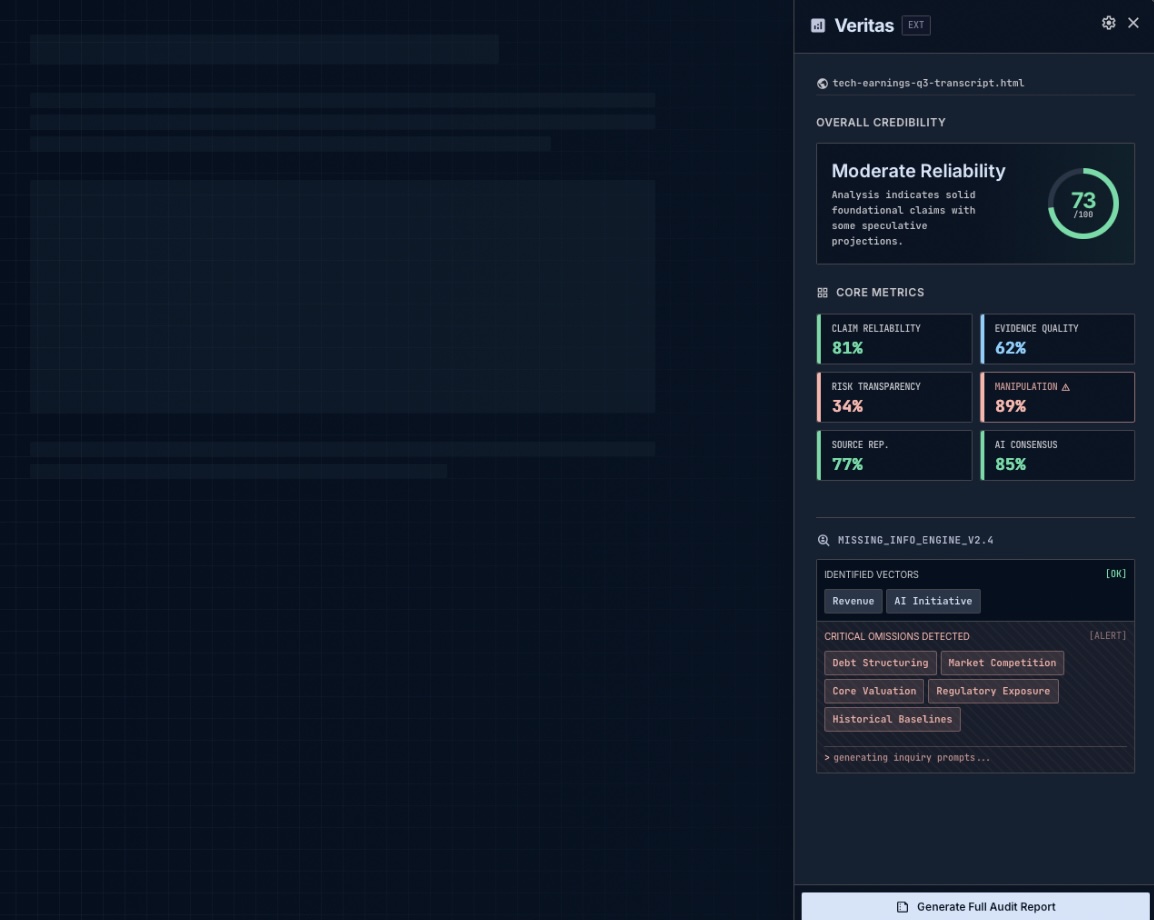
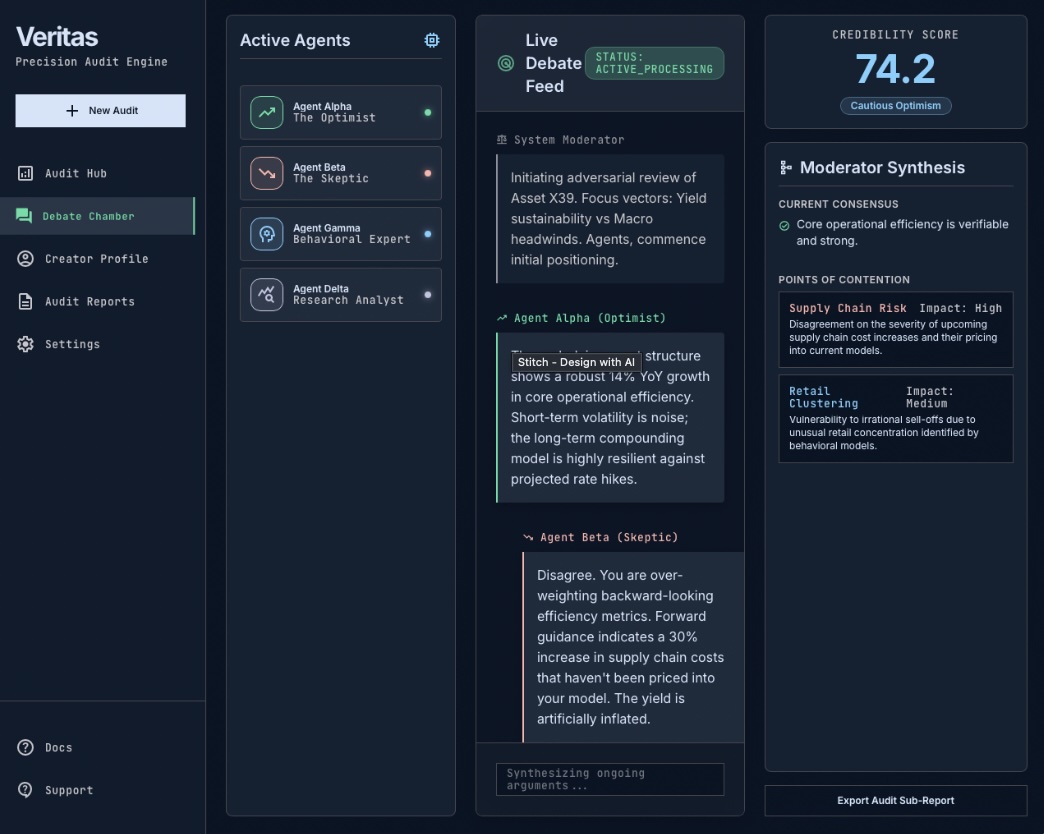
Veritas is a browser extension that audits financial content as you read it, covering everything from stock tips and crypto calls to earnings rumors and influencer "analysis." The moment you land on a financial claim, Veritas quietly performs the kind of due diligence a careful analyst would, and surfaces the result inline so you never have to leave the page. Its single most important design choice is restraint: Veritas does not pretend to be an oracle. It never tells you to buy or sell. It does not declare a claim "true" or "false." Instead it investigates the claim, explains its reasoning, rates its own confidence, and then hands the final decision back to you. That honesty is the entire point, because in finance, certainty itself is often the manipulation. The Multi-Agent Debate Instead of one AI handing you a verdict you have to trust on faith, Veritas runs a structured debate between five specialized agents and shows you the argument as it unfolds. Each agent has a distinct job, a distinct point of view, and its own guardrails:
The Optimist builds the strongest possible evidence based case that the claim could be true. It looks for genuine supporting data, plausible positive scenarios, and real strengths, so the analysis never becomes reflexively cynical. The Skeptic does the opposite. It hunts for missing evidence, hidden assumptions, and ignored downside, pressure testing every part of the claim that the Optimist wants to believe. The Behavioral Finance Expert ignores whether the claim is true and focuses entirely on how it is being sold. It detects FOMO, false urgency, authority bias, and emotional exploitation, the psychological levers that move money irrationally. The Research Analyst evaluates the quality of the evidence itself. Are sources cited? Are the data points credible? Are the statistics actually verifiable, or just confidently stated? The Moderator reads all four perspectives plus the raw content and synthesizes them into one explainable credibility report, including, crucially, where the agents disagreed.
Scores you can read in two seconds People love glanceable information, so Veritas distills the entire debate into a set of clear scores:
Overall Credibility — the blended, manipulation adjusted trust score. Claim Reliability — how reasonable and evidence backed the claims appear. Evidence Quality — the strength of the supporting data and sources. Risk Transparency — how honestly the downside and risks are disclosed. Manipulation Score — how much persuasive or emotionally driven tactics are present (higher means more manipulation). Consensus Confidence — how much the five agents actually agreed, so a split jury honestly lowers our certainty instead of faking it.
The two features that make it feel objective Two engines keep Veritas from sliding into mere criticism:
The Missing Information Engine does not just judge what was said. It surfaces what the creator conveniently left out. If a post hypes revenue growth and AI adoption but never mentions debt, competition, valuation, or regulatory risk, Veritas says so explicitly. This reframes the entire experience from "you're wrong" to "here is what a complete picture would require." The Source Reputation score audits the creator, not just the content, scoring their historical reliability across prediction accuracy, transparency, evidence quality, disclosure compliance, and consistency. Almost everyone analyzes content. Almost nobody analyzes the person making the claim.
One example, start to finish A post claims: "$NVDA hitting $500 by Friday. Load up NOW before earnings, this is free money, don't miss out." Veritas returns:
Manipulation: 92/100. Urgency ("NOW", "by Friday"), FOMO ("don't miss out"), and risk free framing ("free money") all detected. Evidence Quality: 14/100. No analyst basis, no valuation model, no source for the price target. Risk Transparency: 9/100. Zero mention of downside, volatility, or what happens if earnings miss. Missing Information: No valuation, no historical accuracy of the creator, no disclosure of position. Moderator verdict: Unsubstantiated hype with strong manipulation signals. Treat as a rumor, not analysis. Verify against earnings data and analyst coverage before acting.
That same post probably made thousands of people feel like geniuses for ten seconds. Veritas gives them the two seconds of clarity they needed instead.
How we built it
The core of Veritas is an adversarial agent pipeline. Each of the five agents is a separately prompted model instance with its own role, objective, and guardrails, so they genuinely pull in different directions instead of quietly echoing one another. The four debating agents run first, and the Moderator receives all four perspectives plus the original raw content before producing the synthesis. Turning a debate into numbers A debate is only useful at a glance if it resolves into trustworthy scores, so we built a weighted scoring model. Each agent emits one or more sub scores ( s_i \in [0, 100] ), and overall credibility is their weighted aggregate, with the weights summing to one: C=∑i=1nwi si,∑i=1nwi=1 C = \sum_{i=1}^{n} w_i \, s_i, \qquad \sum_{i=1}^{n} w_i = 1 C=i=1∑nwisi,i=1∑nwi=1 Manipulation, though, should not just sit politely beside the other scores. It should actively erode trust. So we apply a penalty term where ( m ) is the manipulation score and ( \lambda ) controls how harshly manipulative framing is punished: Cadj=C⋅(1−λ m100) C_{adj} = C \cdot \left( 1 - \lambda \, \frac{m}{100} \right) Cadj=C⋅(1−λ100m) This is why a claim packed with real data can still score poorly: if it is drenched in urgency and FOMO, the penalty drags the adjusted credibility down to reflect that the framing is engineered to bypass judgment. Finally, we refuse to fake certainty. Consensus Confidence is weighted by the variance across the agents' scores. When the agents broadly agree, confidence is high. When they split, our stated confidence drops honestly, rather than projecting false precision: Confidence∝1−σagents2σmax2 \text{Confidence} \propto 1 - \frac{\sigma^2_{\text{agents}}}{\sigma^2_{\max}} Confidence∝1−σmax2σagents2
Architecture
Naively, five agents means five sequential model calls, which is far too slow for something that has to feel instant inside a browser. So we parallelized the four debaters and only ran the Moderator afterward, which cut response time dramatically: javascript// Four agents debate in parallel, the moderator synthesizes after const opinions = await Promise.all( [optimist, skeptic, behavioral, researcher].map((agent) => agent.analyze(claim, context) ) ); const report = await moderator.synthesize(claim, opinions); The frontend is a lightweight browser extension that extracts the financial claim and its surrounding context directly from the page, sends it through the pipeline, and renders the credibility report inline. The user never has to copy text, switch tabs, or leave the post they are reading. The audit comes to them.
Challenges we ran into
Keeping the agents genuinely adversarial. Large language models love to agree. Our first versions produced five voices that all politely nodded along. It took real prompt surgery to stop the Skeptic from quietly drifting into validating the Optimist, and to force each agent to defend its assigned worldview even when the consensus pulled the other way. Latency. Five sequential model calls felt sluggish, and a due diligence tool that makes you wait is a tool you stop using. Parallelizing the four debaters and reserving the final synthesis for the Moderator was the change that made Veritas feel responsive enough to live inside a browser. Calibration. Early scoring was painfully binary. Almost everything came back as either flawless or pure fraud. Introducing the manipulation penalty and the variance weighted confidence smoothed the output into something that tracks how a real analyst would actually judge a claim, with all the gradations in between. Separating hype from substance. This was the hardest balance of all. Some of the most manipulative financial content also contains genuinely real data. Teaching the agents to credit the legitimate evidence while still flagging the emotional framing around it, rather than throwing out the whole claim, took the most iteration.
Accomplishments that we're proud of
We made AI reasoning transparent. Users do not just receive a credibility score from a black box. They see why, including exactly where the five agents disagreed, which turns a verdict into a process they can audit themselves. We built a financial tool that knows the limits of its own knowledge. Veritas says "unverified" instead of bluffing. In a domain flooded with false confidence, a tool that is honest about uncertainty is exactly what an investor needs. We audit the creator, not just the content. Almost no competitor does this. Turning the vague question "can I trust this person?" into a concrete, multi factor reputation score is, we believe, the single most defensible thing Veritas does. We turned a gut feeling into numbers. That uneasy "this seems too good to be true" instinct is now a set of concrete, explainable scores anyone can read in two seconds, backed by reasoning they can expand.
What we learned
One AI scoring a tip feels like an opinion. Five AIs visibly debating it feels like due diligence. Showing the disagreement was a far bigger trust unlock than any single model improvement we made. The transparency is the product. Detecting what is missing matters more than detecting what is wrong. A financial claim can be technically true and still be dangerously misleading purely by omission of risk. The Missing Information Engine ended up being one of our most powerful and most distinctive features. Refusing to fake certainty makes the tool more credible, not less. Confidence is only valuable when it is earned, and admitting the limits of the analysis paradoxically made users trust the analysis more. The strongest manipulation in finance is rarely an outright lie. It is usually true data wrapped in urgency and FOMO, engineered to make you act before you think. That is exactly the pattern the Behavioral Finance agent is built to catch, and learning to isolate framing from fact reshaped our whole approach.
What's next for Veritas
The biggest leap is true tracking over time. Right now Veritas audits a claim in the moment. Next, a tip flagged today gets re-graded once reality catches up, so we build a permanent, public accuracy record for every creator. That single feature turns Veritas from a snapshot into a genuine Rumor vs. Reality Tracker, where the market itself eventually grades who was telling the truth. Beyond that, the roadmap includes:
Persistent creator reputation profiles that accumulate history across thousands of past calls, so reputation reflects a track record rather than a single post. Live market and earnings data integration to ground the Research Analyst in real numbers, moving the audit from plausibility toward verification. Instant on-page warnings that surface the moment a high manipulation financial claim loads, flagging the hype before it ever has a chance to move money.
Veritas started as a way to answer one question in the ten seconds before someone makes a bad trade. The goal now is to make that answer faster, sharper, and impossible to ignore.
Built With
- jest
- llm
- manifest
- node.js
- postgresql
- react
- redis
- typescript
- vercel


Log in or sign up for Devpost to join the conversation.