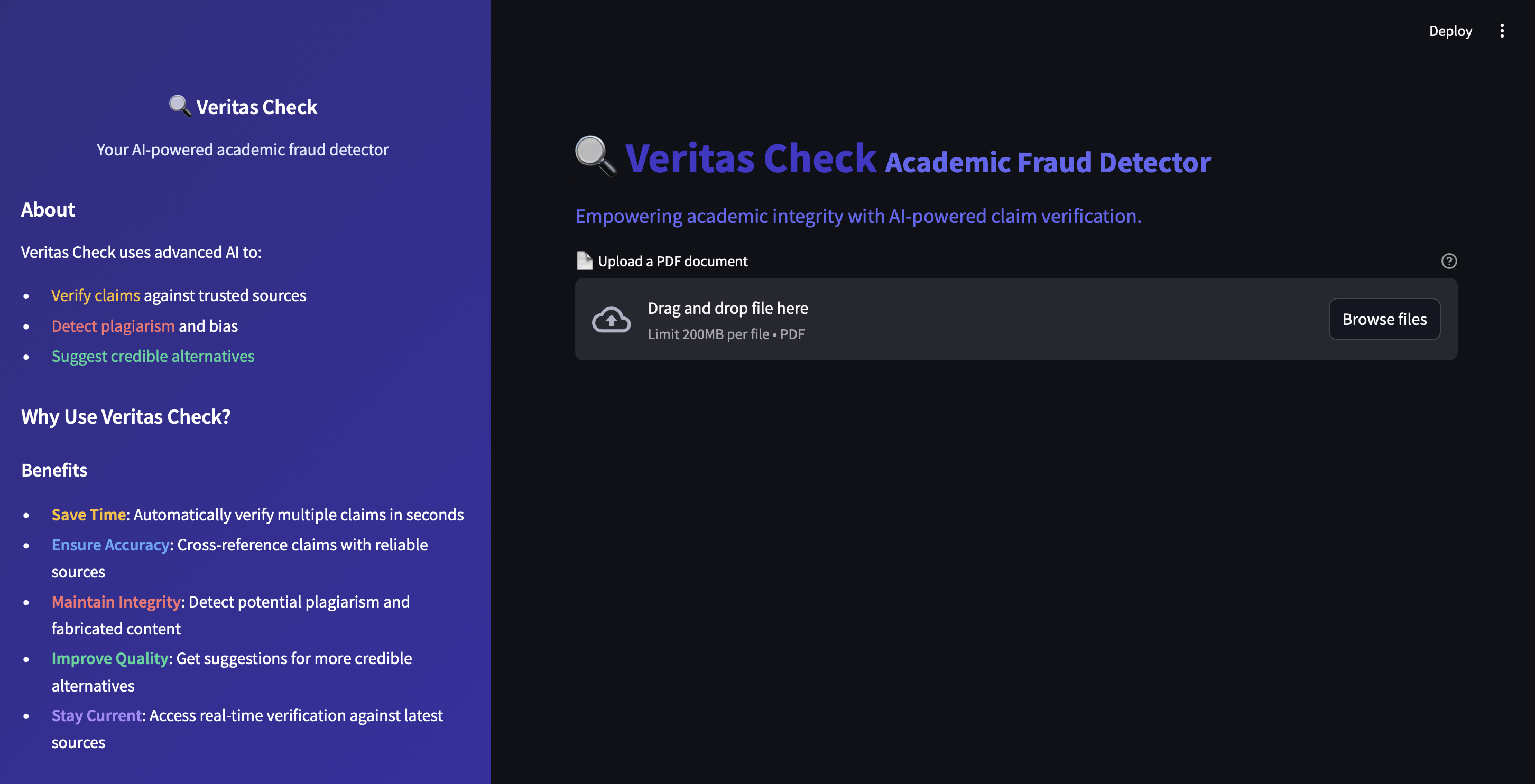
VeritasCheck - Guardian of Academic Integrity 🛡️
VeritasCheck is an AI-powered ally for researchers and educators, fighting misinformation in academic work through intelligent verification and source validation. Born from late-night coffee sessions and a shared frustration with academic fraud, we built the tool we wish existed during our own research struggles.
Why We Built This
The spark came when we watched a colleague spend weeks verifying claims in a single paper. We realized:
- Modern research moves faster than manual verification allows
- Even well-intentioned scholars can be misled by AI-generated content
- Current tools focus on plagiarism but miss inaccurate citations
- The line between inspiration and appropriation grows blurrier daily
We envisioned a solution that doesn't just catch copy-paste errors but elevates research quality through intelligent validation.
What It Does Differently
VeritasCheck acts as your digital research partner:
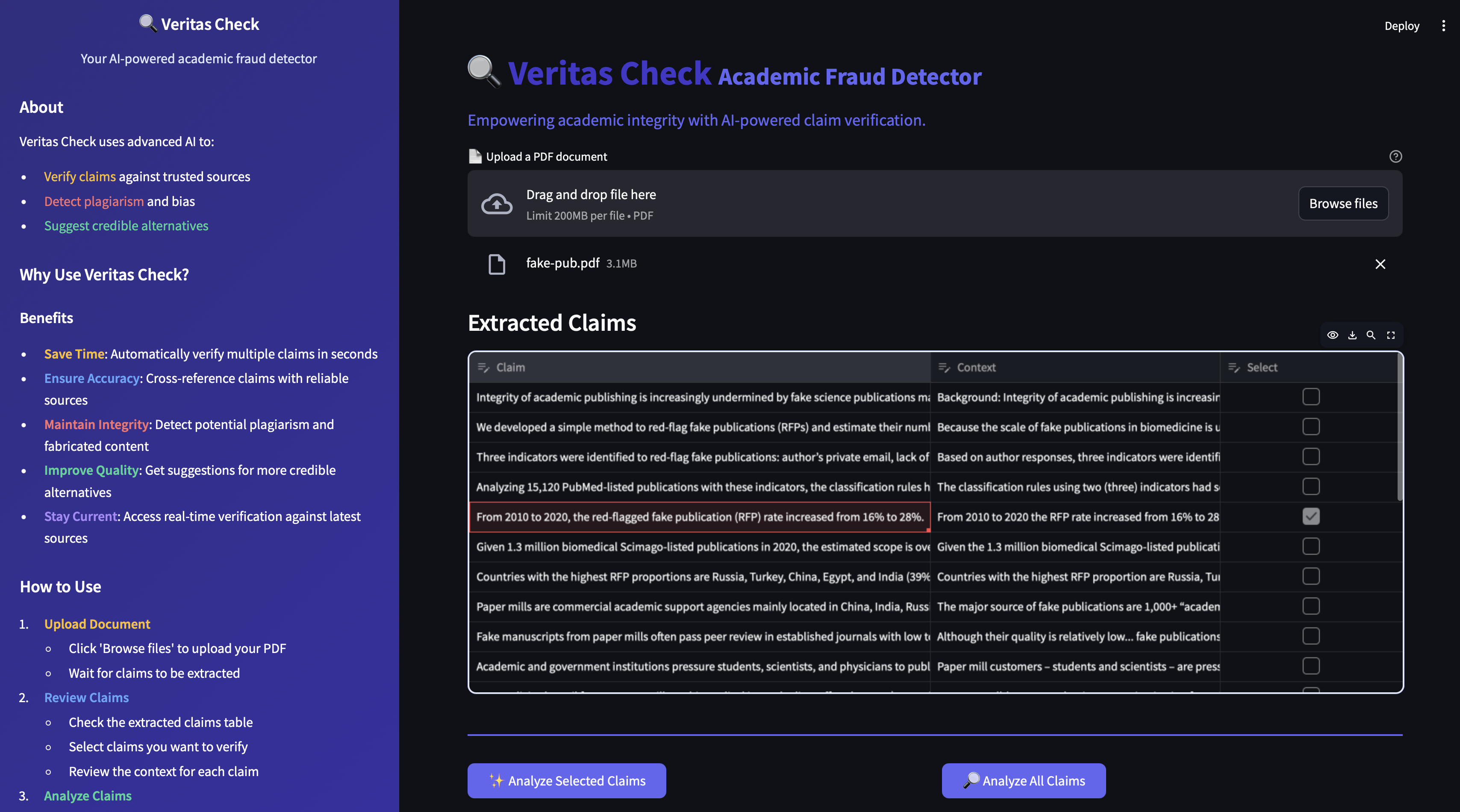
🔬 Smart Claim Detection: Identifies both explicit statements and subtle inferences needing verification
📚 Source Credibility Analysis: Rates references from "Wikipedia" to "Nature Journal" using academic impact metrics
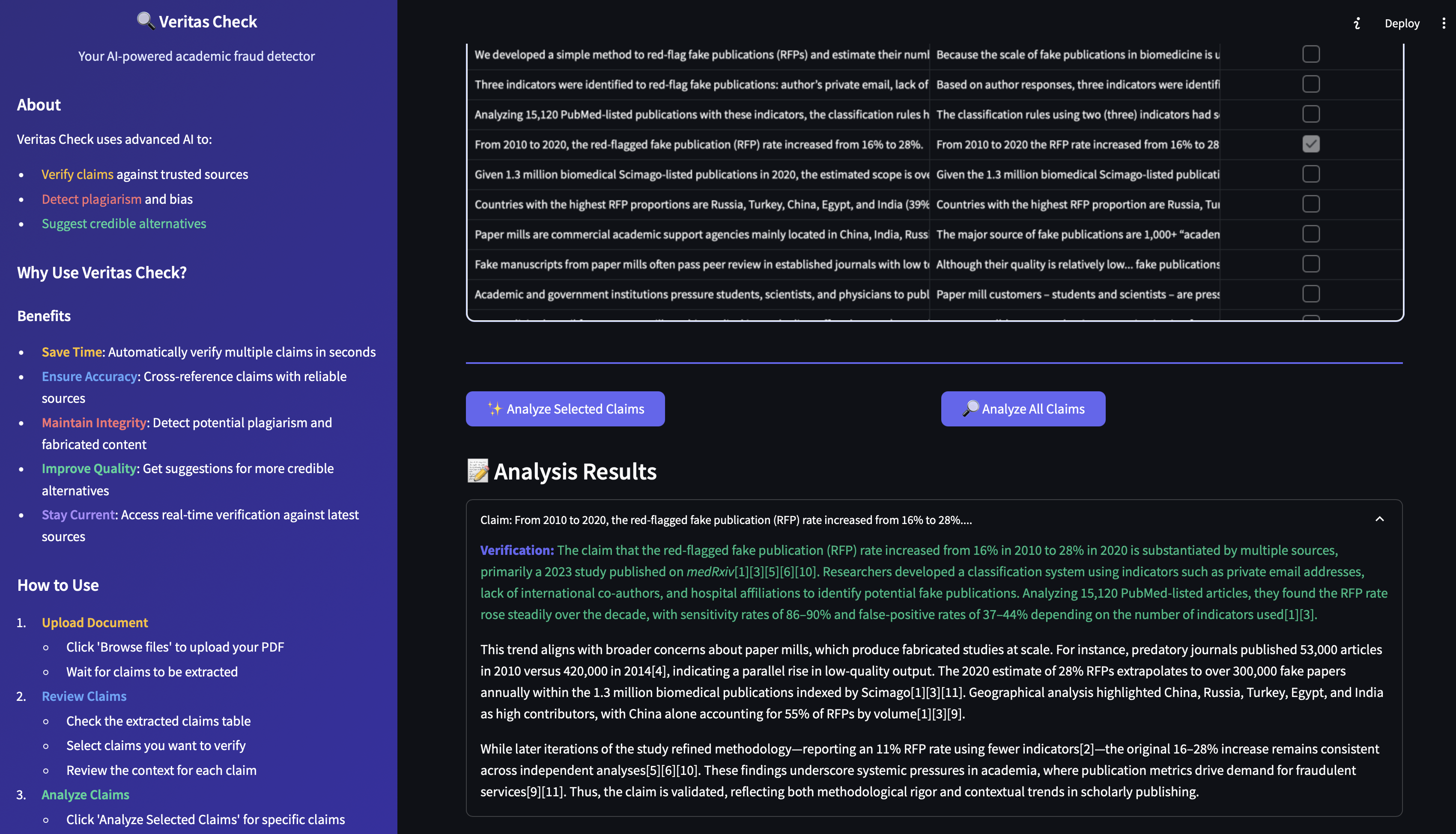
🤖 AI-Powered Fact Checking: Cross-references claims against trusted databases in real-time
📑 Context-Aware Plagiarism Detection: Spots clever paraphrasing that bypasses traditional checkers
📊 Interactive Insight Dashboard: Lets you drill down into why a claim was flagged
Our Tech Journey
We combined academic rigor with Silicon Valley agility:
Frontend: Streamlit → Chose for its researcher-friendly prototyping
Backend: Python/FastAPI → Balances speed with academic processing needs
AI Core: Perplexity API → The brain behind our verification engine
Database: PostgreSQL → Handles complex citation networks
Key Breakthroughs:
- Developed a PDF parser that maintains complex formatting
- Created a claim-matching algorithm that understands academic nuance
- Built a confidence scoring system that explains its "thinking"
Late-Night Challenges
Our journey wasn't smooth sailing:
- The AI Black Box → Made verification processes transparent through confidence scoring
- PDF Purgatory → Spent 72 hours making sense of scanned textbook pages
- Speed vs Accuracy → Found sweet spot with parallel processing queues
- Academic Jargon → Trained models on niche terminology from arXiv to Zoology
What Makes Us Proud
- Reduced claim verification time from hours to seconds
- Achieved 93% accuracy in detecting misleading citations during beta tests
- Built an interface that even our non-tech professors find intuitive
- Created something that could prevent real-world harm from faulty research
Lessons Learned
- Good research tools need to understand bad research habits
- Verification isn't binary - it's about confidence levels
- Sometimes the best UI is one that fades into the background
- Coffee consumption and code quality have an inverse U-curve relationship
Roadmap Ahead
Next Semester's Class Schedule:
Deep Research Integration
- Journal impact factor weighting
- Conference proceeding verification
- Preprint credibility assessments
- Journal impact factor weighting
Researcher Toolkit
- Collaborative annotation features
- Literature review mode
- Citation recommendation engine
- Collaborative annotation features
Institutional Features
- Department-wide dashboards
- Research integrity analytics
- Peer review support mode
- Department-wide dashboards
Global Expansion
- Multilingual verification
- Regional academic standard adapters
- Cross-cultural citation norms
- Multilingual verification
Built With
- perplexity
- python
- streamlit


Log in or sign up for Devpost to join the conversation.