Inspiration
Modern American democracy depends on citizens’ ability to understand, evaluate, and challenge the arguments behind public policy and legislation. Yet today, this process is increasingly broken. Public discourse is fragmented across partisan media, social platforms, and adversarial political messaging, where arguments are often incomplete, emotionally charged, and disconnected from verifiable evidence. Citizens are routinely exposed to claims without clear sourcing, and misinformation can spread faster than it can be evaluated. As a result, voters, policymakers, and institutions are forced to make decisions without reliable access to the strongest evidence on either side of critical issues. We were inspired by a simple question: what if debate itself could be transparent, evidence-driven, and verifiable in real time? What if citizens could directly observe competing arguments, inspect their supporting evidence, and understand the reasoning behind critical policy decisions?
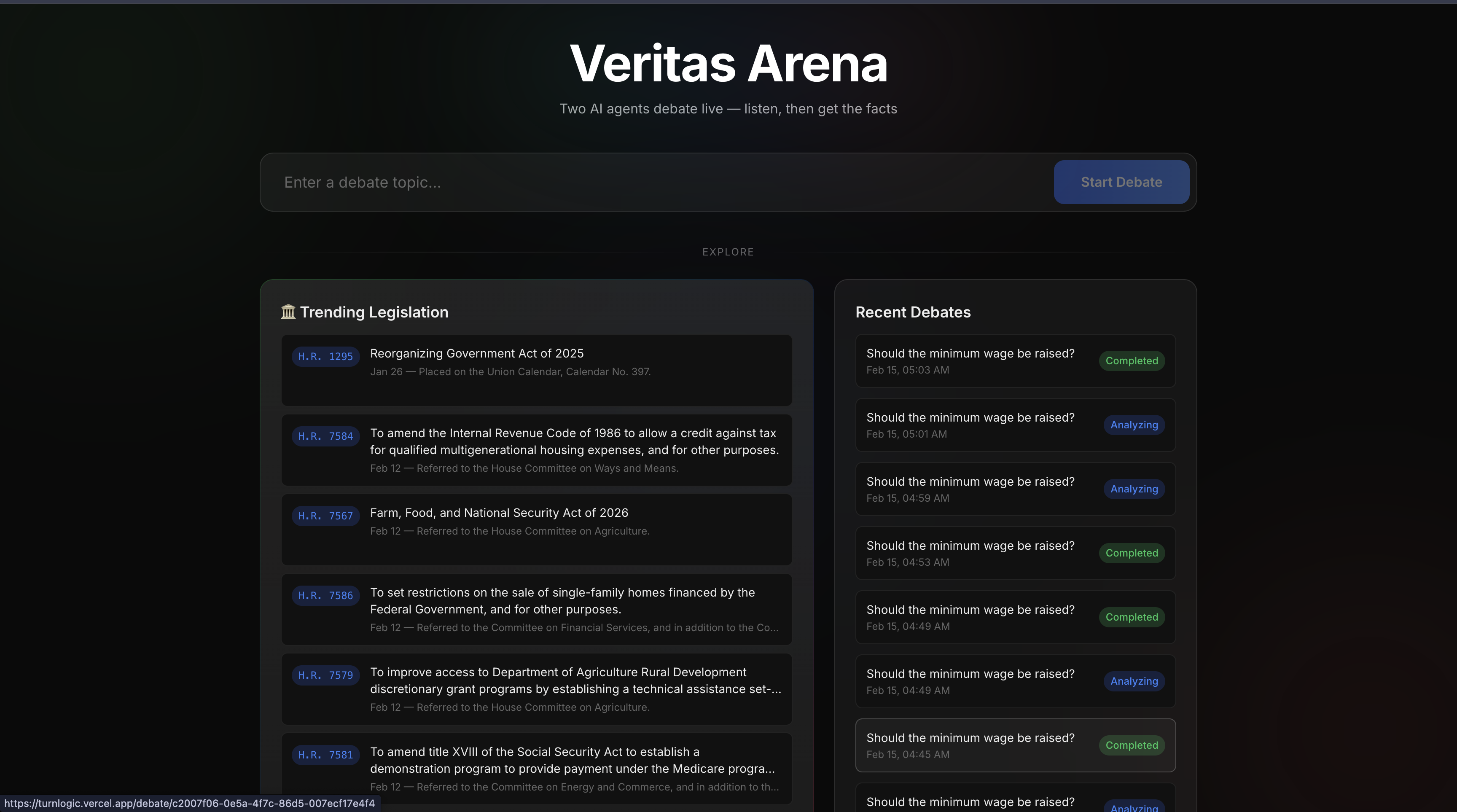
Our goal with Veritas Arena was to build a real-time platform where users can explore debates on important policies and legislation, observe transparent reasoning between opposing agents, and directly inspect the evidence behind every claim. By transforming debate into a structured, computational, and verifiable process, Veritas Arena aims to strengthen democratic decision-making and restore trust in evidence-based public discourse.
What it does
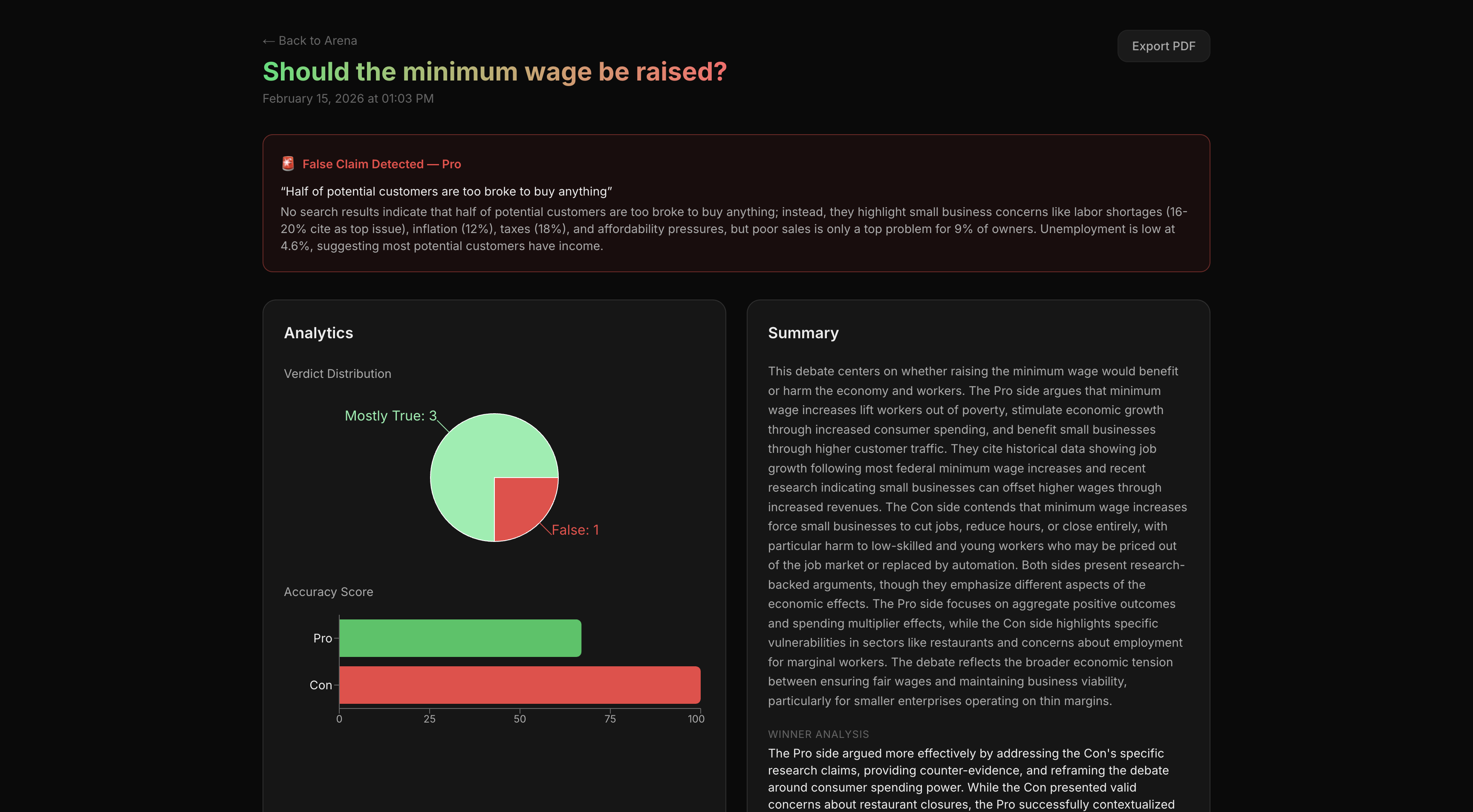
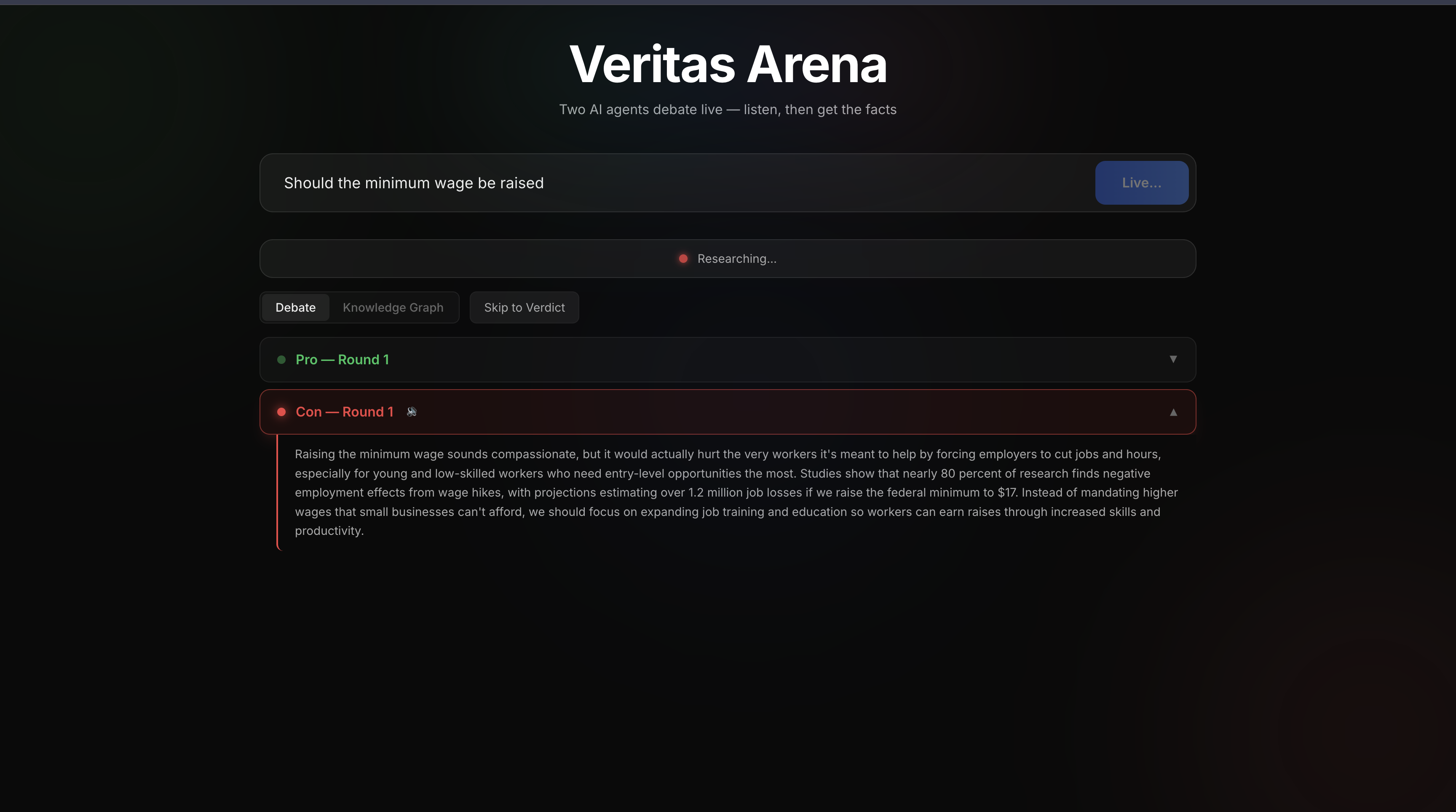
Veritas Arena is a real-time platform that hosts debates between autonomous AI agents using live research and transparent reasoning. A third AI agent continuously fact-checks claims and surfaces supporting evidence. All referenced sources are displayed through an interactive knowledge graph, allowing users to see exactly which policy documents support each argument. Users can explore debates on live government legislation or enter their own custom topics, enabling policymakers, researchers, and citizens to understand complex issues through transparent, evidence-driven reasoning. Additionally, safety guardrails are implemented to ensure that debates remain grounded in lawful, ethical, and constructive discourse. The system enforces fundamental moral and legal constraints, preventing agents from generating arguments that promote violence, illegal activity, or harm.
How we built it
VeritasArena combines real-time LLM orchestration, streaming infrastructure, and avatar rendering into a unified system.
The frontend was built using Next.js with a streaming interface that displays live debate responses, fact-check indicators, and an interactive knowledge graph. The backend orchestrates multiple autonomous agents using Claude for debate generation and Perplexity Sonar API for real-time research. Supabase is used for state management and coordinating debate execution.
We implemented parallel agent execution and streaming pipelines to minimize latency and create a natural conversational flow.
Challenges we ran into
One of the main challenges was implementing the Model Context Protocol (MCP) to reliably orchestrate multiple autonomous agents with shared state. Each debate involves concurrent execution of two debater agents and a fact-checking agent, all of which must access consistent context, prior messages, and retrieved evidence. We had to implement structured message passing, context serialization, and retrieval pipelines so that agents could dynamically query the knowledge graph and maintain coherent reasoning across turns.
Designing the real-time database architecture was another major challenge. Using Supabase, we built a schema to persist debate state, argument trees, evidence references, and agent outputs while supporting concurrent writes and low-latency reads. We implemented event-driven updates and streaming subscriptions so the frontend could react immediately to partial agent outputs. Ensuring consistency across asynchronous agent execution, streaming pipelines, and frontend rendering required careful handling of transactions, state versioning, and synchronization.
Finally, we also had to integrate multiple SDKs into a unified low-latency pipeline, including Claude for reasoning, Perplexity Sonar for real-time retrieval, and ElevenLabs for voice synthesis. Each SDK had different streaming interfaces, latency profiles, and response formats. We implemented custom async wrappers, streaming handlers, and orchestration logic to normalize outputs and allow parallel execution without blocking.
Accomplishments that we're proud of
We successfully built a fully autonomous AI debate system capable of generating real-time, evidence-based arguments between opposing agents. We also built a robust system with LangGraph, and we reduced latency significantly from our first iteration to our last iteration. We also went from using an expensive OpenAI embedding model to a local HuggingFace model. We also built an amazing analytics dashboard, with really nice 3D knowledge graphs. It was really nice to build a very robust streaming service as well.
We implemented live streaming responses, continuous fact-checking, and an interactive knowledge graph that connects arguments directly to supporting sources. We also integrated realistic avatars that speak and visually represent each agent, creating a natural and engaging debate experience.
Most importantly, we transformed debate into a transparent, verifiable, and evidence-driven process.
What we learned
Learned a lot about real-time streaming with AI agents, and building multi-agentic systems with LangGraph specifically. Safety timeouts on event driven architectures are necessary! Also, we all learnt how to use claude code for the first time, while using various new MCP servers like Supabase, Playwright, and Vercel. Learn about how to plan and prompt effectively as well. I believe the last important skill that we all improved on was debugging - there was a lot of AI code that we had to personally traverse through and provide solutions for.
What's next for Veritas Arena
A big next step is to make Veritas Arena go viral by enabling popular YouTubers, streamers, and public figures to host live debates on important policy and societal topics. Influential creators shape how millions of people form opinions, yet these discussions often lack transparent evidence and rigorous fact-checking. By embedding Veritas Arena directly into live streams, creators can host debates where every claim is immediately supported or challenged with verifiable sources, allowing audiences to observe transparent reasoning in real time. This transforms passive viewership into active understanding and helps audiences engage with complex issues through evidence rather than rhetoric alone.
Future work includes integrating live government legislation feeds so debates can be automatically generated around newly proposed bills, expanding the knowledge graph to connect arguments across broader domains, improving fact-check accuracy through stronger retrieval and verification pipelines, and enabling users to interactively explore debates, inspect evidence chains, and analyze reasoning at a deeper level.
Our long-term vision is to build a system that helps policymakers evaluate legislation, helps researchers analyze competing claims, and helps citizens understand complex issues through verifiable, evidence-driven debate. By making reasoning transparent, auditable, and accessible, Veritas Arena has the potential to strengthen public discourse, reduce the influence of misinformation, and reinforce the epistemic foundations on which American democracy depends.
Built With
- claude
- css
- html
- huggingface
- langgraph
- next.js
- openai
- perplexity
- react
- typescript
- vercel

Log in or sign up for Devpost to join the conversation.