-
-
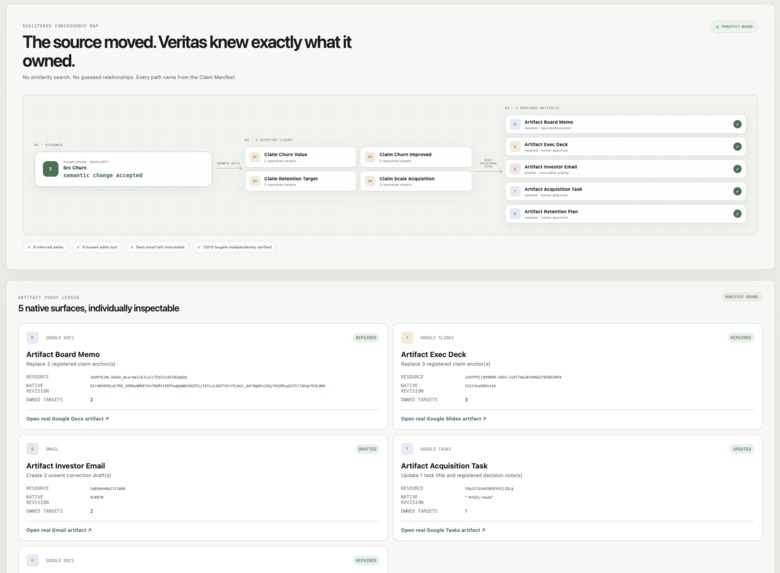
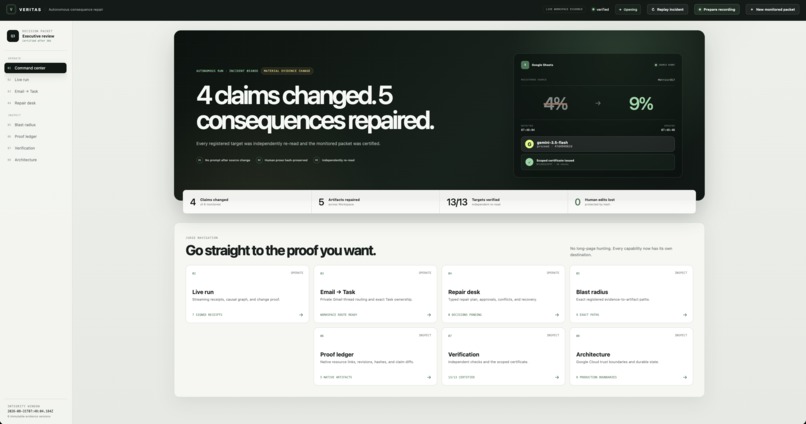
One Sheet change repaired five Workspace artifacts, verified 13/13 targets, and preserved every human edit.
-
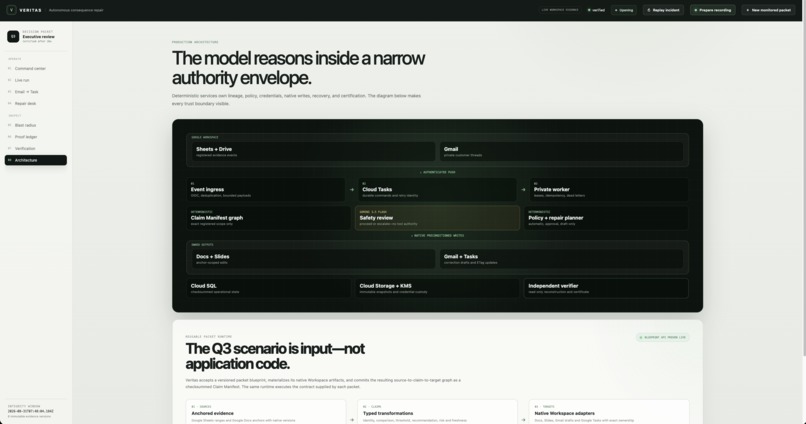
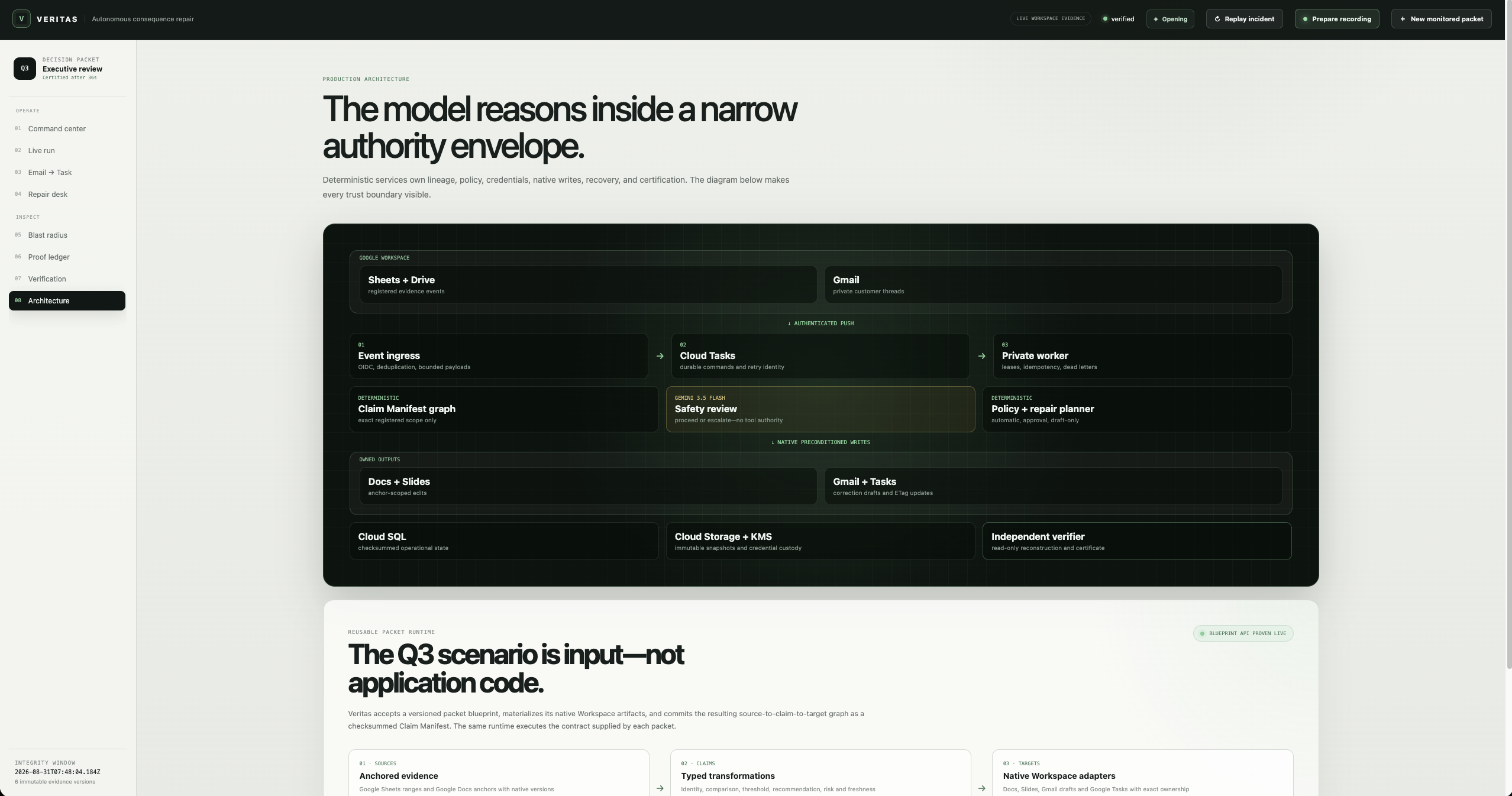
Cloud Run, Cloud Tasks, Vertex AI, Cloud SQL, encrypted evidence, guarded writes, and independent verification.
-
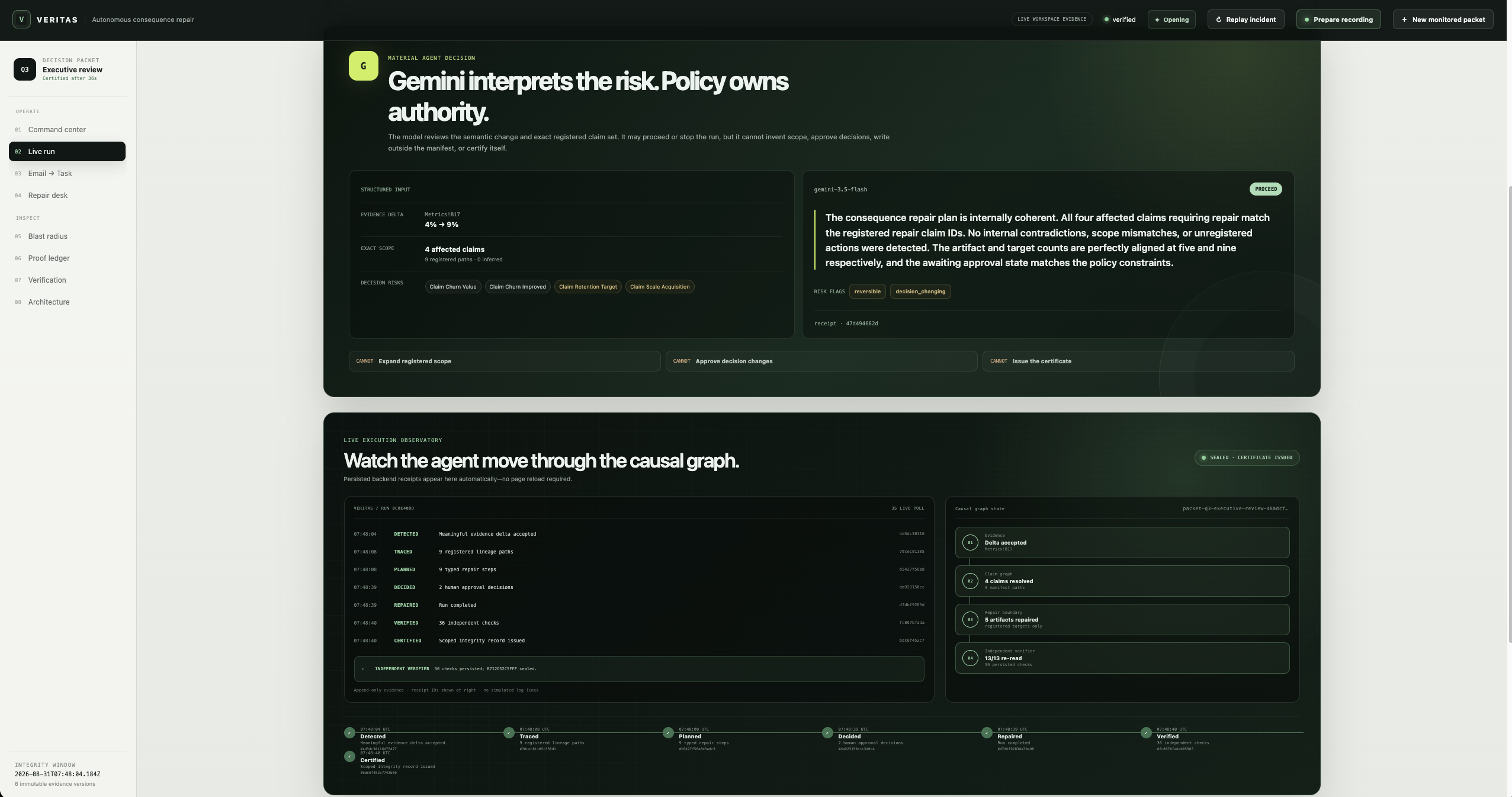
Gemini interprets semantic risk while deterministic policy controls scope, approvals, writes, and certification.
-
Factual repairs run automatically while decision-changing consequences pause for explicit human approval.
-
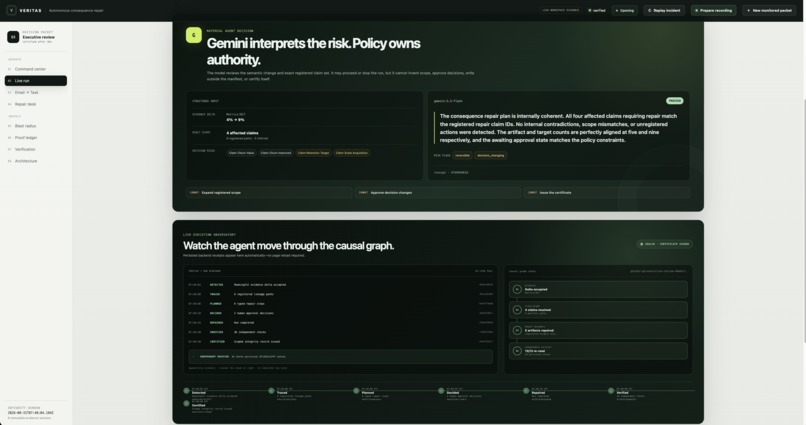
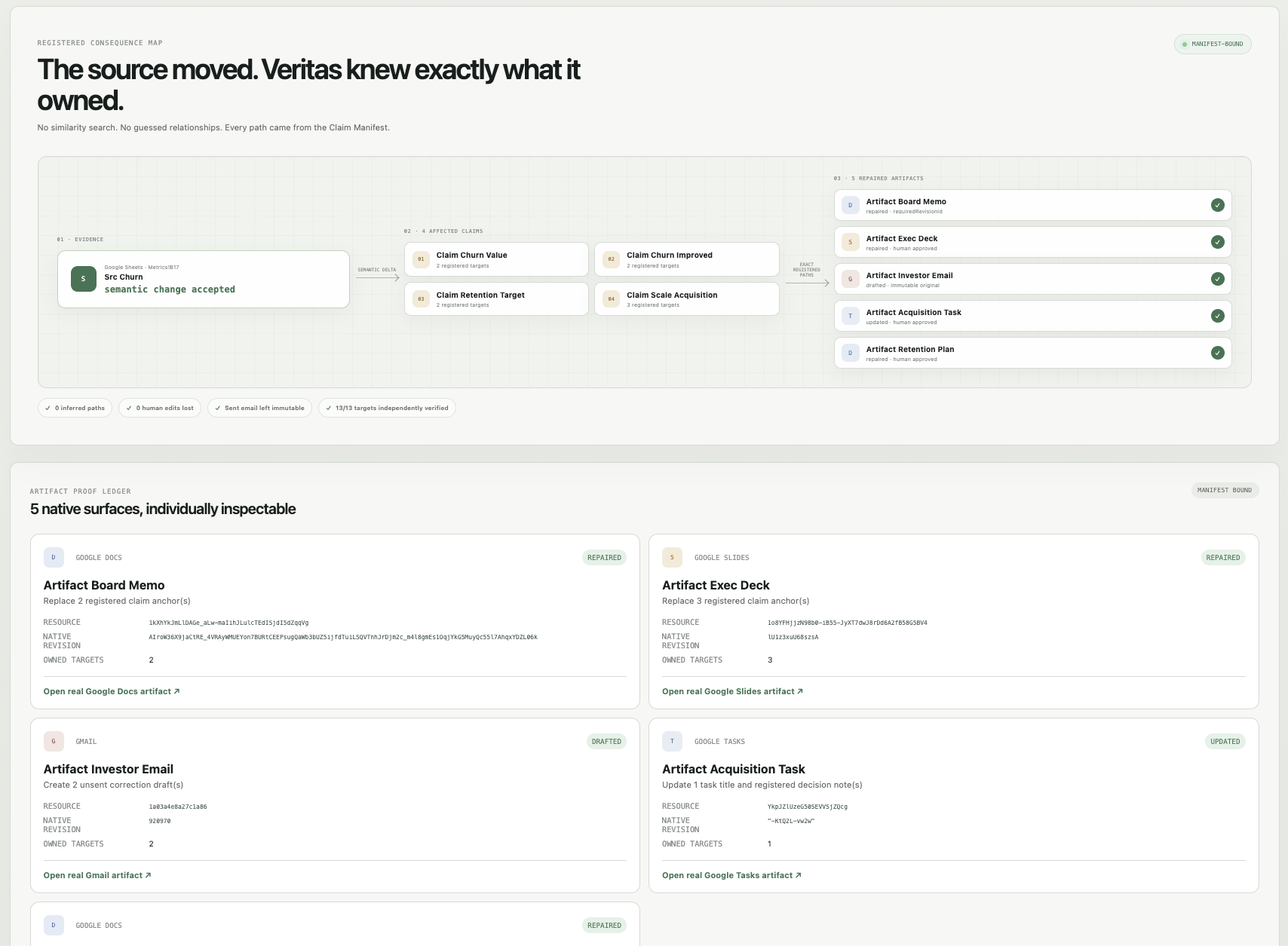
One source, four affected claims, five native artifacts, nine registered paths, and zero inferred paths.
Inspiration
AI can create a strategy memo, presentation, investor email, and execution plan in seconds. But when the source spreadsheet changes the next morning, those outputs silently disagree.
The source may now be correct while the rest of the business is wrong. Teams either repair everything manually or rerun brittle automations that can overwrite human work. We built Veritas to solve this missing problem: not generating more content, but safely repairing the consequences of changed evidence.
What it does
Veritas is an autonomous consequence-repair agent for Google Workspace.
Teams register important claims, their source evidence, and the exact artifacts that depend on them in a versioned Claim Manifest. When monitored evidence changes, Veritas:
- Captures an immutable snapshot of the change.
- Uses Gemini to understand its semantic impact.
- Traverses only registered claim-to-artifact relationships.
- Repairs affected Docs, Slides, Gmail drafts, and Google Tasks.
- Preserves human edits using hashes and revision preconditions.
- Pauses decision-changing actions for human approval.
- Independently re-reads every target after execution.
- Issues an integrity certificate only after complete verification.
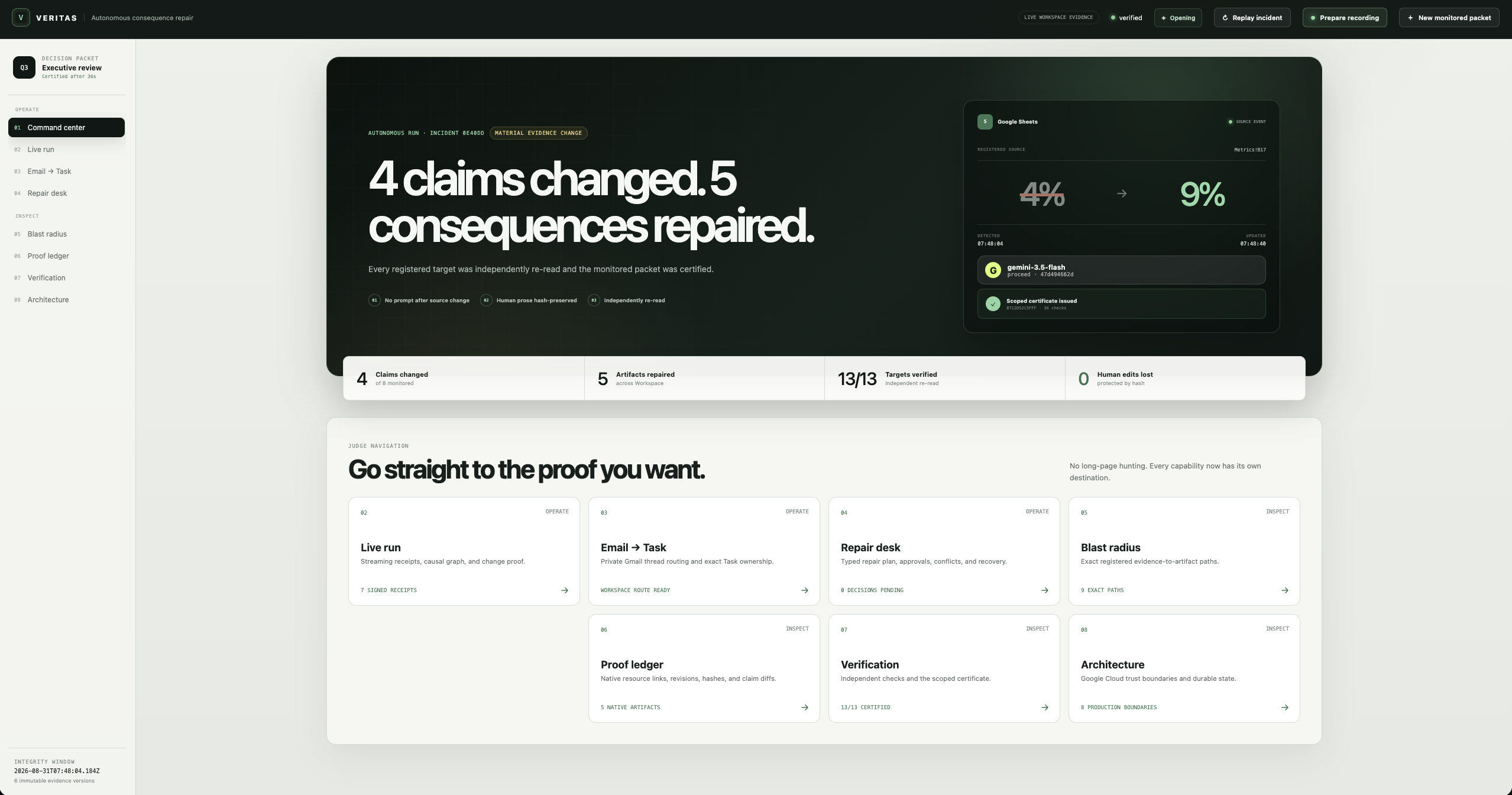
In our live demonstration, changing churn from 4% to 9% in a real Google Sheet affects four claims and five downstream artifacts through nine exact paths. Veritas repairs the consequences, preserves manually written content, requests approval for sensitive decisions, and finishes with 13/13 targets verified and zero human edits lost.
How we built it
Veritas separates probabilistic reasoning from deterministic authority.
Gemini 3.5 Flash on Vertex AI performs structured semantic-change analysis and safety review through the Google Gen AI SDK. Gemini can recommend whether the workflow should proceed or escalate, but it cannot expand the registered scope or authorize arbitrary writes.
Cloud Run hosts the command center, API, event ingress, and private repair worker. Cloud SQL stores manifests, journals, leases, approvals, and audit receipts. Pub/Sub and Cloud Tasks provide durable asynchronous execution, retries, replay, and failure recovery. Cloud Storage and Cloud KMS protect versioned evidence snapshots, while Secret Manager secures Google Workspace credentials.
Native Google APIs connect Veritas to Drive, Sheets, Docs, Slides, Gmail, and Tasks. The command center is built with React and TypeScript, while the backend uses Python and FastAPI. Terraform and Docker make the deployment reproducible.
Challenges we ran into
The hardest challenge was allowing an agent to perform real actions without giving it unsafe authority.
We had to handle duplicate events, concurrent edits, stale approvals, partial failures, retry safety, and the different revision models used by each Google Workspace application.
Preserving human work was especially important. Veritas therefore uses content hashes, revision preconditions, typed repair policies, and three-way merging instead of blindly regenerating entire documents.
A successful mutation response is also not proof of consistency. We built a separate read-only verifier that re-fetches every protected target through its native API before issuing a certificate.
Accomplishments that we're proud of
- Built and deployed a real end-to-end agent on Google Cloud.
- Connected real Google Sheets, Docs, Slides, Gmail, and Tasks.
- Implemented exact causal tracing with zero inferred write paths.
- Added human authority boundaries for decision-changing actions.
- Preserved human-written content with zero silent overwrites.
- Made sent emails immutable and generated correction drafts instead.
- Added durable retries, idempotency, replay, leases, and failure recovery.
- Built a live command center with receipts, causal graphs, proof, and verification.
- Completed more than 230 backend tests, 26 frontend tests, and a 40-scenario deterministic safety benchmark.
What we learned
Reliable agents require more than a capable language model.
The model should interpret meaning and propose bounded actions. Deterministic infrastructure must own scope, credentials, policy, mutations, approvals, recovery, and proof.
We also learned that trust does not come from an agent reporting that it succeeded. Trust comes from constrained authority, immutable evidence, and independent verification.
What's next for Veritas
Next, we plan to extend the Claim Manifest and typed connector system to Jira, Salesforce, Notion, Slack, data warehouses, and internal enterprise APIs.
We also want to provide teams with tools for visually registering new consequence paths, defining organization-specific approval policies, and continuously monitoring integrity across multiple business systems.
Our long-term goal is to make consequence repair a standard integrity layer for agentic work: whenever source truth changes, every registered consequence follows safely and provably.
Built With
- api
- artifact
- docs
- drive
- fastapi
- flash
- gemini
- gmail
- kms
- postgresql
- pub/sub
- python
- react
- registry
- run
- secret
- sheets
- slides
- sql
- tasks
- terraform
- typescript
- vertex
- workspace


Log in or sign up for Devpost to join the conversation.