Inspiration
Embodied AI and robotics models rely on high-quality, first-person video demonstrations of real people performing everyday physical tasks—like picking up a cup and setting it down. While this training data is critical, the supply chain behind it is broken: buyers struggle to verify genuine human footage from recycled clips or synthetic fakes, contributors wait weeks for payouts, and consent and licensing terms routinely get lost. We built Veritas so that data acquisition and payment depend on cryptographic and multi-model proof, not blind trust.
What it does
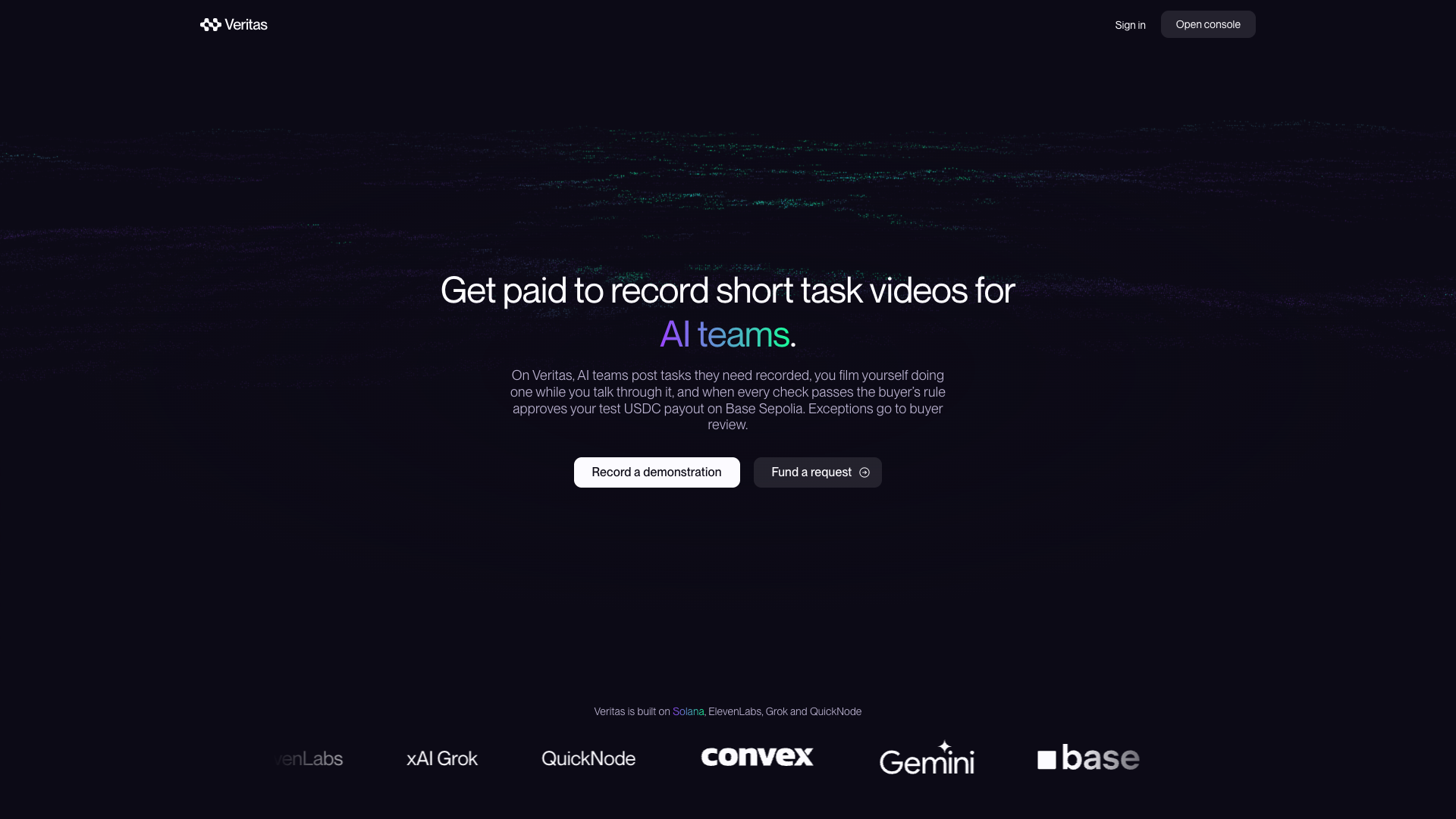
Veritas is a marketplace and settlement desk for verified robot-training demonstrations:
- Task Funding: Buyers post a task with a rubric, fund it in USDC, and set an auto-pay rule.
- Verified Capture: Contributors film themselves performing the task while narrating it, with explicit consent recorded up front.
- Dual-Vendor AI Judging: Two independent visual judges—Google Gemini and xAI Grok—evaluate the clip frame by frame against the rubric. If they disagree, or either fails the clip, it routes to the buyer for manual review instead of auto-paying.
- Anti-Fraud & Deduplication: Duplicate and copy detection prevents the same footage—even if re-encoded—from ever being paid twice.
- Bounded Autonomy: If all checks pass, the buyer's deterministic rule triggers the payout. A finance agent can explain and propose payouts, but it can never unilaterally approve or sign one.
- Instant, Auditable Settlement: Contributors are paid in USDC on Base or Solana. Every movement of funds posts to a balanced double-entry ledger, and transfers are reconciled directly against the chain.
- On-Chain Licensing: Each accepted clip mints a 1-of-1 Token-2022 license token on Solana, permanently recording the license terms, consent, and dataset manifest on-chain.
Teams can also connect their own AI agents via MCP to browse tasks, create orders, and fund bounties—while strict trust boundaries ensure agents can propose and pay, but never accept work or approve their own payouts.
How we built it
- Convex: The core system of record holding orders, the double-entry ledger, evidence logs, approvals, scheduled jobs, and real-time dashboard updates.
- Solana: Devnet funding, contributor payouts from a dedicated payout wallet, and Token-2022 license minting.
- xAI Grok: Serves as our second visual judge, the default finance-agent model, and powers a Telegram bot that drafts bounty posts for buyer approval.
- QuickNode Streams: Pushes on-chain transfers to a signed webhook, where every delivery is treated as an untrusted hint and re-verified over RPC before touching the books.
- ElevenLabs: Delivers spoken cues before recording, a spoken coaching debrief afterward, and audio watermark detection that flags AI-generated narration for human review.
- x402 & Coinbase CDP: Enables single-request USDC funding and server wallets governed by independent spending caps.
- Next.js on Vercel & Python: Powers the web application, backed by a Python verifier that enforces strict report schema consistency.
Challenges we ran into
- Treating AI output as evidence, not authority: Designing strict trust boundaries so an AI judge can block a payout, but can never approve one on its own.
- Handling uncertain payments: Network timeouts don't prove a transfer failed, requiring every payment attempt to be stored durably, deduplicated, and reconciled against RPC state.
- Keeping money exact everywhere: Eliminating floating-point rounding bugs by representing all balances and transfers as exact integer micro-USDC units.
- Preventing double-payouts: Catching cropped, trimmed, or re-encoded video duplicates before funds leave the escrow wallet.
Accomplishments that we're proud of
- Building a complete end-to-end testnet flow backed by a balanced double-entry ledger and on-chain reconciliation.
- Writing roughly 1,600 automated tests in CI covering financial invariants, edge cases, and agent trust boundaries.
- Architecting AI agents that can usefully propose and execute workflows without ever holding the keys to approve their own requests.
What we learned
The hardest part of paying for data isn't moving the money—it's maintaining an auditable trail that proves, afterwards, why every single payout was legitimate.
What's next for Veritas
- Mobile App: Launching a dedicated mobile capture experience (coming soon).
- Full Live Pipeline: Transitioning the Grok visual judge, ElevenLabs watermark checks, and Solana payouts from synthetic test harnesses to full live end-to-end runs.
- Robotics-Ready Exports: Supporting bulk dataset exports in standard robotics training formats (such as RLDS and LeRobot).
Disclaimer: Veritas currently operates on testnet using test USDC only.
Built With
- solana
