-
-
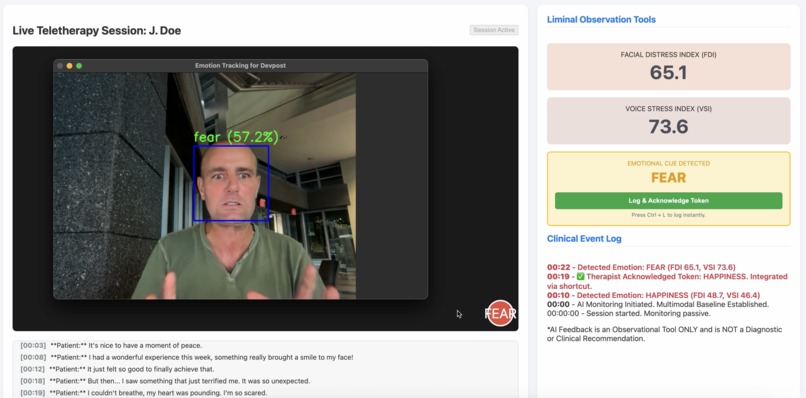
Example Result
Inspiration: Bridging the Empathy Gap The inspiration for this project, the Hybrid Real-Time Emotion Tracker, came from recognizing a fundamental limitation in modern communication and data analysis: the empathy gap. In fields like remote user testing, e-learning, and virtual interviews, we lose subtle, non-verbal feedback. We wanted to build a simple, accessible tool that could restore the human element by providing immediate, objective data on a person's emotional state, turning passive video observation into actionable emotional intelligence. The core goal was to prove that complex, open-source AI could be reliably run on common desktop hardware to democratize affective computing. The most significant learning was a deep appreciation for the trade-offs required in a real-time computer vision system:
The Speed-Accuracy Dilemma: We learned that models optimized for high theoretical accuracy (like RetinaFace/SSD) are often too slow to be practical in a continuous, real-time environment. This forced us to develop a hybrid architecture that breaks the problem into two parts.
The Power of Open Source: We mastered combining two separate, robust open-source libraries—the rapid detection capability of OpenCV (specifically the Haar Cascade classifier) and the deep, pre-trained emotional analysis of DeepFace—to solve a single, complex problem.
Environment Stability: We solidified the importance of using virtual environments (venv) for development, realizing that installation conflicts (like the tf-keras issue) often stem from conflicting packages rather than code errors. Our project was built around a hybrid, two-stage processing pipeline to maximize performance:
Stage 1: Fast Face Detection: We used the extremely lightweight and fast OpenCV Haar Cascade classifier to quickly scan the video frame and generate the bounding box coordinates (the x, y, w, h of the face). This step is optimized for speed and stability, ensuring a high frame rate.
Stage 2: Accurate Emotion Analysis: We then passed only the cropped Region of Interest (ROI)—the face image itself—to the powerful DeepFace model. Crucially, we instructed DeepFace to skip its own slow internal face detector, allowing it to focus exclusively on running the emotion classification (the AI portion) on the clean, small image we provided.
Output: The script then takes the final emotion result (e.g., "Happy") and draws it along with the confidence score in a high-contrast green text onto the original video frame, creating the final, usable output. Challenges We Faced The project's development was defined by overcoming severe, low-level integration issues unique to running deep learning on a local machine:
Camera Resource Locking: The biggest challenge was a persistent system-level conflict where the Mac's camera driver would not reliably hand off the video stream to our Python application. This resulted in the blank window and "Waiting for face..." errors that required extensive debugging.
Resolution: We fixed this by finding the correct CAMERA_INDEX and applying mandatory low-level settings (like the MJPG codec) in OpenCV to force the stream into a format the libraries could process.
Dependency Hell: We repeatedly encountered the tf-keras ValueError during environment setup.
Resolution: The fix was to adopt best practices: creating a dedicated virtual environment and manually installing the missing required packages within that isolated space, ensuring a conflict-free execution environment.

Log in or sign up for Devpost to join the conversation.