-
-
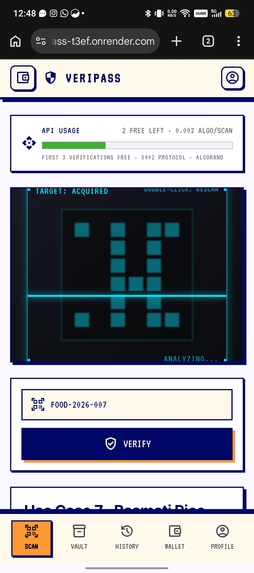
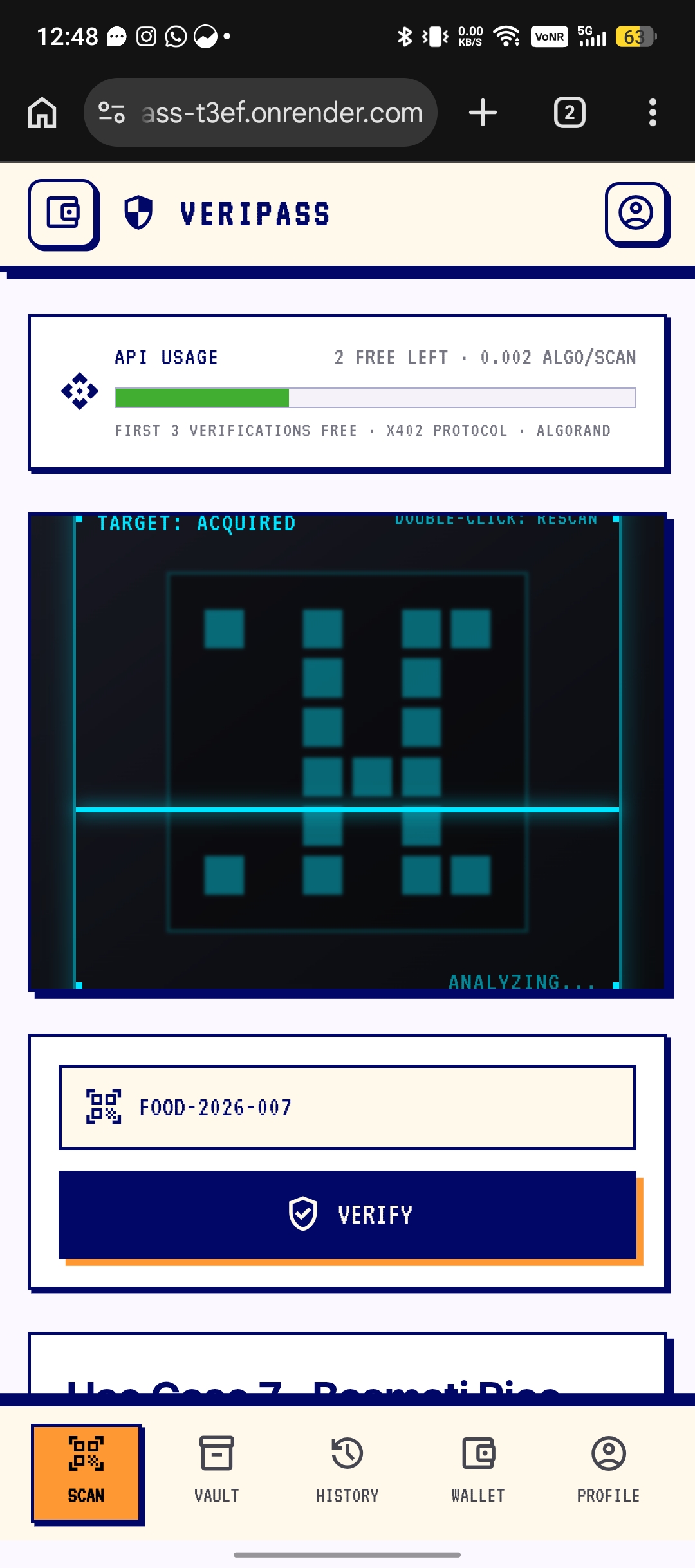
Scan menu
-
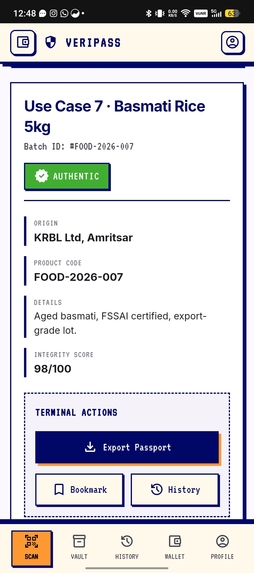
Scanning product Details
-
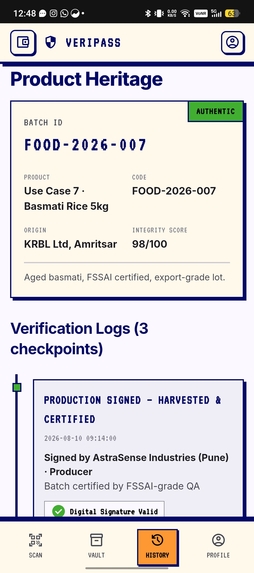
Product details
-
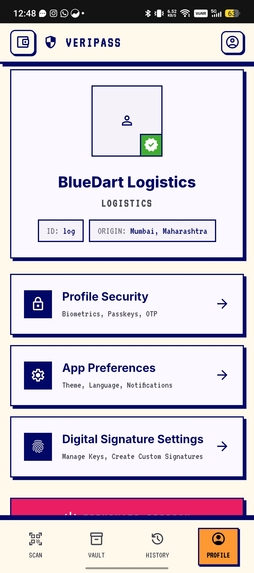
Profile page
-
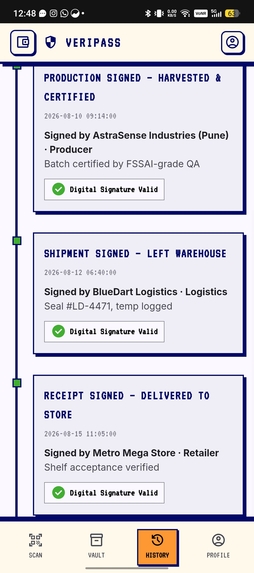
Product History
-
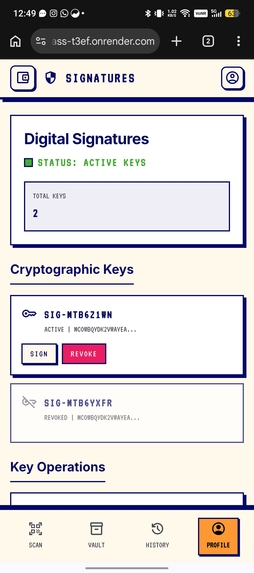
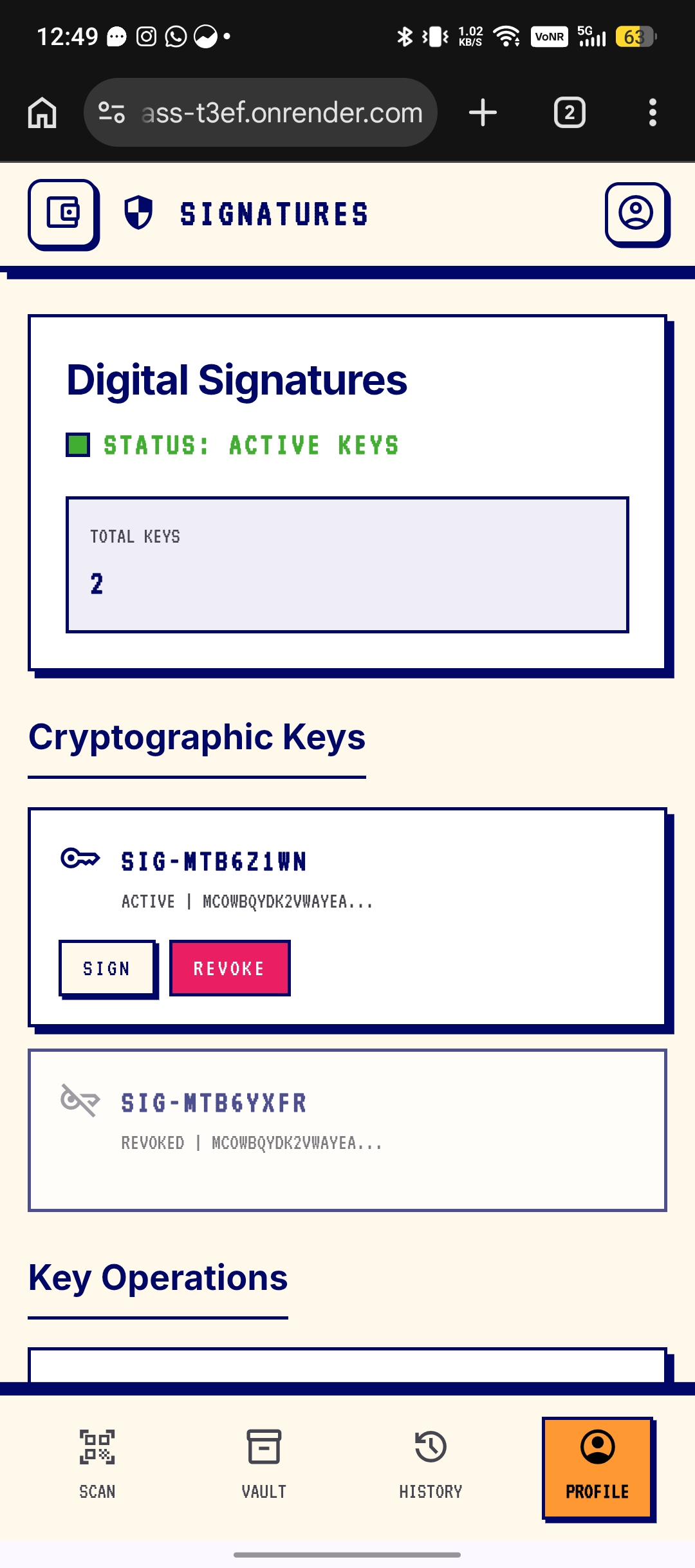
signature keys by users
-
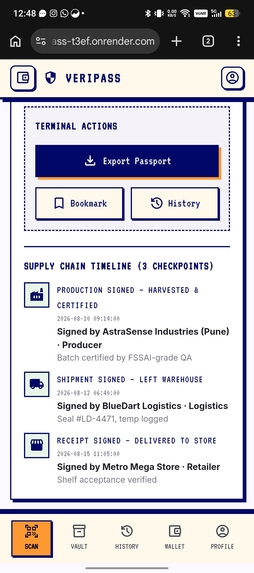
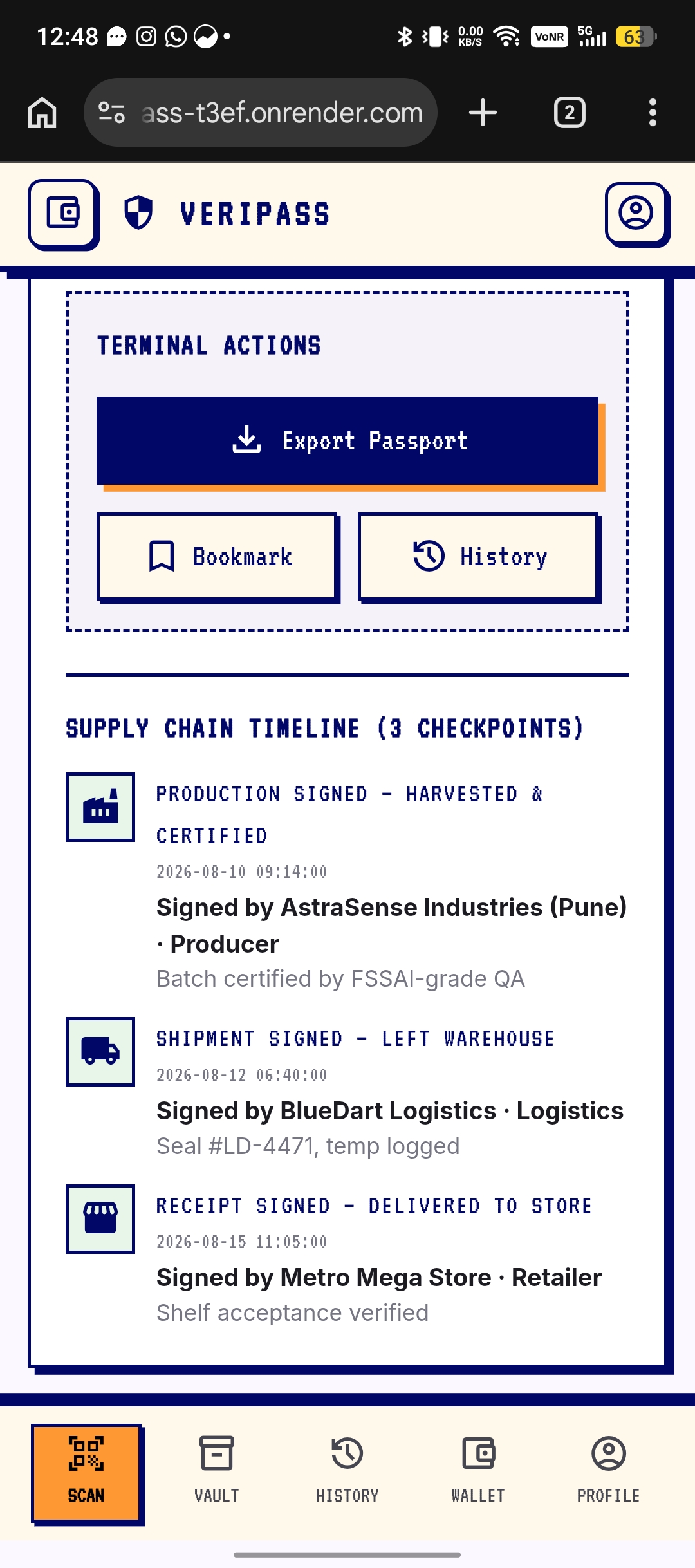
product history short
-
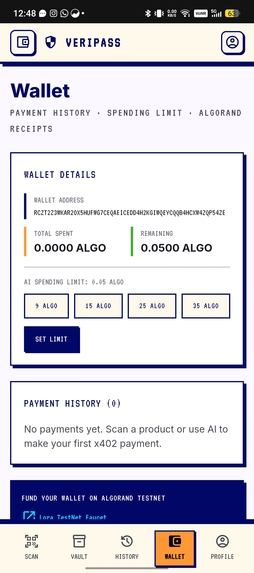
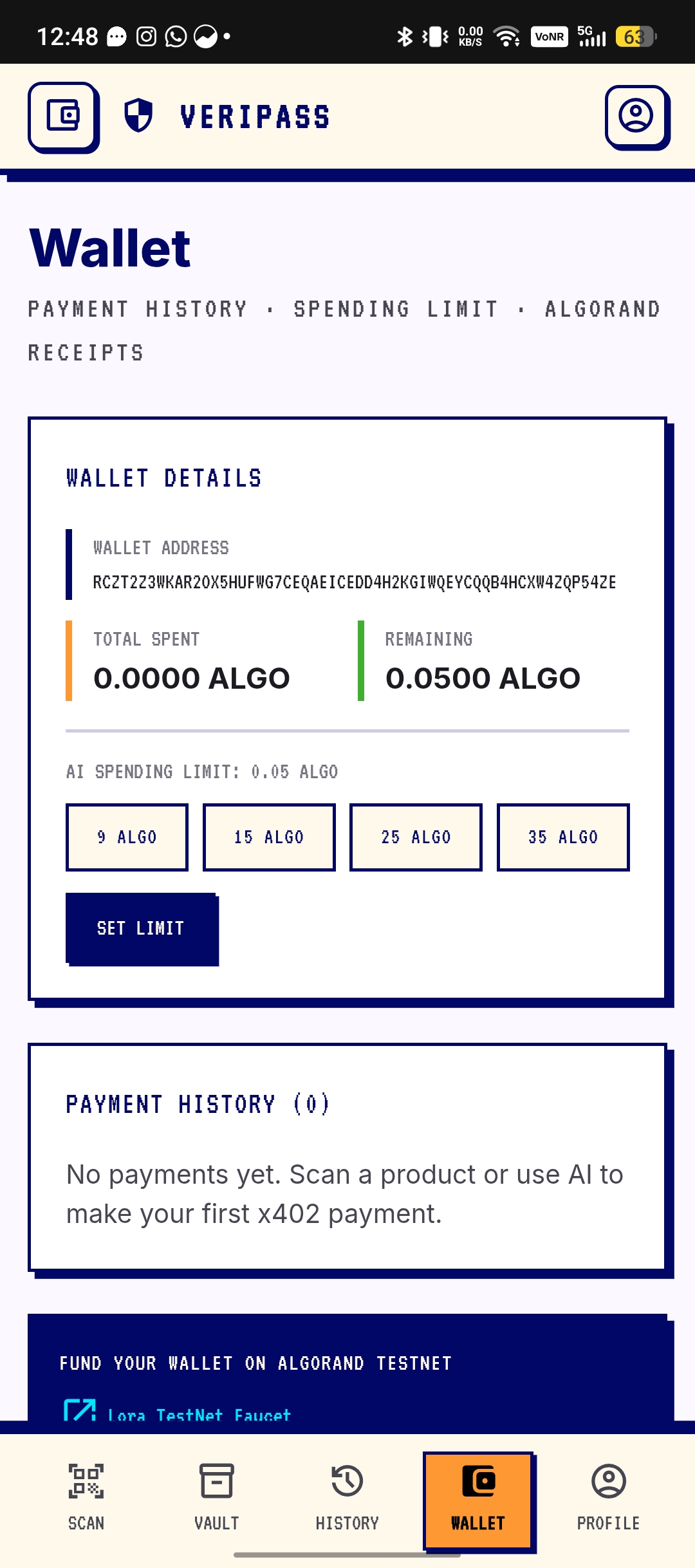
wallet deatils
-
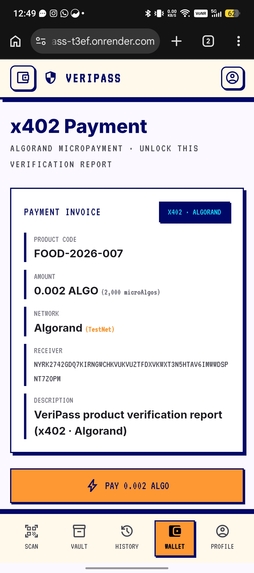
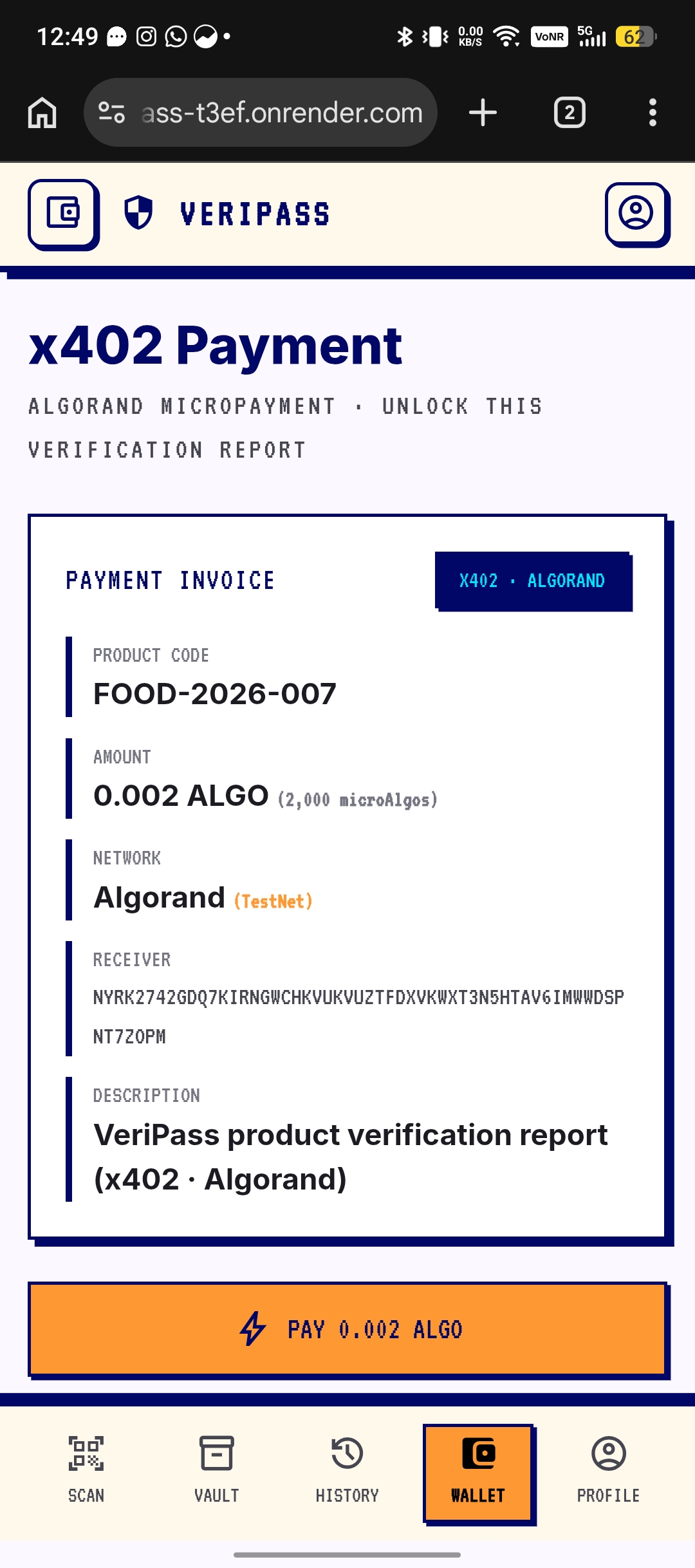
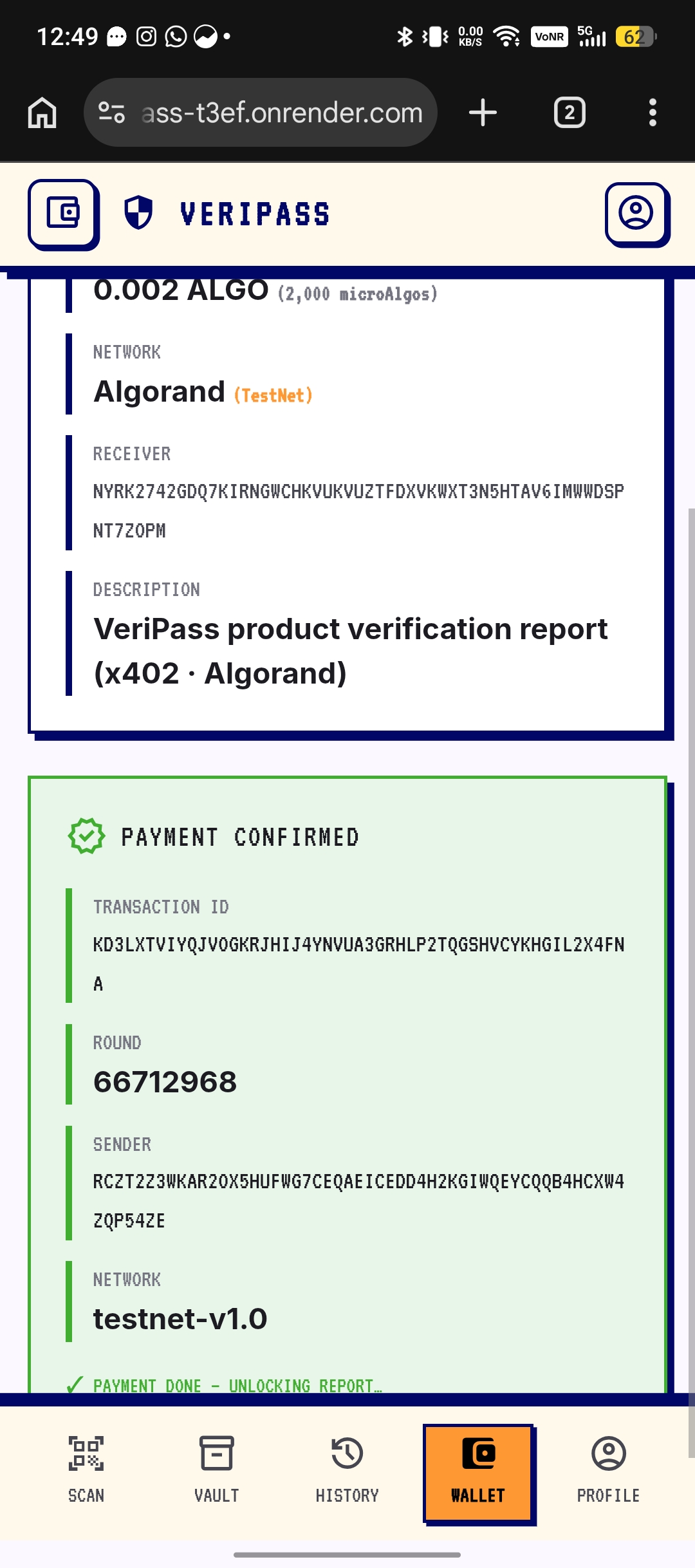
confirm payment
-
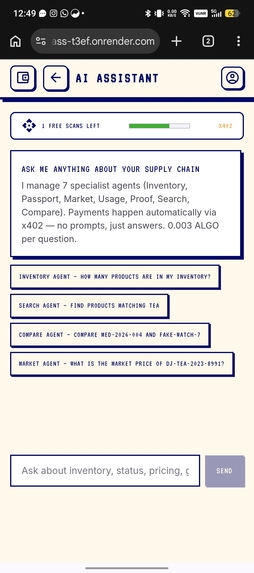
Ai for all micro transactions and Ease od use
-
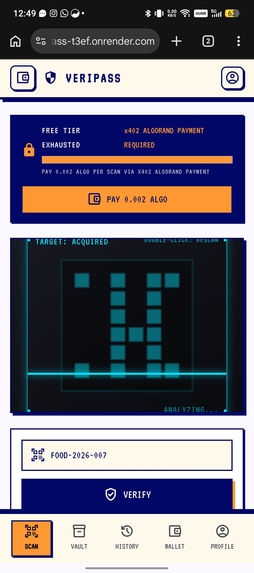
scan + pay per use button
-
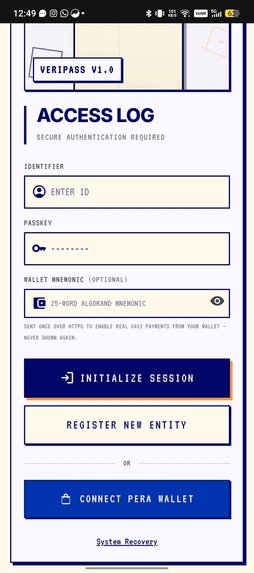
login page with pera wallet
-
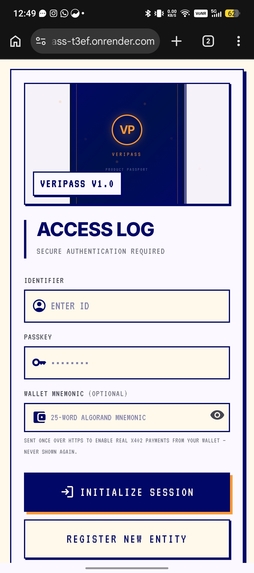
login page
-
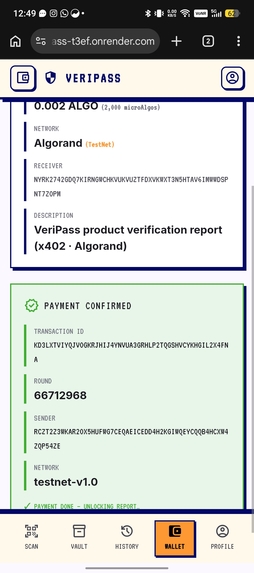
payments reciet
-
Logo + Initiative
💡 Inspiration
India loses ₹1.5 lakh crore annually to counterfeit products — adulterated medicines, fake electronics, forged luxury goods. As students at Bangalore Institute of Engineering, we've seen this problem up close. Existing supply-chain verification is either too expensive for small businesses or too centralised to be trustworthy.
Then we discovered the x402 protocol — HTTP 402 Payment Required — and realised something powerful: AI agents can now pay for services autonomously. What if we combined product verification with agentic micropayments? Instead of forcing users into expensive subscriptions, what if AI agents could pay per-use to verify products — buying trust like they buy tools in coding environments?
That's when VeriPass was born: an anti-counterfeit product passport where AI agents pay per-use on Algorand to verify authenticity, trace supply chains, and fight counterfeiting.
🛠️ What It Does
VeriPass is an x402 product passport platform on Algorand with three core capabilities:
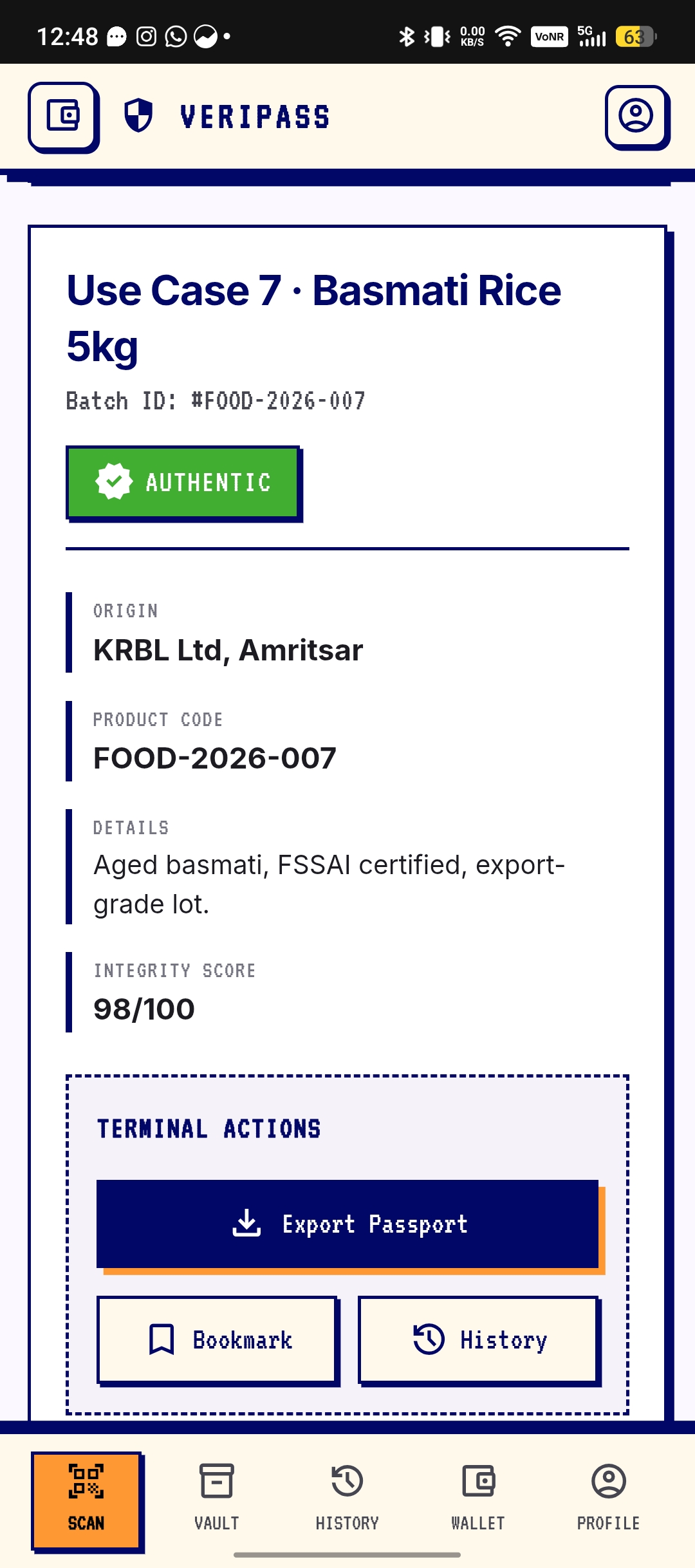
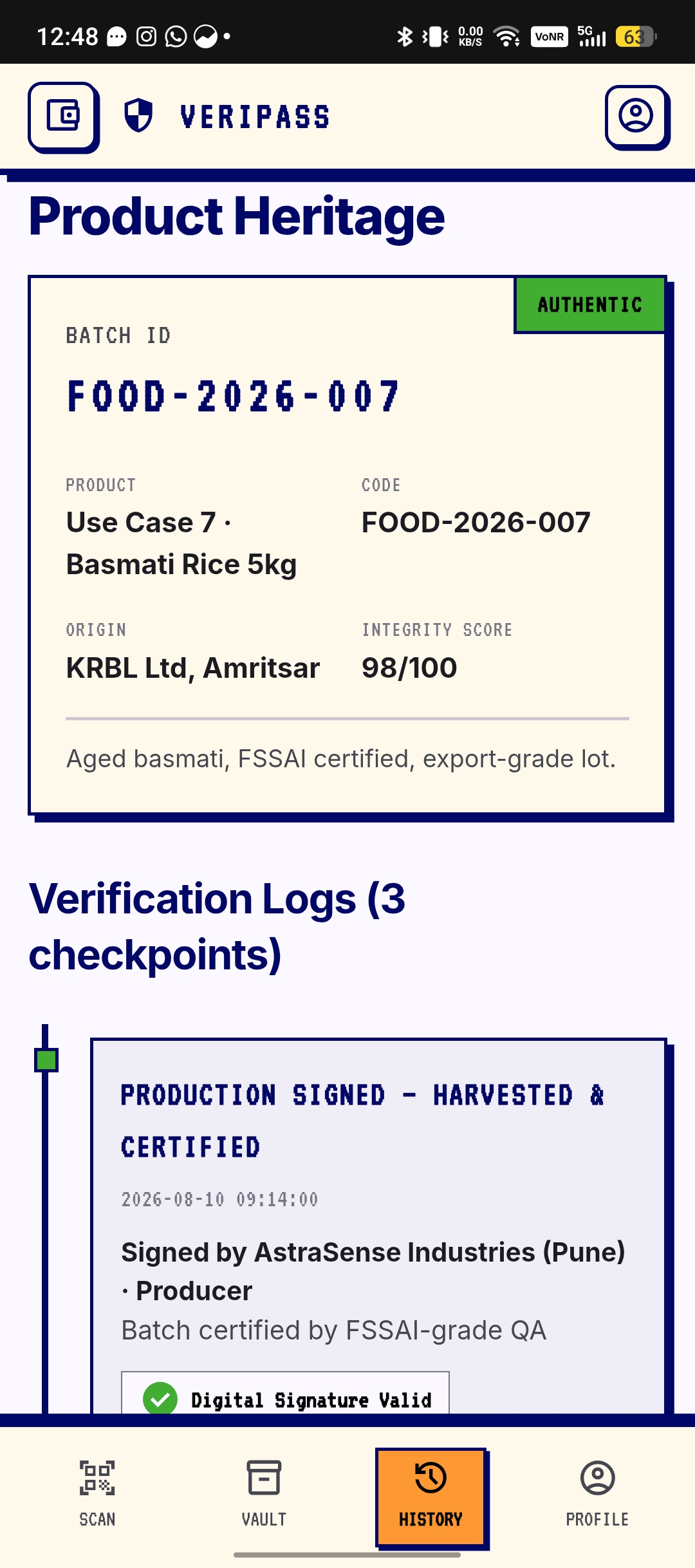
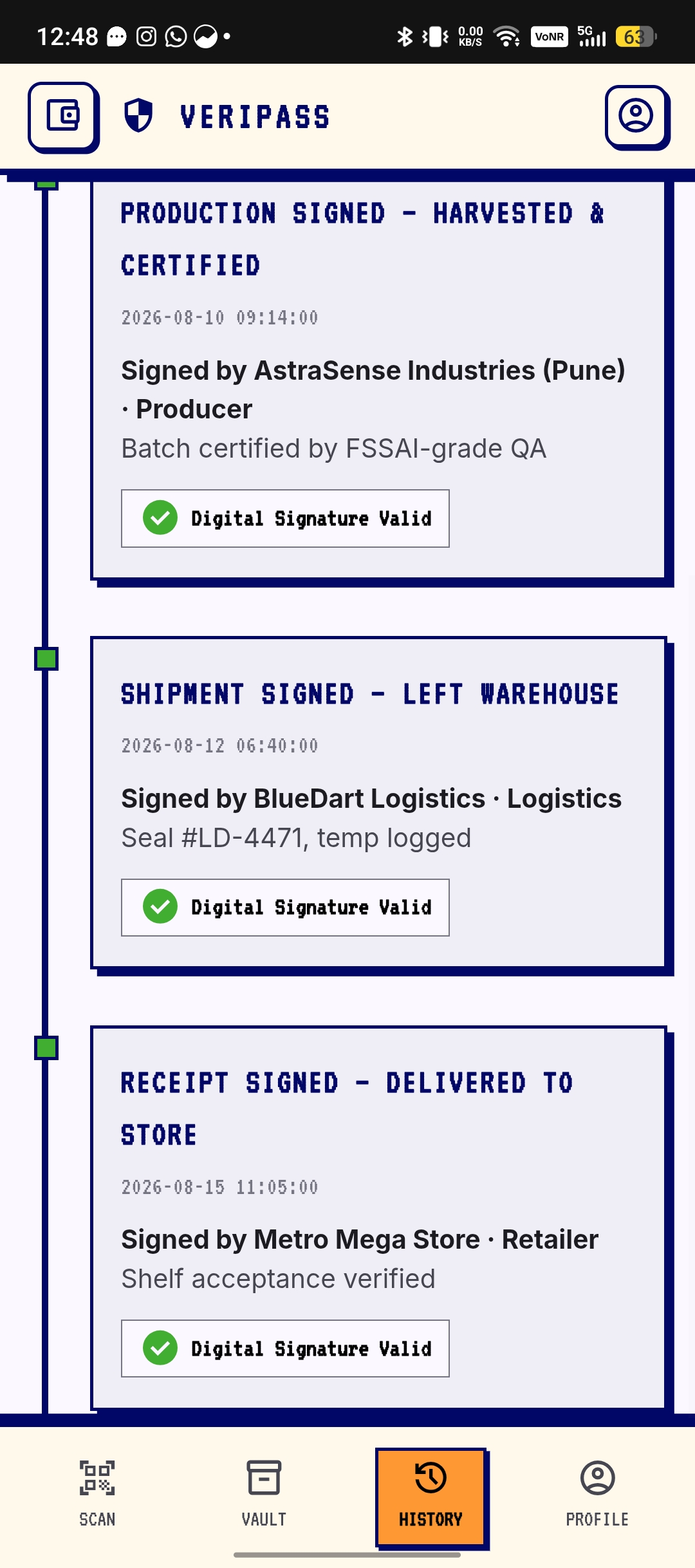
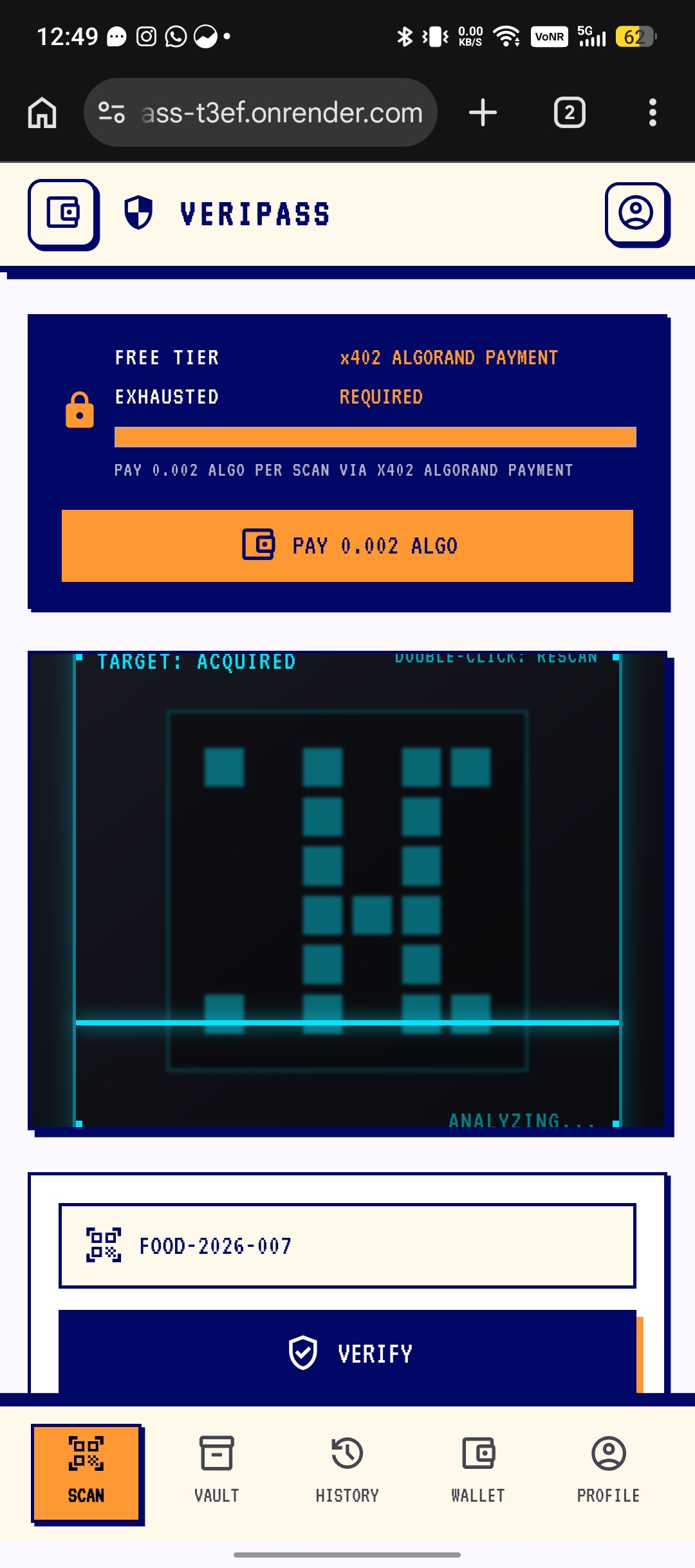
1. Product Verification — Users scan a QR code to view a product's full chain-of-custody: where it was made, who handled it, how it got to the shelf. Each checkpoint is cryptographically signed.
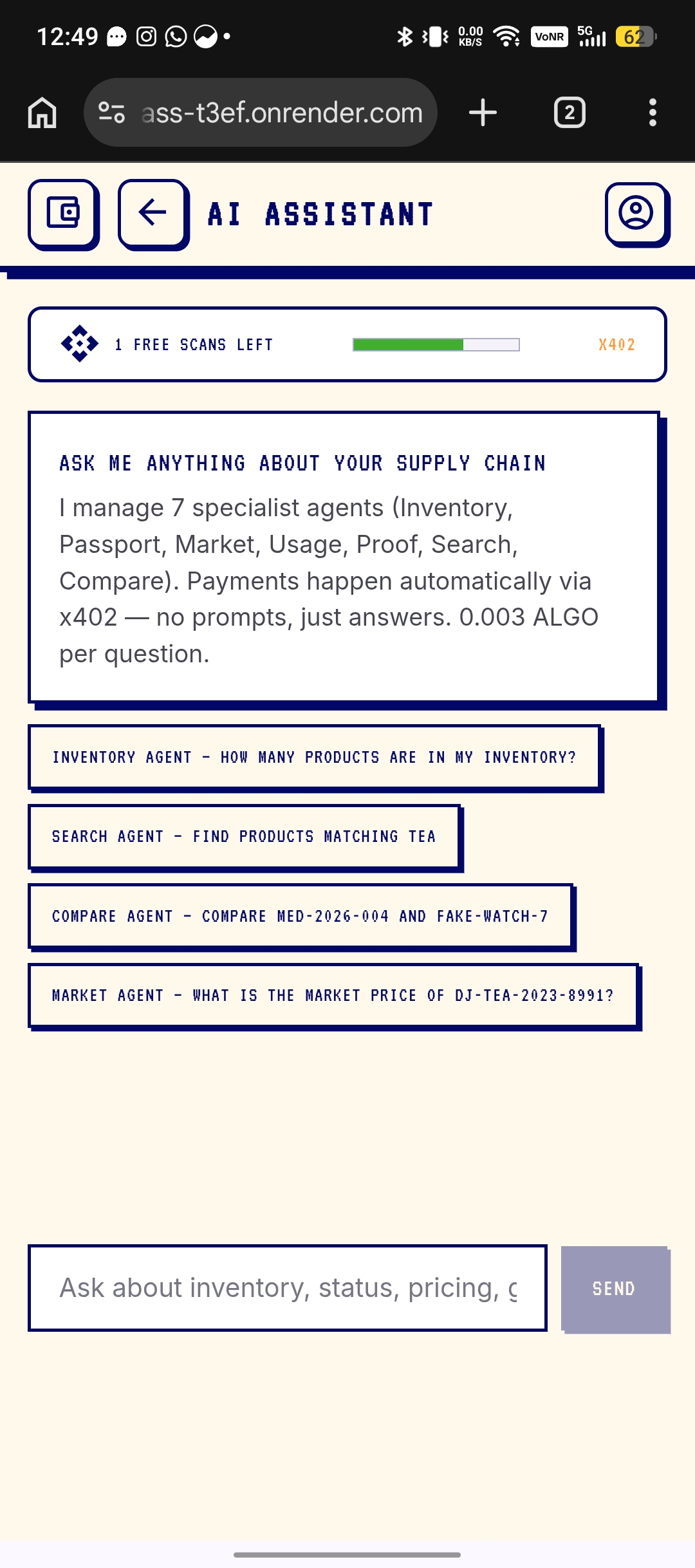
2. AI Agentic System — 7 specialist AI agents (inventory, passport, market, usage, proof, search, compare) that each charge micropayments via x402. A Research Agent demonstrates machine-to-machine commerce by paying three services in sequence: market data → news → report.
3. x402 Micropayments — Every action (scan, query, report) triggers a real Algorand TestNet transaction. No subscriptions, no credit packs — just pay-per-use.
The cost model per action is:
$$C_{\text{action}} = \begin{cases} 0.002 \text{ ALGO} & \text{product scan} \ 0.003 \text{ ALGO} & \text{agent query} \ 0.005 \text{ ALGO} & \text{comparison report} \end{cases}$$
⚙️ How We Built It
Frontend: React 19, Vite, TypeScript, Tailwind CSS — a state-based SPA with 13 screens including a live QR scanner, AI chat, wallet dashboard, and passport viewer. Pera WalletConnect for Algorand integration.
Backend: Hono (Node.js) with 30+ REST API endpoints, SQLite via built-in node:sqlite (zero native deps), HMAC-signed authentication, and ed25519 digital signatures for supply-chain checkpoints.
AI: Google Gemini (gemini-3.6-flash) with tool-calling for each agent. Agents autonomously check wallet balances, execute payments, and return verified data. An agentic loop runs up to $N_{\max} = 6$ iterations per query.
Payments: Native Algorand TestNet transactions via algosdk v3. Each user gets a unique wallet. GoPlausible facilitator handles x402 protocol settlement. Payments are direct wallet-to-wallet transfers — no smart contracts.
The system architecture follows:
$$\text{User} \xrightarrow{\text{scan}} \text{React SPA} \xrightarrow{\text{API}} \text{Hono Backend} \xrightarrow{\text{x402}} \text{Algorand TestNet}$$
$$\text{AI Agent} \xrightarrow{\text{tool call}} \text{Gemini} \xrightarrow{\text{payment}} \text{Algorand} \xrightarrow{\text{proof}} \text{Product Passport}$$
🧩 Challenges We Ran Into
x402 spec was evolving — The protocol changed during the hackathon. We had to adapt our middleware integration multiple times to match the latest
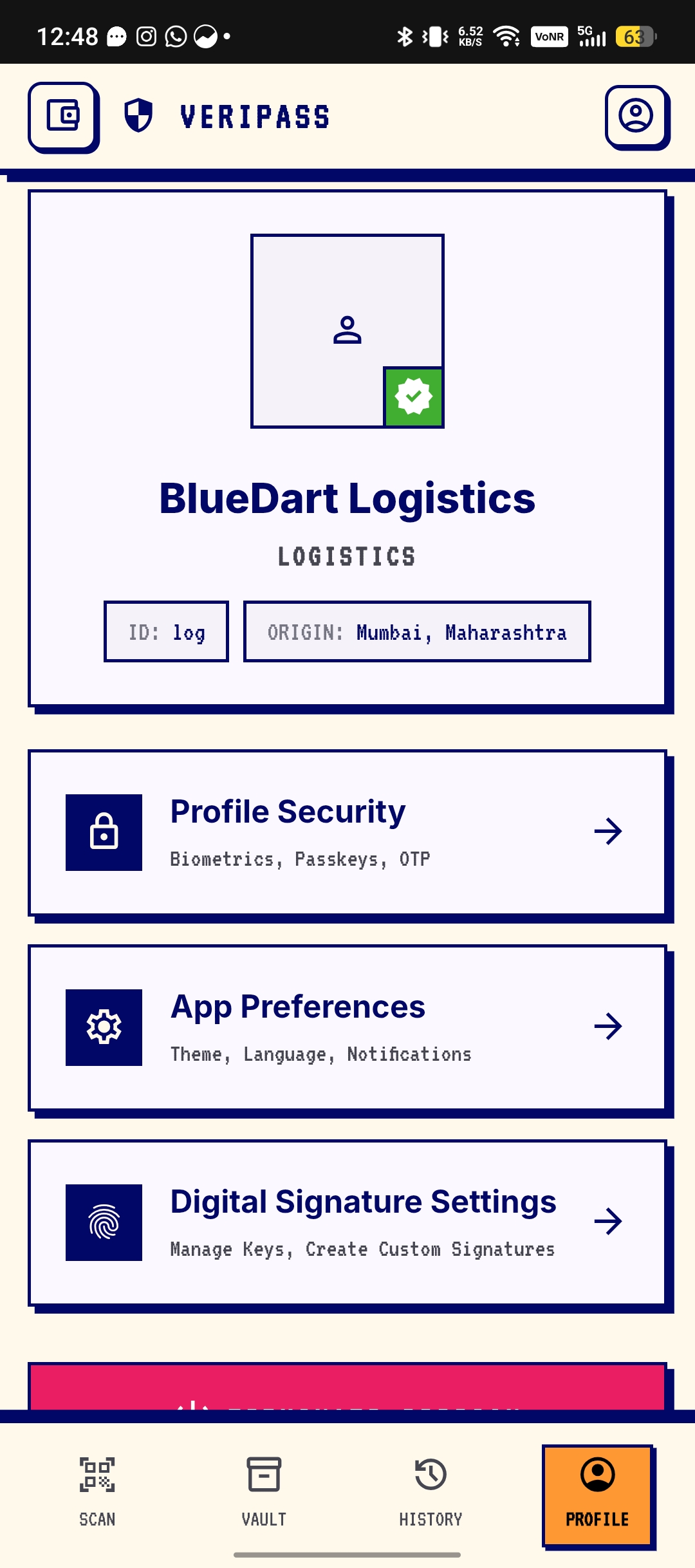
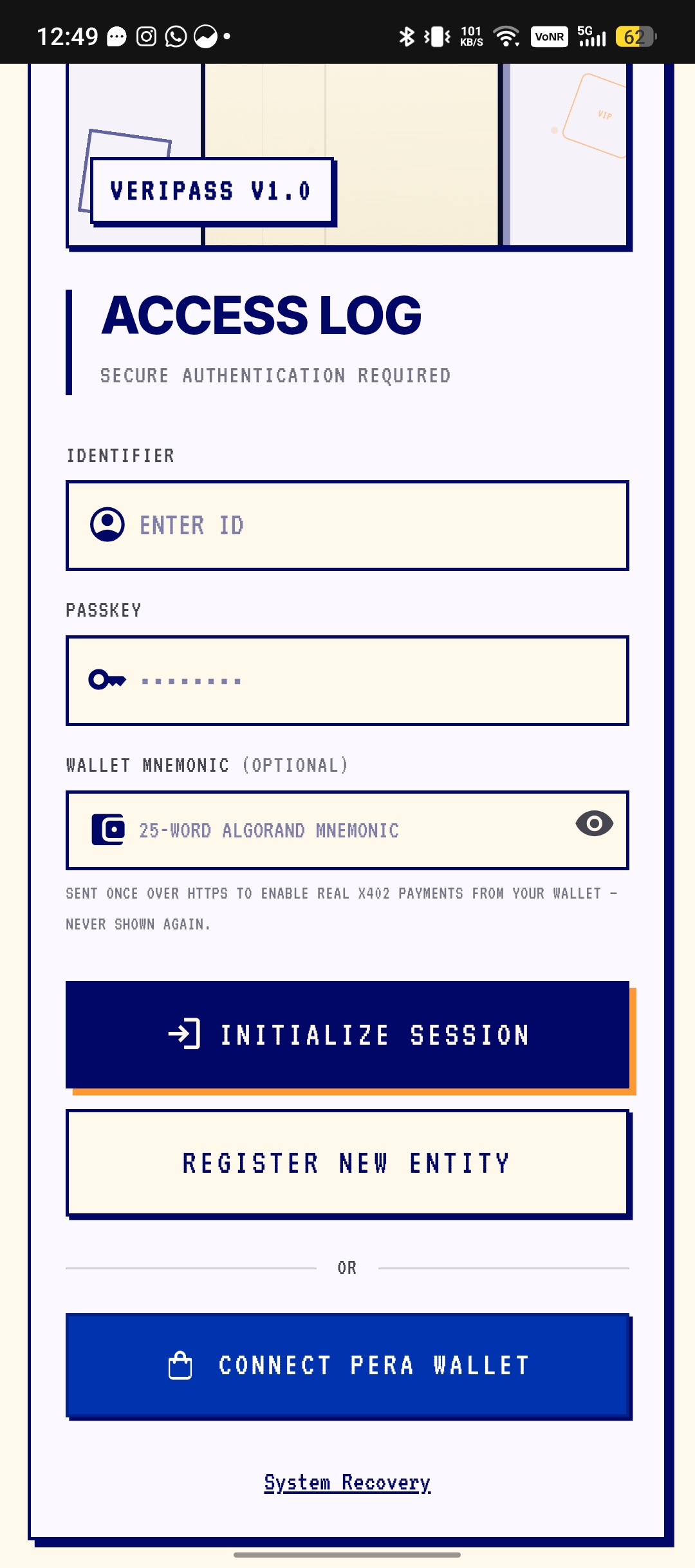
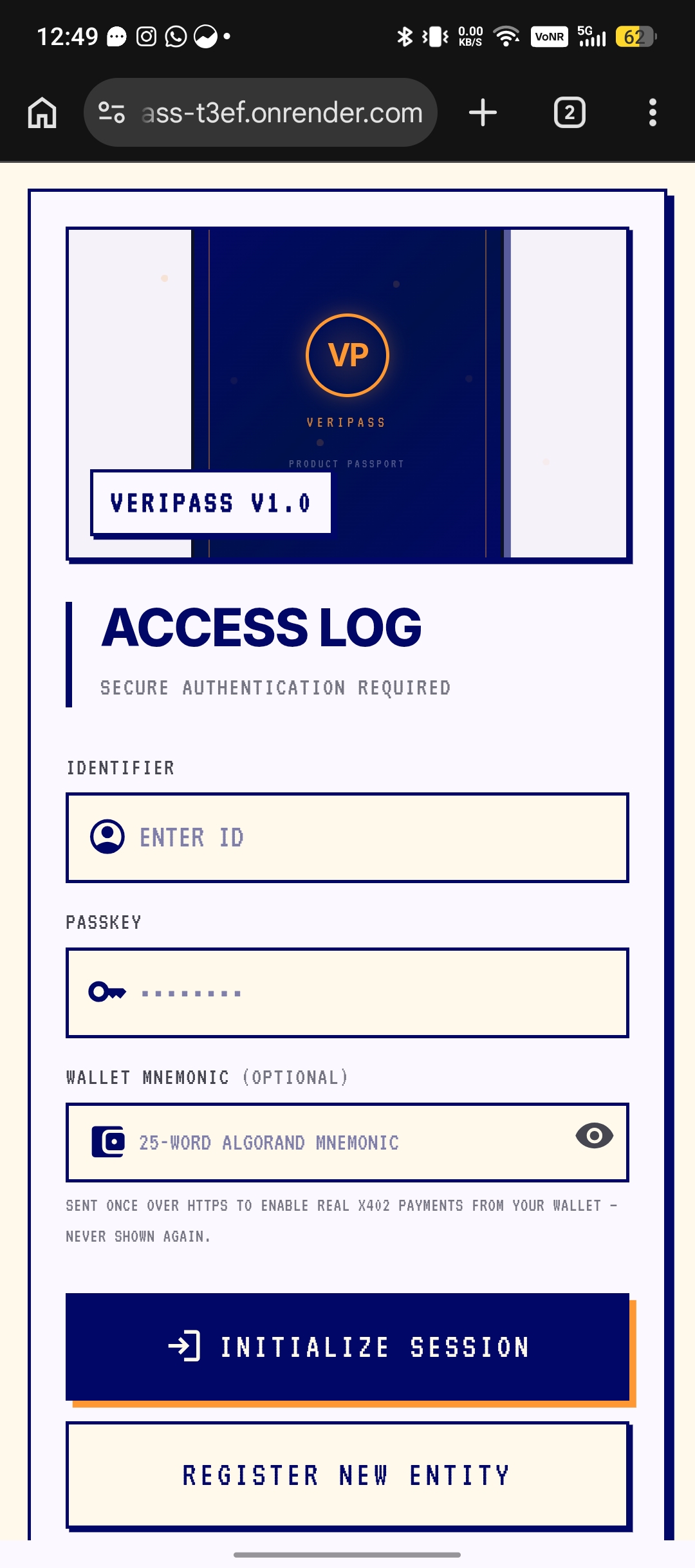
@x402/honoAPI.Wallet management is hard — Each user needs a unique Algorand wallet, but managing mnemonics securely at scale is non-trivial. We solved it with a gitignored wallet store and optional client-side Pera signing.
AI tool-calling reliability — Getting Gemini to reliably call tools (wallet check, payment, product lookup) required extensive prompt engineering. The agentic loop sometimes hallucinated tool names — we added strict validation.
Cold starts on free tier — Running on Render free tier means ~30s cold starts. SQLite also doesn't handle concurrent writes well. Acceptable for a demo, but would migrate to PostgreSQL in production.
Security incident — Wallet mnemonics were accidentally exposed in the initial README push. We caught it, redacted them, and added a gitignore rule. Lesson learned: always audit before pushing.
🏆 Accomplishments We're Proud Of
Real x402 payments working end-to-end — From QR scan → AI agent → Algorand payment → verified passport, every step is real. Transactions are viewable on Lora TestNet Explorer.
7 AI agents with autonomous payments — Each agent charges micropayments and executes real ALGO transactions without human intervention. The Research Agent pays 3 services in sequence:
$$\text{Research} \xrightarrow{0.003} \text{Market Data} \xrightarrow{0.003} \text{News} \xrightarrow{0.003} \text{Report}$$
Zero native dependencies — Using Node.js built-in
node:sqlitemeant no native compilation, no build failures, and seamless deployment.Full platform — 30+ API endpoints covering auth, verification, AI, payments, digital signatures, and admin dashboard — a complete platform, not a prototype.
Made in India — Built entirely by students at Bangalore Institute of Engineering, addressing a uniquely Indian problem.
📚 What We Learned
x402 is real machine-to-machine commerce — Not just a spec, but a working protocol that enables autonomous agent payments. The future of commerce is agents paying agents.
Algorand is built for micropayments — With finality time:
$$t_{\text{finality}} \approx 3.3\text{s}, \quad f_{\min} = 0.001 \text{ ALGO/txn}$$
Traditional payment gateways charge ₹2–5 per transaction, making micro-verification impossible. Algorand makes it viable.
Simple architecture wins — No smart contracts, no DeFi complexity — just native ALGO transfers via HTTP headers. Sometimes the simplest solution is the best one.
AI agents need wallets and budgets — The shift from "humans pay" to "agents pay" requires wallet management, spending limits, and audit trails. We built all three with a spend-policy guard:
$$\text{allowed}(s) = \begin{cases} \text{true} & \text{if } s \leq s_{\max} \ \text{false} & \text{otherwise} \end{cases}$$
where $s$ is cumulative spend and $s_{\max}$ is the budget cap.
- SQLite is surprisingly production-ready — Zero config, single file, built into Node.js. Perfect for hackathon-scale projects.
🚀 What's Next for VeriPass
Mainnet deployment — Move from Algorand TestNet to Mainnet with real ALGO payments and production wallet management.
PostgreSQL migration — Replace SQLite with PostgreSQL for concurrent write support and horizontal scaling.
Mobile app — Native React Native app with camera-based QR scanning and Pera Wallet deep linking.
Enterprise API — B2B API for manufacturers to register products and issue passports at scale.
Multi-chain support — Expand beyond Algorand to support other x402-compatible chains.
AI agent marketplace — Let third-party developers deploy their own verification agents on the VeriPass network.
Regulatory integration — Connect with Indian government supply-chain digitisation initiatives (Digital India, BIS compliance).


Log in or sign up for Devpost to join the conversation.