-
-

Tested MVP by Jury
-
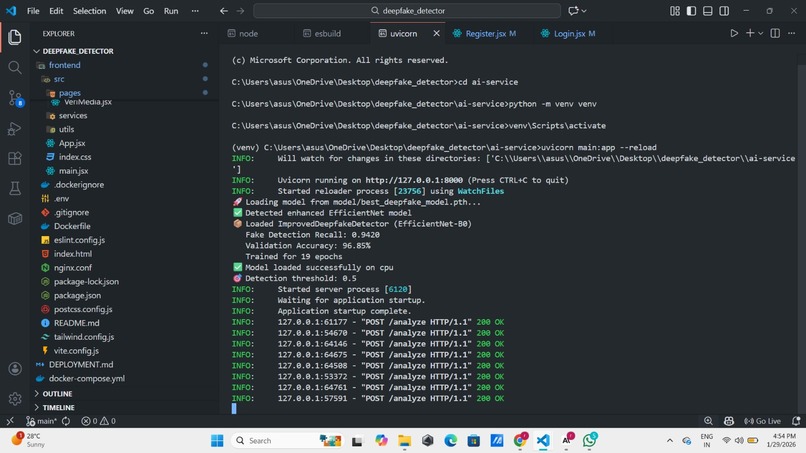
WorkSpace & Model Accuracy
-

MVP of VeriMedia

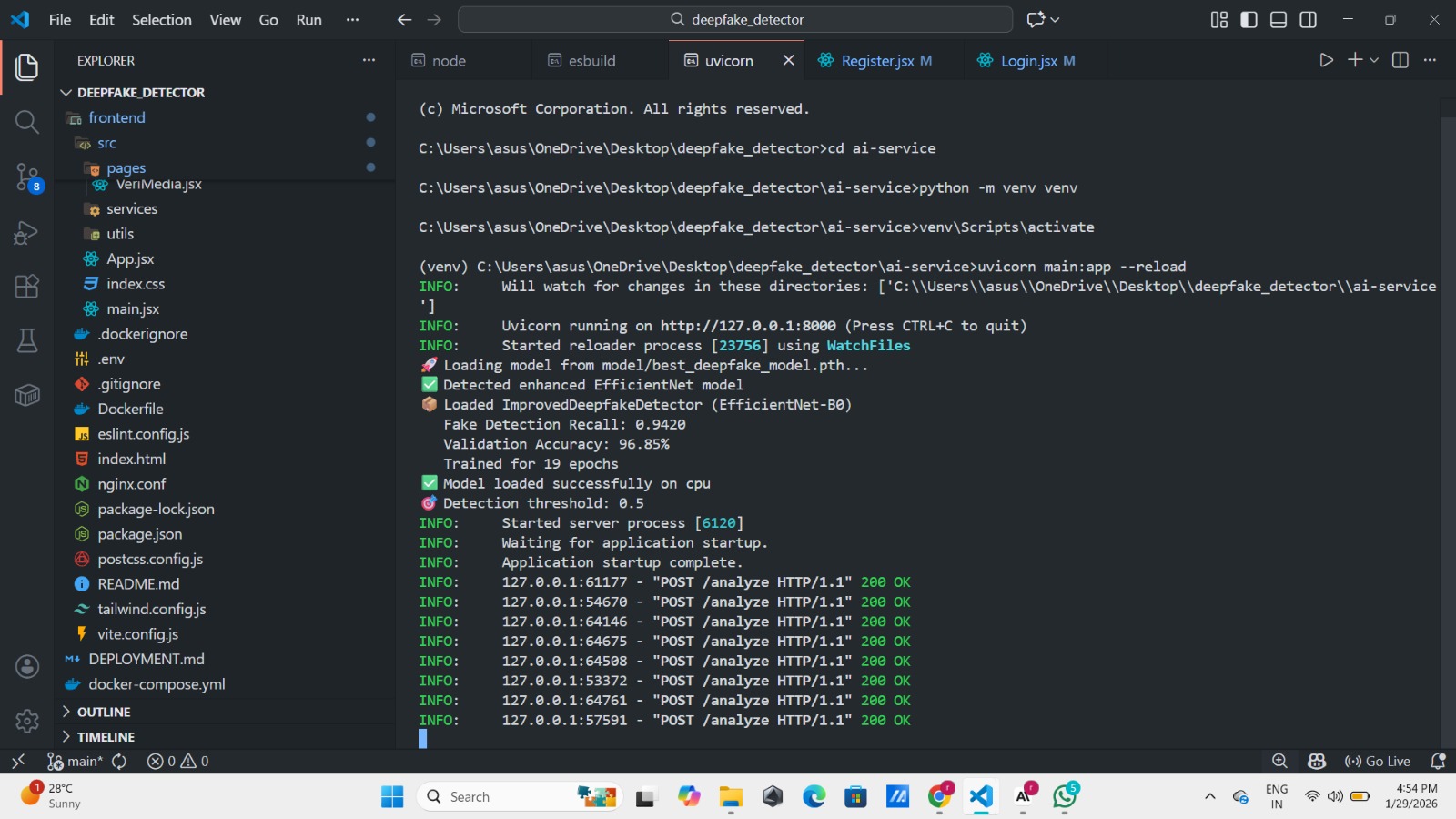

Inspiration
The growing realism of deepfake images and videos poses serious risks to digital trust, misinformation control, and personal security. Existing detection systems often fail against high-quality or unseen manipulations. This motivated us to build VeriMedia, a platform that leverages Transformer-based attention to detect subtle global and temporal inconsistencies that traditional models overlook.
What it does
VeriMedia is an AI-powered deepfake detection platform that classifies images (and extensible to videos) as Real or Fake. By combining CNN-based feature extraction with Transformer attention, it analyzes both local texture artifacts and global facial relationships to produce reliable confidence scores.
How we built it
- Data Pipeline: Preprocessed benchmark deepfake datasets (FaceForensics++, Celeb-DF) using face detection, alignment, resizing, and normalization.
- Model Architecture: Implemented a hybrid CNN + Transformer model, where CNNs extract local features and Transformers model long-range dependencies.
- Training & Evaluation: Trained using binary cross-entropy loss and evaluated with accuracy, precision, recall, and ROC–AUC.
- System Design: Designed the pipeline to be modular, enabling future extensions to video and multimodal inputs.
Challenges we ran into
- Computational Overhead: Transformer models required significant memory and careful hyperparameter tuning.
- Generalization Issues: Performance dropped when testing across datasets due to domain shifts.
- Data Quality: High-quality deepfakes often contain minimal artifacts, making detection harder.
- Overfitting: Prevented using augmentation, regularization, and early stopping.
Accomplishments that we're proud of
- Successfully built a Transformer-based deepfake detection system from scratch.
- Achieved strong accuracy and generalization compared to baseline CNN models.
- Designed a clean, extensible architecture suitable for real-world deployment.
- Gained hands-on experience with attention mechanisms and hybrid deep learning models.
What we learned
- Global context is critical for deepfake detection, not just local textures.
- Transformers significantly enhance robustness when paired with CNN backbones.
- Dataset diversity is more important than model complexity.
- Model interpretability and evaluation are essential for trust in AI systems.
What's next for VeriMedia : AI-Powered Deepfake Detection Platform
- Extend detection from images to full video analysis using temporal Transformers.
- Add multimodal verification (audio–visual consistency checks).
- Optimize models for real-time inference.
- Deploy VeriMedia as a web-based and API-driven platform for broader access.
Built With
- bootstrap
- css3
- docker
- express.js
- fastapi
- html5
- javascript
- mongodb
- node.js
- python
- react
- tailwindcss
- transformers


Log in or sign up for Devpost to join the conversation.