-
-
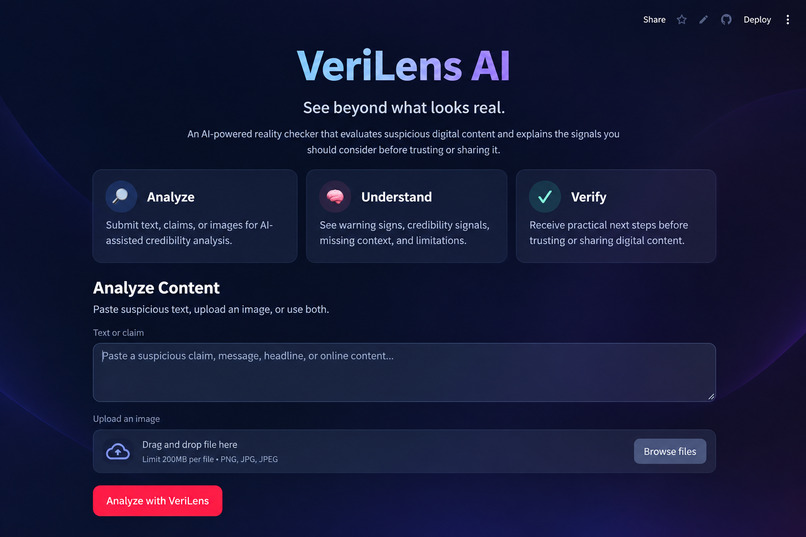
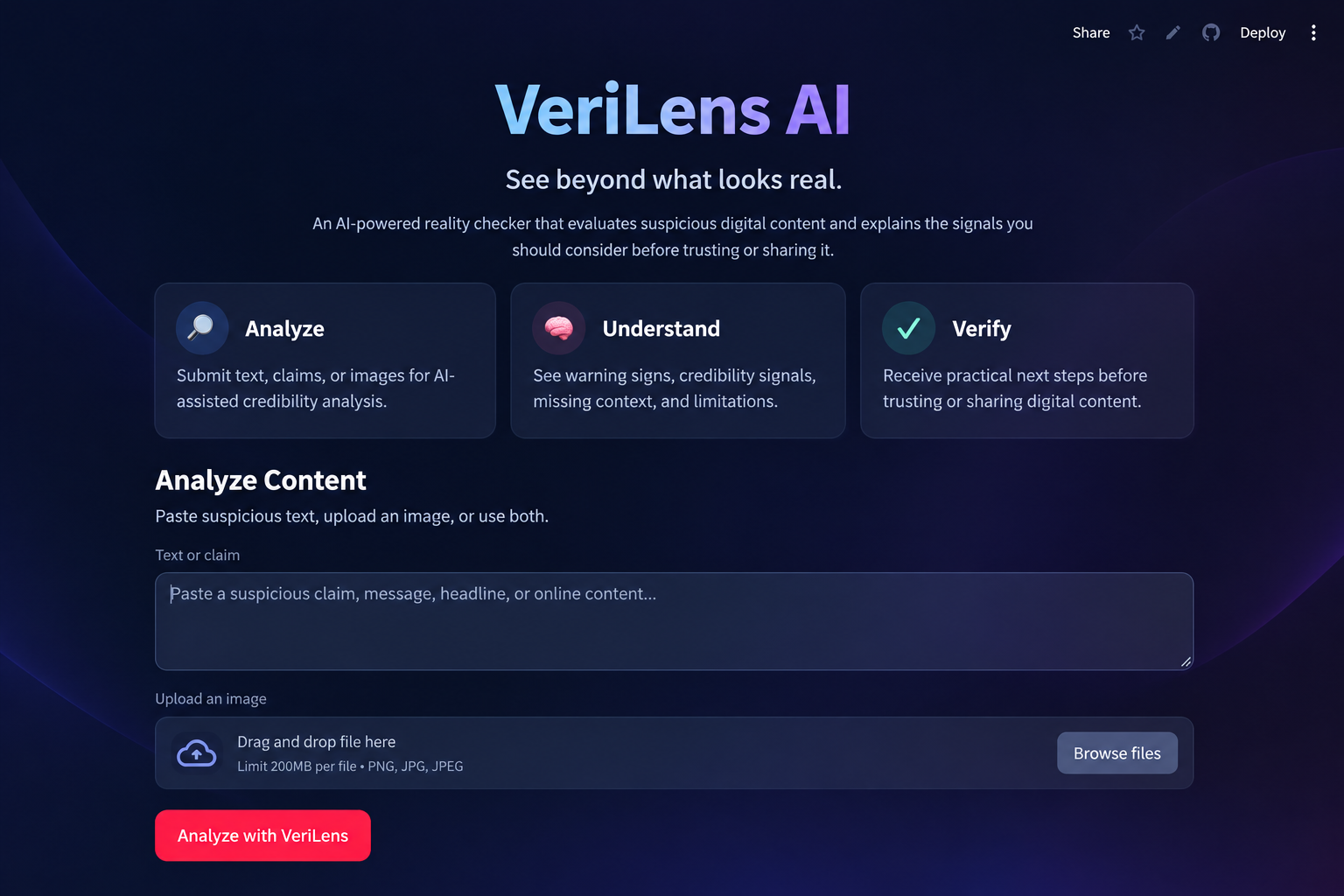
VeriLens AI: Analyze text and images, identify credibility signals, and receive AI-powered insights and verification guidance.
-
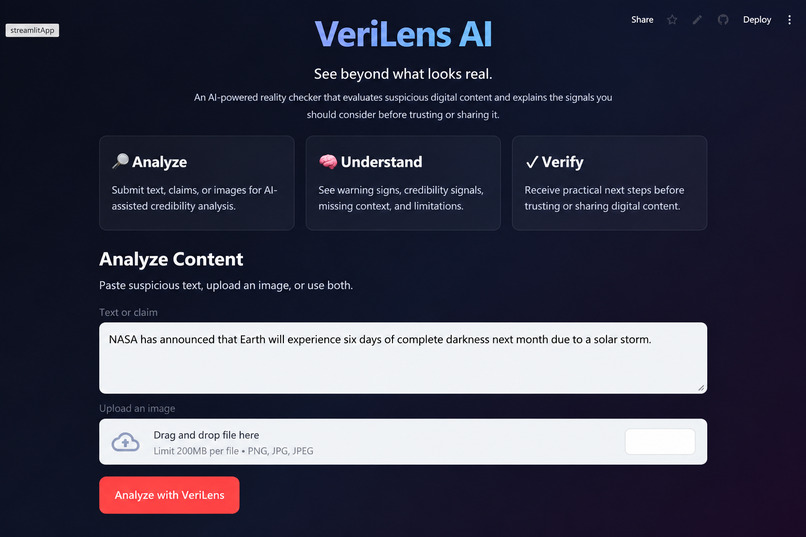
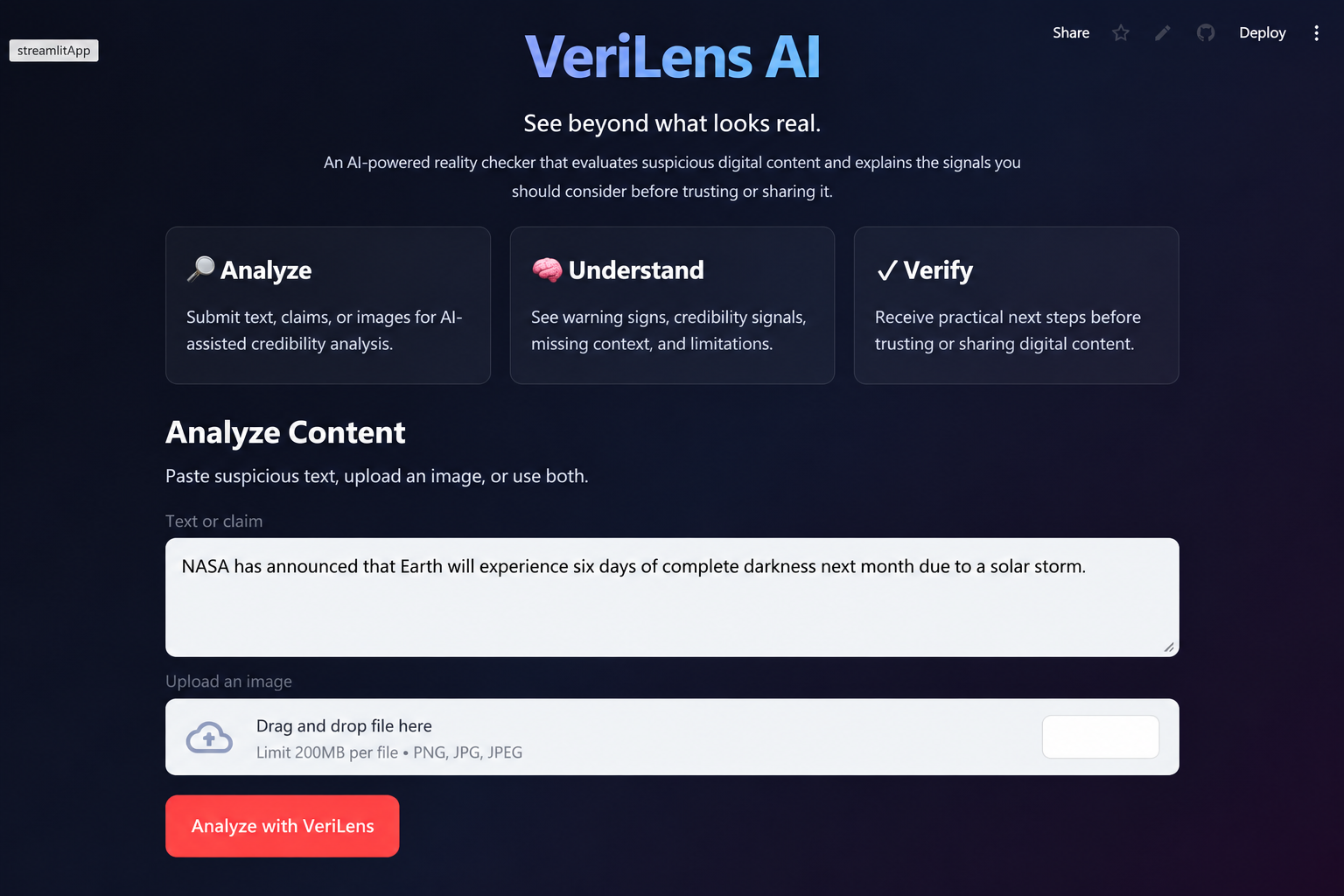
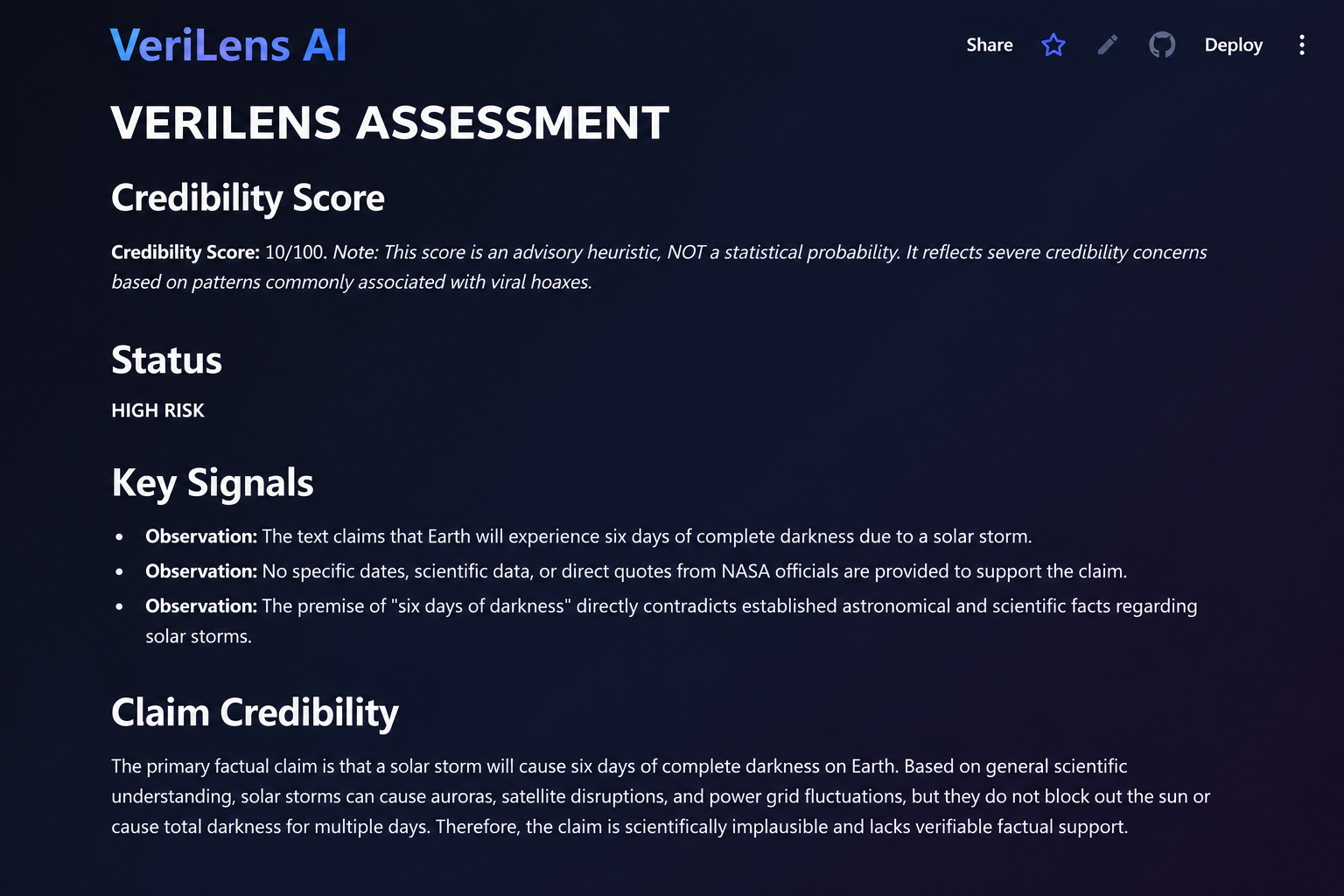
Example input: A suspicious NASA claim submitted to VeriLens AI for credibility analysis.
-
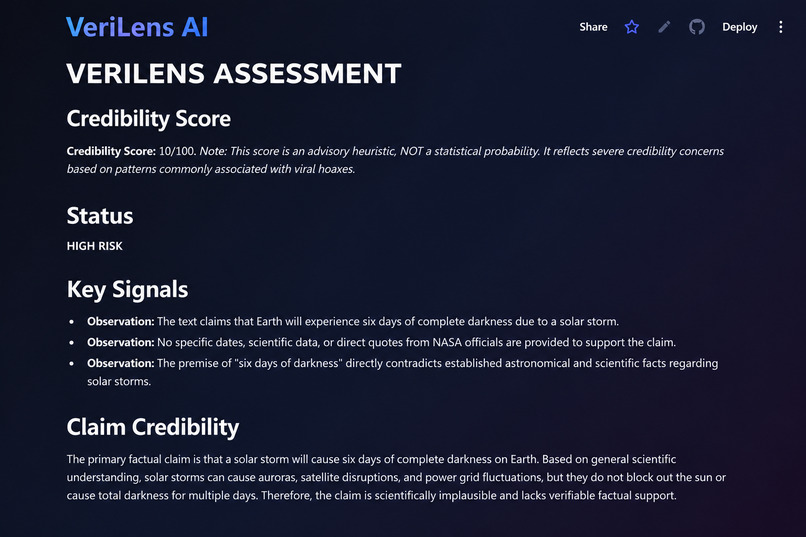
VeriLens AI flags a misleading NASA claim with a 10/100 credibility score, HIGH RISK status, and explainable warning signals.
-
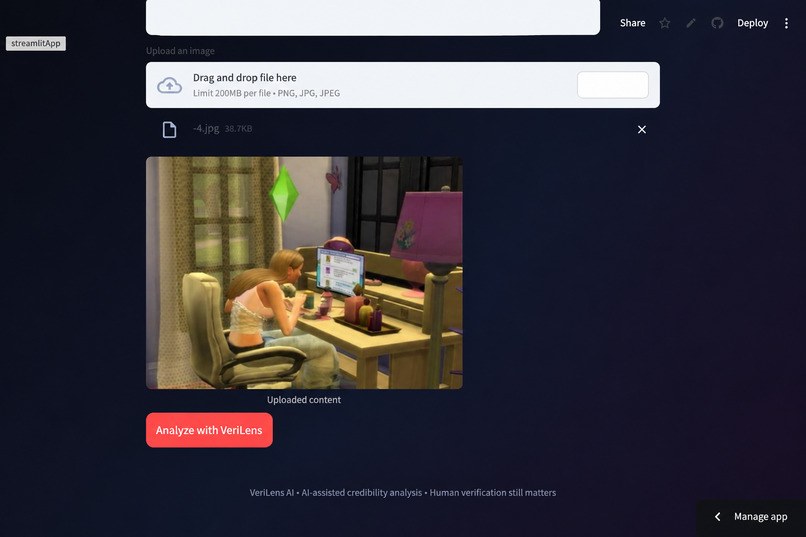
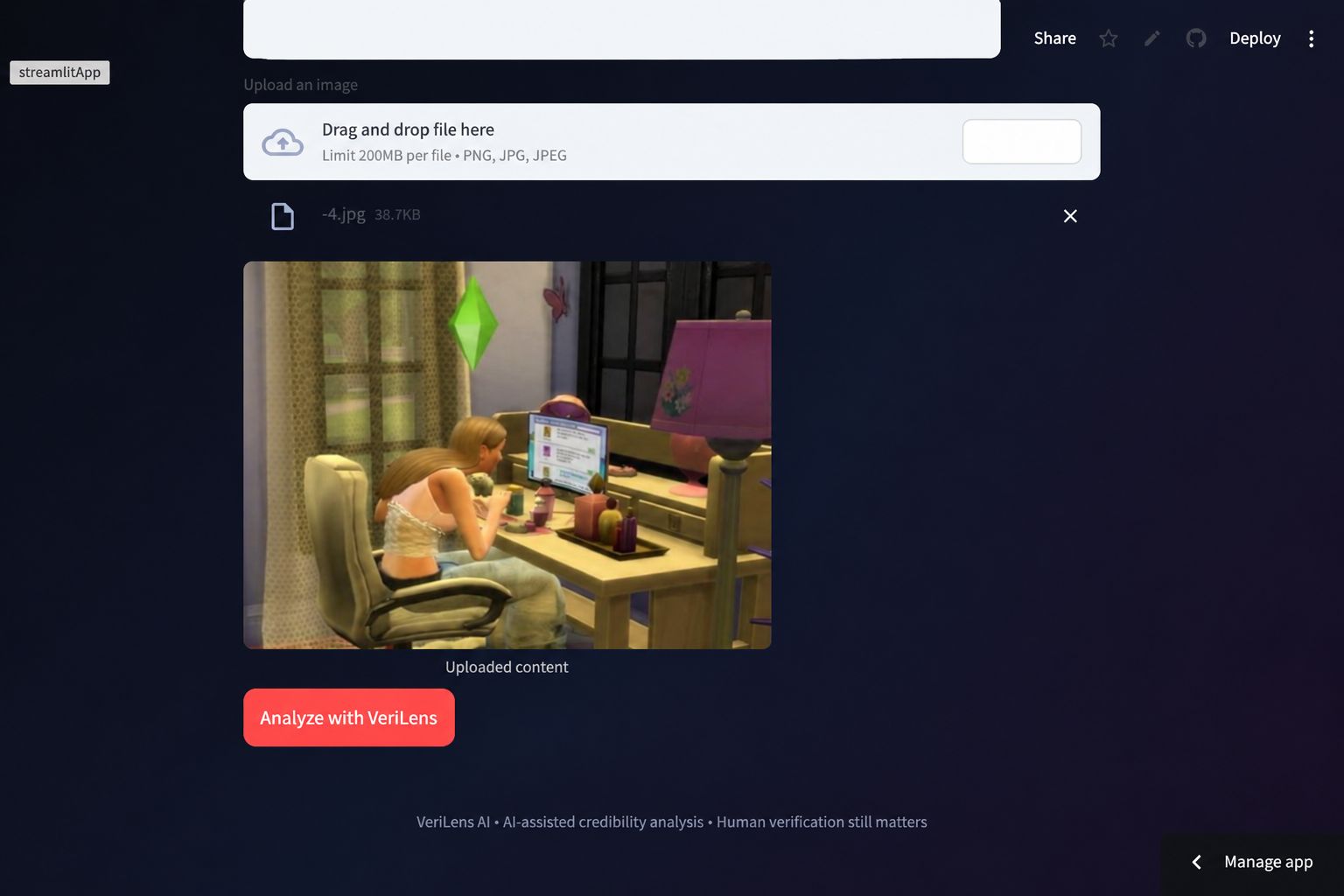
VeriLens AI image upload demo: A screenshot from The Sims submitted for AI-powered credibility and context analysis.
-
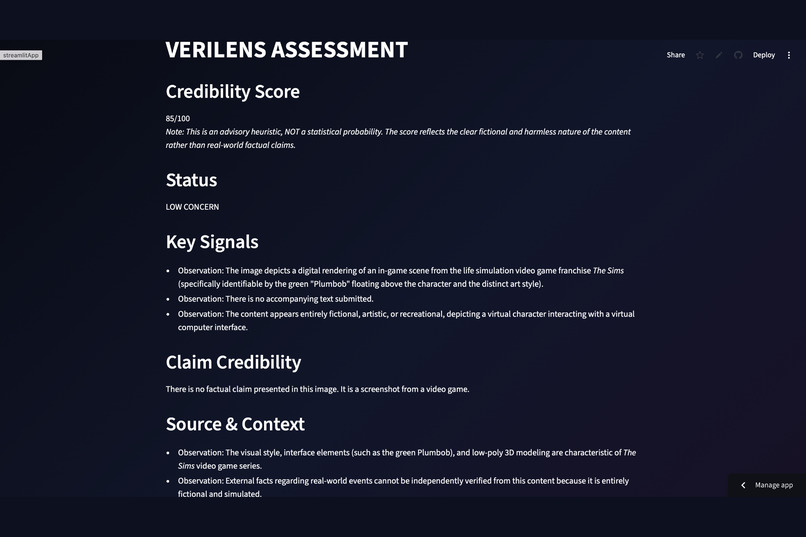
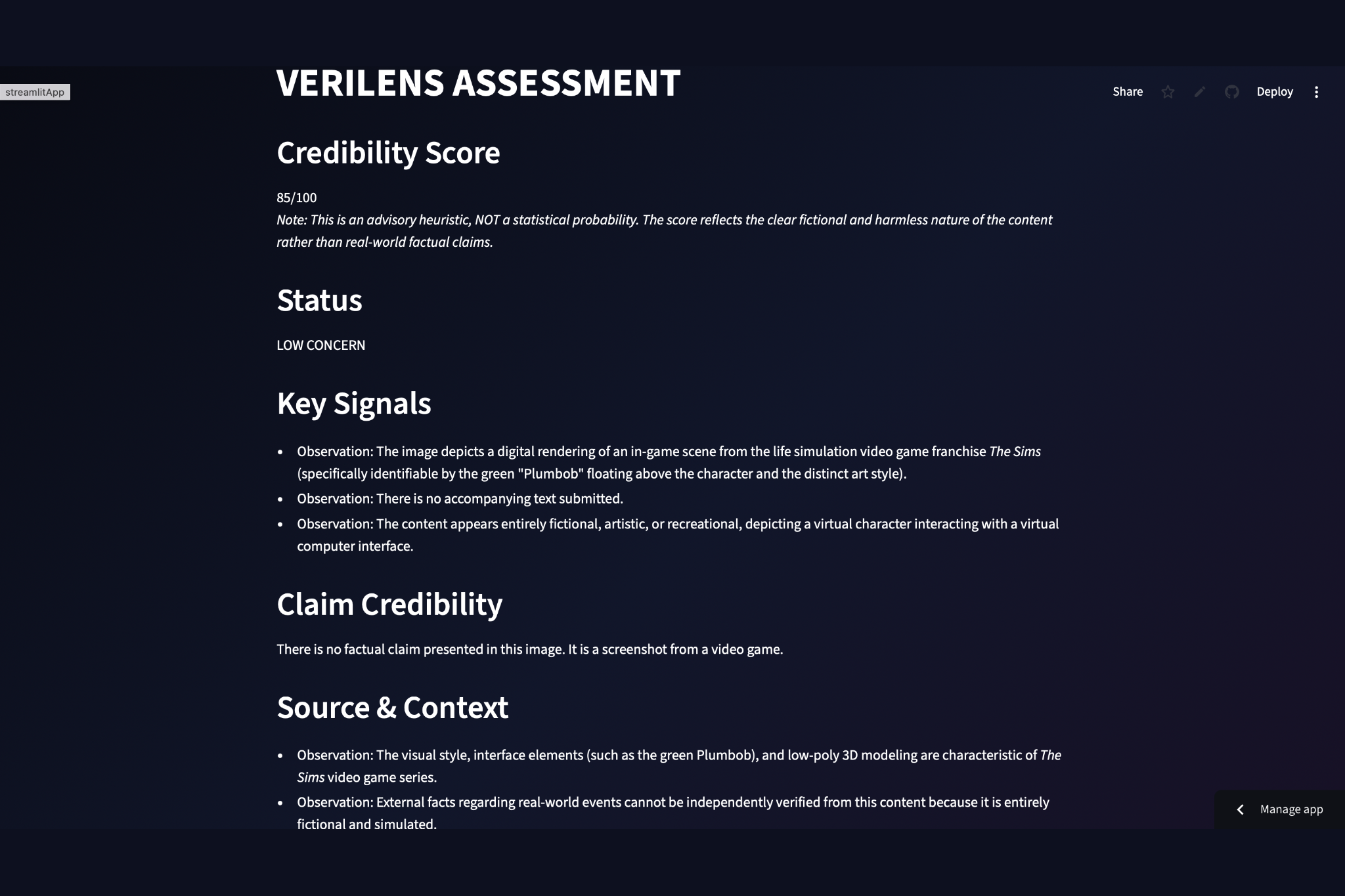
VeriLens AI analyzes an uploaded image, assigning an 85/100 credibility score and LOW CONCERN status with explainable key signals.
-
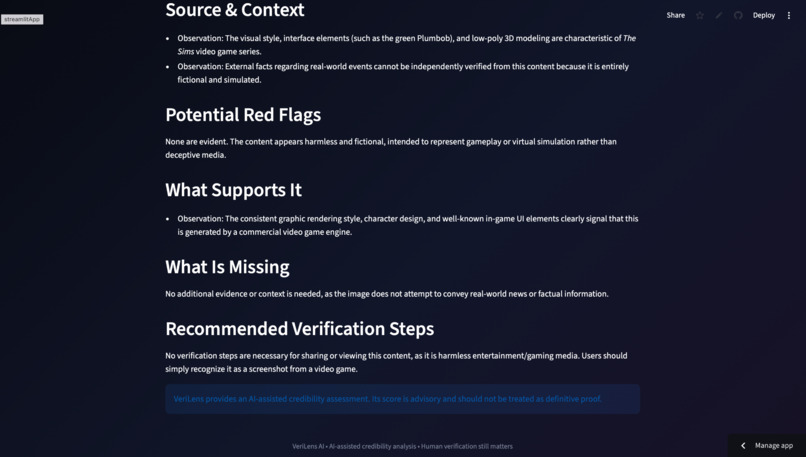
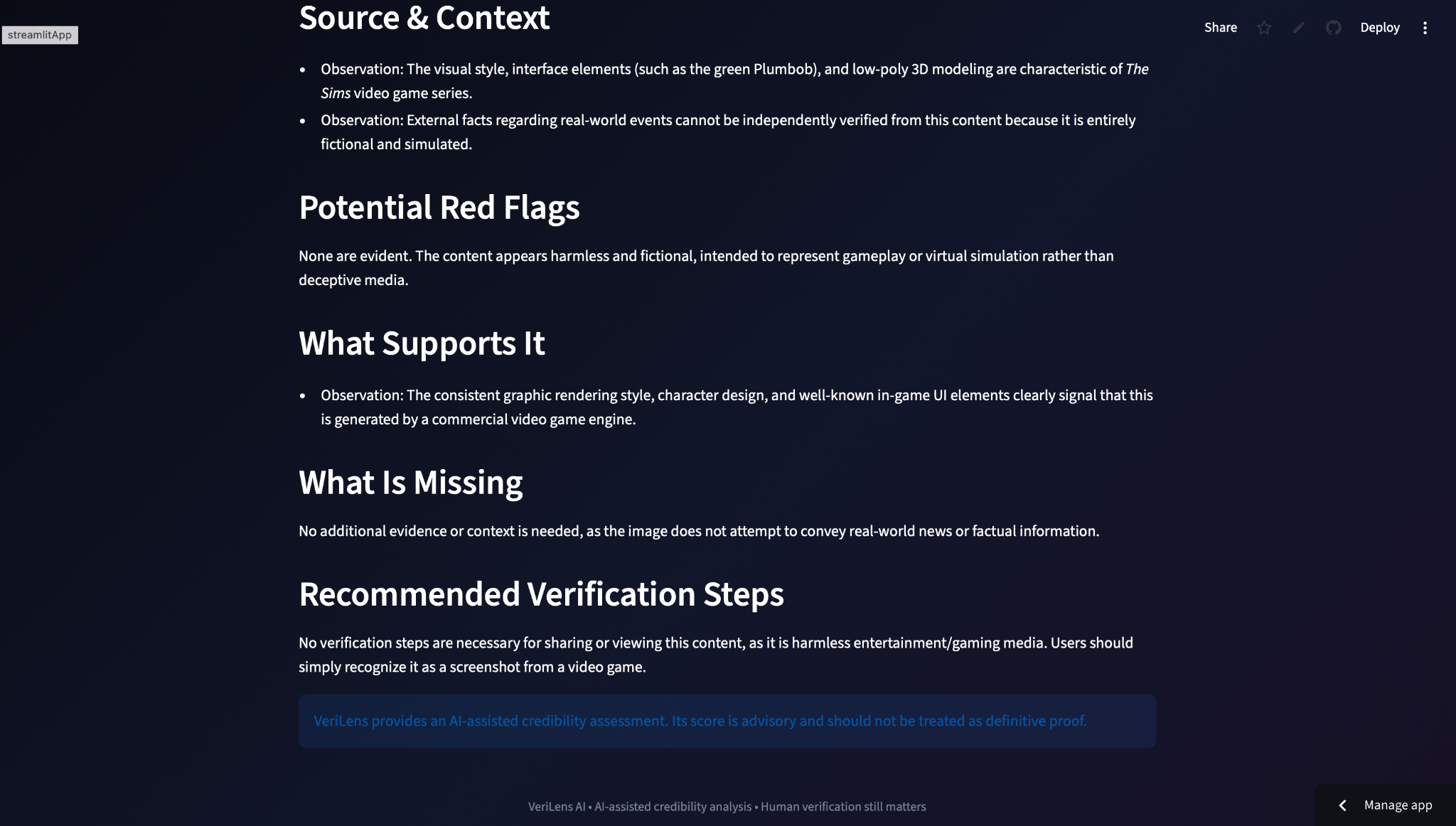
VeriLens AI explains red flags, supporting evidence, missing context, and recommended verification steps for an uploaded image.
Inspiration
With AI-generated images and written content becoming increasingly realistic, it is becoming harder for people to determine what information they can trust online. Misleading claims, manipulated visuals, and content presented without proper context can spread quickly across digital platforms.
We created VeriLens AI to make the process of evaluating suspicious digital content simpler, more accessible, and easier to understand.
Our goal was to help users think critically before trusting or sharing information.
What it does
VeriLens AI is an AI-powered credibility assistant that helps users evaluate suspicious text, online claims, and images.
Users can enter text, upload an image, or provide both for multimodal AI analysis.
The application generates an explainable assessment that includes:
- An advisory credibility score from 0 to 100
- An overall risk indicator
- Key credibility signals and potential warning signs
- Claim credibility analysis
- Source and context considerations
- Potential manipulation or misleading elements
- Supporting information and missing evidence
- Recommended verification steps
Instead of simply declaring content "real" or "fake," VeriLens explains why certain information may require further investigation.
The credibility score is an AI-generated assessment, not a statistically verified probability or a definitive fact-check.
How we built it
We developed VeriLens AI as an interactive web application using Python and Streamlit.
We integrated the Google Gemini API through the Google GenAI SDK to support multimodal analysis of text and images.
The application follows a straightforward workflow:
- The user submits text, an image, or both.
- The application sends the provided content to the Gemini multimodal AI model.
- The model examines the available content for credibility signals, inconsistencies, missing context, and potential warning signs.
- VeriLens organizes the findings into a structured credibility assessment.
- The user receives an advisory credibility score, explanations, and recommended verification steps.
We used Pillow for image handling, GitHub for source code management and collaboration, and Streamlit Community Cloud to deploy the application publicly.
We also designed a custom interface to make the analysis process simple and understandable.
Challenges we ran into
One of our biggest challenges was integrating a multimodal AI model into a functional web application while keeping the experience accessible.
During development, we encountered API configuration issues, model availability errors, and deployment challenges when moving from our local environment to Streamlit Community Cloud.
We resolved these issues by testing the API integration, correcting model configurations, securely managing API keys through deployment secrets, and validating the deployed application with text and image inputs.
Another important challenge was communicating AI-generated credibility assessments responsibly. We designed VeriLens to highlight uncertainty and provide verification recommendations rather than making definitive claims about authenticity.
Accomplishments that we're proud of
We successfully developed and publicly deployed a working AI-powered credibility assistant.
Our accomplishments include:
- Building a functional Streamlit web application
- Integrating Google's multimodal Gemini AI
- Supporting both text and image analysis
- Generating structured and explainable credibility assessments
- Providing practical verification recommendations
- Publishing our project code on GitHub
- Successfully testing the publicly deployed application
We are particularly proud of transforming our initial idea into a working prototype that users can access directly through a web browser.
What we learned
Throughout this project, we gained practical experience in AI application development, API integration, cloud deployment, and collaborative software development.
We learned how to build an interactive Python application, integrate multimodal AI capabilities, manage dependencies, and troubleshoot deployment errors.
We also developed a better understanding of responsible AI design, particularly the importance of transparency, explainability, and communicating uncertainty.
Most importantly, we learned that AI should support critical thinking rather than replace human judgment.
What's next for VeriLens AI
We plan to improve VeriLens AI by expanding its capabilities and strengthening the reliability of its assessments.
Potential future improvements include:
- Integrating external source and URL verification
- Improving assessment consistency through structured testing
- Expanding support for additional media formats
- Developing more detailed visual explanations of credibility signals
- Gathering user feedback to improve usability
- Exploring evidence-based verification workflows
Our long-term vision is to make VeriLens AI a practical digital literacy and cybersecurity assistant that helps people navigate an increasingly complex information environment.
VeriLens AI is not intended to replace professional fact-checking or independent source verification. It is designed to help users recognize potential concerns and make more informed decisions before trusting or sharing digital content.

Log in or sign up for Devpost to join the conversation.