Inspiration
The idea for VeriLeaf started with a simple frustration.
I've watched people around me, students, volunteers, everyday community members give up weekends to plant trees, organise beach cleanups, and run recycling drives. They do it because they care. But when they're done, there's nothing to show for it. No record. No recognition. No proof that it ever happened.
At the same time, I kept seeing organisations struggle to verify whether their environmental programs were actually producing real-world results. The gap between action and proof was costing the entire sector credibility.
Then I started thinking about what blockchain is actually good for, not speculation, not trading, but permanent, tamper-proof records that anyone can verify. And it clicked: this is exactly the infrastructure the environmental sector is missing.
What if completing a beach cleanup felt as rewarding as finishing a Duolingo streak? What if your volunteer history was as shareable as a GitHub contribution graph? What if every tree you planted earned you a credential as verifiable as a university certificate? That's VeriLeaf.
What it does
VeriLeaf is an environmental impact platform that lets people do three things: complete real-world environmental challenges, get their actions independently verified, and earn permanent digital credentials that prove what they did.
The core idea is simple, millions of people take environmental action every day (planting trees, cleaning beaches, recycling, volunteering) but none of it gets recorded in a way that's credible or shareable. VeriLeaf fixes that.
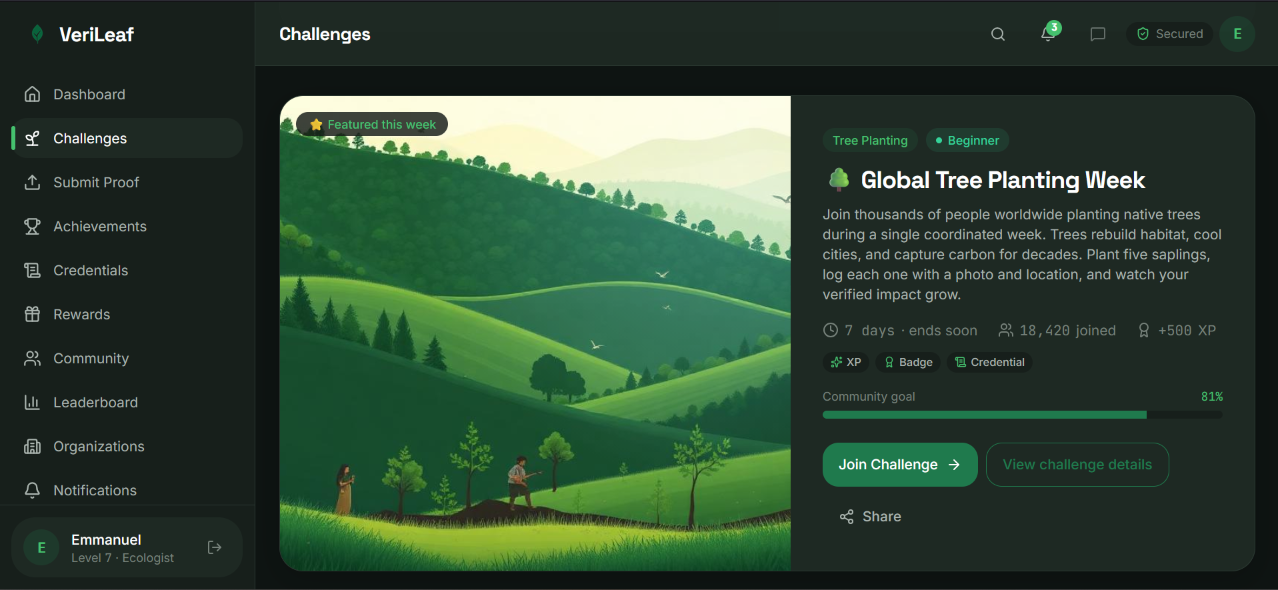
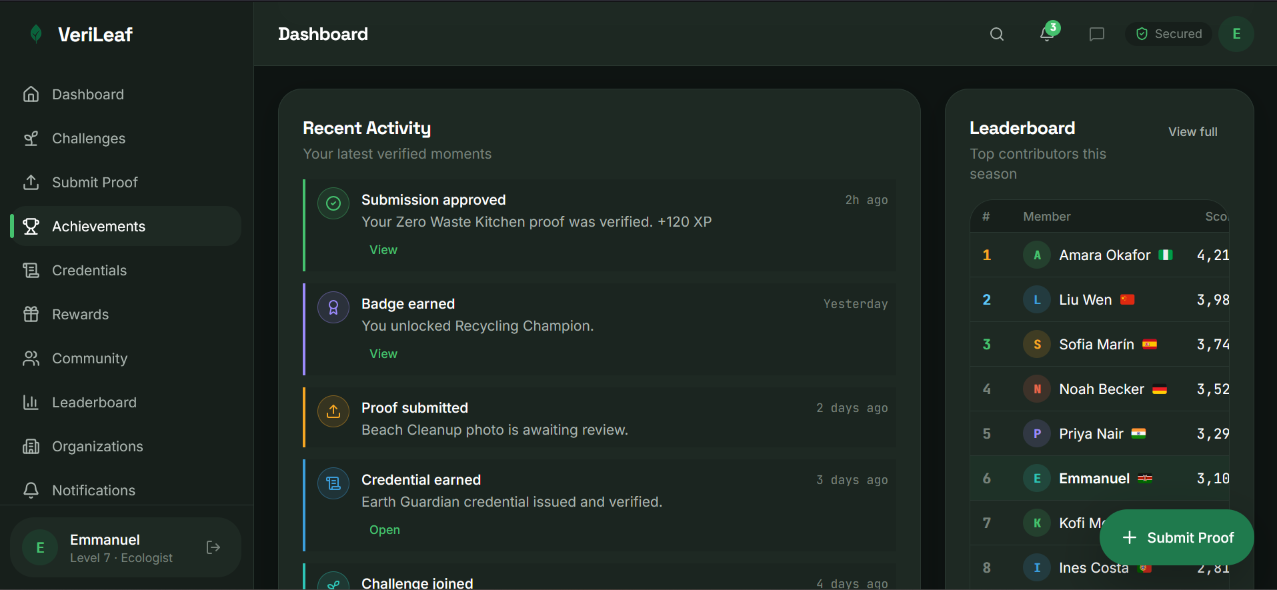
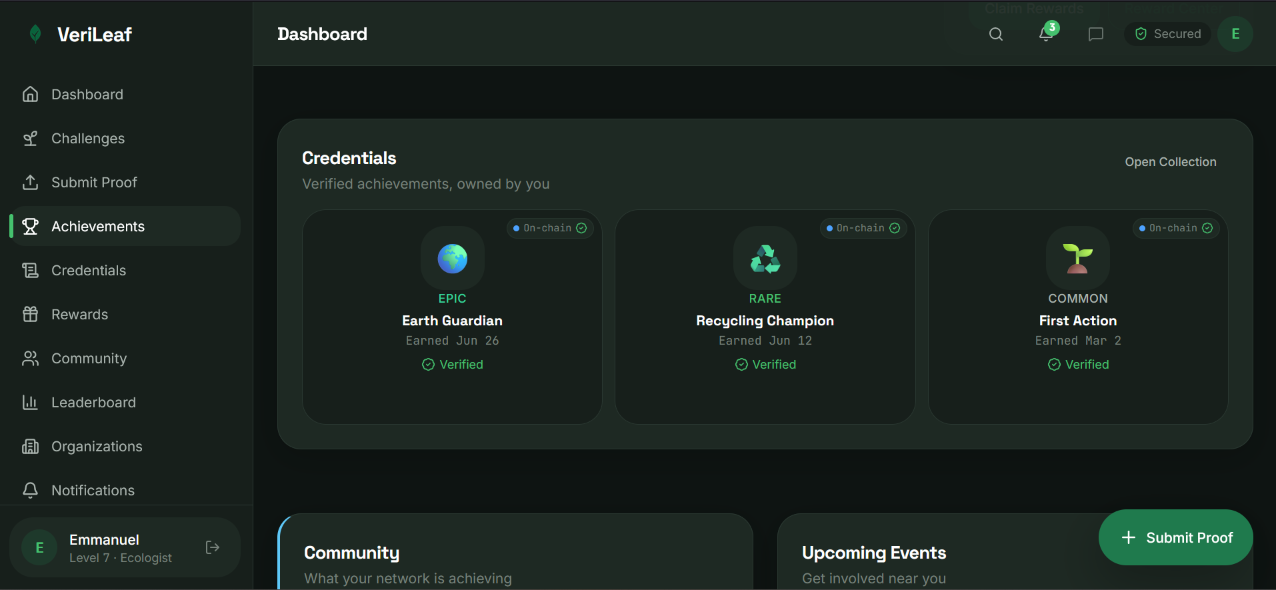
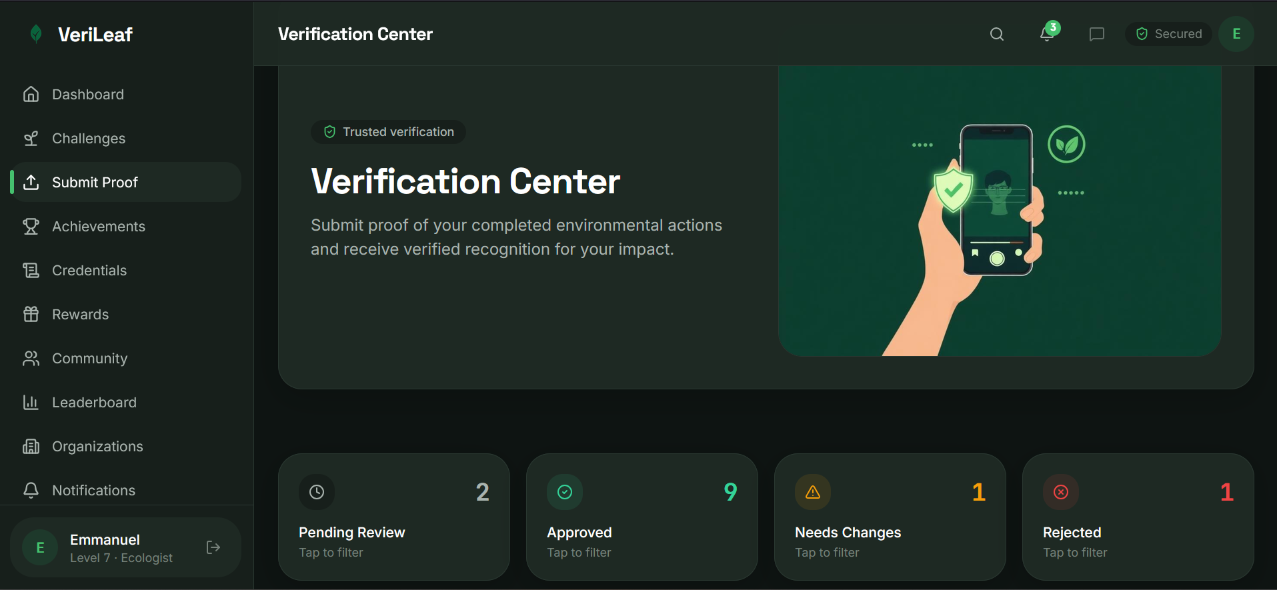
How it works: A user joins a challenge, say, "Plant 5 Trees" or "Beach Cleanup Drive." They complete it in the real world, come back to the platform, and submit photo/video proof along with location and description. A moderator reviews the submission. If it's approved, the user earns XP, badges, and a blockchain-backed credential stored permanently on the Sui network tamper-proof, publicly verifiable, and owned by the user.
What makes it different:
- The blockchain layer is completely invisible to users who don't care about crypto. It works like earning a certificate, not like minting an NFT.
- Every approved action is verified by a human, not just self-reported which is what gives the credentials actual credibility.
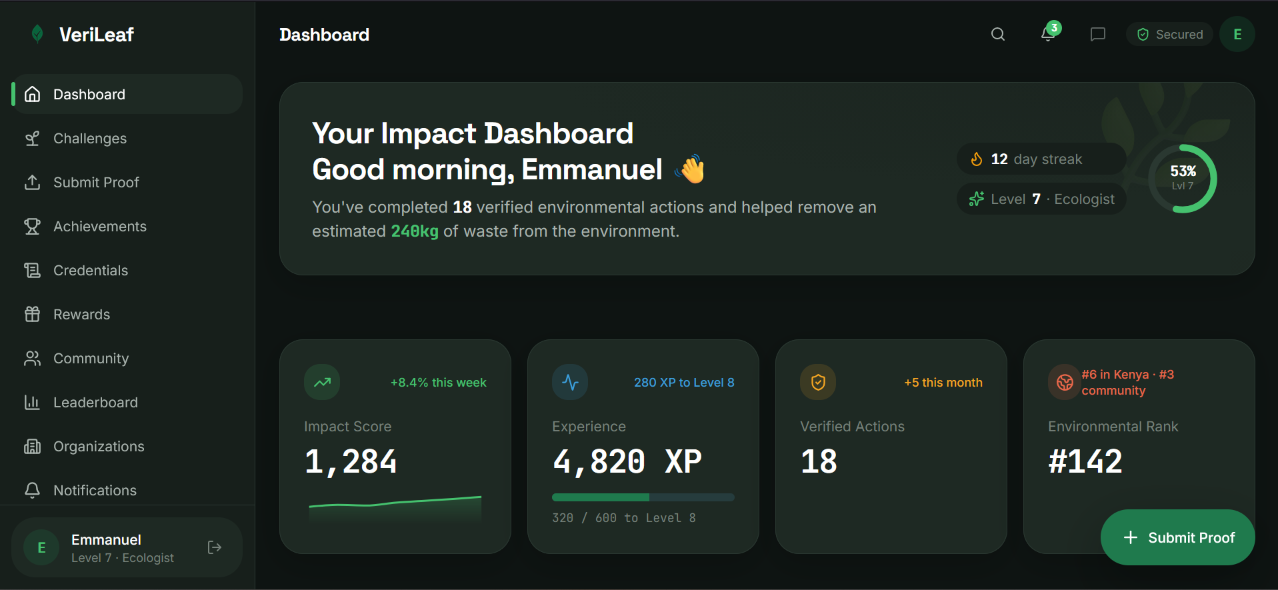
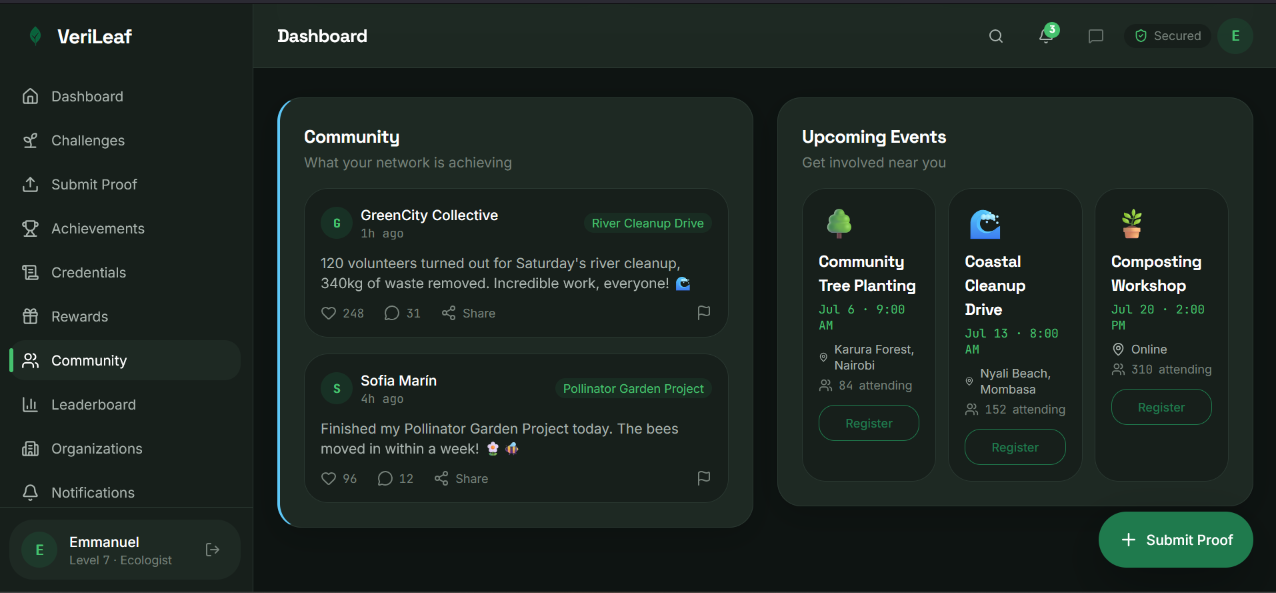
- The engagement model borrows from Duolingo (streaks, XP, levels), Strava (impact calendars, leaderboards), and GitHub (contribution graphs, public profiles) so participation feels rewarding without being gimmicky.
How i built it
VeriLeaf was built as a full-stack Web3 platform with a deliberate focus on making blockchain invisible to the end user. Someone with zero crypto knowledge should be able to use the entire product without ever feeling like they're "using crypto."
Frontend React + TypeScript + Vite + Tailwind CSS shadcn/ui · Framer Motion · Lucide React · Recharts · Mapbox
The UI is governed by a custom design system (DESIGN.md) a detailed specification covering every color token, typography rule, spacing scale, radius value, motion duration, and component state across the entire application. This was written before a single line of code, ensuring the product looks intentional rather than assembled.
The design language draws from Apple, Linear, Stripe, and Notion calm, minimal, and premium. Nature-inspired colors (forest green, sky blue, earth amber, lagoon teal) give the platform visual warmth without drifting into NFT-marketplace territory.
Backend Supabase, Postgres database, authentication, file storage
Supabase handles user authentication, challenge data, submission storage, community feeds, and leaderboards. Proof media (photos, documents) is stored in Supabase Storage, with metadata indexed for reviewer access.
Blockchain Layer Sui Network, on-chain credential issuance
Sui was chosen for three reasons:
Sub-second finality credentials appear instantly after approval Near-zero transaction fees issuing thousands of credentials at scale is economically viable Object-centric model each credential is a genuine on-chain object owned by the user, not just a database entry
The verification flow works like this: a user submits proof → a human moderator reviews it → on approval, a tamper-proof credential is issued to the user's Sui wallet. The credential is permanently public and verifiable by anyone; an employer, a university, an NGO without needing to trust VeriLeaf as an intermediary.
Verified Action → Moderator Review Approved → Sui Permanent On-Chain Credential Verified Action Moderator Review
Approved Sui
Permanent On-Chain Credential The AI Verification Helper
One of the features I'm most proud of is the Verification Readiness Score, an AI assistant embedded in the proof submission flow that analyses a submission before it's sent for review. It checks image quality, GPS metadata, date accuracy, and whether the evidence matches the challenge requirements, then gives the user a readiness score (e.g. 78%) with specific suggestions for improvement.
This dramatically reduces rejection rates by catching problems before they reach a moderator making the verification process faster for everyone.
Product Modules Built
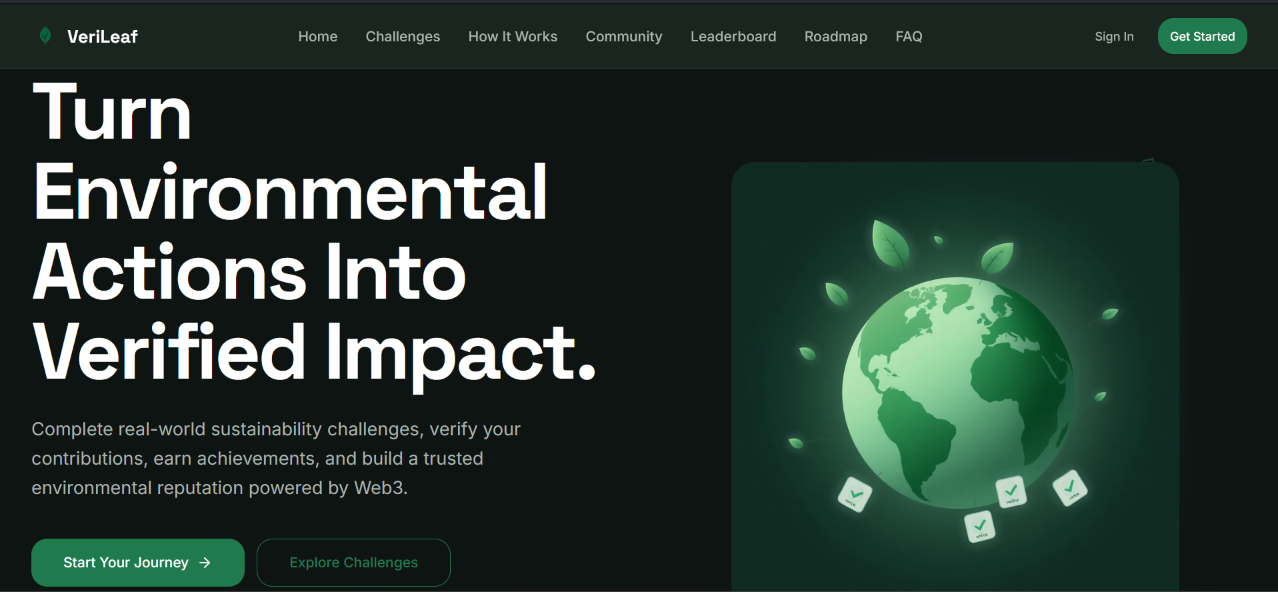
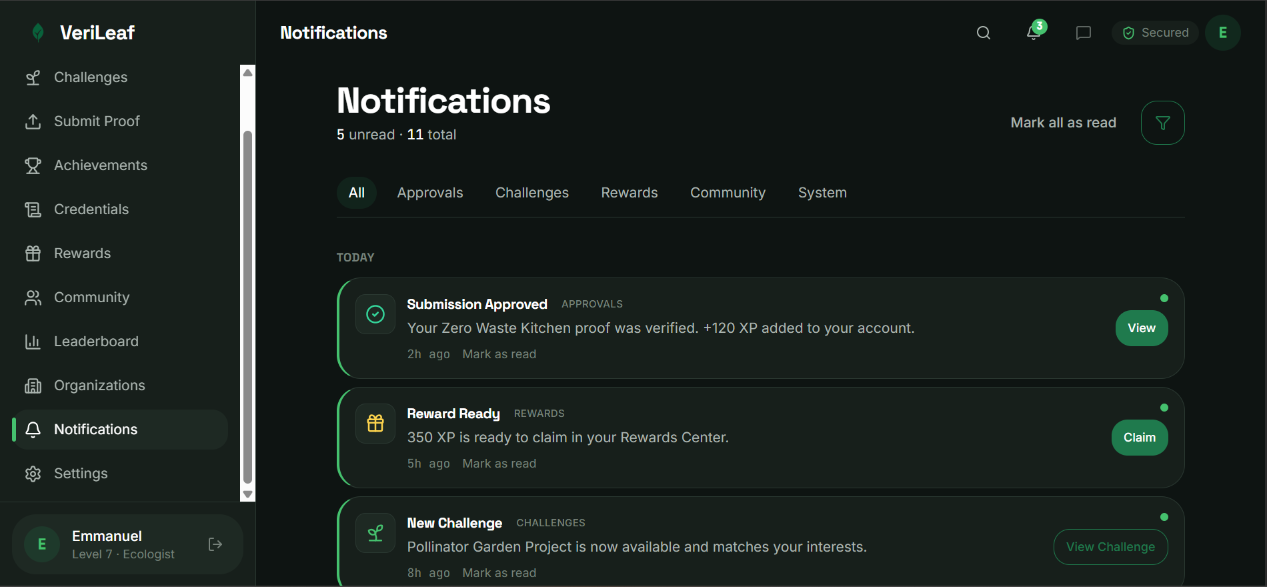
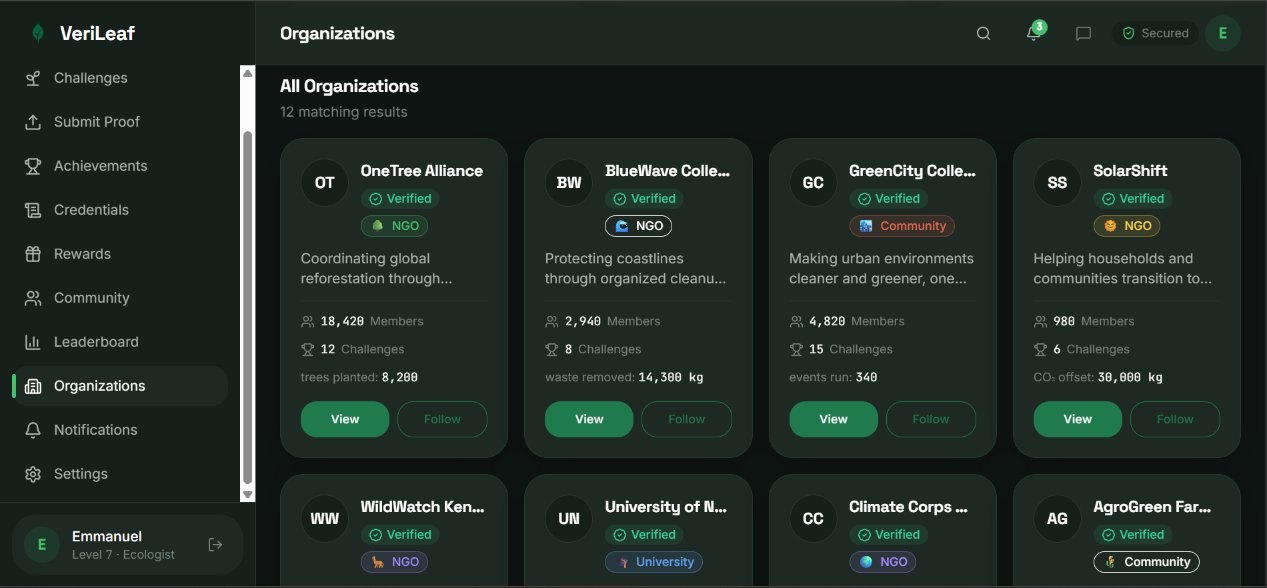
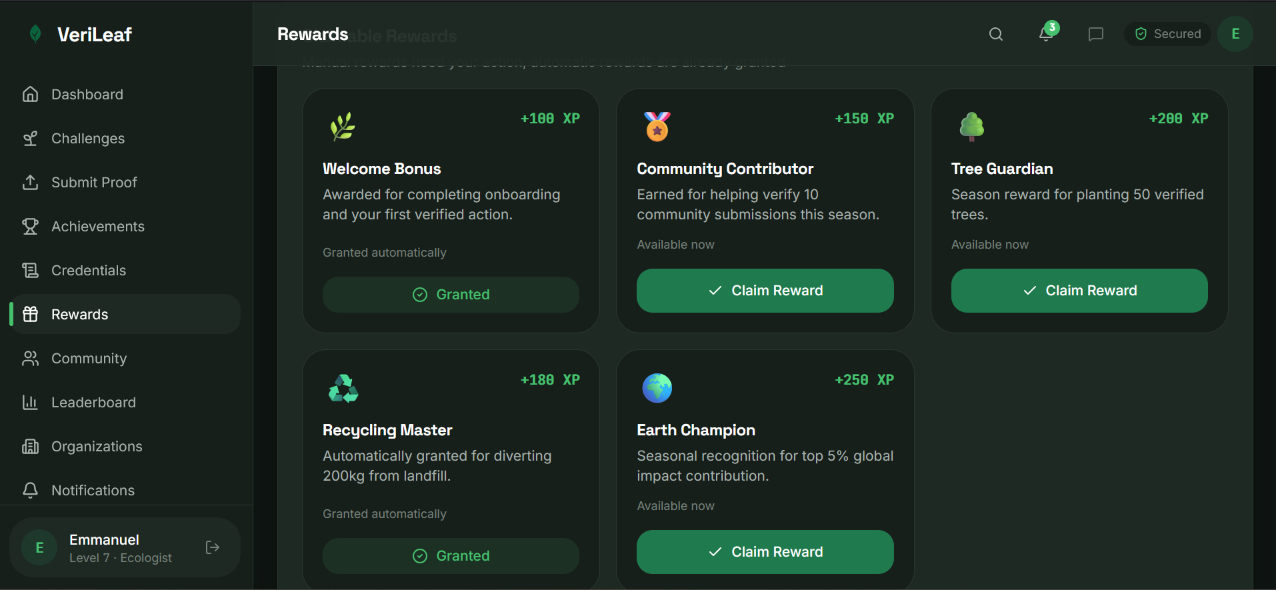
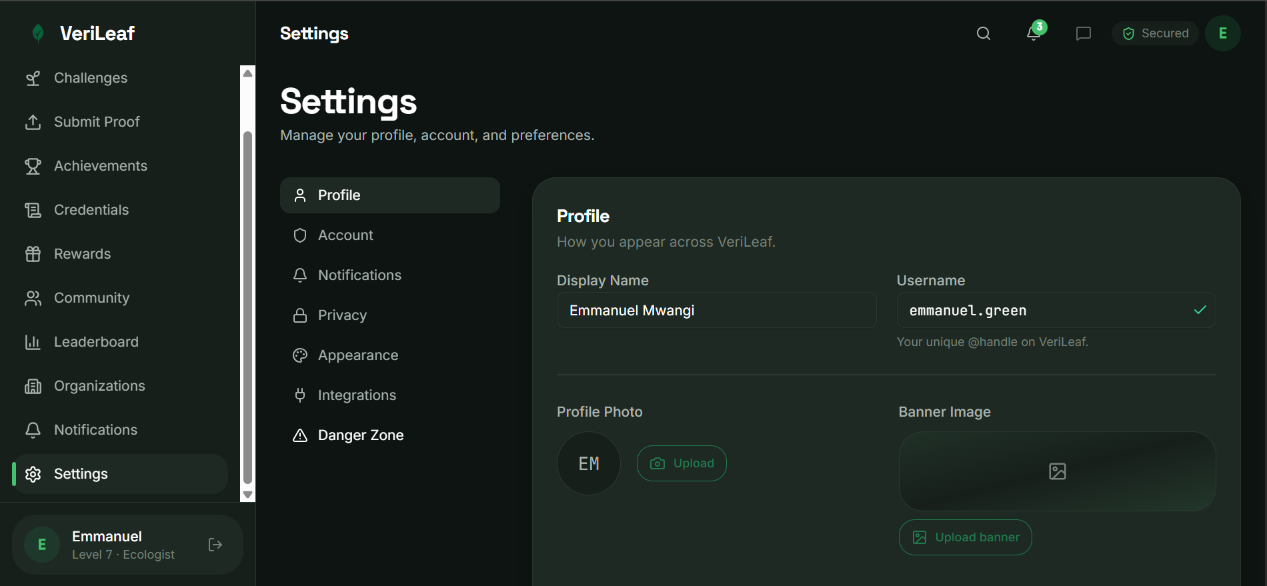
Landing Page/✅ Live Onboarding/onboarding✅ Live Dashboard/dashboard ✅ Live Challenges Hub/challenges✅ Live Verification Center/verification✅ Live Profile/profile✅ Live Rewards Center/rewards✅ Live Organizations/organizations✅ Live Leaderboard/leaderboard✅ Live Notifications/notifications✅ Live Settings/settings✅ Live About/about✅ Live Admin Dashboard /admin✅ Live
Challenges i ran into
Making blockchain genuinely invisible
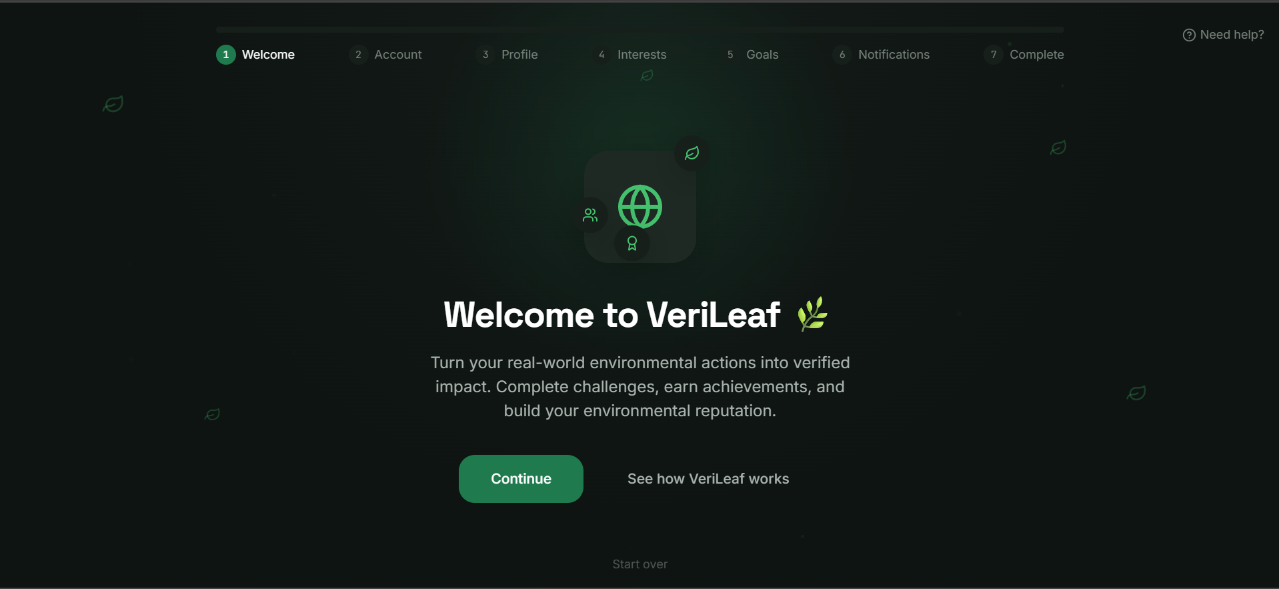
This was harder than expected. Every design decision, the navigation labels, the onboarding copy, the credential card design, the wallet setup flow required conscious effort to remove crypto language without losing the underlying trust signal. The guiding principle became: show the benefit, hide the mechanism.
Building a credible verification system without a live moderator team
VeriLeaf's credibility rests entirely on the verification layer. For the prototype, this runs on realistic mock data but the design had to make the process feel procedural and trustworthy even without real moderators behind it. The submission timeline, the readiness score, the reviewer feedback card, and the estimated review time all exist to make the process feel as trustworthy as the outcome.
Designing for two completely different user types
VeriLeaf has to work for a 19-year-old student in Nairobi who has never heard of blockchain, and for an NGO program manager who needs an audit trail for a funder report. The same platform, the same flows, serving radically different mental models. Every feature had to be explained in plain language while still satisfying the requirements of a technical reviewer.
Scope management under a deadline
A platform like this has essentially infinite surface area, there are always more pages to build, more edge cases to handle, more features to add. The discipline of identifying which six pages a hackathon judge would actually navigate, and making those six excellent rather than building twenty mediocre ones, was a constant tension throughout the build.
What i learned
- Blockchain is a trust layer, not a feature
The biggest lesson was that blockchain works best when users don't think about it at all. The moment someone sees "Connect Wallet" on a signup screen, you've already lost half your audience. VeriLeaf taught me to think about Web3 infrastructure the way you think about HTTPS, it's working in the background, making everything trustworthy, and nobody needs to know how it works to benefit from it.
- Design systems compound over time
Writing DESIGN.md before building felt like overhead. By the tenth page, it was the most valuable decision I made. Every new component was consistent with everything before it because the rules were already written. The product looks like one thing, not like ten pages built at different times.
- Verification is the hard problem
Anyone can build a platform where people log environmental actions. The genuinely difficult problem is making those logs trustworthy. The proof submission flow, the AI readiness assistant, the human review layer, the on-chain credential, each one exists because the one before it isn't sufficient alone. Real-world verification at scale requires a system, not a feature.
- The gap between Web3 and Web2 UX is a product problem, not a technical one
The tools exist. Sui is fast and cheap. Supabase is reliable. The gap is almost entirely in how products are designed and what language they use. Saying "Credential earned" instead of "NFT minted" is not a small choice, it's the difference between a product that anyone can use and one that only crypto-native users will try.
What's next for Verileaf
VeriLeaf is a prototype, but it's a prototype of something that needs to exist.
The roadmap after this hackathon:
Phase 2: Onboard real NGOs and universities as verified organization partners Phase 3: Build AI-assisted proof review to scale moderation without a large human team Phase 4: Connect communities across borders into a global impact network with shared rewards and cross-organization credentials
The infrastructure for verified environmental action doesn't exist yet at scale.
VeriLeaf builds it.
Built With
- canva
- claude
- figma
- lovable


Log in or sign up for Devpost to join the conversation.