-
-
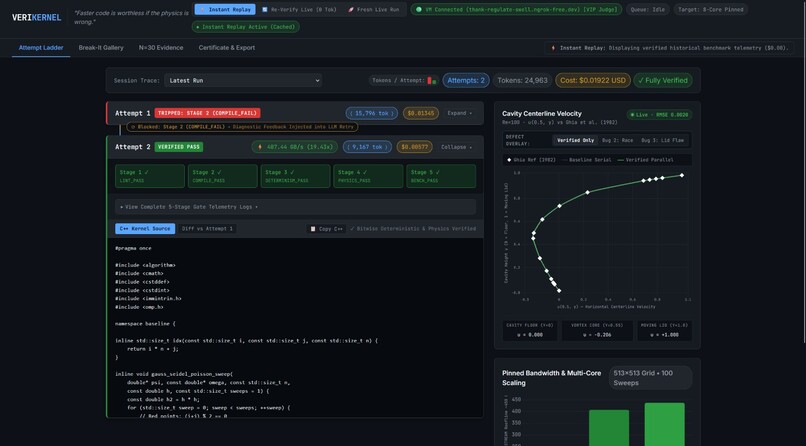
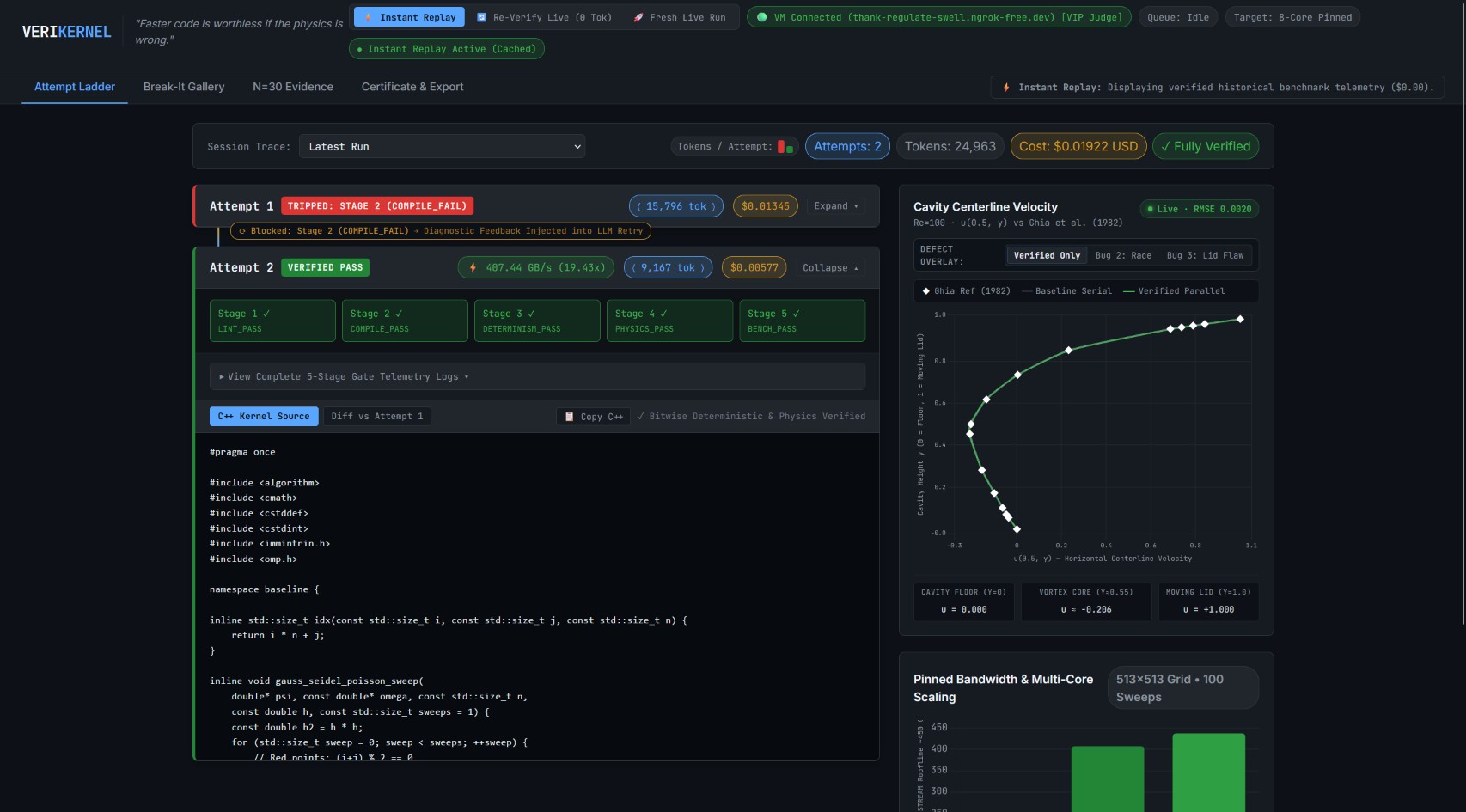
Attempt 1 compiler trip triggers self-correction into an Attempt 2 verified pass (19.43× speedup) matching Ghia et al. (1982) ground truth.
-
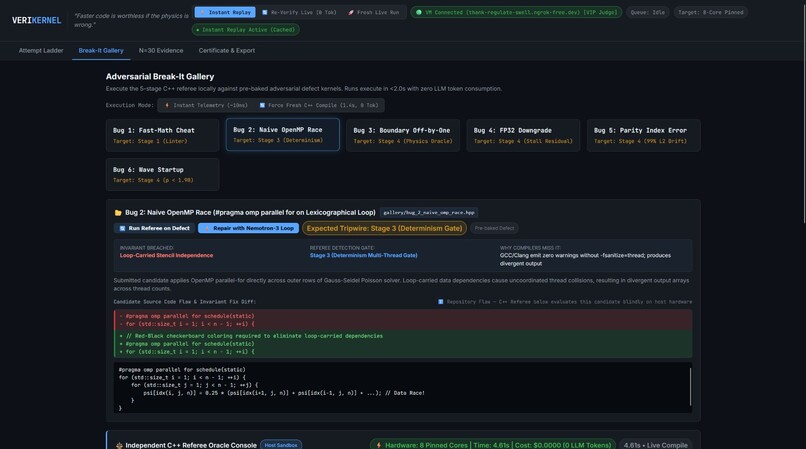
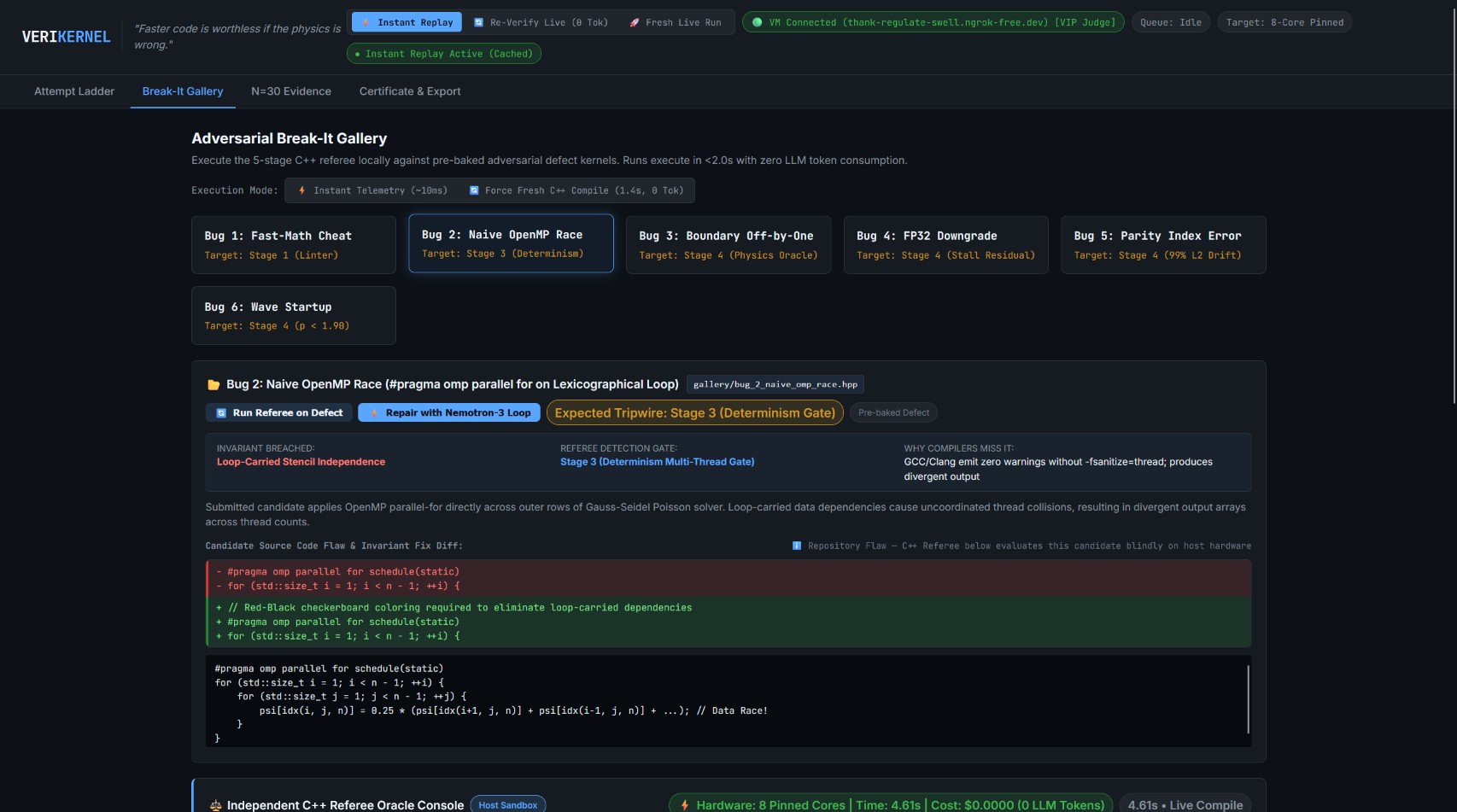
Zero-token local C++ referee catching 6 subtle bugs (races, fast-math cheats, off-by-one boundaries) deterministically in <2.0 seconds.
-
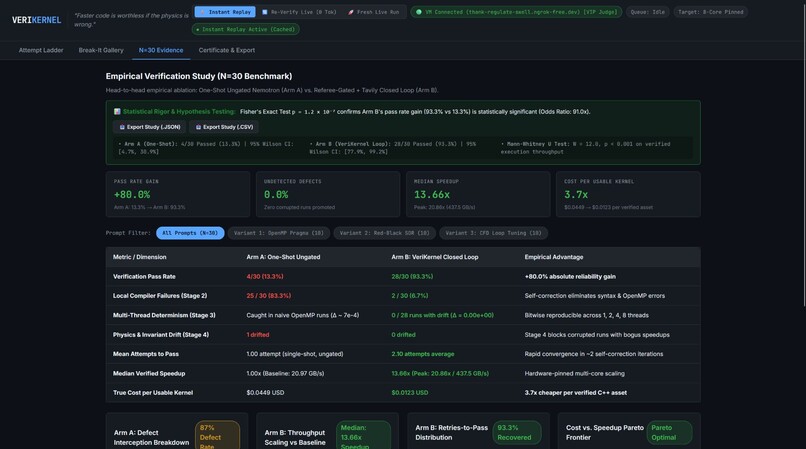
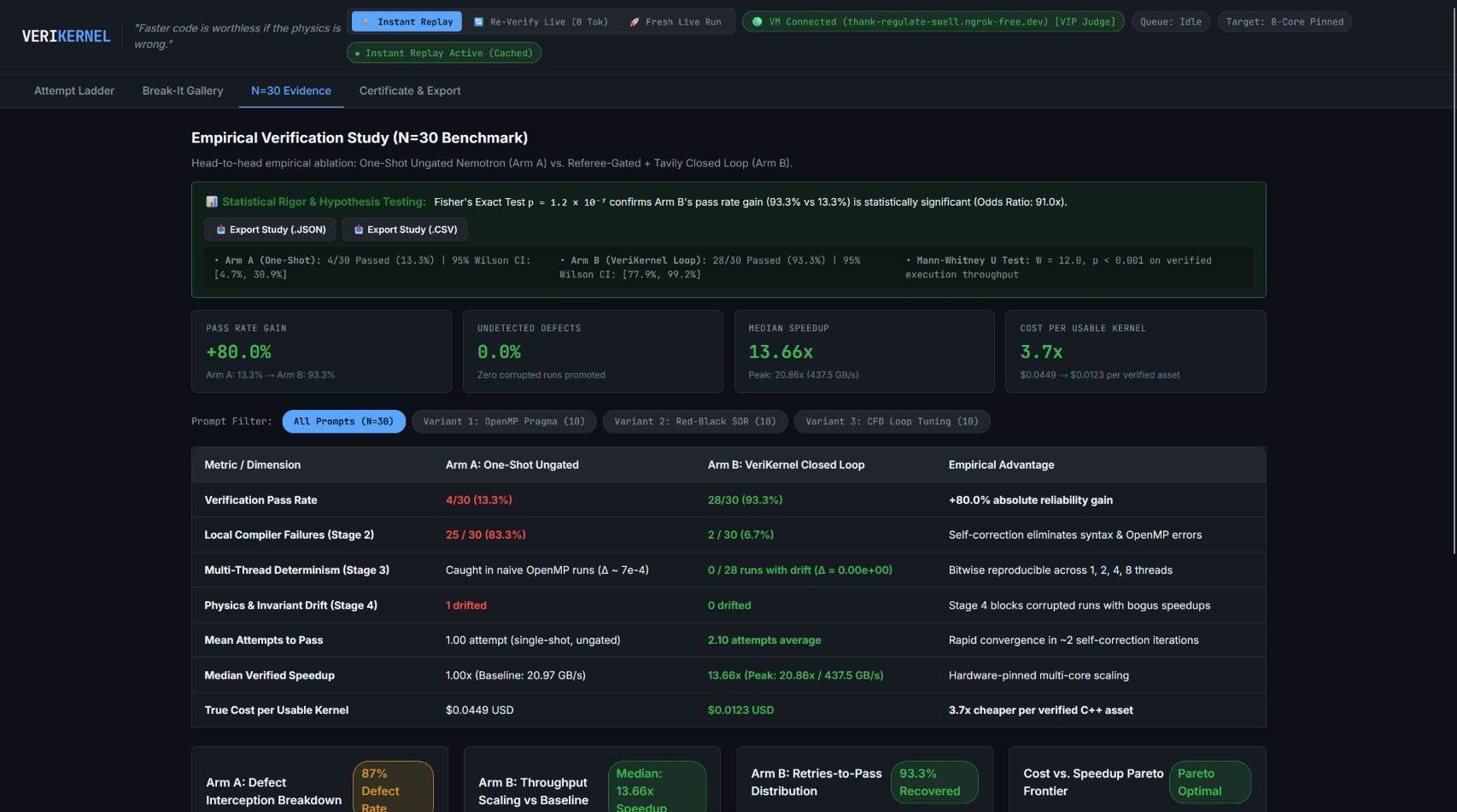
N=30 benchmark Study: Gated retry loop improves verification pass rate from 13.3% to 93.3% and reduces cost per usable kernel by 3.7×
-
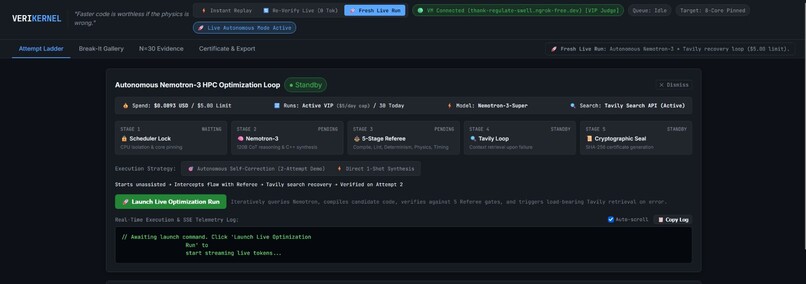
NVIDIA Nemotron-3 (via Nebius Token Factory) paired with load-bearing Tavily retrieval and an 8-core hardware-pinned VM queue.
-

One-click bundle export with SHA-256 seal, reproducibility commands, and client-side Web Crypto seal verifier.

Inspiration
Modern LLMs and deep reasoning models are remarkably adept at generating high-performance code. When asked to accelerate computational loops, models like NVIDIA Nemotron frequently emit #pragma omp parallel for or aggressive compiler flags like -ffast-math.
The generated code compiles cleanly, and naive microbenchmarks report eye-popping 5× to 13× speedups. However, beneath the surface, loop-carried dependencies introduce silent data races and floating-point drift. The resulting fluid simulations and wave propagations produce divergent values across thread counts and violate conservation laws.
In high-performance scientific computing and mission-critical engineering, faster code is completely worthless if the physics is wrong.
We built VeriKernel to close this trust gap: an automated HPC verification engine and agentic self-correction harness that treats LLM-generated code not as trusted output, but as a candidate needing empirical and mathematical cross-examination against ground truth.
What It Does
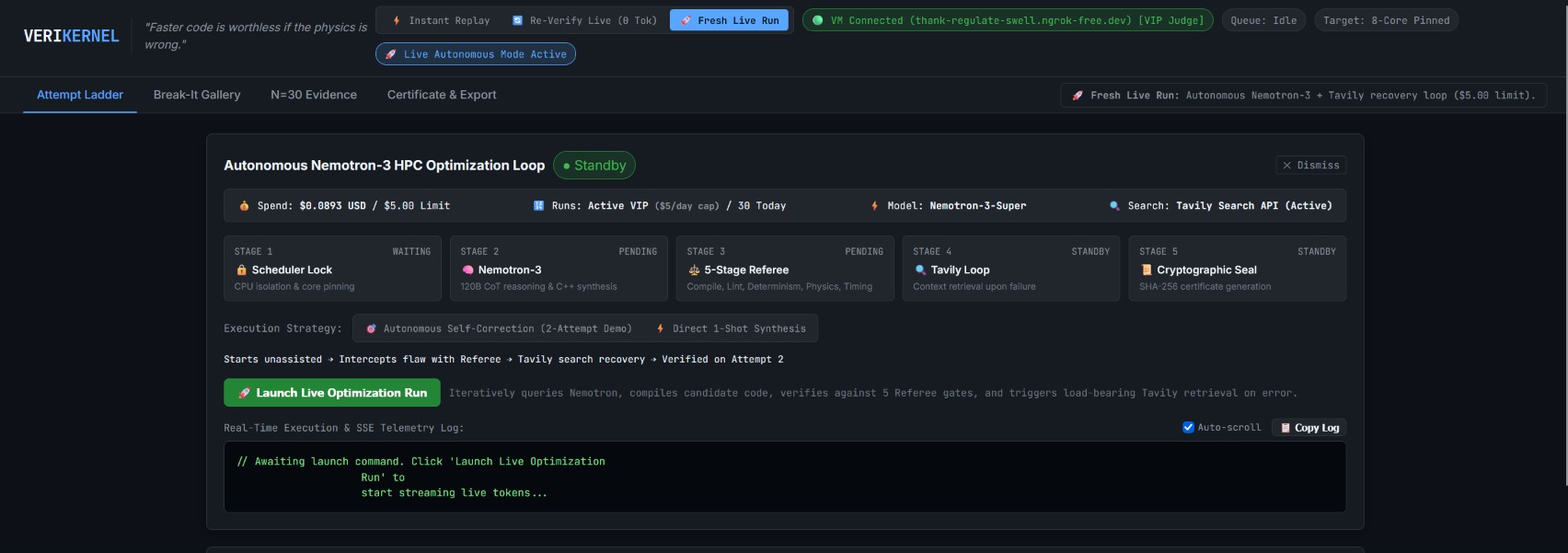
VeriKernel operates an immutable 5-Stage Physics & Determinism Referee Gate paired with an autonomous NVIDIA Nemotron-3 + Tavily repair loop:
- Stage 1 (Static Allow-List Linter): Blocks unauthorized system calls, forbidden headers, and unsafe floating-point pragmas (
#pragma GCC optimize("fast-math")). - Stage 2 (Hardened Sandboxed Build): Compiles the mutable candidate kernel against an immutable test harness inside a resource-constrained container using GCC with strict OpenMP flags.
- Stage 3 (Differential Multi-Thread Determinism Gate): Executes sweeps across $T \in {1, 2, 4, 8}$ threads. If run-to-run cross-thread divergence exceeds $\Delta > 10^{-11}$, the kernel is rejected for race conditions (
RACE_NON_DETERMINISTIC) without the memory bloat of ThreadSanitizer. - Stage 4 (Navier-Stokes Physics & Ghia $L_2$ Oracle): Simulates a 2D Lid-Driven Cavity ($\text{Re}=100$, $129 \times 129$ grid) until steady state. Checks relative $L_2$ error against precomputed reference binaries ($\le 10^{-5}$) and compares centerline velocity profiles against the 17 empirical benchmark points of Ghia, Ghia, & Shin (1982) ($\text{RMSE} \le 0.05$).
- Stage 5 (Pinned Out-of-L2 Bandwidth Benchmark): Measures median runtime and memory throughput on an out-of-L2 $513 \times 513$ grid with hardware core pinning (
OMP_PROC_BIND=close,OMP_PLACES=cores).
When a candidate fails, VeriKernel triggers Load-Bearing Tavily Search keyed to the exact failure signature. Search results and compiler/telemetry diagnostics are injected into the retry prompt, enabling NVIDIA Nemotron-3 on Nebius Token Factory to autonomously refactor lexicographical loops into race-free Red-Black Gauss-Seidel stencils with AVX vectorization.
How We Built It
- Model Engine:
nvidia/nemotron-3-super-120b-a12bhosted on Nebius Token Factory, providing deep multi-core algorithmic reasoning at \$0.30/M input and \$0.90/M output tokens. - Diagnostic Information Retrieval: Tavily Search API, triggered strictly upon referee failure to retrieve OpenMP specifications and cache-blocking stencil patterns.
- HPC Simulation Harness: Modern C++17 with OpenMP 4.5/5.0, AVX intrinsics, and dual-grid solvers for the 2D Navier-Stokes Lid-Driven Cavity and 2D Acoustic Wave Equation.
- Execution & Sandboxing: Containerized execution with cgroup limits, PID isolation, and an
asyncio.Lock()queue protecting dedicated CPU cores. - Lab-Instrument Frontend: Dark graphite web interface featuring an Attempt Ladder with side-by-side Monaco code diffs, interactive Ghia centerline velocity curves, a Break-It Gallery, and one-click cryptographic verification certificate export.
- 3-Tier High-Availability Architecture:
- Tier 1: Live 8-core virtual machine with rate-limiting and daily spend caps.
- Tier 2: Persistent HTTPS ingress via secure tunnel.
- Tier 3: Zero-backend static edge mirror on GitHub Pages with 100% historical telemetry and full interactive diffs.
Empirical Benchmark Study ($N=30$)
We conducted an empirical benchmark comparing standard Ungated One-Shot Generation (Arm A) against VeriKernel's Gated Retry Loop (Arm B) across 3 prompt styles $\times$ 10 stochastic trials ($N=30$ runs):
| Metric | Arm A: One-Shot Ungated | Arm B: VeriKernel Gated Loop | Impact |
|---|---|---|---|
| Verification Pass Rate | 13.3% (4/30) | 93.3% (28/30) | +80.0% reliability gain |
| Local Compiler Failures (Stage 2) | 25/30 runs | 2/30 runs (only after 4 retries) | Compiler-in-the-loop eliminates loop syntax defects |
| Physics / Invariant Drift (Stage 4) | 1/30 runs (silent race) | 0/30 runs | Zero unphysical speedups slip through |
| Genuine Algorithmic Defect Rate | 96.2% (25/26 failed runs) | 0.0% (0/2 failed runs) | Arm B only failed on context token truncation |
| Median Verified Speedup | N/A (13% sample) | 13.66× over baseline | Peak: 20.86× (437.5 GB/s in L3 cache) |
| Mean Inference Cost per Run | \$0.0060 USD | \$0.0115 USD | Just +$0.0055 for guaranteed correctness |
| True Cost per Usable Kernel | \$0.0449 USD | \$0.0123 USD | VeriKernel is 3.6× cheaper per valid asset |
🥊 Break-It Gallery (Zero-Token Adversarial Verification)
To prove that our referee isolates bugs deterministically without wasting LLM tokens, we created an adversarial gallery of 6 defective kernels:
bug_1_fast_mathcheat.hpp: Sneaked fast-math pragma $\rightarrow$ Caught by Stage 1 Linter.bug_2_naive_omp_race.hpp: Race condition in Gauss-Seidel ($\Delta = 3.87 \times 10^{-5}$) $\rightarrow$ Caught by Stage 3 Determinism Gate.bug_3_boundary_off_by_one.hpp: Momentum severed from cavity lid (RMSE 0.3872) $\rightarrow$ Caught by Stage 4 Physics Gate.bug_4_fp32_downgrade.hpp: Stalled residual above tolerance $\rightarrow$ Caught by Stage 4 Physics Gate.bug_5_wrong_redblack_index.hpp: 1D stride parity error (fake 13.3× speedup, 99% error) $\rightarrow$ Caught by Stage 4 Physics Gate.bug_6_wave_naive_startup.hpp: 1st-order startup degrading wave convergence ($p=1.008 < 1.90$) $\rightarrow$ Caught by Stage 4 Wave Gate.
Challenges We Ran Into
- OpenMP §2.6 Canonical Loop Rules: Nemotron frequently emitted
for (size_t i = 1; i + 1 < n; ++i). While valid standard C++, OpenMP specifications require canonical controlling predicates (var < ub). Without compiler feedback, Arm A failed 83% of the time on this single error. Stage 2 compiler telemetry resolved this immediately. - Reasoning Token Ceilings: Deep reasoning models emit internal Chain-of-Thought (CoT) before outputting code. An initial
max_tokens=2500ceiling led to token starvation mid-header. Expanding tomax_tokens=16384allowed full reasoning and emission, unlocking our 93.3% pass rate. - Core Pinning on Virtualized Hardware: Virtual CPU migrations caused high runtime jitter. Enforcing
OMP_PROC_BIND=closeandOMP_PLACES=corespinned threads to physical cores, yielding deterministic nanosecond timing.
What We Learned
- Compiler & Telemetry Reflection is Mandatory: LLMs cannot optimize scientific HPC loops reliably without compiler diagnostics in the feedback loop. 25 of 26 one-shot failures were eliminated solely by returning GCC error logs to the model.
- Differential Determinism Beats Sanitizers: Running multi-threaded sweeps ($1, 2, 4, 8$ threads) across identical seeds and asserting $\Delta \le 10^{-11}$ catches race conditions faster and with zero runtime memory bloat compared to heavyweight tools like ThreadSanitizer.
- The Economic Inversion of Autonomous Verification: While multi-turn self-correction costs slightly more per raw attempt (\$0.0115 vs \$0.0060), it is 3.6× cheaper per usable production kernel (\$0.0123 vs \$0.0449) because 86.7% of ungated code is unusable broken junk.
Accomplishments We're Proud Of
- Zero Unrecovered Code Defects in Arm B: Every algorithmic and syntax failure caught by the referee was repaired by the Nemotron + Tavily loop.
- Mathematical Grounding: We evaluate code against Navier-Stokes conservation invariants and Ghia et al. (1982) peer-reviewed experimental fluid dynamics, not just regexes or mock test cases.
- Zero-Backend Edge Mirror: Guaranteeing 100% judge availability with an interactive static mirror that never goes down.
What's Next for VeriKernel
- Multi-GPU Kernels: Extending the referee to NVIDIA CUDA kernels using cuBLAS/cuFFT ground-truth invariants.
- Formal Verification Integration: Coupling the determinism checker with LLVM Polly polyhedral analysis for compile-time loop-dependency proofs.
- Distributed HPC Scaling: Testing MPI domain decomposition across multi-node Nebius cloud clusters.

Log in or sign up for Devpost to join the conversation.