-
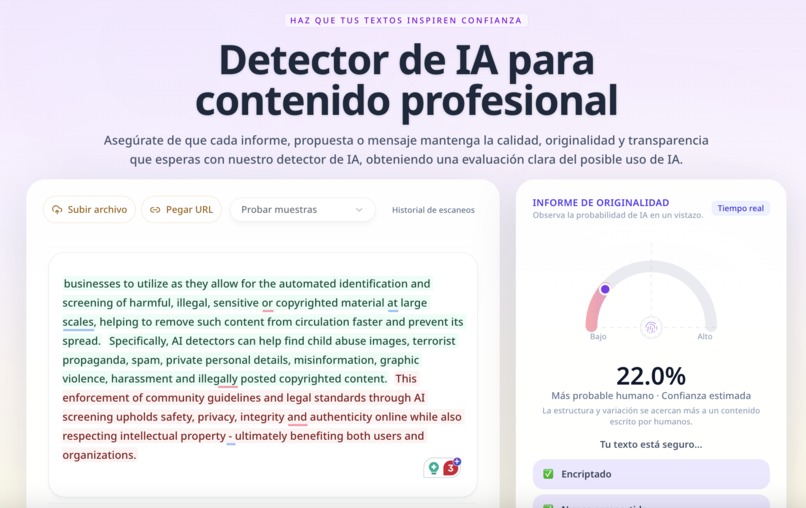
hero page
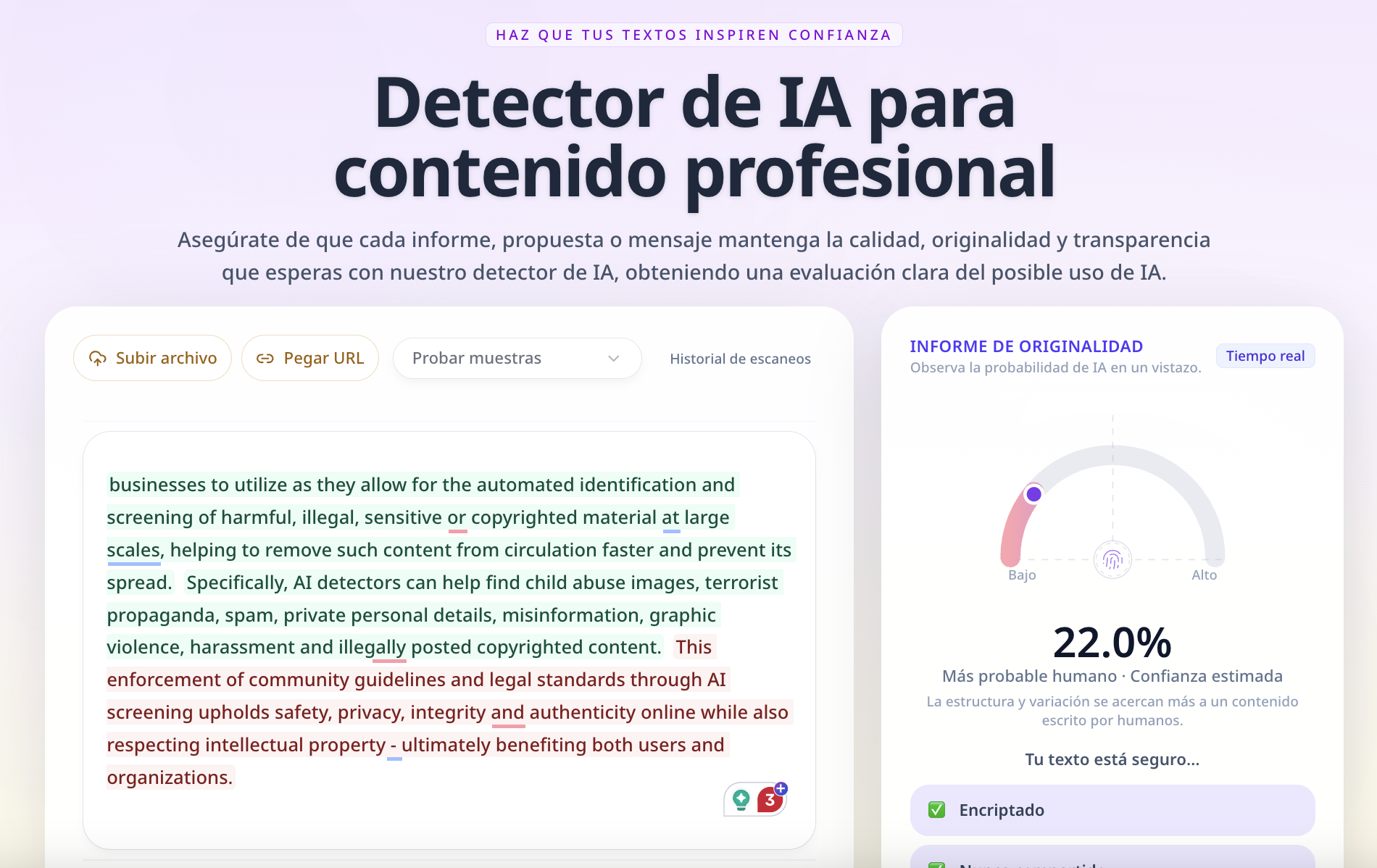
Inspiration
I was helping friends review essays and articles and noticed everyone was copy-pasting non-English text into English-centric AI detectors and then guessing what the scores meant. At the same time, schools and teams were saying “you can use AI, but not too much” without any practical way to see how much AI might be in a piece of writing. VeriIA grew out of that gap: a detector de IA that takes non-English use cases seriously and gives reviewers a simple, visual signal instead of a black box.
What it does
VeriIA is a detector de IA for professional text. You paste or upload content and it: • estimates how likely the text is to have been written with AI (a global probability score), and • highlights each sentence so you can see which parts look more “AI-like” and which look more human.
It’s used for essays, reports, articles and business documents where people want the speed of AI but still need a human-readable indication of possible AI use.
How I built it
I built VeriIA as a web app with: • Next.js + React for the frontend and main UX, • Vercel for hosting and deployments, • Supabase / Postgres for auth and storing scan history and user data, • an internal service layer that calls external AI models, normalizes their outputs and maps scores back to sentences for highlighting.
Most of the work went into the data flow and the UI: handling different input types (paste, upload), splitting and scoring sentences, and keeping the interface clean enough that non-technical reviewers can understand the result.
Challenges I ran into • Non-English reliability: many detectors and benchmarks are English-first, so getting reasonable behavior on other languages required extra calibration and a lot of manual testing. • Explaining uncertainty: users often want a yes/no answer, but the system can only give probabilities. Designing copy and visuals that communicate “this is a signal, not a verdict” was surprisingly hard. • Text length and cost trade-offs: long documents are the most interesting, but they are also the most expensive to process. I had to find a reasonable balance between granularity, speed and running costs.
Accomplishments that I’m proud of • Shipped a working, publicly available detector de IA that handles real-world documents end-to-end. • Designed a results view (score + sentence highlights) that early users can understand without reading a technical guide. • Built a small but growing user base that actively sends feedback on edge cases and new language needs. • Kept the whole thing running as a lean indie project using a simple, maintainable stack.
What I learned • AI detection is inherently noisy; the real product is not the raw score, but how you help people interpret and act on it. • Non-English users are used to being an afterthought in tooling, and they notice when a product is actually tested on their language. • Clear constraints (“this might be wrong”, “longer texts work better”) build more trust than pretending the model is perfect. • From a technical side, good developer experience (Next.js, Vercel, Supabase) makes it much easier to iterate quickly on product ideas.
What’s next for VeriIA – Detector de IA for professional content
Next steps are: • expanding and tightening support for more languages and regions, • adding team-oriented features like shared workspaces and simple reporting, • exploring bulk checks and better evaluation datasets so I can measure progress more objectively, • continuing to refine the UX so the tool stays honest about its limits while still being useful in day-to-day review workflows.
Built With
- cloudflare
- nextjs
- supabase
- typescript
- vercel

Log in or sign up for Devpost to join the conversation.