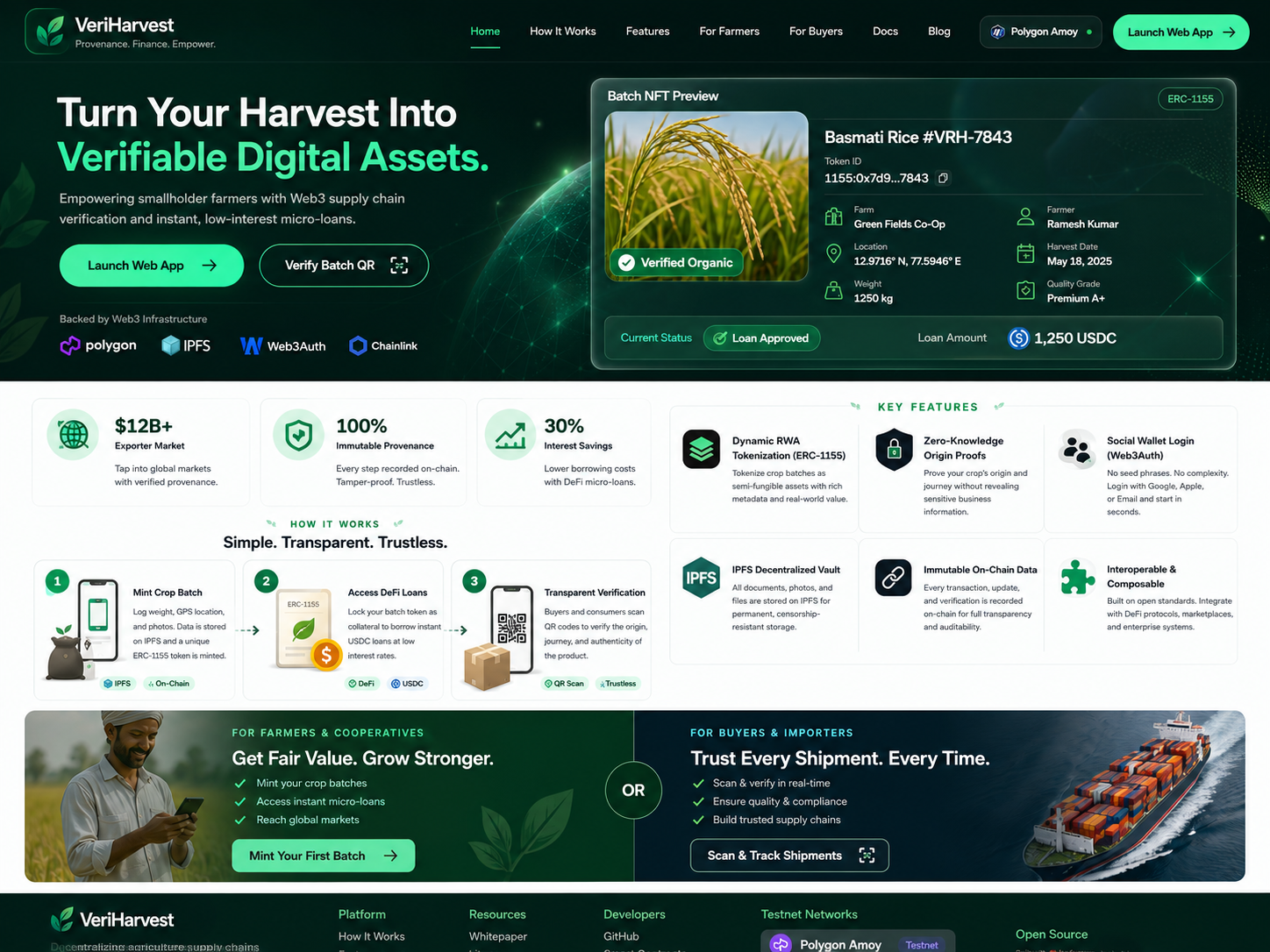
VeriHarvest: Decentralized Supply Chain & Real-World Asset (RWA) Micro-Financing
Inspiration
Smallholder farmers form the backbone of global agriculture, yet they remain trapped in systemic financial exclusion. In developing regions, smallholders routinely lose up to 30% of their potential harvest value to predatory middlemen because they lack verifiable proof of origin required by modern export standards (such as EUDR regulations and fair-trade certifications). Furthermore, when farmers require short-term capital for seeds or fertilizers, traditional financial institutions turn them down due to a lack of verifiable collateral, leaving them at the mercy of loan sharks charging 30–50% interest rates.
We were inspired to build VeriHarvest to bridge this gap. By combining decentralized storage, dynamic smart contracts, and Real-World Asset (RWA) tokenization, we realized we could give farmers an immutable digital identity for their crops, transforming raw harvests into verifiable financial assets.
What it does
VeriHarvest is a Web3-powered supply chain provenance and micro-financing platform that tokenizes agricultural yield onto the blockchain.
- Batch Minting & RWA Creation: Farmers log harvest details (crop type, GPS coordinates, weight, and quality metrics) which are pinned to IPFS and minted as dynamic ERC-1155 tokens on an EVM-compatible testnet.
- Instant DeFi Micro-Loans: Verified harvest tokens can be locked into our
MicroLoanVaultsmart contract as collateral, allowing farmers to access instant, low-interest USDC micro-loans funded by global liquidity providers. - Consumer Origin Verification: End-consumers and export auditors can scan a QR code printed on the packaging to view an unalterable, end-to-end timeline of the crop's lifecycle, verifying authenticity, farm coordinates, and fair-trade compliance without exposing sensitive farmer metadata.
How we built it
We built VeriHarvest during a high-stakes 24-hour sprint using a modern Web3 architecture:
- Smart Contracts (Solidity & Hardhat): Developed
BatchFactory.solto handle ERC-1155 batch minting and metadata updates, alongsideMicroLoanVault.solto manage automated asset locking, loan disbursement, and liquidation mechanisms on the Polygon Amoy Testnet. - Frontend UI (Next.js & Tailwind CSS): Designed an intuitive, mobile-first interface optimized for ease of use by non-technical field workers and co-ops.
- Web3 Integration (Wagmi, Viem & Web3Auth): Integrated Web3Auth to allow farmers to authenticate using simple social logins (Google/Phone number) while abstracting away complex seed phrase management, paired with Wagmi/Viem for blockchain interactions.
- Decentralized Storage (IPFS / Pinata): Embedded immutable file hashes containing batch images, GPS data, and quality certifications directly into token URI metadata via Pinata.
Challenges we ran into
- Balancing Decentralization with UX: The average smallholder farmer cannot navigate gas fees or private key storage. Implementing Web3Auth social logins alongside seamless testnet transaction handling without sacrificing decentralized verification was a major design challenge.
- Smart Contract Collateral Valuation: Calculating fair loan-to-value (LTV) ratios dynamically within a smart contract without relying on centralized price feeds was tricky. We implemented a mathematical model to calculate maximum borrowable limits based on certified crop weight ($W$) and baseline market value ($P_{base}$):
$$\text{Max Loan} = \left( W \times P_{base} \right) \times \text{LTV}_{\text{ratio}}$$
- Strict 24-Hour Timeline: Scoping down our ambition to deliver a rock-solid, fully functioning MVP without broken endpoints within the strict 24-hour code-freeze window forced us to prioritize core features like batch minting and QR generation over secondary analytics dashboards.
Accomplishments that we're proud of
- End-to-End Functional Pipeline: Successfully deployed and verified smart contracts on testnet, connected them to our Next.js frontend, and demonstrated full minting-to-verification loops during live testing.
- Seamless Web2-to-Web3 Onboarding: Built a zero-friction authentication flow using social logins, making Web3 technology practically invisible to end users.
- Clean & Scalable Architecture: Engineered modular smart contracts and responsive UI components that satisfy strict judging standards for technical architecture and security.
What we learned
- RWA Tokenization Realities: Tokenizing real-world assets requires strict alignment between on-chain data hashes and off-chain physical realities. Designing data structures that remain lightweight yet auditable was a major learning milestone.
- Gas Optimization: Optimizing ERC-1155 batch functions taught us valuable lessons about Solidity storage slots and contract execution gas fees.
- Rapid Web3 Prototyping: We honed our ability to architect, deploy, and debug smart contracts and frontend web apps under intense time constraints.
What's next for VeriHarvest
- Zero-Knowledge Proof (ZKP) Integration: Incorporate ZK-SNARKs so farmers can prove compliance with export standards without revealing precise farm locations or commercial profit margins.
- IoT Sensor Feeds: Partner with IoT hardware suppliers to automatically stream soil moisture, ambient temperature, and humidity metrics directly onto IPFS hashes via Chainlink Oracles.
- Mainnet Deployment & Pilot Testing: Deploy to an EVM Layer-2 mainnet (such as Arbitrum or Polygon) and pilot the solution with local agricultural cooperatives for real-world field feedback.

Log in or sign up for Devpost to join the conversation.