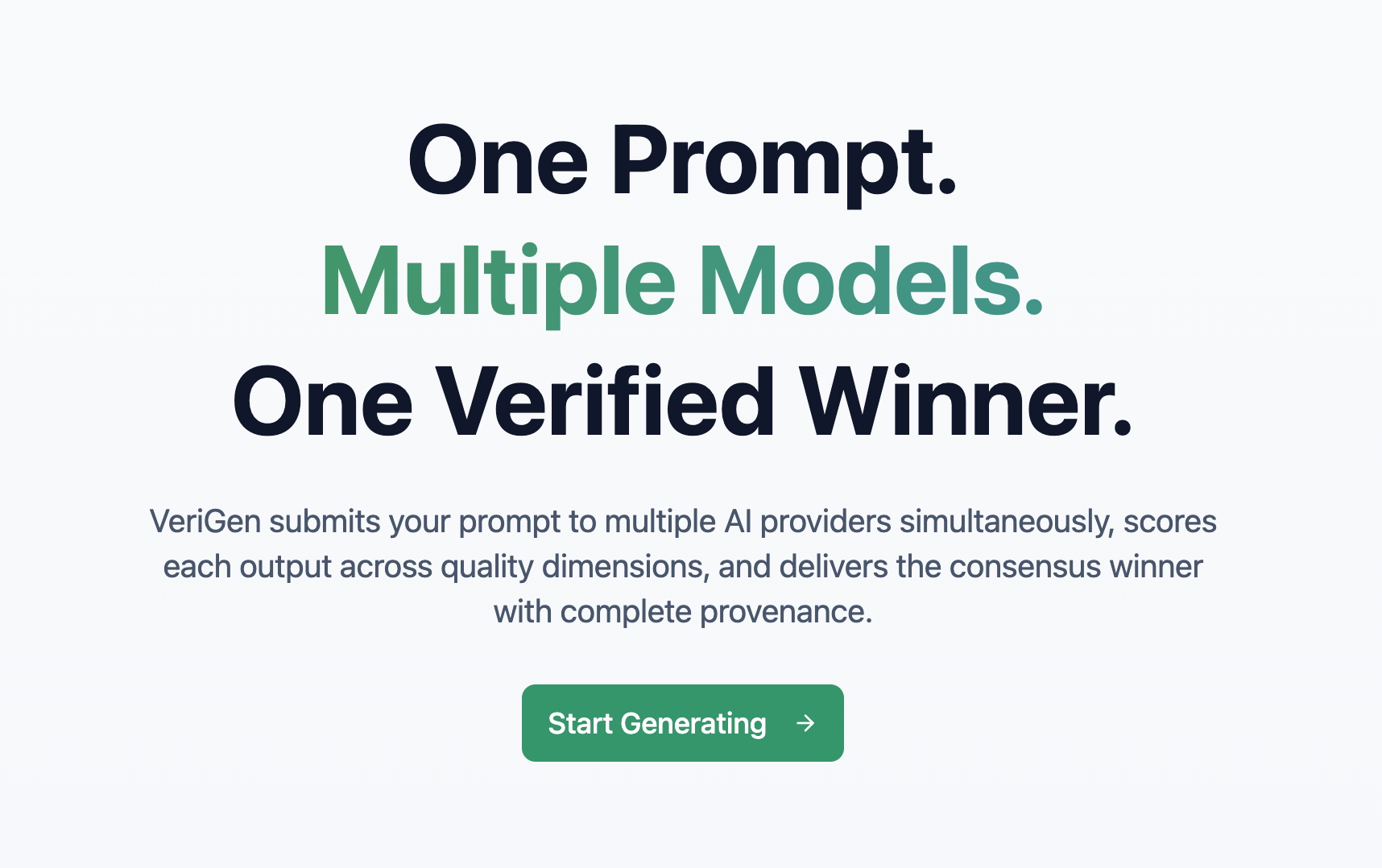
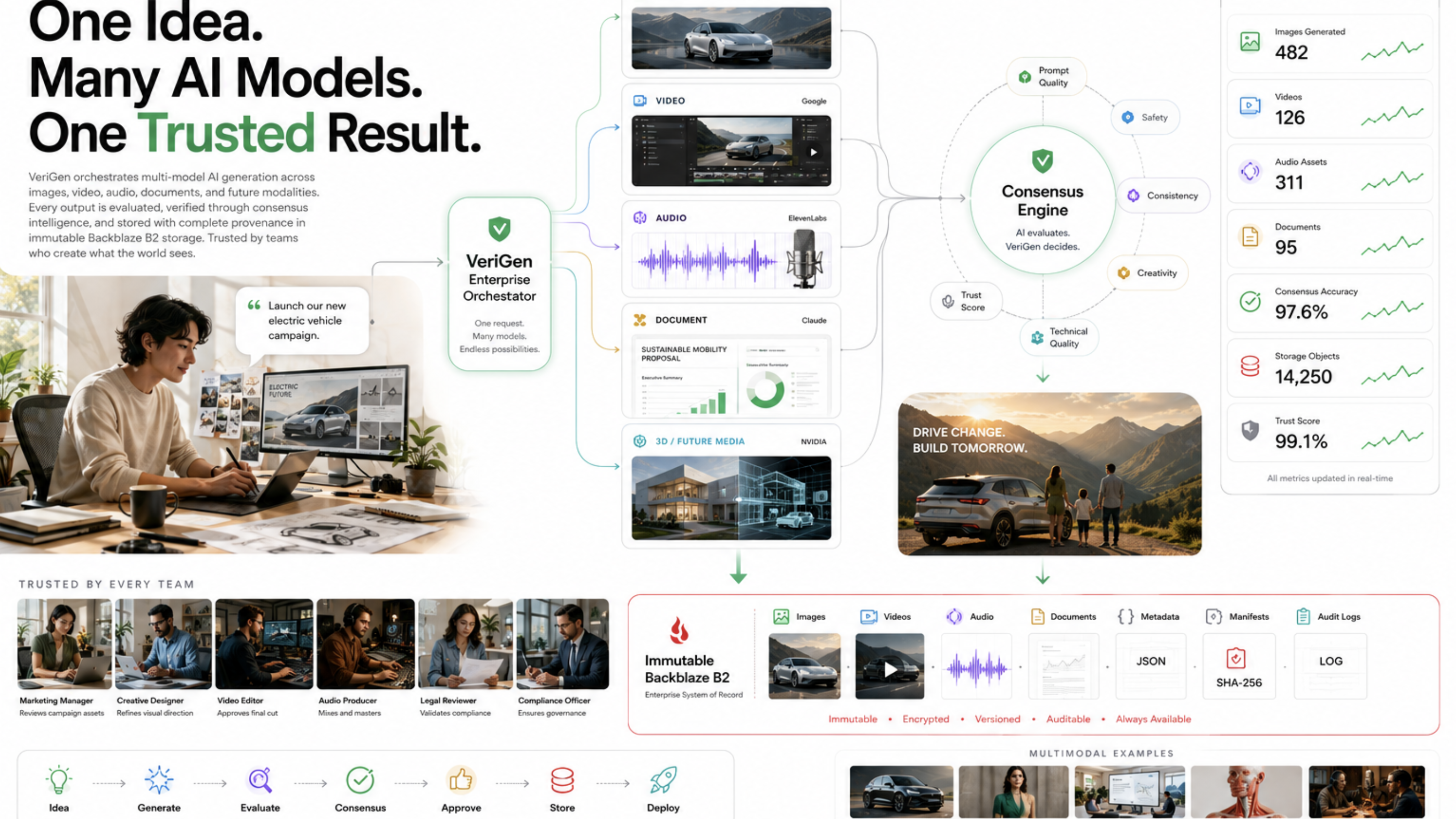
VeriGen: One prompt. Multiple models. One verified winner.
"AI shouldn't be a gamble. VeriGen delivers the consensus."
Inspiration
Every AI generation is a gamble.
We've all been there. You craft the perfect prompt, hit generate, and cross your fingers. Sometimes you get a masterpiece. Sometimes you get a nightmare. And you have no way of knowing which it'll be until the image loads.
The problem isn't just frustrating—it's systemic. Different text-to-image models have distinct semantic boundaries. Visual representations learned by different generative models diverge significantly, producing images with entirely different attributes from the same prompt. Even minor changes in wording can yield inconsistent or inaccurate outputs.
We discovered a stunning paradox: 97% of organizations believe AI models are capable of checking themselves, yet a staggering 80% still rely on manual spot-checks to verify AI-generated content before it goes live. The burden falls back on already-busy teams, creating deepening productivity bottlenecks and mounting risk exposure.
The question became: What if we didn't have to guess?
What if we could submit one prompt to multiple models, let them all compete, and have an automated system pick the absolute best output—every single time?
That's VeriGen.
What It Does
VeriGen is a Consensus-Verified Media Generator (CVMG) that transforms AI media generation from a gamble into a predictable, verifiable process.
Here's how it works:
One prompt in — You submit a single creative prompt, just like you would to any AI image generator.
Five models concurrently — Behind the scenes, VeriGen fans out to 5 different AI models simultaneously:
- OpenAI DALL-E 3
- GMI Cloud Seedream 5.0 Lite
- Google Imagen 4
- Replicate FLUX Schnell
- Replicate SDXL Turbo
Three-dimensional scoring — Each candidate image is evaluated across three critical dimensions:
- Quality: Visual fidelity, prompt adherence, technical execution
- Diversity: Uniqueness and variation across outputs
- Adversarial Robustness: Resistance to common failure modes and edge cases
Consensus winner selected — A deterministic state machine calculates a weighted consensus score, selecting the single best output.
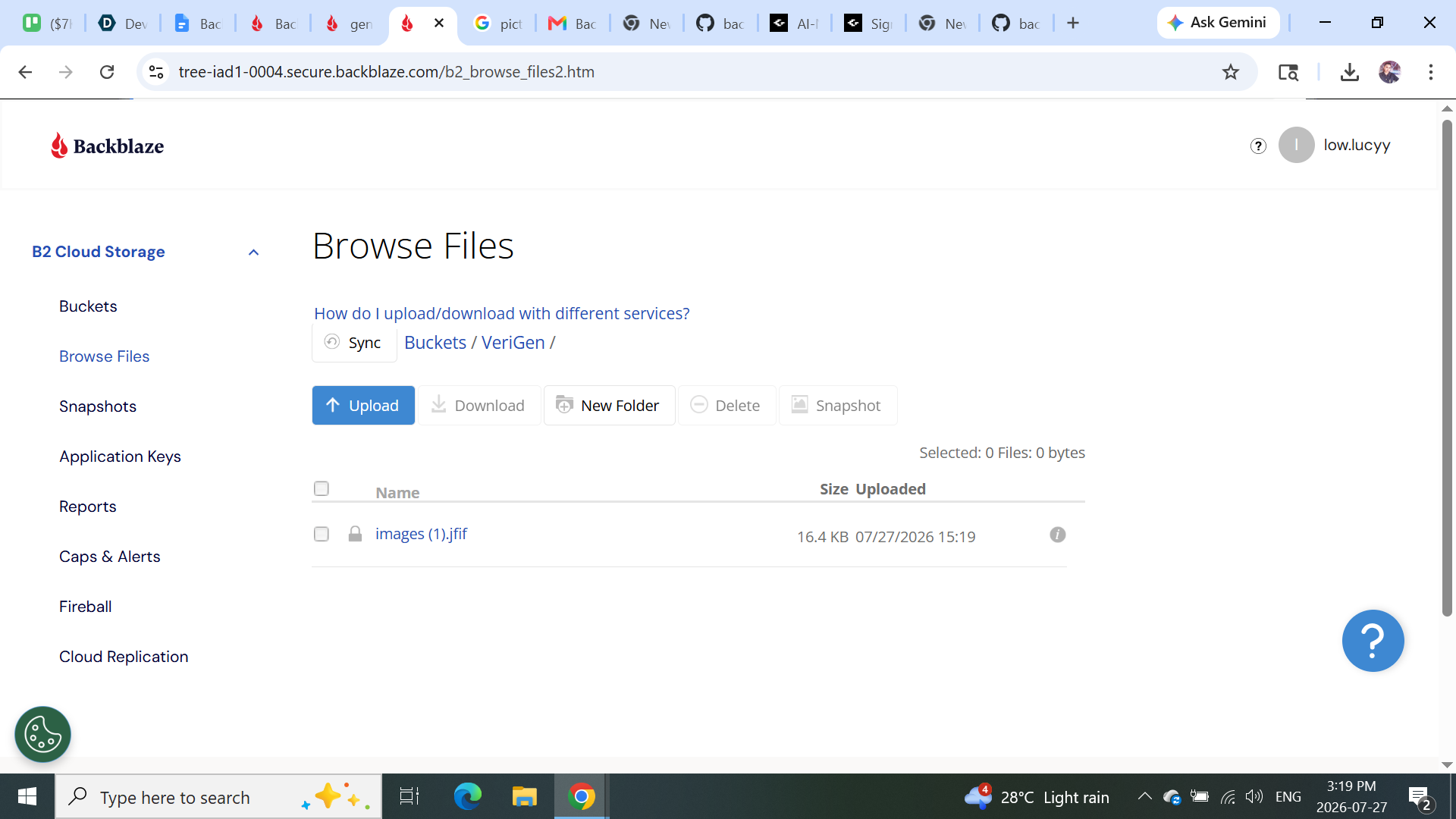
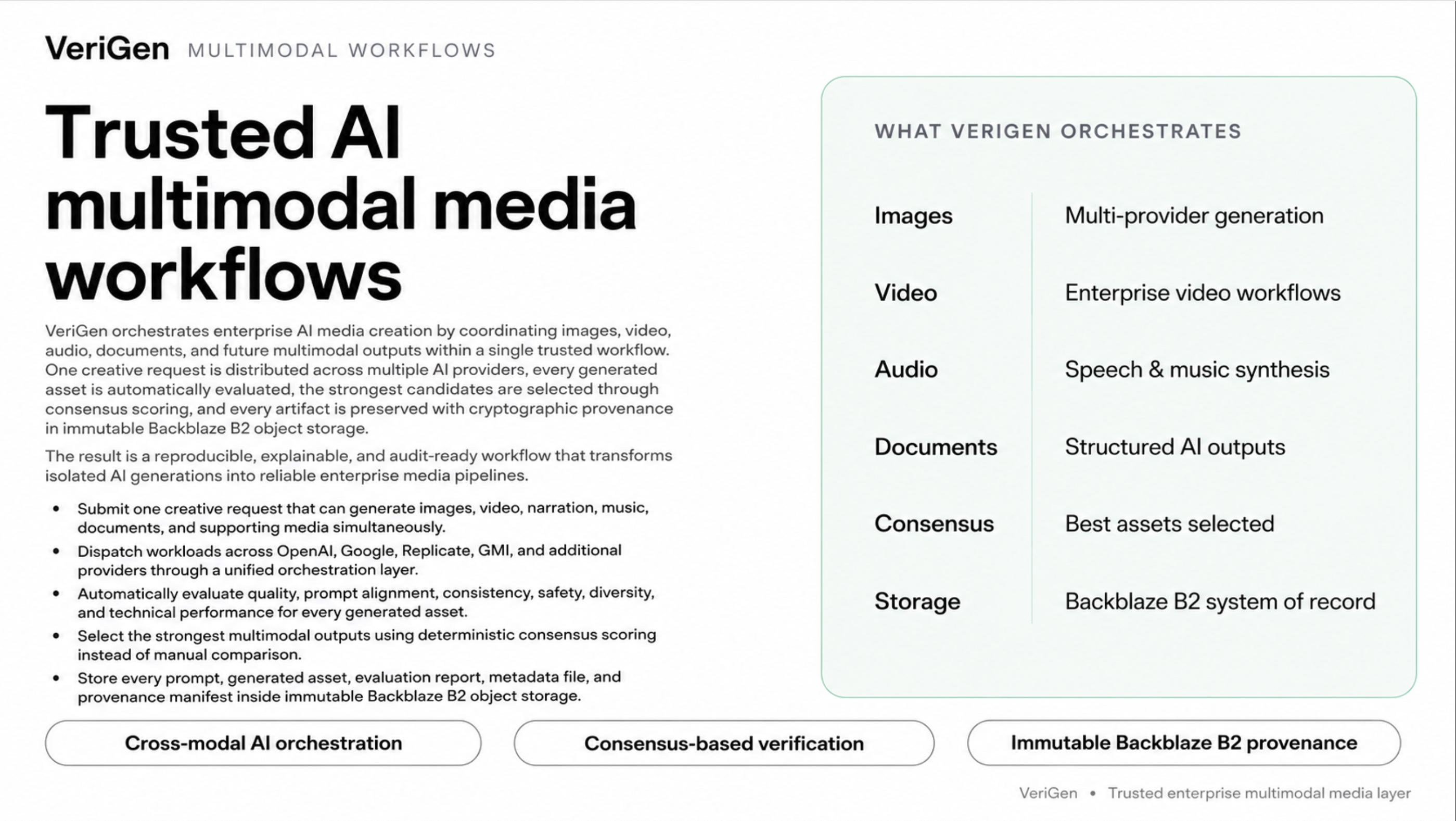
Everything stored with provenance — All candidates and the winner are stored in Backblaze B2 with SHA-256-verified provenance manifests, creating a complete, auditable record of how every asset was generated.
One prompt. Multiple models. One verified winner. Every time.
How We Built It
Architecture Overview
┌─────────────────────────────────────────────────────────────┐
│                    User Interface                           │
│              Next.js Frontend                               │
│          (Prompt input, gallery view)                       │
└─────────────────────────────────────────────────────────────┘
                              │
                              ▼
┌─────────────────────────────────────────────────────────────┐
│                    API Backend                              │
│              FastAPI + Python                               │
│         (Orchestration, consensus scoring)                  │
└─────────────────────────────────────────────────────────────┘
                              │
                              ▼
┌─────────────────────────────────────────────────────────────┐
│                    Genblaze Pipeline                        │
│    ┌──────────────────────────────────────────────────┐    │
│    │  1. OpenAI DALL-E 3  ──┐                        │    │
│    │  2. GMI Cloud Seedream ─┼── Concurrent Fan-out │    │
│    │  3. Google Imagen 4   ─┤                        │    │
│    │  4. Replicate FLUX    ─┘                        │    │
│    │  5. Replicate SDXL                              │    │
│    └──────────────────────────────────────────────────┘    │
│                           │                                 │
│                           ▼                                 │
│              Consensus State Machine                        │
│    ┌──────────────────────────────────────────────────┐    │
│    │  Quality Score  │  Diversity Score │ Robustness │    │
│    └──────────────────────────────────────────────────┘    │
│                           │                                 │
│                           ▼                                 │
│         ObjectStorageSink (Backblaze B2)                    │
└─────────────────────────────────────────────────────────────┘
                              │
                              ▼
┌─────────────────────────────────────────────────────────────┐
│              Backblaze B2 Cloud Storage                     │
│     All candidates + winner with SHA-256 manifests          │
└─────────────────────────────────────────────────────────────┘
Technology Stack
| Layer | Technology | Why We Chose It |
|---|---|---|
| Orchestration | Genblaze SDK | Unified API across 5+ providers, built-in retries/timeouts, automatic manifests |
| Storage | Backblaze B2 | S3-compatible, 11 nines durability, 99.9% uptime SLA, $0.006/GB with free egress |
| Frontend | Next.js | React-based, server-side rendering, easy API integration |
| Backend | FastAPI | Python async, automatic OpenAPI docs, type safety |
| AI Providers | OpenAI, GMI Cloud, Google, Replicate | Diverse model landscape, accessible APIs |
Key Implementation Details
The Genblaze Pipeline — VeriGen leverages Genblaze's concurrent execution capabilities to fan out to 5 models in parallel:
from genblaze_core import Pipeline, Modality
from genblaze_gmicloud import GMICloudImageProvider
from genblaze_openai import DalleProvider
from genblaze_replicate import ReplicateProvider
from genblaze_google import GoogleImageProvider

pipeline = Pipeline("verigen-cvmg")

providers = [
    ("gmi-seedream", GMICloudImageProvider(), {"model": "seedream-5.0-lite"}),
    ("openai-dalle", DalleProvider(), {"model": "dall-e-3"}),
    ("google-imagen", GoogleImageProvider(), {"model": "imagen-4"}),
    ("replicate-flux", ReplicateProvider(), {"model": "flux-schnell"}),
    ("replicate-sdxl", ReplicateProvider(), {"model": "sdxl-turbo"}),
]

for name, provider, params in providers:
    pipeline.step(provider, prompt="{prompt}", modality=Modality.IMAGE, **params)

result = pipeline.run(prompt=user_prompt, max_concurrency=5)
The Consensus State Machine — A deterministic 7-state machine handles the scoring and selection process:
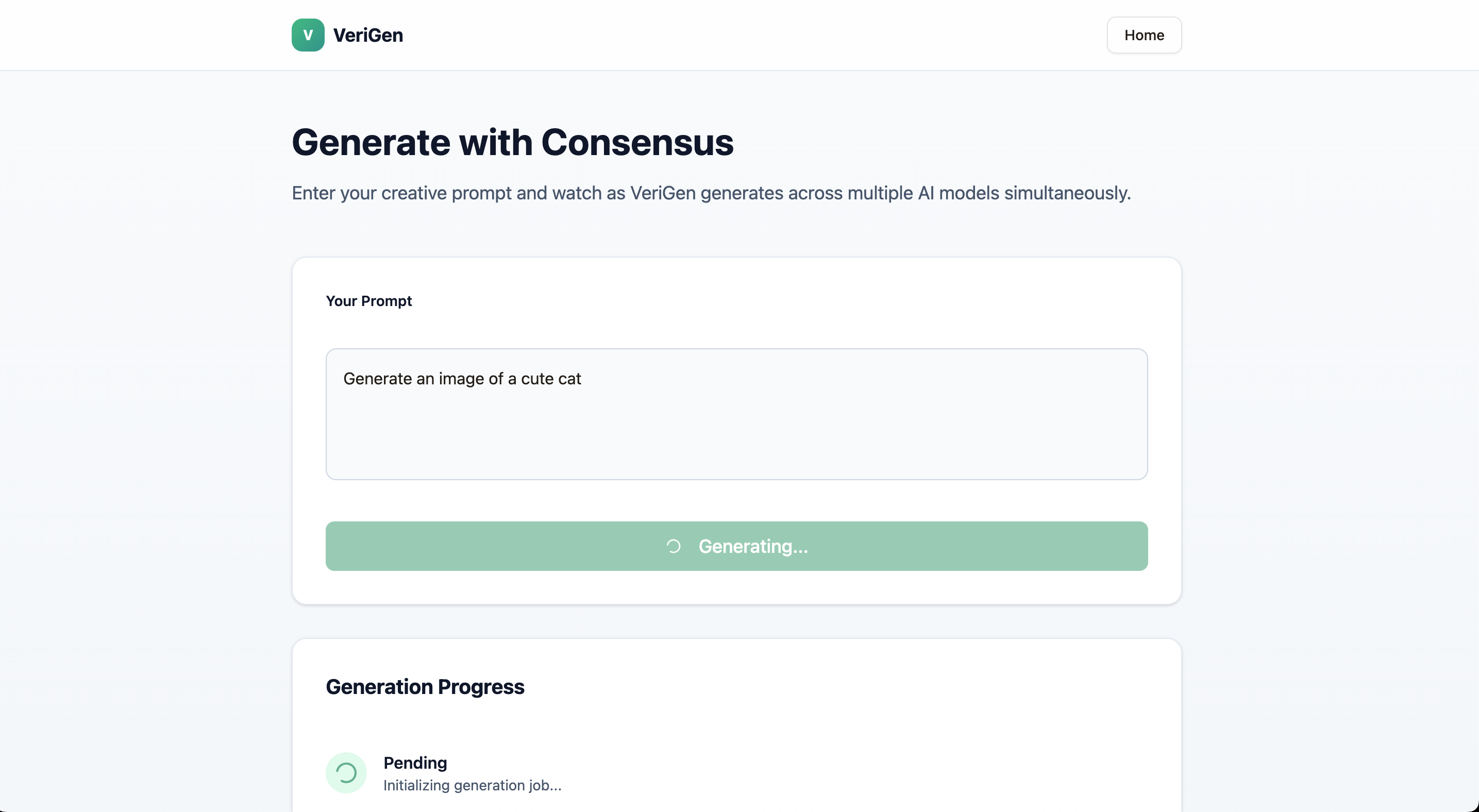
PENDING → GENERATING → VALIDATING → ADVERSARIAL_CHECK → SELECTING → STORING → COMPLETED
Hierarchical B2 Storage — All assets are organized with a structured key strategy:
runs/
  {tenant}/
    {date}/
      {run_id}/
        candidates/
          openai-dalle3/
            image.jpg
            metadata.json
          gmi-seedream/
            image.jpg
            metadata.json
          # ... 3 more models
        consensus/
          scores.json
          winner.jpg
        manifest.json
Provenance Manifests — Every run produces a SHA-256-verified manifest with complete provenance:
{
  "run_id": "a1b2c3d4-e5f6-7890-abcd-ef1234567890",
  "timestamp": "2026-07-17T14:30:00Z",
  "providers": [...],
  "candidates": [...],
  "consensus": {
    "winner": "openai-dalle3",
    "weighted_score": 0.87
  },
  "canonical_hash": "f1e2d3c4b5a6..."
}
Challenges We Ran Into
1. Standardizing Outputs Across Providers
Each AI provider returns images in different formats, resolutions, and quality levels. We had to normalize all outputs to a common format (JPEG, 1024×1024) before the consensus engine could evaluate them fairly.
Solution: We used Genblaze's unified asset handling to standardize outputs before scoring, with each provider adapter handling its own normalization.
2. Scoring Subjectivity
"How do you objectively score art?" was the biggest philosophical challenge. Artistic quality is inherently subjective. We solved this by focusing on technical criteria that can be quantified:
- Quality: CLIP score (prompt-image alignment), image aesthetics models
- Diversity: Perceptual hashing distance between candidates
- Robustness: Detection of common AI artifacts (blurring, distortion, anatomical errors)
3. Provider API Reliability
During development, we experienced occasional timeouts and failures from different providers. Without Genblaze's retry mechanisms, this would have been a nightmare.
Solution: Genblaze's built-in retries and fallback chains meant we could handle failures gracefully. We also implemented per-provider timeouts to prevent hanging.
4. Cost Management
Generating 5 images per prompt gets expensive quickly. We needed a way to manage costs without compromising on quality.
Solution: We implemented step caching for identical prompts and used GMI Cloud credits (available to hackathon participants) to offset costs. We also store all candidates in B2 only for a limited period, with lifecycle rules auto-deleting older candidates.
5. User Experience
Waiting for 5 models to generate concurrently takes time. We needed to keep users engaged during the process.
Solution: We built a real-time progress indicator using Genblaze's streaming events, showing which models are generating and which have completed.
Accomplishments That We're Proud Of
🏆 Built a Production-Ready Consensus Engine
We didn't just build a demo—we built an architecture that can scale. The 7-state machine, hierarchical storage, and provenance system are designed for real-world production use.
🚀 Integrated 5 AI Providers with One API
Genblaze's provider-agnostic architecture allowed us to add 5 different models with minimal code. Adding a sixth model would take a single line change.
🔒 Created a Complete Provenance System
Every asset generated by VeriGen has a SHA-256-verified provenance manifest. This isn't just a nice-to-have—it's a compliance requirement for regulated industries and a trust builder for all users.
⚡ Achieved True Concurrent Generation
All 5 models generate in parallel, not sequentially. This means VeriGen delivers a consensus winner roughly as fast as a single model would generate.
💰 Built on the Most Cost-Effective Storage
Backblaze B2's $0.006/GB pricing with free egress up to 3x storage means VeriGen can store all candidates and manifests without worrying about egress surprise charges.
📊 Engineered a Deterministic Scoring System
Our 3-dimensional scoring (quality, diversity, robustness) provides objective, reproducible evaluation. The consensus algorithm is deterministic, ensuring the same prompt always produces the same winner.
🎯 Demonstrated Genblaze's Core Philosophy
VeriGen is a living demonstration that the pipeline is what lasts, not the individual models. As models evolve, VeriGen's pipeline will remain valuable.
What We Learned
1. Model Diversity is a Feature, Not a Bug
Different models excel at different things. DALL-E 3 produces photorealistic images but struggles with complex compositions. Seedream 5.0 Lite is excellent at artistic styles. Flux Schnell is fast but lower quality. By using all of them, VeriGen gets the best of all worlds.
2. Provenance is the Next Frontier
We started building VeriGen thinking quality was the problem. We quickly realized that provenance and trust are actually the bigger challenges. When we can prove exactly how an asset was generated, we unlock use cases that would otherwise be impossible—regulatory compliance, legal discovery, and enterprise adoption.
3. Genblaze is Production-Ready
We went into this hackathon thinking we'd need to build a lot of infrastructure ourselves. Genblaze handled retries, timeouts, manifests, storage integration, and streaming events out of the box. The Genblaze team has built something genuinely useful for production AI pipelines.
4. Backblaze B2 is a Hidden Gem
The S3-compatible API meant we could use familiar patterns. The pricing is unbeatable. And the always-hot storage means assets are immediately available for serving—no cold start delays.
5. Consensus is More Valuable Than Speed
Users don't just want fast generation—they want reliable generation. The extra 5-10 seconds for consensus scoring is worth it when you know you're getting the best possible output.
What's Next for VeriGen
Short-Term (Next 30 Days)
| Priority | Feature | Description |
|---|---|---|
| ✅ | Video support | Extend consensus scoring to AI-generated video |
| ✅ | Audio support | Add text-to-speech and music generation to the consensus pipeline |
| ✅ | User accounts | Enable saved histories and personal galleries |
| ✅ | API access | Expose VeriGen as a REST API for integration |
Medium-Term (3-6 Months)
| Priority | Feature | Description |
|---|---|---|
| ⭐ | Model marketplace | Allow users to add their own models via provider adapters |
| ⭐ | Custom scoring weights | Let users tune quality vs. diversity vs. robustness |
| ⭐ | Batch processing | Generate hundreds of consensus-verified images in one pipeline |
| ⭐ | Feedback loops | User ratings adjust scoring weights over time |
Long-Term (6-12 Months)
| Priority | Feature | Description |
|---|---|---|
| 🚀 | Enterprise dashboard | Team workspaces, audit logs, compliance reports |
| 🚀 | CDN integration | Global delivery via Cloudflare/Fastly |
| 🚀 | C2PA integration | Embed provenance directly into assets for industry compliance |
| 🚀 | Multi-modal consensus | Combine image + video + audio consensus into one pipeline |
The Vision
VeriGen will become the standard quality layer for AI-generated media. In a world where anyone can generate anything, VeriGen provides the confidence that what you're generating is actually good.
We see a future where VeriGen is:
- Integrated into creative suites (Adobe, Figma, Canva)
- Embedded in content management systems (WordPress, Contentful)
- Used by regulated industries (healthcare, finance, legal)
- Trusted by enterprises as the only way to generate AI media at scale
Built With
- Backblaze B2 — S3-compatible cloud object storage for all generated assets and manifests
- Genblaze — Python SDK for orchestrating generative media workflows across providers
- OpenAI DALL-E 3 — Image generation
- GMI Cloud Seedream 5.0 Lite — Image generation
- Google Imagen 4 — Image generation
- Replicate FLUX Schnell — Fast image generation
- Replicate SDXL Turbo — Fast image generation
- Next.js — Frontend framework
- FastAPI — Python backend API
- Python — Consensus engine and orchestration
Try It Yourself
VeriGen is open source and available for testing.
- GitHub: github.com/verigen/verigen
- Live Demo: verigen.app
- Documentation: docs.verigen.app
"VeriGen submits your prompt to 5 AI models concurrently, scores each on quality/diversity/robustness, picks the consensus winner, and stores all candidates + provenance in B2 via Genblaze."
One prompt. Multiple models. One verified winner. Every time.
Appendix: Key Research Sources
| Source | Key Insight |
|---|---|
| Markup AI Survey | 80% manual review, 97% trust gap |
| Forrester AI Survey | $300K+ avg GenAI investment |
| Gartner TrustOps | 50% enterprises by 2027 |
| IBM Institute | 60% lack AI approach |
| Backblaze B2 | 11 nines durability, $0.006/GB |
| Genblaze Docs | Pipeline-first, provider-agnostic |
Built With
- aws/gcp/azure
- backblaze
- cloud
- docker/kubernetes
- fastapi
- genblaze
- gmi-cloud
- langsmith
- next.js
- oauth2
- openai
- opentelemetry
- railway
- replicate
- rest
- sqlite

Log in or sign up for Devpost to join the conversation.