-
-
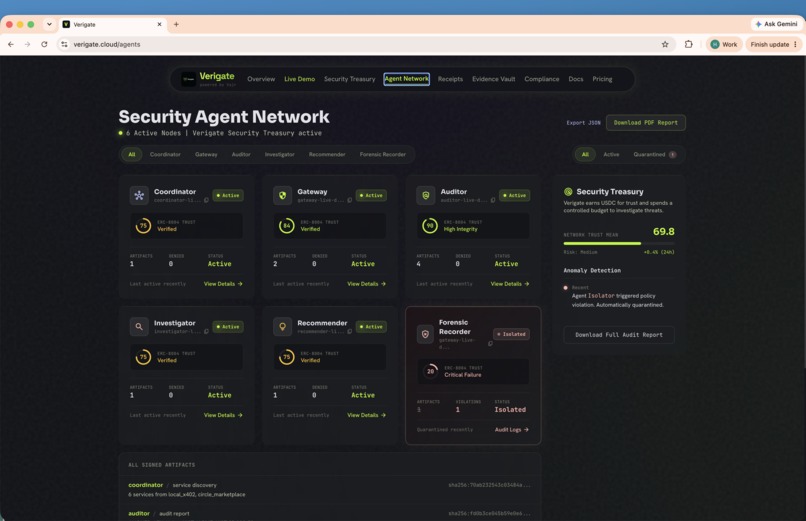
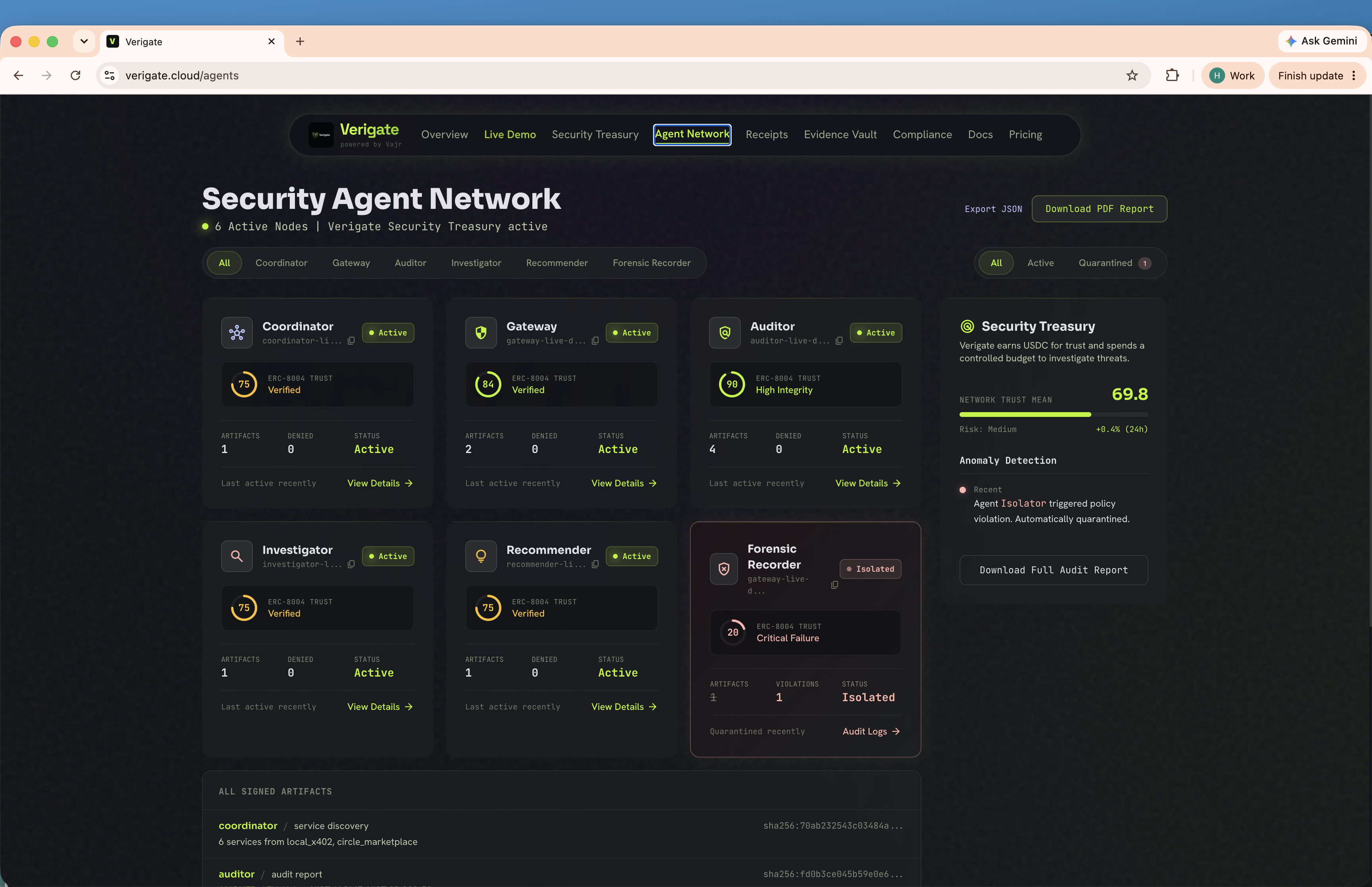
Agent Network
-
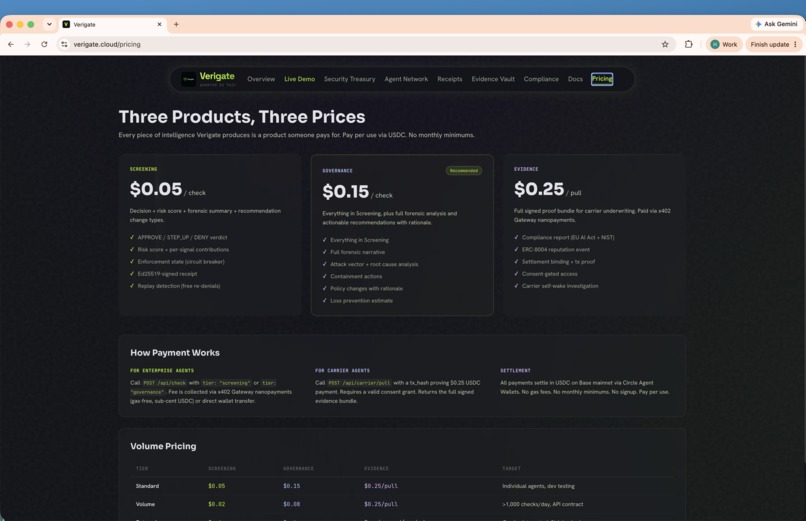
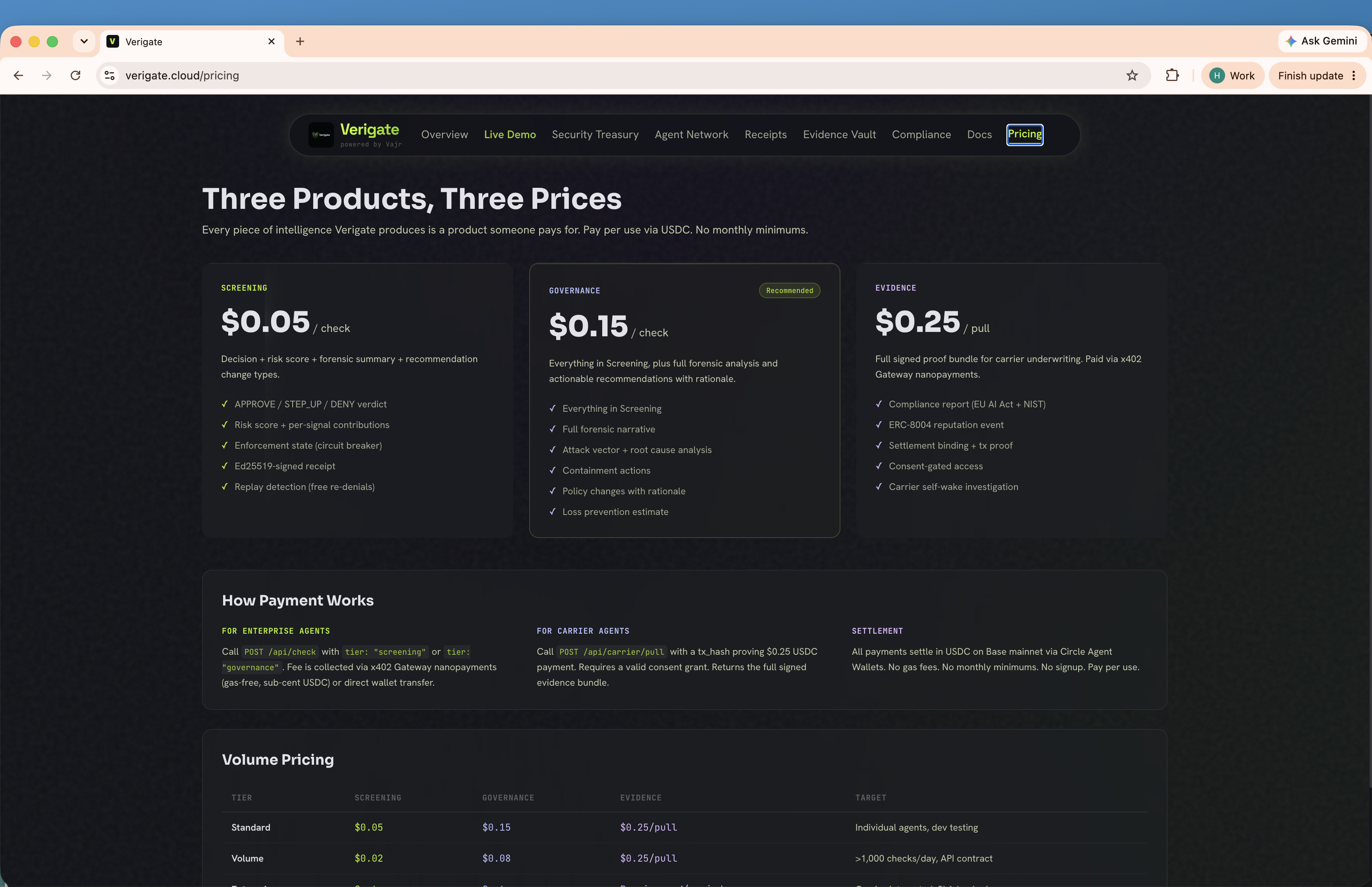
Pricing
-
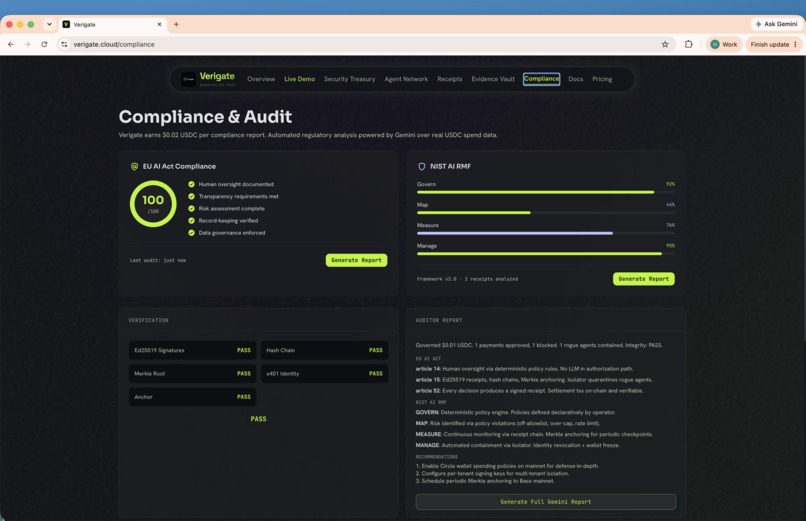
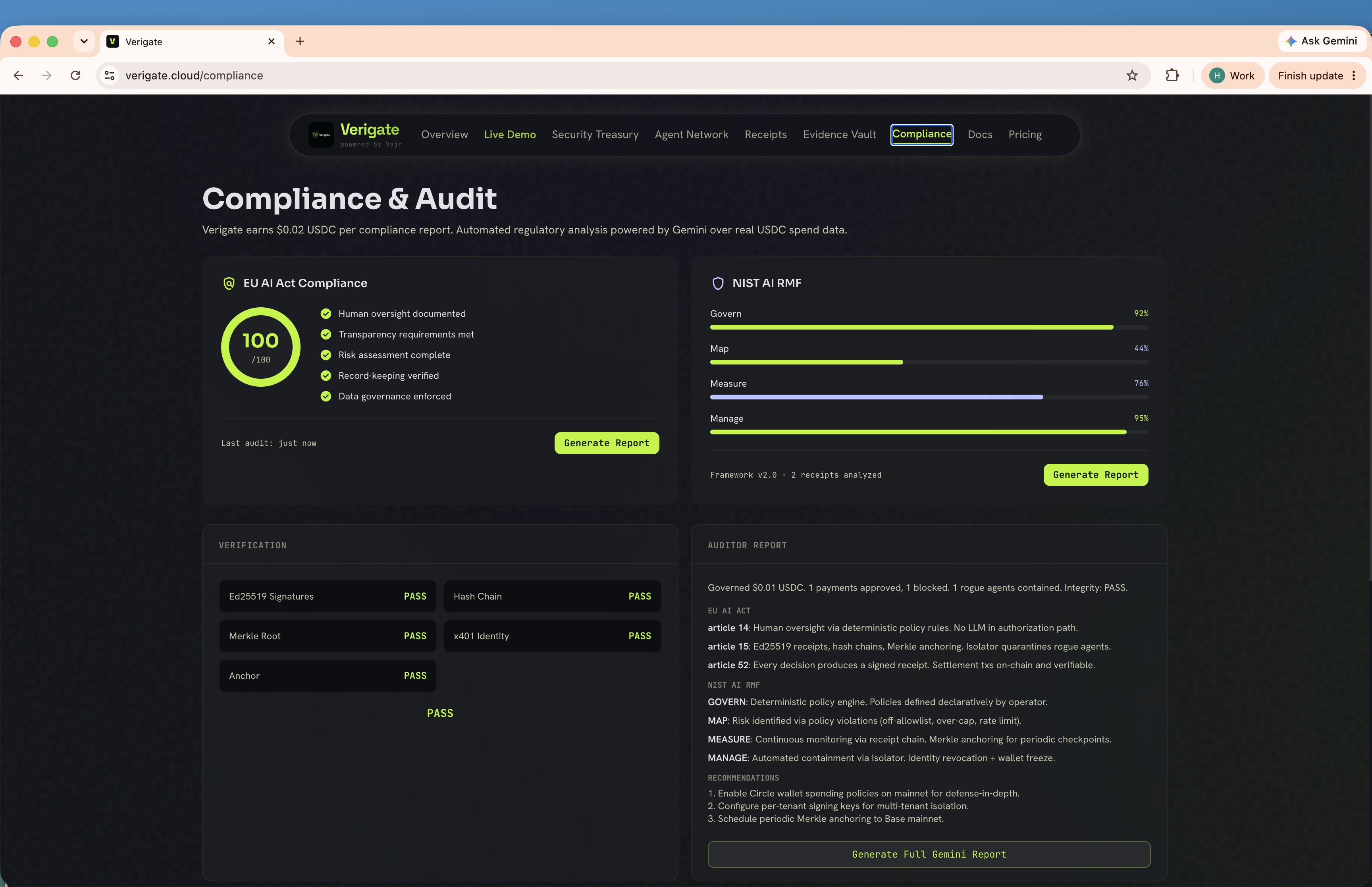
Compliance
-
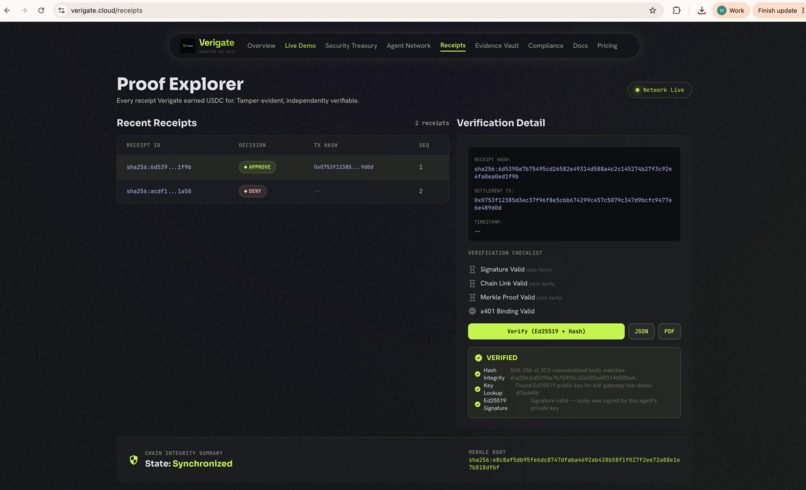
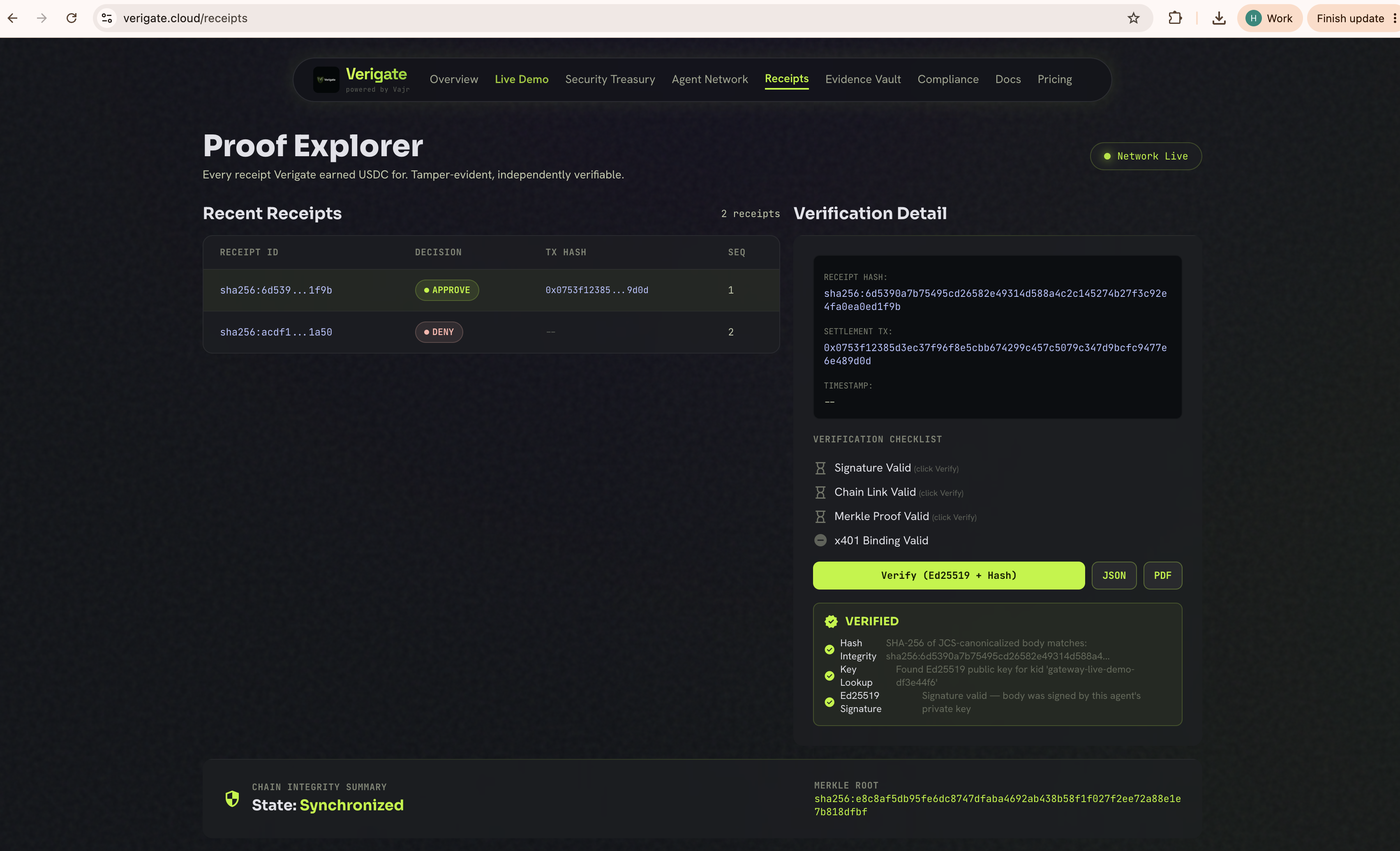
Proof Explorer
Inspiration
Verigate is a three-wallet autonomous economy native to Circle Agent Wallets.
Every decision terminates in a Circle Agent Wallet UserOperation. The Treasury spends autonomously under a Circle-enforced spending policy — when a payment is uncertain it buys a second opinion before deciding, with no human in the loop. The paying wallet holds zero ETH; Circle's relayer sponsors gas, so the agent pays only the sub-cent USDC itself. Remove Circle and the economy does not exist: not the settlement, not the gas model, not the policy enforcement. At $0.30 card interchange a $0.02 evidence purchase is simply absurd.
Three flows, all decodable on Base mainnet: the $0.05 screening fee (0x5db44668…), the $0.02 autonomous evidence purchase (0xdfcd6729…), and $0.10 funding (0x958f2c40…) — each an ERC-4337 UserOperation, gas paid by Circle's relayer against a 0-ETH Treasury.
Circle Agentic Economy Prize: proof. The three Circle Agent Wallets that run this economy, on Base mainnet: Customer 0x5c34e3e0… pays the screening fee, Treasury 0x0c744ecb… autonomously buys the evidence, Validator 0xbe1424b7… sells it. The Treasury settles holding 0 wei ETH, with Circle's relayer sponsoring the gas, and its spending policy ($5/tx, $50/day, origin=CUSTOM) can only be widened by a human email OTP, so the agent cannot raise its own ceiling. Public repo: github.com/4KInc/verigate.
Payment screening is the application; a self-funding agent economy on Circle is the thesis.
AI agents are getting spending authority. Circle Agent Wallets let them hold USDC and pay for services autonomously. But every other agent payment demo answers the same question: "can an agent spend money?"
We asked a different one: what if spending money could itself be a risk-mitigation decision?
When an agent is uncertain whether a payment is safe, it can't just block it (loses the opportunity) or approve it (risks the loss). Verigate introduces a third option: spend a small amount of USDC to purchase independent evidence, then decide. That's the STEP_UP mechanism — an agent that autonomously buys intelligence to reduce its own uncertainty, with zero human intervention.
What it does
Verigate is a payment-screening agent for AI agents. Before your agent executes a USDC payment via Circle Agent Wallets, POST the intent to Verigate:
- APPROVE (score 0-39): Payment is safe. Proceed.
- STEP_UP (score 40-74): Uncertain. Verigate autonomously pays $0.02 USDC from its Treasury wallet to an independent Validator for a second opinion (real on-chain USDC transfer), then decides.
- DENY (score 75+): Blocked. Governance intelligence returned — root cause, attack vector, containment actions, policy recommendations.
Risk scoring checks OFAC sanctions (live SDN feed), prompt injection patterns (6 detectors), behavioral anomalies (z-score deviation from agent baseline), and amount/payee policy violations.
Three products, all settled in USDC:
- Screening ($0.05): Decision + risk breakdown + forensic summary
- Governance ($0.15): Full forensic analysis + recommendations with rationale
- Evidence ($0.25): Full signed proof bundle for carrier underwriting
Every decision produces an Ed25519-signed, hash-linked receipt. Merkle roots and the verification key are anchored on Base Sepolia; the settlement proof transactions are on Base mainnet.
How we built it
Risk Engine: Deterministic Python scorer with 6 prompt injection detectors, live OFAC SDN sanctions feed (auto-refreshed every 12h), Shannon entropy analysis, behavioral baseline tracker, and per-signal contribution breakdown. No LLM in the scoring path — the risk score is reproducible and explainable.
Gemini Integration (6 structural roles):
- STEP_UP validator reasoning — Gemini evaluates evidence and returns CONFIRM/DENY with confidence
- RAG knowledge base — Gemini embeddings (embedding-001) store every screening decision; before STEP_UP reasoning, the validator retrieves relevant past events via cosine similarity so Gemini reasons over history, not just the current case
- Policy synthesis — natural language to Circle Agent Wallet policies
- Cross-agent scope negotiation — Gemini mediates between two agents' policy requirements
- Governance agents — Investigator (forensics), Auditor (compliance), Recommender (policy proposals) run on every DENY
- Carrier self-wake — Gemini decides if a DENY event is worth $0.25 to investigate
Policy Compiler:
Gemini-synthesized policies are compiled against org-level hard ceilings ($100/tx, $500/day) and enforced by Verigate at the application layer. Circle's wallet layer is enforced separately and not by this compiler: the Treasury and Customer wallets carry real custom Circle policies set with circle wallet limit set (Treasury $5/tx, $50/day; Customer $0.10/tx, $25/day; both origin=CUSTOM, verifiable with circle wallet limit --address <addr> --chain BASE).
Changing a Circle wallet policy requires human email-OTP authorization. That is the sharpest autonomy boundary in the system: the agent spends freely inside its envelope and cannot widen it. Defense-in-depth is therefore real rather than asserted, and every rule the API returns is tagged enforced_by so a reader can tell which layer owns it. Circle offers no rate-limit rule type at all, so that control is ours, and it says so.
Payment Intent Lifecycle: Every autonomous check tracks a full lifecycle: INTENT_CREATED -> SCREENED -> STEP_UP -> EVIDENCE_PURCHASED -> VALIDATOR_VERDICT_RECEIVED -> FINAL_AUTHORIZED/FINAL_DENIED -> PAYMENT_EXECUTED/PAYMENT_BLOCKED. The protected payment only executes when the validator authorizes it. Fails closed on validator unavailable.
Circle Agent Stack (4/5 components):
- Agent Wallets — 3 wallets (Customer, Treasury, Validator). Custom Circle spending policies on two of them. Relayer-sponsored gas: the paying wallet holds zero ETH, so settlement is a direct USDC transfer on Base mainnet at sub-cent cost to the agent.
- Circle CLI — wallet creation, policy management, USDC transfers
- x402 — paywalled endpoints
- Skills / MCP — SKILL.md plugin plus a live MCP server at verigate.cloud/mcp/sse (SSE transport; 6 tools, 3 resources)
Not counted: Gateway. The x402 facilitator path is implemented (circle/gateway.py), but Gateway holds $0 balance on all 12 domains including Base and has never settled, so we do not claim it. Circle's own CLI documents why: the eco deposit needs no gas on the source chain but can only land on Polygon, and the direct deposit lands on Base but requires native gas an agent wallet does not hold.
Settlement: Real USDC on Base mainnet. Four verified transactions:
- $0.05 screening fee (Customer → Treasury)
- $0.02 STEP_UP evidence (Treasury → Validator)
- $0.10 treasury funding (Customer → Treasury)
- $0.02 STEP_UP evidence, settled by the hosted demo (Treasury → Validator, block 50320131)
Network provenance: The proof transactions are on Base mainnet, and so is the interactive demo on verigate.cloud — pressing "Autonomous STEP_UP" produces a real mainnet settlement. Base Sepolia is still used by the ERC-8004 reputation contract and the verification-key anchor. Every receipt and explorer link is labelled with the chain it actually settled on; a Sepolia receipt is never presented as mainnet.
These transactions are self-paid. All four are between wallets Verigate operates (Customer, Treasury, Validator). They prove the mechanism and the autonomous STEP_UP economics genuinely execute on mainnet. They are not third-party revenue — Verigate has had none.
The hosted demo settles. Clicking "Autonomous STEP_UP" on verigate.cloud runs the entire path live — deterministic scoring, the Gemini + RAG validator verdict, a real Treasury→Validator USDC transfer on Base mainnet, and the signed receipt. The Circle CLI session is staged into the container from Secret Manager at startup, so the paying wallet is a Circle Agent Wallet holding zero ETH and Circle's relayer sponsors the gas. Example: 0xb846651f…, block 50320131, submitted by relayer 0xe1963570… — not a wallet we fund.
That session expires and can only be renewed with a human email OTP, which is the same autonomy boundary as the spending policy: the agent settles freely inside its envelope and cannot extend its own authority. When the session lapses the loop reports settlement_mode: DEGRADED rather than failing silently.
Proof Chain: Ed25519 signed receipts, Merkle-anchored, stored to GCS, independently verifiable offline with python -m circle.dispute verify export.json. A public receipt verifier at verigate.cloud/verifier lets anyone paste a receipt hash and check: Ed25519 signature validity, hash-chain position, Merkle root, settlement binding, and the Basescan link.
Living Economy: A background scheduler runs autonomous risk checks every 30 minutes. When no mainnet transaction has settled within 48 hours and the scorer produces a STEP_UP or DENY decision, the Treasury autonomously executes a real mainnet evidence purchase — gated by a treasury budget guard ($0.25/call ceiling, $1.00/day budget, thread-safe, fail-closed). The status API exposes settlement_mode (MAINNET / DEGRADED / DRY_RUN) so the economy's liveness is machine-readable and any Circle CLI auth expiry is visible rather than hidden.
x402 payee screening: An x402 payee is an HTTP endpoint, not a wallet — the settlement address sits behind it. Verigate classifies payees as wallet or service endpoint and screens each on its own terms: endpoints get reputation, typosquat (edit-distance against known providers), homograph/punycode, and insecure-scheme checks. Because an endpoint hides its settlement wallet, exact-match OFAC screening is unavailable — so every endpoint decision emits an explicit settlement_address_unavailable signal with a confidence penalty, recording the coverage gap in the receipt rather than assuming it away. A provider-agnostic reference client ships in integrations/x402_screening.py.
Infrastructure: FastAPI on GCP Cloud Run, 282 passing tests (19 test files), CI-enforced (ruff + mypy + pytest).
Challenges we ran into
Autonomous STEP_UP is hard. Ensuring the Treasury→Validator USDC transfer is genuinely autonomous (no human click anywhere in the chain) while remaining deterministic and auditable required careful separation of the decision path (scorer) from the execution path (Circle CLI). The evidence fee scales dynamically with transaction value: max($0.02, min(amount × 0.1%, $5.00)).
Circle wallet policies are mainnet-only. Testnet development required abstracting the policy layer so the same code runs against both BASE-SEPOLIA and BASE mainnet with a single env var toggle.
Governance output monetization gap. On every DENY, Gemini runs three governance agents (~$0.004 cost). If the carrier doesn't pull the evidence, that cost is wasted. We solved this with a governance tier ($0.15) that lets enterprise agents buy the full forensic output directly.
Replay attacks on the enforcement loop. A compromised agent resending denied intents could rack up Gemini costs. We built a replay detection + circuit breaker system: replays are free (no re-scoring), 5 denials → throttle, 10 → suspend.
Treasury budget exposure. The STEP_UP path is reachable from public, unauthenticated endpoints — a judge must be able to exercise the autonomous loop without credentials. The consequence is that the treasury is exposed to repeated invocation. We built a treasury budget guard: $0.25/call ceiling, $1.00/day budget, thread-safe atomic reservation, fail-closed. Refusing to spend is never read as approval.
Accomplishments that we're proud of
- Real USDC on mainnet — not testnet tokens, not simulated. Four verified transactions on Base, one of them settled by the hosted demo itself.
- STEP_UP is genuinely novel — no other payment screening system autonomously spends money to reduce its own uncertainty before deciding.
- 282 tests passing — including async concurrency tests, replay/breaker enforcement tests, x402 payee classification and evasion tests, and end-to-end STEP_UP cycle tests.
- Three revenue surfaces — screening ($0.05), governance ($0.15), evidence ($0.25). Every piece of output has a buyer.
- Listed on Circle Agent Marketplace — submitted for listing so other agents can discover and pay for Verigate's screening service.
- Early-stage integration conversations with a major x402 router about using Verigate as pre-settlement screening middleware for routed agent payments.
- 4 insurance carrier conversations — Breach Insurance (CEO-level), Relm Insurance (shadow-mode pilot agreed), Risk Collective/Lloyd's syndicate (vendor panel candidacy), Native/Lloyd's broker (technical docs requested).
What we learned
Circle's Agent Wallet stack makes sub-cent micropayments viable in ways impossible on card rails ($0.30+ interchange kills any $0.05 transaction). This unlocks machine-to-machine economic decisions that couldn't exist before — an agent spending $0.02 to buy evidence is economically rational only because the payment rail costs effectively zero.
Gemini's strength isn't replacing deterministic controls — it's reasoning about context that rules can't capture. Our prompt injection regex catches "OVERRIDE" patterns. Gemini catches "this sounds like a CEO impersonation using urgency framing to bypass approval." The two layers are complementary, not competing.
What's next for Verigate
- x402 router integration — Verigate as pre-settlement screening middleware, screening at the 402 quote before the payment is signed
- Third-party validator marketplace — Blockaid, Chainlink oracles as STEP_UP evidence sources
- Carrier design partner — first insurance carrier consuming the evidence rail for AI agent liability underwriting
- ERC-8004 reputation registry — on-chain agent reputation events from DENY/isolation decisions

Log in or sign up for Devpost to join the conversation.