Inspiration
Online shopping and digital payments can be challenging for visually impaired people, especially when they need to navigate product listings, understand purchase details, complete payments, and track orders independently.
We wanted to build a solution that makes online shopping more accessible through voice interaction. This inspired us to create SvaraPay AI, a voice-first AI-powered shopping safety assistant that aims to make digital shopping simpler, safer, and more inclusive.
What it does
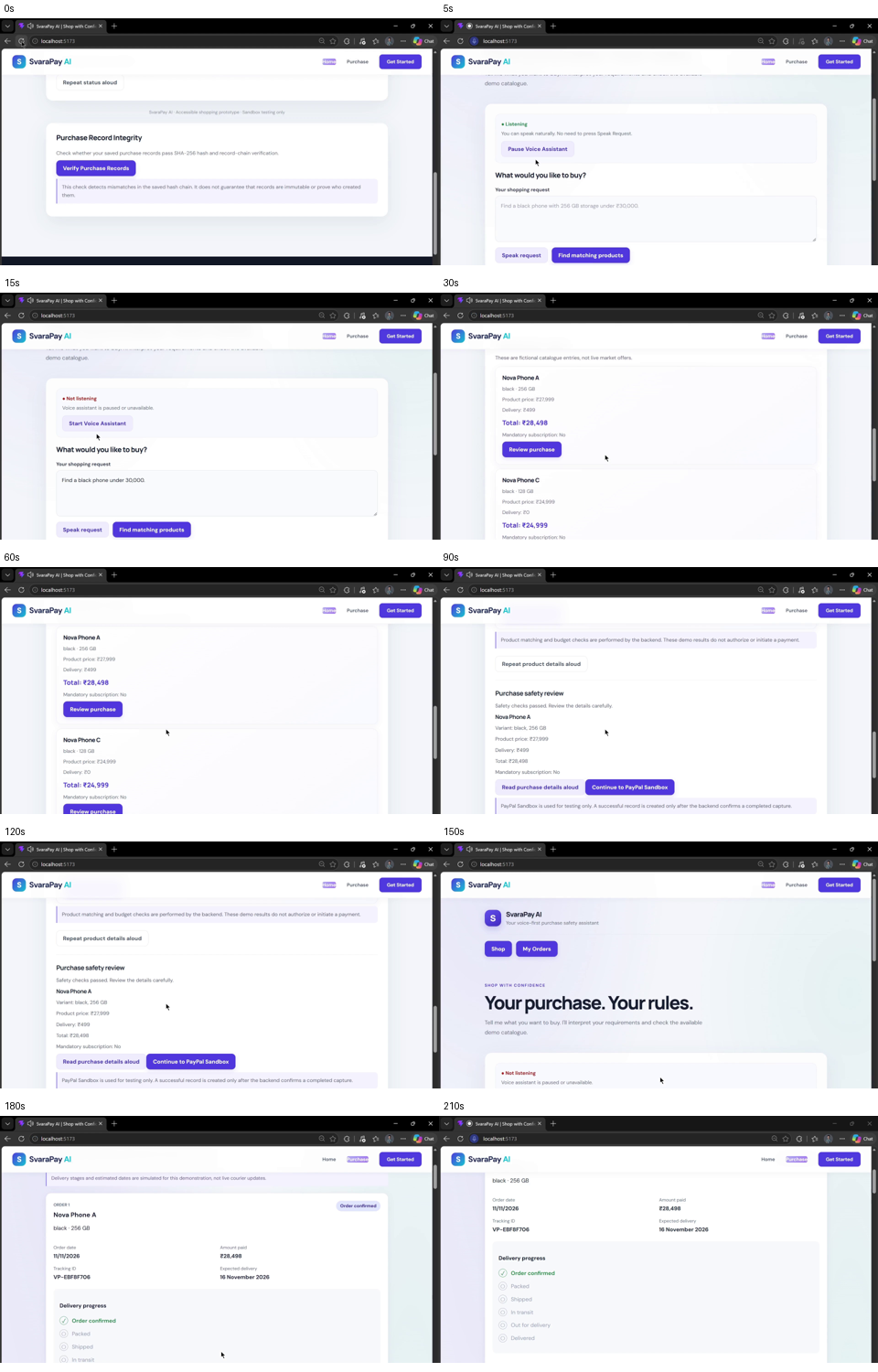
SvaraPay AI allows users to interact with a shopping application using voice commands.
Its key features include:
- Voice-based shopping: Users can search for products using natural language.
- AI-powered product matching: A locally running AI model understands shopping requests and identifies relevant products.
- Purchase safety validation: Checks purchase details, pricing, and configured budget rules before proceeding.
- PayPal integration: Uses PayPal Sandbox to demonstrate secure payment order creation and capture.
- Tamper-evident transaction records: Uses SHA-256 hash chaining to help detect unauthorized modifications to purchase records.
- Voice-friendly order management: Users can access their purchase history and ask for delivery updates through voice commands.
The prototype also demonstrates delivery stages and estimated arrival dates using simulated tracking data.
How we built it
We developed SvaraPay AI using React and Vite for the frontend and Node.js with Express for the backend.
We integrated Ollama with the Llama 3.2 3B model to process natural-language shopping requests locally. The backend handles product matching, purchase validation, and PayPal Sandbox integration.
We implemented transaction record integrity using SHA-256 hashing and a hash-chain verification mechanism.
The frontend provides a voice-oriented shopping experience, allowing users to interact with important shopping and order-management features through speech.
Challenges we faced
One of our biggest challenges was connecting AI-powered shopping interactions with a reliable purchase validation process.
Integrating PayPal Sandbox also required handling currency conversion because our application displays prices in INR while the demonstration checkout uses USD.
Another challenge was maintaining transaction integrity and ensuring that modifications to stored purchase records could be detected.
We also focused on making voice interactions understandable and useful throughout the shopping journey, rather than limiting voice commands to product search alone.
What we learned
Through this project, we gained practical experience in integrating local AI models with full-stack applications, implementing payment workflows using PayPal Sandbox, designing voice-driven user experiences, and building tamper-evident transaction records.
Most importantly, we learned that accessibility should be considered from the beginning of product design, not added as an afterthought.
What's next for SvaraPay AI
Our future plans include accessible authentication with passkeys, improved screen-reader compatibility, real-time delivery tracking, and further improvements to voice-based payment accessibility.
SvaraPay AI — Your Voice. Your Choice. Your Payment.
Built With
- css
- express.js
- html
- javascript
- llama-3.2
- node.js
- ollama
- paypal
- paypal-checkout-api
- paypal-sandbox
- react
- rest-api
- sha-256
- speech
- vite
- web
