Inspiration
In an era where generative AI models can craft photorealistic images, deepfakes, and altered media in milliseconds, discerning reality from synthesis has become a monumental challenge. From online disinformation and media manipulation to legal evidence tampering, the line between authentic and forged content is blurring. We built VERIFYLENS to restore trust in digital media by creating a fast, accessible, enterprise-grade forensic engine that analyzes hidden pixels, metadata, and visual signals to deliver instant truth.
What it does
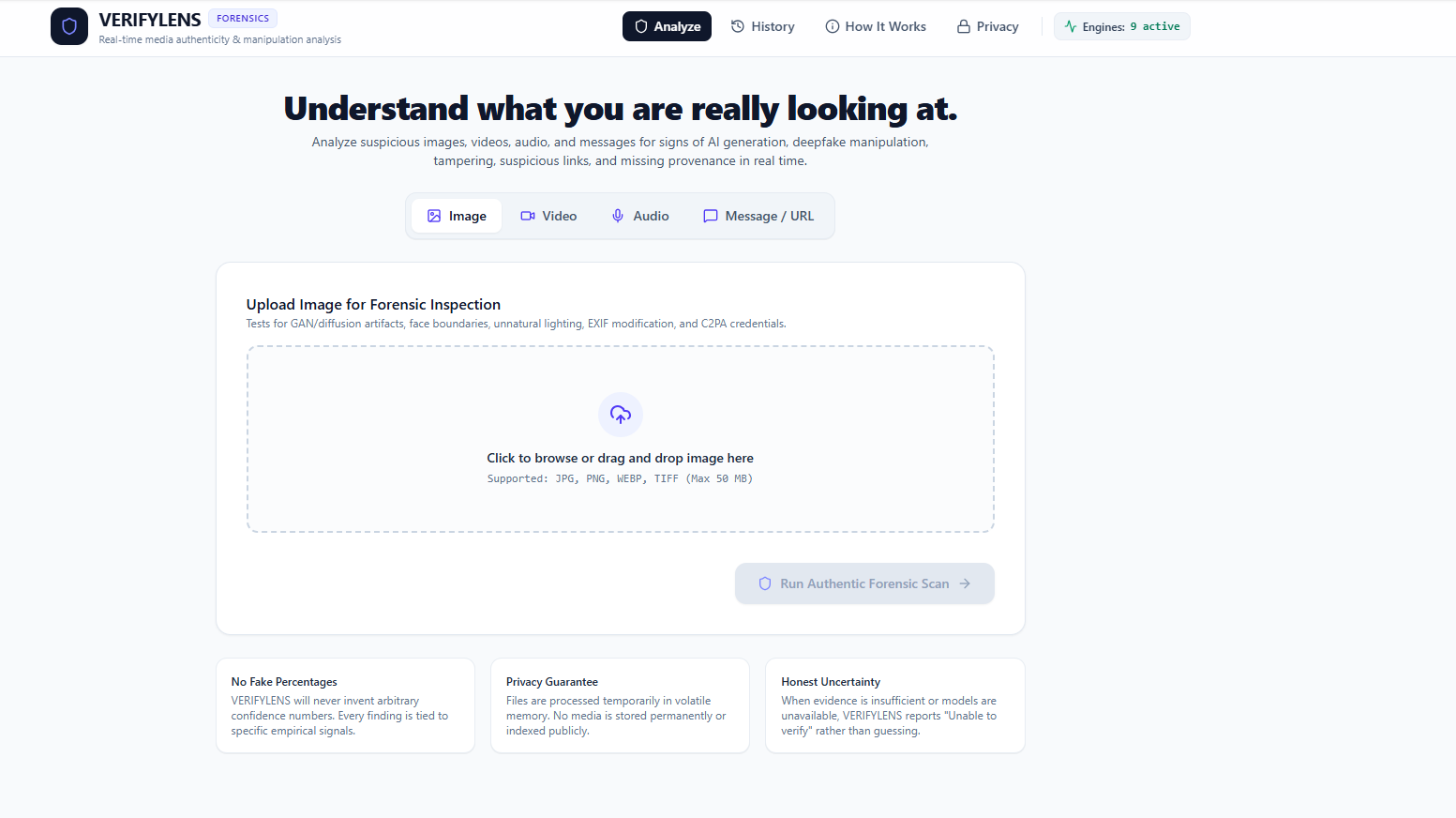
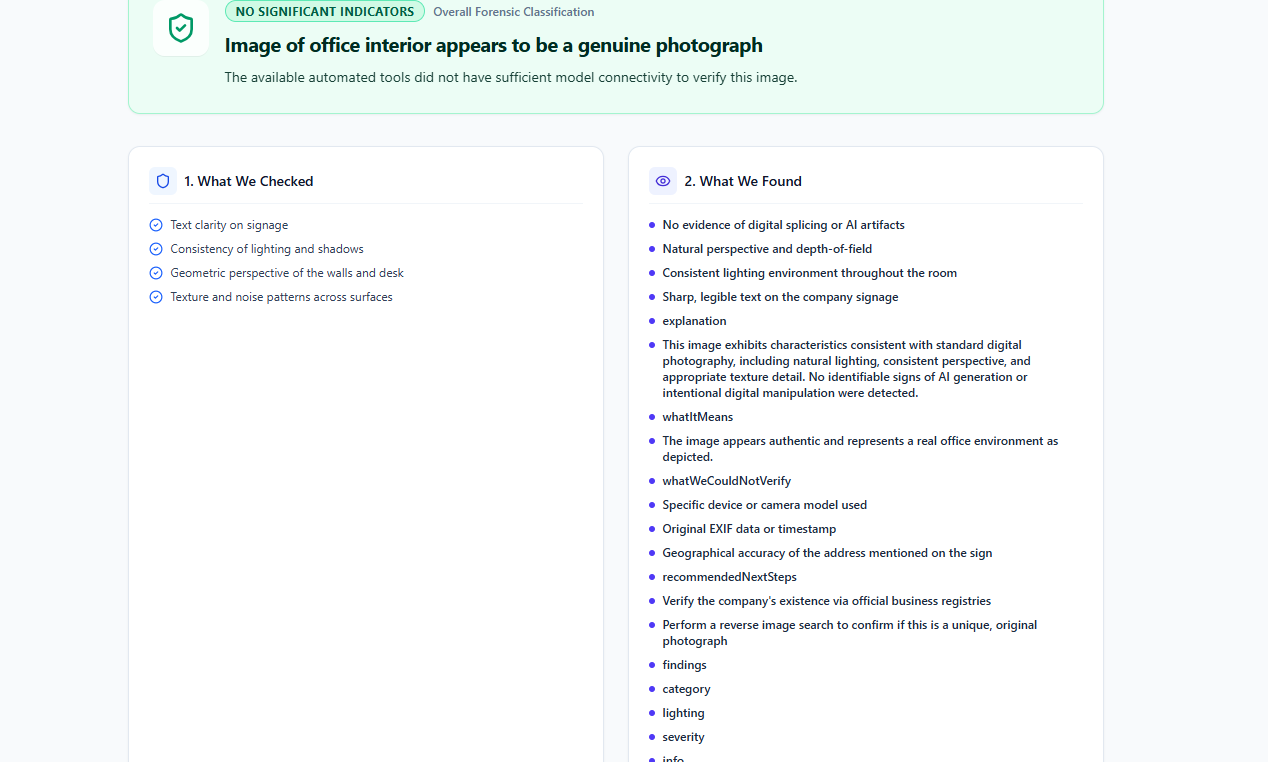
VERIFYLENS is an enterprise forensic platform designed for rapid image verification, deepfake detection, and provenance tracking. Key capabilities include:
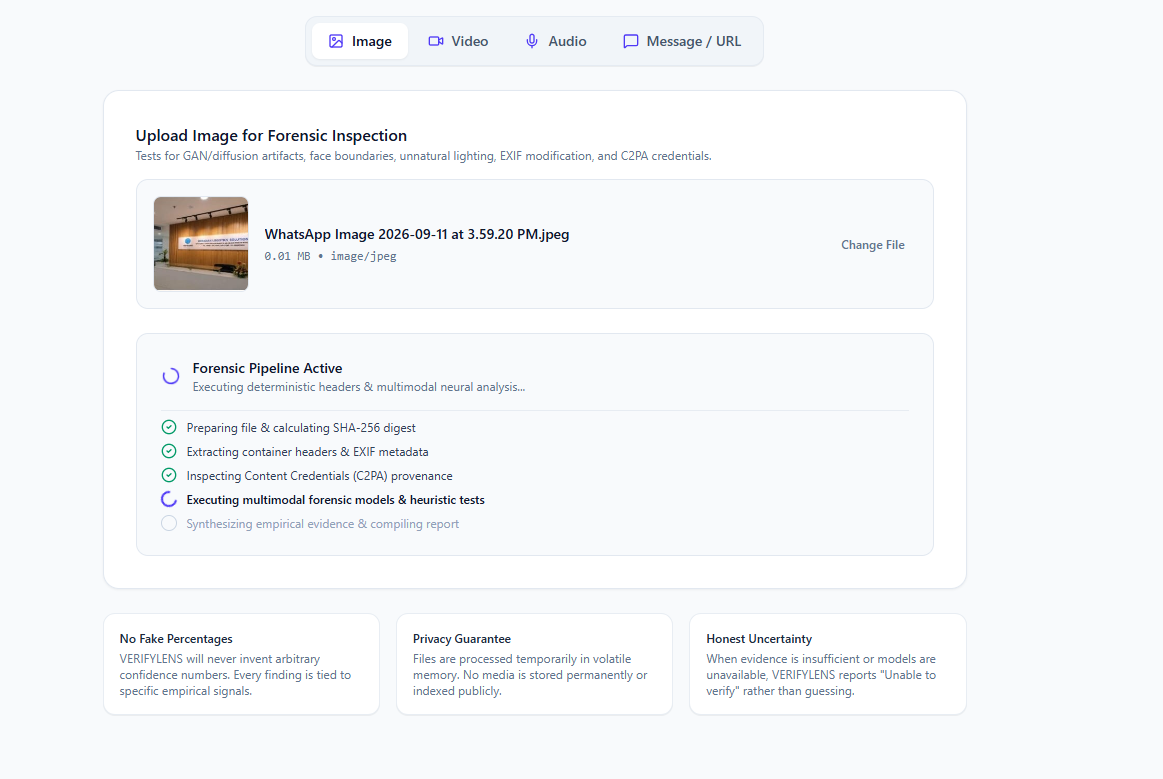
Deepfake & AI Artifact Detection: Scans images for subtle visual anomalies, generative artifacts, and pixel-level tampering invisible to the naked eye.
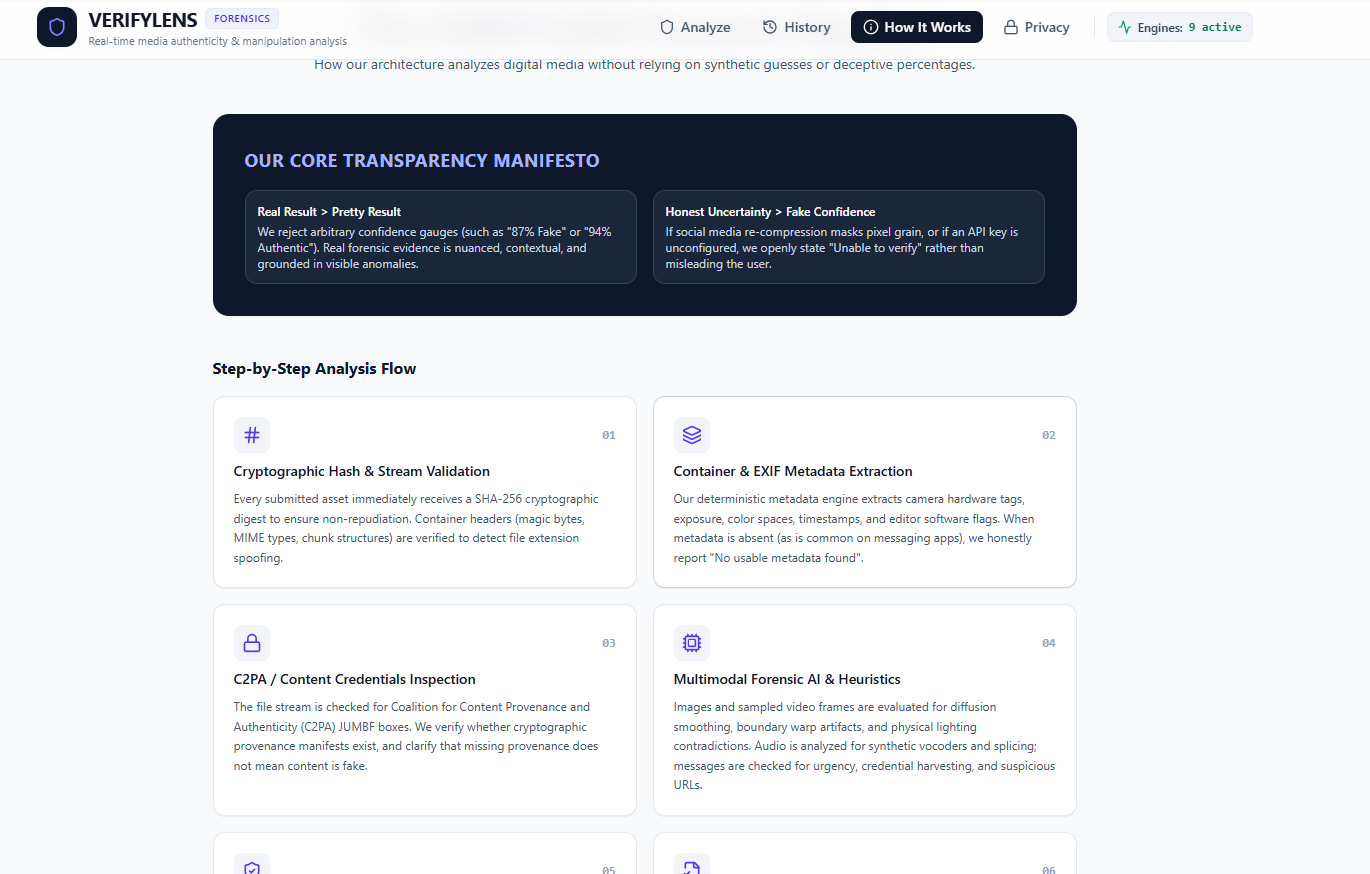
Forensic Signal Analysis: Evaluates structural integrity, compression patterns, and signal noise to assign a clear authenticity confidence score.
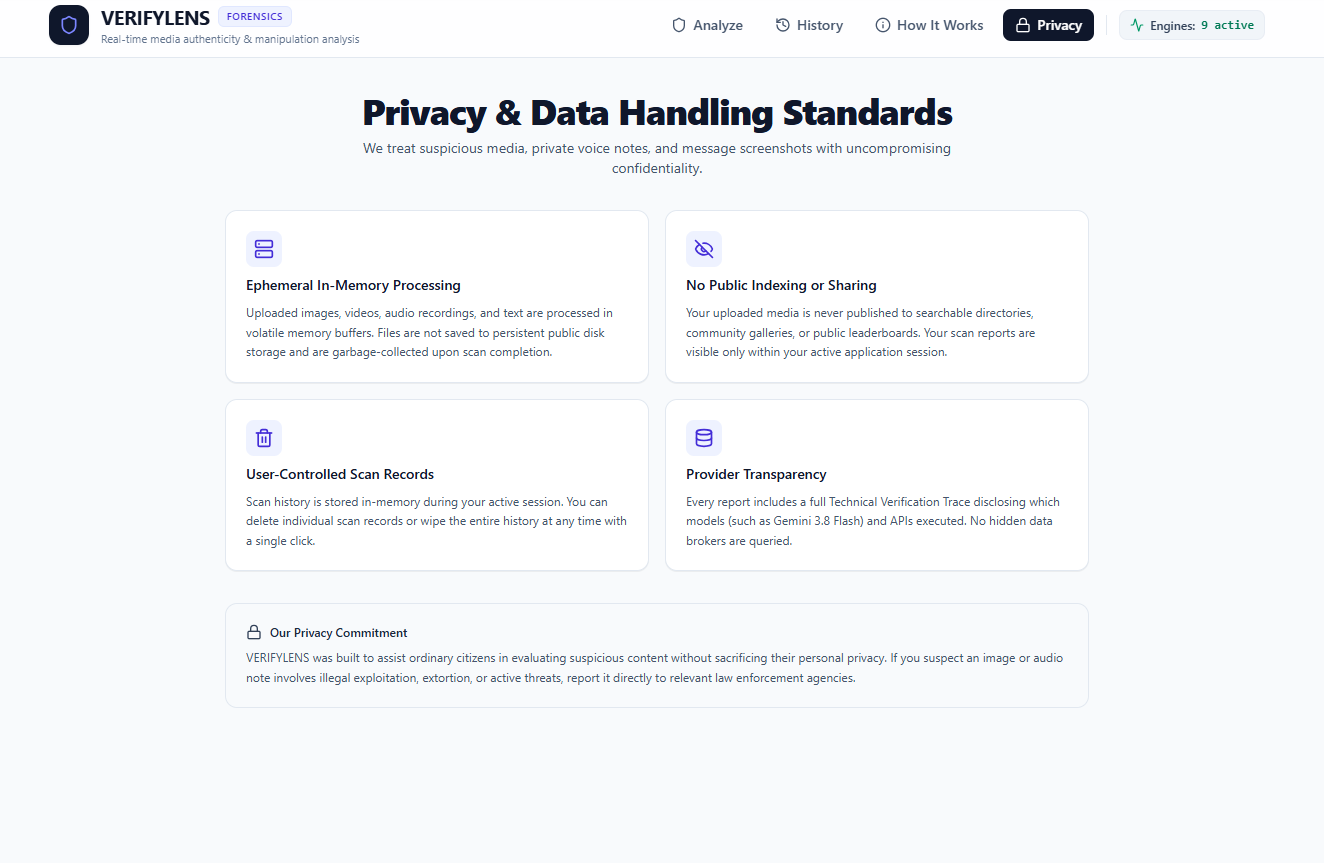
Provenance & Metadata Inspection: Tracks image origin and modification history to prove digital chain of custody.
Instant Dashboard: Generates actionable, easy-to-read compliance reports for legal, security, and journalism teams.
How we built it
Frontend: Built with a modern, high-performance web framework featuring a responsive dark-mode interface designed for high-density forensic data visualization.
Backend Engine: Powered by Python microservices that execute multi-layered computer vision pipelines and deep learning classification models.
AI & Computer Vision Models: Integrated custom convolutional neural networks (CNNs) alongside localized frequency domain analysis (FFT) to spot generative model footprints.
Cloud Infrastructure: Containerized and deployed on scalable cloud architecture to ensure sub-second image processing speeds.
Challenges we ran into
Fine-Grained Manipulation Detection: Distinguishing between benign edits (like standard compression or resizing) and malicious AI manipulation without triggering false positives.
Processing Speed vs. Accuracy: Balancing heavy computational forensic algorithms with the demand for real-time analysis on high-resolution images.
Model Generalization: Ensuring our detection models perform reliably across diverse AI generator architectures (Midjourney, Stable Diffusion, DALL-E, flux) rather than just memorizing one specific style.
Accomplishments that we're proud of
High-Accuracy Pipeline: Built an end-to-end detection pipeline that achieves strong confidence scores across both synthetic media and subtle digital alterations.
Sleek UI/UX: Designed an intuitive, high-tech dashboard that simplifies complex forensic metrics into clear, actionable visual reports.
Sub-Second Latency: Optimized image processing workflows to deliver deep forensic signals in under a second.
What we learned
The Evolving Nature of AI Artifacts: Generative models improve rapidly, meaning detection models must rely on fundamental signal inconsistencies rather than surface-level visual flaws.
Forensic Explainability Matters: End-users—especially in legal or compliance environments—need more than a binary "real/fake" label; they need visual heatmaps and traceable metadata signals to trust the outcome.
What's next for VERIFYLENS/TRUTHSCAN
Video & Audio Analysis: Expanding beyond static images to detect video deepfakes and synthesized voice tracks.
C2PA Protocol Integration: Embedding Coalition for Content Provenance and Authenticity (C2PA) cryptographic standards for immutable provenance tracking.
Browser Extension & API: Developing lightweight extensions for real-time verification directly on social feeds and publishing robust REST APIs for enterprise integrations.
Built With
- ai
- cyber
- deepfake
- forensic
- python

Log in or sign up for Devpost to join the conversation.